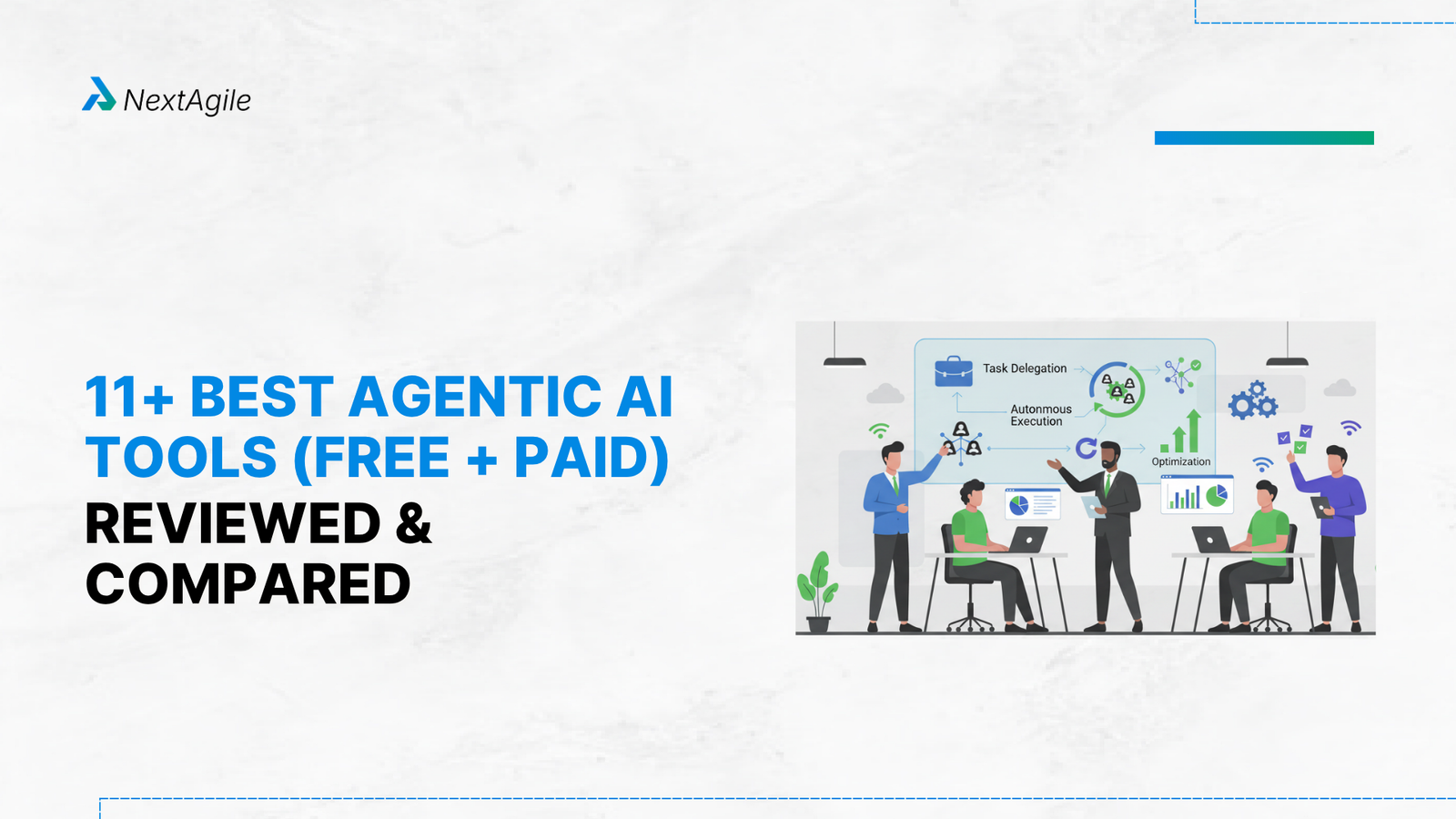
Key Highlights of 11+ Best Agentic AI Tools Gartner predicts that by 2028, 33% of enterprise software applications will include agentic AI, up from less than 1% in 2024. This guide covers 12 agentic AI tools across 4 categories: development, business operations, agile delivery, and horizontal automation. Includes an 8-criteria evaluation scorecard enterprises can use to assess any agentic AI platform. 65% of companies have already automated some workflows with agentic AI (Capgemini, 2026). Key selection principle: match the tool to the use case category, not to marketing claims. Introduction Agentic AI tools are software platforms that enable AI agents to plan, execute, and adapt multi-step workflows autonomously without requiring human input at every stage. They differ from traditional automation tools because they reason about goals, handle exceptions through decision logic, and coordinate across multiple systems rather than following rigid rule-based sequences.
The market for these tools is expanding rapidly. Gartner predicts that by 2028, 33% of enterprise software applications will include agentic AI functionality, up from less than 1% in 2024. More practically for teams making decisions right now: 65% of companies have already automated some workflows using agentic AI (Capgemini, 2026). The question is no longer whether to evaluate these tools. It is which ones to evaluate and how.
This guide organizes the leading agentic AI tools by enterprise use category, provides an 8-criteria evaluation scorecard, and highlights the tools most relevant to agile delivery teams. For teams that need structured guidance through this selection process, NextAgile’s Agentic AI Workshop includes a hands-on tool evaluation module.
What Makes a Tool Agentic? The Baseline Requirements Not every tool marketed as “agentic” in 2026 meets the actual requirements for agentic AI behavior. Before evaluating any platform, verify these four baseline capabilities:
Goal-directed planning: The system can receive a high-level goal and plan the steps to achieve it, not just execute a fixed workflowTool use: The system can call external APIs, databases, browsers, or code executors to gather information and take actionAdaptive execution: The system can modify its plan based on intermediate results, not just fail when a step does not go as expectedMemory and context: The system maintains state across the steps of a workflow, not just within a single prompt exchange Tools that lack any of these four capabilities are automation tools or copilots, not genuine agentic AI systems. The distinction matters for governance, reliability, and the scope of problems they can solve. Teams still learning terminology should review Agentic AI vs AI Agents before comparing platforms.
11+ Best Agentic AI Tools (Free & Paid) Compared in 2026 # Agentic AI Tool Category Best For Pricing Type 1 GitHub Copilot Workspace (Agentic Mode) Software Development Developer teams using GitHub Paid 2 Aha! Develop Agile / Product Delivery SAFe teams, PI planning, backlog management Paid 3 Ajelix Business Operations / Automation Business teams, analysts, operations, reporting Free + Paid 4 Jira (Atlassian Intelligence) Agile / Project Management Agile teams already using Jira Paid 5 Microsoft Copilot Studio Business Operations Microsoft-centric enterprises Paid 6 Automation Anywhere (AI + RPA) Automation / Operations Large enterprises with legacy + SaaS systems Paid 7 UiPath (AI Agents) Automation / Document Workflows BFSI, BPO, finance operations Paid 8 Moveworks Employee Support / IT Ops IT helpdesk, HR automation Paid 9 Glean Enterprise Search / Knowledge AI Knowledge-heavy organizations Paid 10 Contentstack (Agentic Experience Platform) Agentic Experience / Content Operations Enterprise digital teams, content operations, and personalized experiences Paid 11 LangChain + LangGraph Custom Agentic Development Technical teams building custom AI agents Free + Paid 12 CrewAI Multi-Agent Framework Research, compliance, analysis pipelines Free + Paid 13 n8n Workflow Automation / Self-Hosted Privacy-focused enterprises, custom automation Free + Paid
Agentic AI Tools for Software Development and Delivery Teams 1. GitHub Copilot Workspace (Agentic Mode) GitHub Copilot in its agentic workspace configuration can receive a natural language task description, plan the implementation steps, write code across multiple files, run tests, and iterate based on test results. It integrates directly into GitHub’s pull request workflow.
Strengths:
Native GitHub integration with zero context switching for developer teams Strong code generation quality from OpenAI’s latest models Agentic task completion without leaving the developer environment Best for: Developer-first teams already using GitHub with strong agile delivery workflows
Governance note: Code generated by agentic systems requires human review before merge. Configure branch protection rules accordingly.
2. Aha! Develop (SAFe and Agile-Aligned) Aha! Develop connects roadmap strategy to engineering execution across Scrum, Kanban, and SAFe workflows. Its generative AI assistant creates user stories, suggests story point estimates, and plans sprint compositions based on backlog health.
Strengths:
Connects PI planning to sprint-level execution in a single platform AI-generated user stories reduce Product Owner preparation time by 30 to 40% Supports SAFe portfolio and PI planning alignment Best for: Enterprises running SAFe across multiple teams who need AI-assisted PI Planning preparation
3. Ajelix Ajelix is an agentic AI workspace built for business operations, enabling teams to automate spreadsheet workflows, reporting, presentations, document analysis, and data-driven tasks from a single platform. Rather than acting as a standalone chatbot, Ajelix plans and executes multi-step tasks, producing complete business deliverables such as dashboards, reports, presentations, and web apps while keeping work organized in a persistent workspace. It integrates with Google Workspace and supports a wide range of business use cases without requiring coding skills.
Strengths:
Generates complete business deliverables, including spreadsheets, dashboards, presentations, reports, and web apps Persistent AI workspace that allows users to review, refine, and continue work instead of starting from scratch each session Automates spreadsheet analysis, reporting, document processing, and presentation creation without requiring technical expertise Best for: Business teams, analysts, operations, finance, and marketing professionals looking to automate knowledge work and create business deliverables with an agentic AI workspace.
4. Jira (Atlassian Intelligence) Atlassian Intelligence embeds agentic capabilities directly into Jira’s project management workflow. It can auto-triage incoming issues, suggest sprint compositions based on velocity history, generate release notes from sprint data, and surface dependency risks.
Strengths:
Agentic features work inside the tool most enterprise agile teams already use No migration or adoption cost for existing Jira users Connects to Confluence for documentation automation Best for: Enterprise agile teams where Jira is already the system of record
For a deeper look at how to get the most from Jira’s AI capabilities, see NextAgile’s JIRA Training Masterclass .
Agentic AI Tools for Business Operations 5. Microsoft Copilot Studio Microsoft Copilot Studio provides a low-code environment for building agentic AI systems within the Microsoft 365 ecosystem. Agents execute across SharePoint, Teams, Outlook, and Dynamics 365 using Microsoft Graph API connectivity. Enterprise-grade governance through tenant controls and data loss prevention is built in.
Strengths:
Deep integration with the Microsoft stack most large Indian enterprises already operate Low-code builder allows citizen developers to build agents without deep AI expertise Enterprise governance (DLP, role-based access, audit logging) available out of the box Best for: Microsoft-centric organizations prioritizing governance and citizen developer enablement
6. Automation Anywhere (AI + RPA) Automation Anywhere extends proven RPA infrastructure with AI orchestration through its Agent Builder and Maestro platform. It handles workflows that span legacy systems and modern SaaS applications, with built-in human-in-the-loop capabilities for exception handling.
Strengths:
Mature connector ecosystem spanning thousands of enterprise systems Designed for organizations with significant existing automation investments Strong governance and audit capabilities for regulated industries Best for: Large enterprises standardizing automation across legacy and SaaS systems
7. UiPath (AI Agents) UiPath has evolved from pure RPA into a broader platform incorporating LLM-based reasoning for handling less-structured work. Its AI agents can read documents, extract data, update CRM and billing systems, and handle exceptions using natural language reasoning for ambiguous cases.
Strengths:
Excellent for workflows that cross structured and unstructured data boundaries Strong market penetration in India’s BFSI and BPO sectors Well-established professional services ecosystem for implementation support Best for: Enterprises with document-heavy workflows requiring both structured extraction and natural language reasoning
Agentic AI Tools for Customer Operations 8. Moveworks Moveworks is an enterprise agentic AI platform built specifically for employee experience and IT operations. Its Reasoning Engine plans multi-step resolutions for IT support tickets, HR inquiries, and compliance requests, coordinating across enterprise systems to resolve cases without human intervention.
Strengths:
Purpose-built for enterprise employee support workflows (IT, HR, Finance) Proven at scale with documented resolution rates above 60% for common IT requests Strong governance and escalation controls Best for: Enterprises seeking measurable ROI from IT support and HR automation within 6 months of deployment
9. Glean (Enterprise Knowledge + Agentic Search) Glean unifies enterprise knowledge from emails, documents, chats, and applications into a single searchable intelligence layer. Its AI assistant answers questions in natural language and triggers workflow actions, giving support agents real-time access to the most relevant information across all enterprise systems.
Strengths:
Best-in-class enterprise search with contextual awareness Reduces average handle time for support workflows by surfacing the right knowledge instantly Integrates with Salesforce, ServiceNow, Jira, and most enterprise platforms Best for: Organizations where knowledge fragmentation (not workflow automation) is the primary bottleneck
Horizontal Agentic AI Platforms (Build Your Own) 10. Contentstack (Agentic Experience Platform) Contentstack is the pioneer of the industry’s first Agentic Experience Platform (AXP), a unified system that brings together structured omnichannel content, real-time customer data, and autonomous AI orchestration. Unlike legacy monoliths or fragmented headless tools, Contentstack’s AXP unifies its composable Content Cloud, Data Cloud, and Agent OS to automate digital operations and deliver adaptive digital experiences at scale. Learn more at contentstack.com.
Strengths:
Eradicate Operational Debt: Automates manual, repetitive tasks from SEO tagging to global localization freeing teams to focus on strategy and creative storytelling.
Deliver Adaptive Experiences: Combines reasoning-based AI with real-time intent data to dynamically adapt the customer journey in the moment.
Brand-Safe AI:
Roots AI agents in structured content and brand governance to ensure all automated outcomes remain grounded and safe.
Best for: Enterprise digital leaders and architects looking to move beyond “headless CMS” bottlenecks into automated, hyper-personalized customer journeys.
11. LangChain and LangGraph LangChain provides the foundational components for building agentic systems: tool integration, memory management, agent loops, and chain composition. LangGraph adds explicit graph-based workflow management, supporting branching, cyclic, and multi-agent collaboration patterns.
Strengths:
Highest flexibility of any framework for custom enterprise agentic systems Large ecosystem of pre-built tool integrations (APIs, databases, browsers) Open source with strong community and commercial support Best for: Technical teams in India’s IT services sector building custom agentic workflows on top of their own LLM stack
12. CrewAI CrewAI uses role-based agent design where each agent has a defined persona, goal, allowed tools, and output format. The framework coordinates agents through structured task assignment and message passing, making it easy to reason about what each agent is responsible for.
Strengths:
Role-based design makes multi-agent systems more understandable and maintainable Strong support for compliance and security requirements in finance and insurance Active community with many pre-built crew templates for enterprise use cases Best for: Enterprise teams building document processing, research automation, or analysis pipelines with strict role separation requirements
13. n8n n8n is an open-source workflow automation platform with 350+ native integrations and support for embedding LLM-based AI agents within visual workflows. It is self-hostable, which is important for enterprises with strict data sovereignty requirements.
Strengths:
Self-hosting option meets data residency requirements without cloud dependency Visual workflow builder reduces implementation time for technical but non-ML-specialist teams Growing library of AI workflow templates for common enterprise use cases Best for: Enterprises that need on-premise or VPC deployment for data privacy compliance, particularly in regulated Indian industries
Enterprise Agentic AI Tool Evaluation Scorecard Use this 8-criteria scorecard to evaluate any agentic AI tool before purchasing or building:
Criterion Weight What to Assess True agentic capability High Does it meet the 4 baseline requirements? (goal planning, tool use, adaptation, memory) Governance and audit High Can every agent action be logged and traced? Are human-in-the-loop controls available? Integration depth High Does it connect natively to your existing tech stack without complex middleware? Security and compliance High Data residency, access controls, DPDP Act compliance for India deployments Build vs buy complexity Medium What is the implementation timeline and required expertise? Scalability Medium Can it handle your target workflow volume at enterprise scale? Vendor viability Medium Is this a funded, established vendor or an early-stage startup? Total cost of ownership Medium License cost + implementation + maintenance + monitoring infrastructure
Strong governance often depends on defining an enterprise-wide AI Operating Model
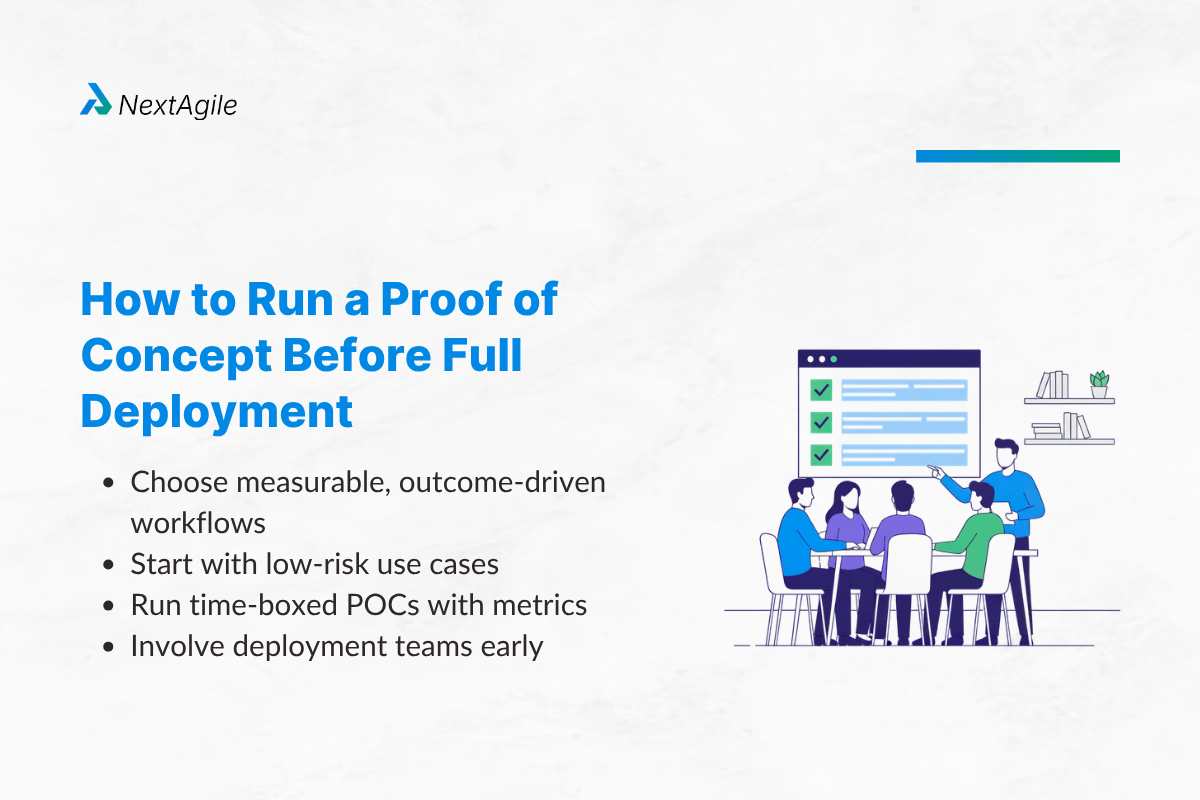
How to Run a Proof of Concept Before Full Deployment
Before committing to any agentic AI tool for enterprise-wide deployment, run a structured proof of concept on a single, bounded workflow:
POC design principles:
Choose a workflow with clear start, end, and measurable success criteria Use a low-risk workflow where errors are detectable and reversible Set a time-boxed evaluation window (4 to 6 weeks) Define your metrics before the POC starts: task completion rate, error rate, cycle time reduction Involve the team that will own the system post-deployment in the POC Common POC workflows for enterprise agentic AI:
IT ticket triage and first-response automation (low risk, high volume, easily measured) Sprint retrospective summary generation from Jira data (agile teams, low risk) Vendor invoice data extraction and validation (finance teams, medium risk) New employee onboarding task checklist generation and assignment (HR teams, medium risk) Organizations moving from pilot to scale often use Generative AI Consulting Services
For NextAgile clients implementing agile delivery transformation alongside AI tool adoption, our AI for Agility Workshop provides a structured POC design framework aligned with your agile maturity level.
Conclusion The agentic AI tool market in 2026 is large, rapidly evolving, and unevenly marketed. Most tools claiming to be “agentic” do not meet the four baseline requirements of goal-directed planning, tool use, adaptive execution, and persistent memory.
Key takeaways for enterprise buyers:
Evaluate tools against the 8-criteria scorecard before purchasing Match the tool category to the use case: development tools for delivery teams, business operations tools for IT and HR automation, horizontal platforms for custom workflows Always run a structured POC before full deployment Governance and audit capabilities are non-negotiable for production enterprise deployments For agile teams specifically, Jira (Atlassian Intelligence), Aha! Develop, and GitHub Copilot Workspace are the highest-value starting points in 2026 If your enterprise is evaluating agentic AI tools for the first time or scaling from a pilot to a production deployment, NextAgile’s Agentic AI Workshop provides structured hands-on training for both technical and non-technical teams. Contact us at consult@nextagile.ai.
Frequently Asked Questions Q1. What are the best agentic AI tools for enterprise in 2026?
The best agentic AI tools depend on your use case category. For software delivery teams, GitHub Copilot Workspace and Jira (Atlassian Intelligence) offer the most immediate value. For business operations, Microsoft Copilot Studio and Automation Anywhere are the most enterprise-ready. For custom agentic system development, LangChain and CrewAI are the most widely adopted frameworks. For employee support automation, Moveworks leads on documented resolution rate and governance.
Q2. How are agentic AI tools different from traditional automation tools like RPA?
Traditional RPA bots follow exact sequences: if a field name or screen element changes, the process fails. They cannot handle exceptions, make contextual decisions, or adapt to ambiguity. Agentic AI tools use LLM-based reasoning to navigate variations, interpret natural language instructions, and adapt their approach as conditions change. RPA automates known sequences. Agentic AI handles goals that require judgment.
Q3. Which agentic AI tools work with Jira for agile teams?
Atlassian Intelligence is native to Jira and provides the most friction-free agentic integration for agile teams. GitHub Copilot connects to Jira through the GitHub-Jira integration. Aha! Develop has a Jira connector for aligning roadmap-level planning with sprint execution. n8n has a Jira node for building custom agentic workflows that read and update Jira data as part of broader automation chains.
Q4. How much does it cost to implement agentic AI tools in an enterprise?
Costs vary widely by approach. Atlassian Intelligence is included in Jira Premium and Enterprise plans (starting at approximately $15 per user per month). Microsoft Copilot Studio is licensed per conversation (starting at $0.01 per message) with enterprise tiers. Custom builds using open-source frameworks like LangChain or n8n have no license costs but require developer time for architecture, implementation, and ongoing maintenance. Total cost of ownership including implementation typically ranges from $50,000 to $500,000+ for a production enterprise agentic deployment depending on scope and integration complexity.
Q5. Are agentic AI tools safe to use in enterprise environments?
Safety depends entirely on governance design, not on the tool itself. Tools like Microsoft Copilot Studio, Automation Anywhere, and UiPath have enterprise-grade security and compliance controls. Open-source frameworks like LangChain require you to build governance controls yourself. Key safety requirements for any enterprise agentic deployment include: audit logging of all agent actions, confidence threshold controls that trigger human review, role-based access controls on what data and systems agents can reach, and documented rollback procedures for reversible actions.
Q6. What is the first agentic AI tool an enterprise should deploy?
Start with the tool that integrates with a system your team already uses daily and that solves a measurable problem with a bounded scope. For agile delivery teams, Atlassian Intelligence in Jira is the lowest-friction starting point. For Microsoft-centric organizations, Copilot Studio within Teams is the fastest path to a visible proof of concept. For technical teams wanting to build custom workflows, n8n provides the best balance of power and self-hosting flexibility for organizations with data residency requirements.
Alok Dimri is the co-founder and leads the overall business at NextAgile, where he is responsible for strategy, client and consultant partnerships, and a whole lot of other core business activities like solutioning, branding, and customer engagement.
Over the past 16 years, he has worked extensively in business strategy, new business development, and key account management initiatives across process consulting and training domains.
 Skip to content