Software Delivery Management: Execution certainty and Predictability
Anuj Ojha
Talk to Expert for Free
Table of Contents
Introduction to Software Develivery Management
Expecting certainty in software development is utopian now and kind of living in a fool’s paradise. We are left with one and only one option to sustain, and that is to respond to unexpected challenges and changes and too with confidence, just like the medical professionals respond to emergencies. In the face of uncertainty and change, we need to identify approaches and practices that could guide us with precision, predictability, and quality.
Imagine you receive a call that a family member has been rushed to the hospital with a critical medical condition. The situation is urgent, and every minute counts. You need to act quickly and make decisions that will ensure the best possible outcome.
In this situation, you would rely on established emergency response protocols, such as calling 108 (India’s ambulance helpline) or rushing to the hospital instead of wasting time in figuring out what to do from scratch. You would also trust the medical professionals to follow established procedures and guidelines to provide the necessary care.
Similarly, in software development, unexpected challenges and changes can arise at any moment. To respond effectively, we need a structured approach to software delivery management, including processes, practices, and tools that enable us to the 4 matras of successful software delivery i.e. to quickly & accurately:
Assess the situation
Make informed decisions
Respond effectively
Collaborate to ensure a coordinated response
Software delivery is no longer just a technical imperative, but a strategic one. The ability to deliver high-quality software quickly and reliably is a key differentiator for organizations to stay ahead of the competition. Despite the best efforts of development teams, software projects often experience delays, cost overruns, and quality issues, resulting in disappointed customers, damaged reputations and significant financial losses.
So, what can organizations do to assure execution certainty in software delivery? The answer lies in adopting a structured approach to software delivery management i.e. to understand the guiding principles and protocols. It requires a deep understanding of the software delivery lifecycle, as well as the ability to manage complexity, uncertainty and change.
In this blog, we will explore the principles, practices, and tools of software delivery management, with a focus on assuring execution certainty. We will delve into topics such as Agile project planning, lean software development, continuous integration and delivery and DevOps among others. We will also examine the role of leadership, culture and collaboration in software delivery, and provide guidance on how to build high-performing teams that could abide by the 4 mantras that we talked about.
So, let’s get started on this journey to transform software delivery and achieve unprecedented levels of speed, quality and reliability!
Overview of Software Delivery Management (SDM)?
A systematic approach that involves the entire software delivery lifecycle is what it takes to deliver software on time, within budget and with the required quality and functionality
We fail because of a lack of understanding of the complexity, uncertainty, and change that’s inherent in software delivery, also called as VUCA environment (Volatality, Uncertainty, Complexity & Ambiguity).
Why do you think collaboration, transparency, and continuous improvement are essential for successful software delivery? It’s because they enable teams to work together towards common goals, share knowledge and expertise, and adapt to changing requirements and circumstances.
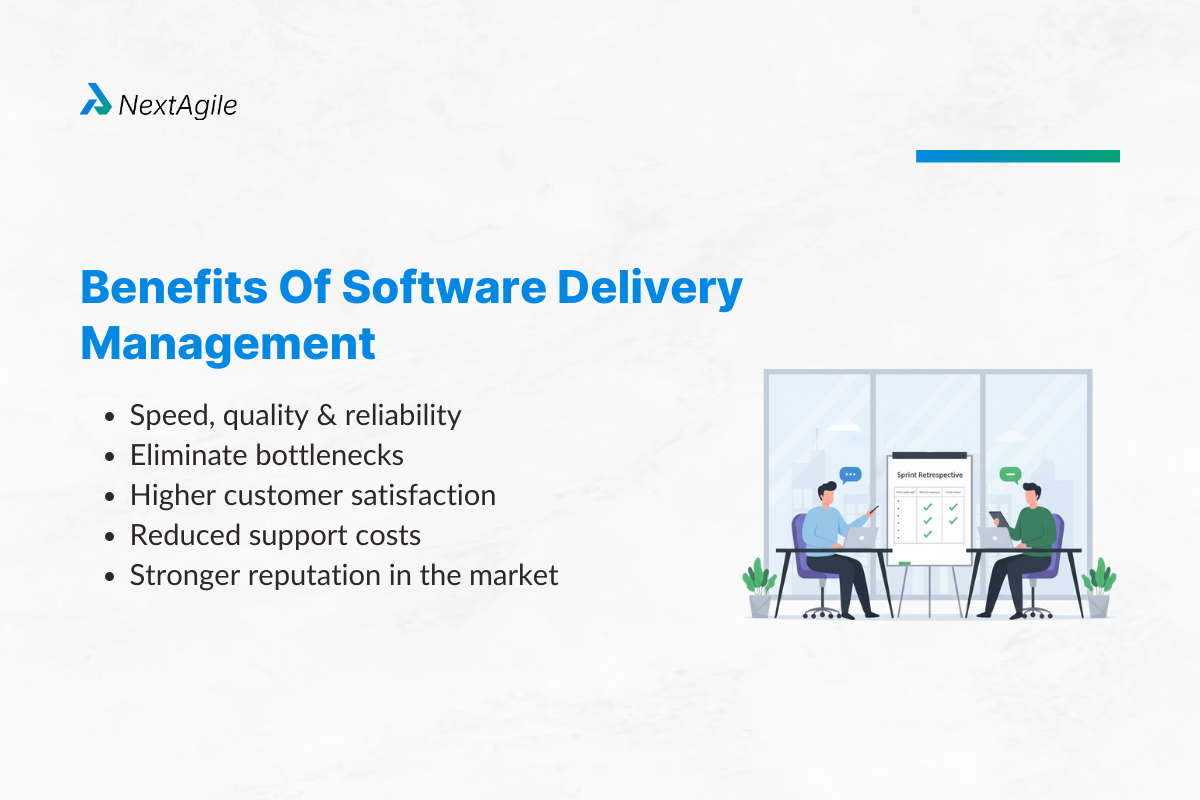
Benefits Of Software Delivery Management
Careful adoption of SDM and Agile practices could enable organizations to deliver more value to their customers.Following are the key benefits of SDM which results in streamlining processes and doesn’t need much explanation –
Speed, quality and reliability are not just nice-to-haves – they’re must-haves.
Eliminate bottlenecks across the value chain, continuously
Higher customer satisfaction
Reduced support costs
Stronger reputation in the market
Transparency, visibility & control
Fosters collaboration and communication among cross-functional teams, stakeholders and customers
Reduce risk by adopting Agile practices like continuous integration and deployment, organizations can reduce the risk of defects and errors, while also reducing the costs associated with manual testing and deployment.
Effective prioritization of software delivery projects to stay value-focused
Strengthen trust & respect in system
Streamlining Requirements And Execution For Efficient Software Delivery Teams
When it comes to software delivery, one of the biggest challenges teams face is managing requirements and execution. It’s easy to get bogged down in endless meetings, email threads, and spreadsheet updates. But what if you could streamline your requirements and execution processes to make your software delivery team more efficient? Let’s explore few pointers which will help us optimize our software delivery methods:
 Skip to content