Key Highlights of Scrum Events The Scrum Guide (2020 edition) uses “scrum events,” not “scrum ceremonies.” The terminology shift was deliberate: events implies structure and purpose; ceremonies implies ritual. The 5 official scrum events are: the Sprint (the container event), Sprint Planning, Daily Scrum, Sprint Review, and Sprint Retrospective. Missing or poorly run scrum events are the most frequent implementation mistake in agile transformations. McKinsey (2023) found that 42% of organizations claiming to “be agile” run scrum rituals without understanding their purpose. Scrum is practiced by 87% of agile teams globally, making scrum events the most widely performed agile practices in enterprise software delivery (Digital.ai State of Agile Report, 2023). In SAFe, team-level scrum events are supplemented by 4 program-level events: ART Sync, System Demo, PI Planning, and Inspect and Adapt. Scrum events are the 5 official, time-boxed events defined in the Scrum Guide that structure the work of every Scrum team within a sprint. They are not optional meetings. They are the inspection and adaptation mechanisms that make Scrum work as an empirical process. Every scrum event exists to create transparency, inspect what happened, and adapt what happens next.
The 2020 edition of the Scrum Guide made a deliberate word choice: “scrum events,” not “scrum ceremonies.” The word “ceremony” implies ritual, tradition, and social obligation. The word “event” implies purpose, structure, and a defined output. This distinction matters in practice. Teams that treat scrum events as ceremonies run them mechanically. Teams that understand them as events run them purposefully.
According to Digital.ai’s 17th Annual State of Agile Report (2023), 87% of agile organizations use Scrum as their primary framework. That means scrum events are the most widely practiced meetings in global enterprise software delivery. Yet McKinsey’s 2023 global survey found that 42% of organizations claiming to practice agile run scrum rituals without understanding their purpose. This guide addresses that gap.
What Are Scrum Events? The Official Definition Scrum events are formal opportunities for inspection and adaptation built into the Scrum framework. Each event has a defined purpose, a time box (maximum duration), required attendees, and an expected output. Missing or shortening a scrum event without understanding its purpose removes an inspection or adaptation point and degrades the team’s ability to empirically manage complex work.
The 3 pillars of empiricism that scrum events support:
Transparency: Events create visibility into the sprint’s work, progress, and impediments Inspection: Events provide regular checkpoints to evaluate progress and quality Adaptation: Events produce decisions and adjustments that prevent deviation from the sprint goal Complete Scrum Events Timebox Reference Table:
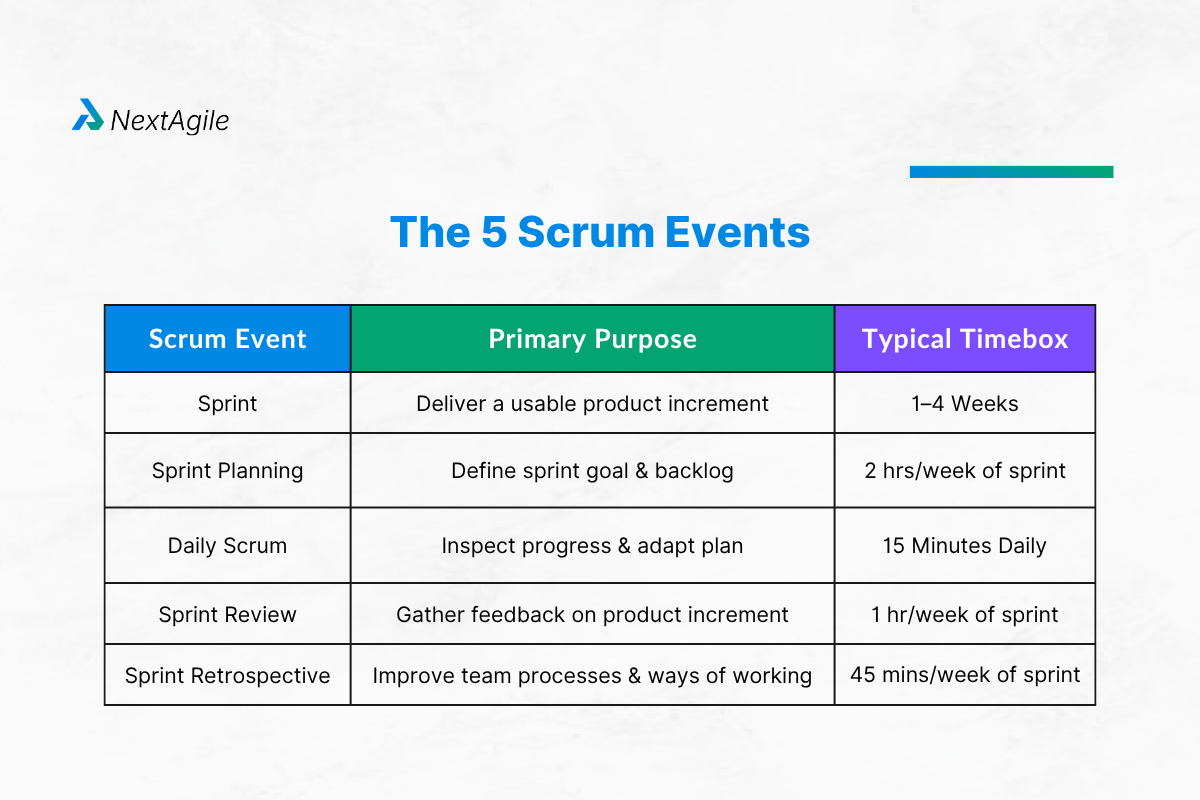
Scrum Event Type Max Duration (2-week sprint) Attendees Primary Output Sprint Container event 1 to 4 weeks (fixed) Full Scrum Team A done product increment Sprint Planning Planning event 4 hours Full Scrum Team Sprint goal + sprint backlog Daily Scrum Inspection event 15 minutes Development Team Daily adaptation plan Sprint Review Review event 2 hours Scrum Team + stakeholders Updated product backlog Sprint Retrospective Improvement event 1.5 hours Scrum Team only Improvement commitments
Scrum Events Create a Continuous Feedback System
Traditional project management often relies on phase gates where planning, execution, testing, and review happen sequentially.
Scrum intentionally distributes feedback throughout the Sprint.
Rather than waiting weeks or months to discover that assumptions were incorrect, Scrum events introduce multiple opportunities to validate direction, adjust priorities, and improve execution while work is still in progress.
This short feedback cycle is one of Scrum’s greatest competitive advantages. The objective is not to avoid mistakes altogether but to detect them early when the cost of correction is significantly lower.
Organizations that consistently improve delivery speed are often distinguished not by better planning, but by faster learning.
Scrum Events Are Risk Management Mechanisms One of the biggest misconceptions about Scrum events is that they exist to satisfy the framework rather than solve delivery problems.
In reality, every Scrum event removes a specific category of delivery risk.
Viewed through this lens, Scrum events become operational control mechanisms rather than calendar meetings. Teams that understand this rarely ask whether an event can be skipped, they instead ask what additional risk they are willing to accept by doing so.
The 5 Scrum Events in Detail
Scrum Event 1: The Sprint The Sprint is the container event that holds all other scrum events and all development work. It is a fixed-length time box of 1 to 4 weeks during which the development team creates a done, usable, potentially releasable product increment. All other scrum events occur inside the sprint.
Key sprint rules from the Scrum Guide 2020:
Sprint length is fixed and consistent. Changing sprint length mid-project is an anti-pattern. No changes are made to the sprint that would endanger the sprint goal A sprint can be cancelled only by the Product Owner if the sprint goal becomes obsolete Shorter sprints create more learning cycles and limit risk; longer sprints reduce overhead Sprint length selection guide:
1-week sprints: High uncertainty, rapidly changing requirements, new teams learning the framework 2-week sprints: Most common default. Balances delivery feedback with planning overhead. 3-week sprints: Complex technical work requiring more development time per story 4-week sprints: Regulatory or compliance environments where sign-off cycles extend delivery For enterprise teams using SAFe, the sprint length is standardized across the ART at 2 weeks. NextAgile’s SAFe consulting services cover sprint synchronization across multi-team ARTs.
Many organizations perceive Sprint boundaries as administrative constraints.Experienced agile practitioners see them differently. The Sprint creates an environment where teams can temporarily shield themselves from constantly shifting priorities and focus on achieving a coherent business objective. Without this constraint, delivery frequently becomes a continuous stream of interruptions, context switching, and partially completed work.
The Sprint acts as a strategic commitment window, enabling teams to balance responsiveness with execution discipline while still allowing the Product Owner to adjust future priorities at regular intervals.
Scrum Event 2: Sprint Planning Sprint Planning is the first event of every sprint. The entire Scrum team meets to answer three questions: Why is this sprint valuable? What can be done this sprint? How will the chosen work get done?
Time box: 2 hours per week of sprint length. A 2-week sprint = 4 hours of sprint planning.
Required attendees: All three Scrum roles attend. The Product Owner explains the most valuable backlog items and their business value. The development team selects the items it can deliver in the sprint. The Scrum Master facilitates the meeting and ensures time boxes are respected.
The 3-part sprint planning structure:
Part 1 (Why): Product Owner presents the sprint objective, and the team crafts a sprint goal collaboratively Part 2 (What): Development team selects product backlog items that serve the sprint goal and fit within team capacity Part 3 (How): Development team decomposes selected items into tasks, estimating effort at the task level Sprint Planning output: A sprint goal (one sentence) and a sprint backlog (selected items and their tasks).
Anti-pattern: Entering sprint planning without refined backlog items
Teams that attempt sprint planning with unrefined backlog items spend 60 to 80% of the planning session estimating and clarifying rather than planning. This is the most common cause of sprint planning running over time. Prevention: hold dedicated backlog refinement sessions 1 to 2 times per sprint so items entering sprint planning have clear acceptance criteria and estimates.
Many teams spend the majority of Sprint Planning discussing story points and task breakdowns. While estimation has value, it is rarely the factor that determines Sprint success. Successful Sprint Planning establishes a shared understanding of business intent, technical approach, dependency risks, and delivery confidence. When teams leave Sprint Planning with identical estimates but different interpretations of success, execution problems emerge almost immediately.
Alignment reduces far more delivery risk than estimation accuracy alone.
Scrum Event 3: Daily Scrum The Daily Scrum is a 15-minute inspection event for the development team. It occurs every day of the sprint at the same time and place. Its purpose is to inspect progress toward the sprint goal and adapt the daily plan accordingly.
Time box: 15 minutes maximum. No exceptions.
Required attendees: Development Team (required and self-facilitating). Scrum Master (optional, attends to coach if needed). Product Owner (optional, listens only).
2020 Scrum Guide update on the Daily Scrum:
The 2020 Scrum Guide removed the mandatory “3 questions” format (What did I do yesterday? What will I do today? Any blockers?). Teams may structure the Daily Scrum however they choose, as long as it focuses on progress toward the sprint goal and surfaces impediments. The 3-question format remains popular and effective for most teams but is not required.
Anti-pattern: The Daily Scrum as a status report to the Scrum Master
When team members address the Scrum Master instead of each other, the Daily Scrum becomes a reporting mechanism rather than a team coordination event. The Scrum Master is not managing the work. The development team is self-organizing. Fix: physically position the Scrum Master outside the team circle. Require all updates to flow peer-to-peer.
As teams mature, the Daily Scrum evolves beyond individual updates.
Instead of reporting activities, mature teams actively identify emerging risks, rebalance work, negotiate priorities, and coordinate around Sprint Goals.
This subtle shift changes the conversation from:
“Here’s what I did yesterday.”
to
“Here’s what our team needs to do today to maximize Sprint success.”
The emphasis moves from individual productivity toward collective ownership, reinforcing one of Scrum’s fundamental principles: accountability belongs to the team, not isolated contributors.
Scrum Event 4: Sprint Review The Sprint Review occurs at the end of the sprint. The Scrum team presents the results of their work to stakeholders and collaboratively discusses what to do next. The sprint review is a working session, not a presentation.
Time box: 1 hour per week of sprint length (2 hours for a 2-week sprint, 4 hours for a 4-week sprint).
Required attendees: Full Scrum Team plus key stakeholders. The attendee list should include the people who can provide meaningful feedback on what was built and what to build next.
Sprint Review structure:
Product Owner opens with sprint goal context and what was accomplished Development team demonstrates completed backlog items (working software, not slides) Stakeholders provide feedback and ask clarifying questions Product Owner and stakeholders discuss product direction and what to prioritize next Product backlog is adjusted based on feedback and market context Critical distinction: The Sprint Review focuses on the PRODUCT. The Sprint Retrospective (the next event) focuses on the PROCESS. Many teams blur this boundary. Stakeholders do not attend the retrospective. Process improvement discussions do not belong in the sprint review.
Anti-pattern: The Sprint Review as a management sign-off meeting
When the sprint review becomes a formal gate where management approves the work, the feedback loop collapses. Stakeholders become evaluators rather than collaborators. Fix: reframe the sprint review as “what should we build next?” not “did you build it correctly?”
The most valuable outcome of a Sprint Review is often not stakeholder approval but stakeholder learning. Demonstrating working software provides an opportunity to validate assumptions about customer needs, usability, business priorities, and market direction. Sometimes the most successful Sprint Review is the one that reveals an incorrect assumption before significant additional investment occurs.
Organizations with strong product cultures celebrate these learning moments because they reduce the cost of future mistakes and enable evidence-based product decisions.
Scrum Event 5: Sprint Retrospective The Sprint Retrospective is the final event of every sprint and the most important mechanism for continuous team improvement. The Scrum team inspects how it worked during the sprint and creates a plan to improve in the next sprint.
Time box: 45 minutes per week of sprint length (90 minutes for a 2-week sprint, 3 hours for a 4-week sprint).
Required attendees: Full Scrum Team only. No stakeholders. The retrospective is a team-only space designed to produce honest process feedback without external observation.
The retrospective addresses 3 questions:
What went well this sprint that we should continue doing? What did not go well that we should stop or change? What specific improvement will we commit to in the next sprint? 2020 Scrum Guide update: The Scrum Guide now explicitly recommends adding at least one retrospective improvement action to the sprint backlog. This makes improvements visible, assigned, and tracked alongside product work.
The most common retrospective failure: Teams identify improvements but never track whether they actually implemented them. Adding retrospective actions to the sprint backlog solves this. Teams that do this implement improvement actions at 3x the rate of teams that document them separately (Scrum Alliance research, 2023).
For team-level retrospective facilitation support, NextAgile’s Team Development Workshop covers 6 retrospective formats matched to team maturity levels. Retrospectives generate meaningful improvements only when team members feel safe discussing failures, disagreements, and process weaknesses openly. When blame dominates the conversation, teams quickly learn to avoid difficult topics and focus only on superficial improvements.
The role of the Scrum Master extends beyond facilitation into cultivating an environment where honest reflection is valued over defensive behavior.
Psychological safety transforms retrospectives from compliance exercises into engines of continuous organizational learning.
Scrum Events vs Scrum Ceremonies: Why the Language Matters Many practitioners still use “scrum ceremonies.” Both terms refer to the same 5 events. However, the 2020 Scrum Guide’s deliberate shift to “scrum events” reflects an important principle: these meetings are not traditions to be observed. They are structured opportunities to inspect real data and make real decisions.
Teams that treat the Daily Scrum as a ceremony run it because they are “supposed to.” Teams that treat it as an event run it to actually coordinate that day’s work. The behavioral difference is significant. Organizations transitioning to agile benefit from adopting the “events” framing from the beginning.
Many organizations proudly report that they conduct every Scrum event exactly as prescribed. Yet delivery outcomes remain inconsistent. Running Scrum events does not guarantee agility. The effectiveness of each event depends on the quality of conversations, decisions, and adaptations it generates. A perfectly time-boxed Daily Scrum that produces no coordination is less valuable than a five-minute discussion that resolves a critical dependency.
Framework compliance establishes structure. Meaningful inspection and adaptation create business value.
Scrum Events in SAFe: What Changes at Enterprise Scale When organizations adopt the Scaled Agile Framework (SAFe), team-level scrum events remain unchanged. Every Scrum team still runs Sprint Planning, Daily Scrum, Sprint Review, and Sprint Retrospective within their 2-week sprint. What changes is the addition of program-level events that coordinate across teams:
SAFe Program Event Frequency Purpose ART Sync Weekly, 30 minutes Cross-team impediment resolution System Demo End of every sprint, 1-2 hours Integrated increment demonstration PI Planning Every 10-12 weeks, 2 days Full ART alignment on program increment Inspect and Adapt End of every PI, half-day Program-level retrospective and improvement
For enterprise teams scaling Scrum across multiple ARTs, the interaction between team-level scrum events and program-level SAFe ceremonies requires careful design. NextAgile’s agile transformation consulting includes scrum event architecture as part of every SAFe implementation engagement.
As organizations grow, there is a natural tendency to increase participants, extend meeting durations, and combine objectives into fewer sessions. While these changes may appear efficient, they often dilute the original purpose of Scrum events.
Scaling should preserve intent rather than duplicate format.
For example, program-level synchronization should complement not replace the team-level inspection and adaptation.
Organizations that scale successfully maintain fast decision-making at the team level while introducing lightweight coordination mechanisms for cross-team dependencies, ensuring agility is expanded rather than centralized.
Scrum Events Health Assessment Use this 10-point checklist to assess your team’s scrum events health. Score each item 1 (never), 2 (sometimes), 3 (usually), or 4 (always).
Assessment Item Score (1-4) Sprint Planning ends with a written sprint goal All items entering Sprint Planning are estimated with acceptance criteria Daily Scrum stays within 15 minutes Daily Scrum is team-facilitated, not Scrum Master-led Sprint Review includes a live working software demo Stakeholders provide specific, actionable feedback in Sprint Review Sprint Retrospective happens every sprint without skipping Retrospective produces 1-2 specific improvement actions Retrospective actions are added to the sprint backlog Your team ran all 4 scrum events in every sprint for the past 3 sprints
Score 34-40: High event maturity. Focus on deepening quality. Score 25-33: Good foundation. Target the 2 lowest-scoring events. Score below 25: Coaching intervention recommended. Scrum Events Reflect Organizational Maturity
The quality of Scrum events often serves as a leading indicator of broader organizational health.
Teams with purposeful Sprint Planning typically demonstrate clearer strategic alignment. Teams with effective Daily Scrums exhibit stronger collaboration and ownership. Teams with high-quality Sprint Reviews maintain closer customer alignment. Teams with psychologically safe Retrospectives improve continuously rather than repeatedly solving the same problems. For executive leaders, observing Scrum events provides valuable insight into organizational culture, leadership effectiveness, and delivery capability far beyond what dashboards or velocity metrics can reveal.
Conclusion Scrum events are the empirical management core of Scrum. Each event is an inspection and adaptation checkpoint that makes complex software delivery predictable, transparent, and continuously improving. Skipping or degrading any event removes a visibility point and reduces the team’s ability to adapt before problems compound.
The 5 scrum events, Sprint, Sprint Planning, Daily Scrum, Sprint Review, and Sprint Retrospective, are not optional rituals. They are the structural mechanisms that make agile delivery work at team level. For enterprise teams scaling across multiple Scrum teams using SAFe, these team-level events connect to program-level ceremonies that align the entire organization.
For organizations implementing Scrum for the first time or improving their existing scrum event practices, NextAgile’s agile consulting and coaching programs provide embedded practitioner support through the first 6 to 12 sprints. Contact us at consult@nextagile.ai .
Frequently Asked Questions Q1. What is the difference between scrum events and agile ceremonies? Scrum events is the official term used in the 2020 Scrum Guide for the 5 structured events that occur within every Scrum sprint. Agile ceremonies is the colloquial term for the same events, sometimes also used to describe equivalent meetings in non-Scrum agile frameworks like Kanban cadences or SAFe ceremonies. The Scrum Guide’s shift from “ceremonies” to “events” in 2020 was intentional: events emphasizes purpose and outcomes; ceremonies emphasizes tradition and ritual.
Q2. Are all 5 scrum events mandatory? According to the Scrum Guide, all 4 scrum meetings (Sprint Planning, Daily Scrum, Sprint Review, Sprint Retrospective) are mandatory within every sprint. The Sprint itself is not optional since it is the container within which all work and all other events occur. Skipping any event is a violation of the Scrum framework. Teams that skip retrospectives under delivery pressure consistently report declining velocity and increasing technical debt over 3 to 4 sprints.
Q3. Can scrum events be shortened below the recommended time box? Yes. The Scrum Guide defines maximum time boxes, not minimum durations. Scrum events can end early when their purpose is achieved. A sprint retrospective that produces clear, actionable improvement decisions in 45 minutes can close, even if 90 minutes were allocated. However, frequently ending events early because the team “ran out of things to say” usually indicates that the event is not being run deeply enough, not that the team is unusually efficient.
Q4. Who is responsible for ensuring scrum events happen? The Scrum Master is responsible for ensuring that scrum events happen, are understood, and are effective within the framework. The development team is responsible for conducting the Daily Scrum. The Product Owner is responsible for maximizing the value of Sprint Review feedback. All three roles share responsibility for the quality of Sprint Planning and Sprint Retrospective. The Scrum Master is the guardian of the process, not the authority over the team.
Q5. How do scrum events change in SAFe multi-team environments? Team-level scrum events remain identical in SAFe. Every Scrum team within an ART still runs all 5 scrum events within their 2-week sprints. SAFe adds 4 program-level events on top of team events: ART Sync (weekly), System Demo (end of sprint), PI Planning (every PI), and Inspect and Adapt (end of PI). The Release Train Engineer (RTE) facilitates program-level events. Team-level scrum events remain team-owned.
Q6. What is the most important scrum event? Every scrum event serves a distinct purpose, and removing any one of them degrades the system. However, the Sprint Retrospective is often cited as the most strategically important event because it is the only mechanism for systematic process improvement. Teams that skip retrospectives stop improving. Teams that run them well continuously raise their velocity, quality, and team health. The Scrum Alliance’s research found that retrospective quality is the single strongest predictor of team performance trajectory over 6-month periods.
Q7. How can organizations assess whether their Scrum events are creating real value? Attendance and adherence to time boxes are useful operational indicators, but they do not measure effectiveness.
A stronger assessment considers whether Scrum events consistently produce better decisions, earlier risk identification, faster dependency resolution, clearer stakeholder alignment, and measurable process improvements.
Teams should periodically evaluate not only whether events occurred, but whether each event led to meaningful inspection, adaptation, or learning. When Scrum events consistently change future behavior rather than simply documenting current status, they are fulfilling their intended purpose.
Anuj Ojha is Co-Founder & Consulting Head at NextAgile. Anuj has designed & led multiple turnkey transformation journeys across industries, domains & geographies and has 16+ years of experience as an agile practitioner. He has worked with CXOs, CTOs & Key Leaders to translate their business objectives on the ground, contextualizing org transformations and creating buy-in across level, leading a team of coaches/consultants to implement agility across 150+ teams & trained more than 12k team members. Anuj’s core area of interest is business agility & working with leaders & teams to achieve long term sustainable, Agile culture & mindset.
 Skip to content