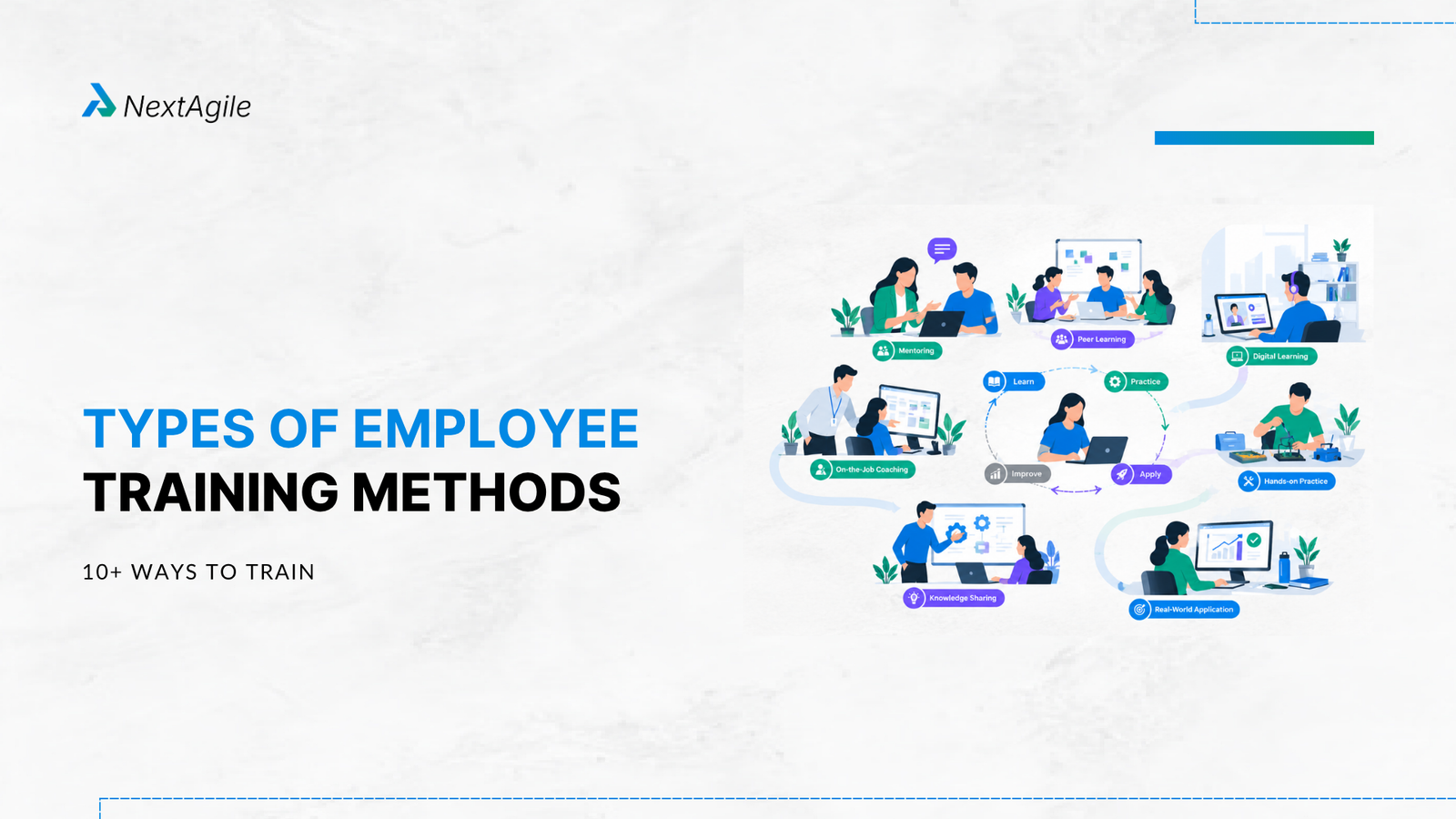
The main types of employee training methods include on-the-job training, job rotation, cross-training, employee shadowing, stretch assignments, e-learning, microlearning, simulations, virtual reality, gamification, coaching, mentoring, peer learning, communities of practice, case studies, role-playing, capstone projects, and blended learning.
There is no single best employee training method for every situation.
Knowledge-based training may work well through e-learning or microlearning. Practical skills often require on-the-job training and simulation. Leadership and interpersonal capabilities need practice, coaching, feedback, and reflection. Complex capabilities usually benefit from a blended approach.
The best method is the one that gives employees the right opportunity to learn, practice, apply, and improve the capability the business needs.
Key Takeaways From This Blog The right training method depends on the capability being developed. Knowledge transfer and behavior change require different learning experiences. On the job training is useful when employees need practical experience in real work situations. E-learning and microlearning are effective for scalable knowledge transfer and reinforcement. Coaching, mentoring, peer learning, and role-playing are valuable for behavioral development. Simulations allow employees to practice decisions before facing similar situations at work. Blended learning combines methods to support learning, practice, application, and reinforcement. Training effectiveness should be measured through behavior and business performance, not attendance alone. A strong training program starts with the business capability required, not with the training platform available. Most employee training fails long before the training room.
The problem is not always poor content or an ineffective trainer. Often, the organization has chosen a training method that cannot produce the capability employees actually need.
A manager who needs to handle conflict cannot learn the skill through information alone. A technical employee cannot become proficient simply by watching a presentation. A sales team cannot improve difficult conversations by completing another knowledge quiz.
The method has to match the outcome.
That is why organizations need to understand the different types of employee training methods and, more importantly, when each method should be used. The right training approach can improve skill transfer, strengthen employee performance, and make learning part of everyday work rather than a one-time event.
Types of Employee Training Methods: Why Beyond Classroom Training Matters Classroom training still has a place in corporate learning. It can introduce concepts, create shared understanding, facilitate discussion, and bring people together around a common business challenge. The problem starts when classroom instruction becomes the entire training strategy.
Consider a manager attending a session on delegation. They may understand delegation principles by the end of the day. They may remember a useful model and even score well on an assessment.
That does not mean they will delegate effectively when a critical project is under pressure.
They still have to decide what to delegate, explain the expected outcome, define decision boundaries, trust the employee, and respond when something goes wrong. Those behaviors require practice and feedback.
This is why modern corporate training methods need to go beyond information delivery. A strong program connects learning to workplace application. Employees learn a concept, practice it, receive feedback, apply it in their role, and return to reflect on what happened.
Organizations looking to build this kind of structured learning experience can explore corporate training programs as part of a broader capability development strategy.
The central question should therefore not be which training format we should use.
The better question is what must employees be able to do differently after the training? That shift changes how the entire program is designed.
Why Choosing the Wrong Training Method Becomes a Business Problem Training is often treated as an HR or L&D activity. But the consequences of ineffective training appear somewhere else. They show up in inconsistent decisions, weak management, slow execution, poor customer experiences, avoidable errors, and employees who still need support months after completing the program.
The issue is often a mismatch between the learning method and the capability.
A compliance module may be perfectly suited to e-learning because the objective is knowledge and awareness. The same approach is unlikely to be enough for developing conflict management or leadership judgment.
This distinction matters because organizations invest significant time and money in training.
If employees complete the program but cannot apply what they learned, the organization has achieved participation rather than capability.
A useful way to think about the problem is:
Knowledge requires understanding. Skill requires practice. Behavior requires repeated application and feedback. Organizational capability requires consistency across people, teams, and situations. Once training is viewed this way, choosing the right employee training methods becomes a business decision rather than a delivery decision.
The Training Method Fit Test Before choosing a training method, ask four questions.
First, what do employees need to know? Second, what do they need to be able to do? Third, what behavior needs to change? Fourth, where will they apply the capability? The answers point toward the right training approach.
If employees need information, digital learning may be enough. If they need a practical skill, they need practice. If they need to change a behavior, coaching and feedback become important.
If the capability involves several of these elements, a blended approach is usually more effective.
This simple distinction prevents a common mistake: using the same training format for every learning objective.
On the Job and Experiential Employee Training Methods Experiential learning puts employees closer to the actual work.
Instead of separating learning from the workplace, these methods use real tasks, real situations, and practical challenges as part of the development process.
They work particularly well for technical capabilities, operational knowledge, leadership development, problem solving, decision-making, and cross-functional skills.
On-the-Job Training On the job training allows employees to learn while performing actual work.
A new employee may complete a process under the supervision of an experienced colleague. A new manager may participate in real performance conversations before leading them independently.
The major advantage is context. Employees learn the exceptions, constraints, decisions, and practical realities that are often missing from formal instruction. They can also see immediately how knowledge affects their work.
The weakness is inconsistency. If there is no defined learning objective, experienced employees may simply show someone how they personally do the work. That can transfer habits rather than capability.
Effective on-the-job training needs clear expectations, guided practice, observation, feedback, and increasing independence.
Job Rotation and Cross Training Job rotation exposes employees to different roles or functions.
It can improve business understanding, strengthen succession planning, develop future leaders, and reduce dependency on individual employees. These outcomes connect closely to the broader work of building high performing teams , since rotation only pays off when it is tied to a defined development objective. A high-potential employee might spend time across operations, product, finance, and customer functions. The purpose should not be movement for its own sake.
Each rotation should have a defined development objective.
Cross-training follows a similar principle. Employees learn responsibilities outside their primary role so teams can maintain continuity and collaborate more effectively.
The strongest programs connect rotation to a capability the organization needs to build.
Shadowing Employee shadowing allows a learner to observe an experienced employee performing a role. This is useful when expertise is difficult to document or when judgment is a major part of the job.
A new manager can observe an experienced leader handling a difficult conversation. A junior consultant can sit in on a client meeting. A new salesperson can observe discovery calls before leading one independently.
Shadowing answers a practical question: What does effective performance actually look like here?
The best programs move from observation to guided practice and then independent performance.
Stretch Assignments Stretch assignments give employees responsibility that is slightly beyond their current level of capability.
A future leader may lead a cross-functional initiative. A senior individual contributor may own a strategic project. A manager may take responsibility for solving a business problem involving several teams.
The assignment creates a real reason to learn.
However, simply making work harder does not create development.
Employees need clear outcomes, access to support, regular checkpoints, and opportunities to reflect on what they learned. Without those elements, a stretch assignment can become additional workload rather than a meaningful development experience.
Technology-Enabled Corporate Training Methods Technology has made training easier to distribute.
Employees can access learning from different locations, complete short modules between meetings, and practice scenarios digitally. Organizations evaluating corporate training and L&D providers should still apply the same test: does the platform serve the learning objective, or is it simply the easiest thing to deploy at scale?
But technology should support the learning objective. It should not dictate the learning strategy.
E-Learning and Microlearning E-learning is useful when organizations need consistent training across large or distributed employee populations.
It works particularly well for product knowledge, processes, policies, technical concepts, compliance, onboarding, and foundational skills.
Microlearning breaks learning into smaller units focused on one concept or behavior.
For example, a manager development program could include short modules on setting expectations, giving feedback, delegating decisions, conducting one to ones, and handling difficult conversations.
Microlearning is especially valuable for reinforcement. An employee may understand a concept during a formal program but forget it when the situation appears three months later.
Short reinforcement content can bring the concept back into focus when needed.
However, digital learning has a clear limitation.
It can explain what effective behavior looks like. It cannot always create the ability to perform that behavior under pressure.
For complex interpersonal skills, e-learning should usually be combined with practice, coaching, simulations, or workplace application.
Simulations and Virtual Reality Training Simulations recreate situations in which employees need to make decisions. They are particularly useful when the consequences of failure are significant or when employees need repeated practice before handling a real situation.
Leadership simulations can test decision-making under pressure. Customer simulations can recreate difficult conversations. Operational simulations can allow employees to practice troubleshooting.
Virtual reality can create even more immersive environments. But realism alone does not make a simulation effective.
The scenario needs to reflect the decisions, constraints, trade-offs, and consequences employees actually encounter.
The best simulations are followed by debriefing. Employees should understand not only what decision they made but also why they made it and what they could do differently next time.
Gamification Training for Employee Engagement Gamification introduces elements such as challenges, progress levels, points, competition, and rewards into learning. It can increase participation, particularly when employees are learning repetitive or information heavy content.
But engagement should not be confused with learning. A training activity can be entertaining without producing meaningful capability.
Gamification works best when the game mechanics reinforce the behavior the organization wants to develop. If repetition matters, create repeated challenges. If problem-solving matters, create scenarios that require decisions.
The game should serve the learning objective.
Social and Relationship-Based Training Methods for Employees Some capabilities are fundamentally social.
Leadership, influencing, communication, collaboration, coaching, conflict management, and stakeholder management develop through interaction with other people.
Social learning methods give employees access to experience, feedback, and different perspectives.
Coaching and Mentoring Coaching and mentoring provide a more personalized learning experience.
Coaching generally focuses on improving a specific capability, behavior, or performance challenge. Mentoring tends to be broader and may involve career development, experience sharing, organizational navigation, and long-term growth.
Both can be valuable.
A manager struggling with delegation may need focused coaching around a specific team situation. An emerging leader preparing for a larger role may benefit from a mentor who provides perspective based on experience.
The quality of the relationship matters. A recurring conversation without goals, reflection, or feedback can easily become another meeting on the calendar.
For leadership capability, organizations can combine these approaches with corporate leadership training to create a more structured leadership development journey.
Peer-to-Peer Learning Peer learning allows employees to learn from people facing similar problems.
Teams can review difficult situations, share practices, demonstrate tools, or discuss how they approached a specific challenge.
This makes learning highly relevant.
A group of managers discussing real delegation problems will often surface practical issues that a generic course cannot anticipate.
Peer learning also creates an important shift.
Employees stop being passive recipients of training and start becoming contributors to organizational knowledge.
Communities of Practice A community of practice brings people together around a shared discipline.
Product managers, Agile practitioners, engineers, project managers, or leaders can use these communities to exchange ideas, solve problems, and discuss emerging practices.
The value is continuity.
Formal training may end after several weeks. A community can continue for years.
This makes communities of practice particularly useful for capabilities that evolve over time and require continuous learning.
Applied and Scenario-Based Employee Training Methods Applied methods make employees think and act.
Instead of asking participants to remember a concept, they ask them to analyze situations, make decisions, communicate a response, and consider consequences.
That makes them particularly useful for workplace skills.
Case Studies Case studies place employees inside a realistic business problem.
A leadership case might involve declining performance, conflicting priorities, and an employee who disagrees with their manager.
A product case might involve competing customer demands, limited resources, and pressure from senior stakeholders.
The value comes from the discussion.
Participants have to explain their reasoning, challenge assumptions, consider alternatives, and make trade-offs.
Case studies are particularly effective for strategic thinking, decision-making, business judgment, problem-solving, and stakeholder management.
Role Playing and Scenario Practice Role-playing gives employees a safe environment to practice difficult conversations.
A manager might practice giving feedback to an employee who repeatedly misses commitments. The facilitator can then change the situation.
What happens if the employee becomes defensive?
What if they disagree with the feedback?
What if they blame another team?
The learner has to respond rather than simply recall a communication model.
This is why scenario practice is powerful for leadership and interpersonal development.
It creates a bridge between knowing what to do and being able to do it.
A focused experience such as the Delegation & Feedback Workshop can use this applied approach to develop behaviors that employees need in real management situations.
Industry-Linked Capstone Projects Capstone projects require employees to apply multiple capabilities to a meaningful business problem.
Instead of completing a final test, participants might develop a solution, analyze an operational issue, create an implementation plan, or present recommendations to stakeholders.
This approach is useful for advanced development programs because the learning becomes connected to business value.
A leadership cohort might work on a problem involving customer experience, operational efficiency, innovation, employee engagement, or cross-functional execution.
The project becomes part of the learning experience and can also produce useful insights for the organization.
Blended Learning: Combining Employee Training Methods for Better Retention Blended learning combines multiple training methods into one learning journey.
A program might begin with e-learning, move into a live workshop, introduce simulation practice, provide coaching, and then require workplace application.
Another program might use microlearning, peer discussion, role-playing, manager feedback, and a follow-up assessment.
The combination should be intentional. Adding more training formats does not automatically create better learning. Each method should have a specific role.
Digital learning can introduce knowledge. A workshop can create shared understanding.
Simulation can provide practice. Coaching can address individual challenges. Workplace assignments can test whether the capability transfers.
This creates a learning cycle:
Learn → Practice → Apply → Receive feedback → Improve → Reinforce
NextAgile structures this progression through its own NextLearning framework , so digital content, live practice, and workplace application stay connected rather than existing as separate initiatives.
Blended learning is particularly useful for organizations that need both scale and depth.
Digital methods can support large populations. Live sessions can create interaction.
Pactical assignments can connect development to real work.
The result is a training experience that continues after the formal session ends.
How to Choose the Right Employee Training Method The right method depends on what employees need to change.
A useful selection process looks at skill type, employee experience, training complexity, and delivery constraints.
Choosing Based on Skill Type Start with the capability.
Knowledge-based subjects may need e-learning or microlearning. Technical skills may require practice and on-the-job training. Leadership skills often require role-playing, coaching, and workplace application.
Capability Suitable Training Methods Product knowledge E-learning, microlearning Technical skills On the job training, simulation Leadership Coaching, role-playing, case studies Communication Role-playing, coaching Decision-making Simulations, case studies Process knowledge E-learning, shadowing Collaboration Peer learning, workshops Customer handling Simulation, role-playing Strategic thinking Case studies, capstone projects
The key is to match the method to the behavior you need to see.
Choosing Based on Employee Role and Experience A new employee and an experienced leader should not receive identical training.
New employees often need structured instruction, shadowing, guided practice, and clear processes.
Experienced professionals may benefit more from peer learning, simulations, coaching, and complex business assignments.
Senior leaders often require highly contextual development involving strategic cases, executive coaching, business simulations, and facilitated reflection.
The more experienced the employee, the less useful generic information becomes. Development needs to become increasingly relevant to the decisions that person actually makes.
Choosing Based on Training Complexity Simple knowledge can often be transferred efficiently through digital learning. Complex capabilities need more practice.
If employees need to exercise judgment, handle ambiguity, influence others, or make
decisions under pressure, information alone will rarely be sufficient.
For example, an e-learning module can explain the principles of conflict management. It cannot fully reproduce the pressure of managing conflict between two high-performing employees during a critical project.
Complexity should therefore determine the depth of the training experience.
Choosing Based on Budget and Delivery Constraints Budget, geography, employee availability, technology, and group size all influence training design.
E-learning and microlearning are useful when organizations need scalable delivery.
Instructor-led training provides deeper interaction. Coaching offers personalization but requires more resources.
Remote teams also need careful design.
Virtual sessions may need shorter learning cycles, stronger facilitation, asynchronous activities, digital practice, and structured reinforcement.
The goal should not be the lowest training cost. The goal should be the strongest capability created for the investment.
How to Build a Blended Employee Training Program A strong blended program starts with a business problem.
Do not begin by selecting a learning platform or booking a workshop.
Start by identifying what employees need to do differently.
1. Define the capability gap Identify what employees currently struggle to do consistently. Avoid broad goals such as improve leadership. Define observable behaviors instead. For example, managers should be able to set clear expectations, delegate decision authority, provide timely feedback, and address performance issues early.
2. Identify the required behavior Translate the capability into workplace actions. Ask what employees should do differently when they return to work. This question makes the training objective measurable. 3. Select the methods Use each method for what it does best. Knowledge can be developed through digital learning. Practice can happen through simulations. Behavioral skills can be developed through role playing and coaching. Complex capabilities can combine several approaches. 4. Sequence the learning Build a deliberate progression. A typical structure may look like: Learn → Practice → Feedback → Apply → Reflect → Reinforce
The sequence matters because employees need time to move from understanding to performance. 5. Create workplace application Give employees a real situation in which to use the capability. This could be a customer interaction, team meeting, strategic project, difficult conversation, or operational challenge. The closer the application is to real work, the stronger the transfer opportunity. 6. Reinforce after training Training should not disappear when the workshop ends. Use coaching, microlearning, peer discussions, manager check-ins, assessments, or workplace challenges to reinforce the capability. 7. Measure transfer Measure what changed. Completion rates are useful for administration. They are not enough to prove effectiveness. Look at behavior, manager observations, quality, productivity, customer outcomes, decision quality, cycle time, or team performance depending on the capability. A structured approach such as the Kirkpatrick model of training evaluation can help distinguish participation from actual capability change. A Practical Employee Training Method Selection Framework Organizations can simplify training design by looking at four levels of development.
Level 1: Knowledge Employees need to understand a concept, process, product, or policy. Useful methods include e-learning, microlearning, presentations, and reference resources. Level 2: Skill Employees need to perform a task correctly. Useful methods include demonstrations, on-the-job training, simulations, shadowing, and guided practice. Level 3: Behavior Employees need to respond differently in real situations. Useful methods include role-playing, coaching, feedback, reflection, and workplace assignments. Capabilities such as feedback and delegation are typical examples of behaviors that only change through repeated practice, not through information alone. Level 4: Capability The organization needs employees to consistently combine several skills in complex situations. Useful methods include blended learning, simulations, coaching, peer learning, capstone projects, and sustained workplace application. This framework helps prevent a common mistake.
Organizations often use a Level 1 solution for a Level 3 or Level 4 problem.
They provide information when what employees actually need is practice, feedback, and repeated application.
How NextAgile Builds Role-Based and Blended Training Programs NextAgile starts with the capability the organization needs to build.
The question is not which training format is easiest to deliver. The question is what employees need to do differently and what learning experience will make that change possible.
That often means combining several methods.
A leadership program may include diagnostic work, live facilitation, simulations, role-playing, coaching, workplace assignments, and follow-up reinforcement.
An Agile capability program may combine structured learning with practical application so teams can connect concepts to planning, prioritization, collaboration, decision-making, and delivery.
This approach is reflected in Agile corporate training solutions , where the emphasis is on developing capability that teams can use in their actual operating environment.
The same principle applies to team development.
A team development workshop can focus on the behaviors, interactions, and working patterns that influence team performance rather than treating development as a one-day event.
The objective is simple. Training should survive the training room. Employees should leave with something they can apply, managers should be able to observe the change, and the organization should have a way to determine whether the capability is improving.
That is where training becomes a business investment rather than an activity on the L&D calendar.
Conclusion There are many employee training methods available to organizations today.
The challenge is not finding enough methods. It is knowing which method to use for which capability.
E-learning can transfer knowledge efficiently. Microlearning can reinforce concepts. On the job training creates practical experience. Simulations and role-playing create opportunities to practice. Coaching and mentoring provide personalized development.
Blended learning brings these approaches together when the capability is too complex for one method.
The strongest training programs therefore start with the business outcome.
What should employees know? What should they be able to do? What behavior should change? Where will they apply it? How will the organization know the capability has improved? Those questions lead to better training decisions.
The real measure of employee training is not how many people attended, how many modules they completed, or how positive the feedback form was. It is what employees do differently when they return to work.
If your teams struggle with capability gaps, inconsistent performance, or low training impact, choosing the right employee training methods becomes essential. NextAgile learning programs can help you identify the right mix of learning approaches, from experiential and blended learning to role-based development, and build a practical training roadmap aligned with your business goals. Do reach out to us at consult@nextagile.ai and we would be happy to explore more.
Frequently Asked Questions 1. What is the most effective employee training method? There is no single most effective employee training method. The right approach depends on the capability being developed. Knowledge may be learned through e-learning, while leadership and interpersonal skills often require practice, coaching, role-playing, feedback, and workplace application.
2. How do companies determine which training method employees prefer? Companies can use surveys, interviews, focus groups, learning analytics, and pilot programs to understand employee preferences. However, preference should not be the only consideration. The training method must also match the capability, role, learning objective, and expected workplace behavior.
3. What is the difference between training delivery methods and training techniques? Training delivery methods describe how training is delivered, such as classroom, virtual, or digital learning. Training techniques describe how participants learn within that format, including role-playing, discussion, simulation, demonstration, case studies, and practical exercises.
4. How can employee training methods be adapted for remote teams? Remote teams can use virtual instructor-led training, e-learning, microlearning, digital simulations, peer learning, virtual role-playing, coaching, and asynchronous assignments. Shorter learning cycles and structured reinforcement can help maintain application and engagement across distributed teams.
5. How do you measure employee learning after different training methods? Measure learning at several levels. Knowledge assessments can test understanding, while simulations and role-playing can test application. Manager observations, workplace assessments, performance indicators, customer outcomes, productivity, quality, and other business metrics can show whether learning transferred into behavior.
6. Which employee training methods work best for new managers? New managers typically benefit from a combination of structured learning, shadowing, coaching, role-playing, peer learning, and workplace assignments. Capabilities such as delegation, feedback, conflict management, decision-making, and team development require practice because understanding the concept alone rarely changes management behavior.
Yamini Dabral is a Marketing Strategist at NextAgile with 5+ years of experience in B2B marketing, brand building, and digital growth. She leads initiatives across SEO, website strategy, content marketing, email campaigns, social media, and go-to-market execution for enterprise consulting and training services. Working closely with agile coaches, consultants, and business leaders, she transforms complex ideas into practical, engaging insights across OKRs, Leadership, Product Management, and Digital Transformation, helping organizations and professionals navigate change with confidence.
 Skip to content