Most organizations respond to performance problems with training before identifying what is actually causing the problem. Employees attend programs, completion rates look healthy, and feedback scores are positive, yet the original business problem remains.
That is where Training Needs Analysis becomes important. A good TNA does not begin by asking which courses employees need. It begins by asking what the business needs to improve, what people need to do differently, and what is preventing that performance today.
For enterprises, this distinction matters. A capability gap may require training. A process problem may require redesign. An accountability problem may require clearer decision rights. A leadership problem may require coaching rather than another classroom program.
The purpose of a Training Needs Analysis is therefore not to create a longer training calendar. It is to make better decisions about where learning investment can actually improve performance.
Training Needs Analysis is a structured process used to identify the gap between current employee or organizational performance and the capabilities required to achieve business goals. A strong TNA examines business objectives, job requirements, individual and team capabilities, root causes, and the most appropriate intervention.
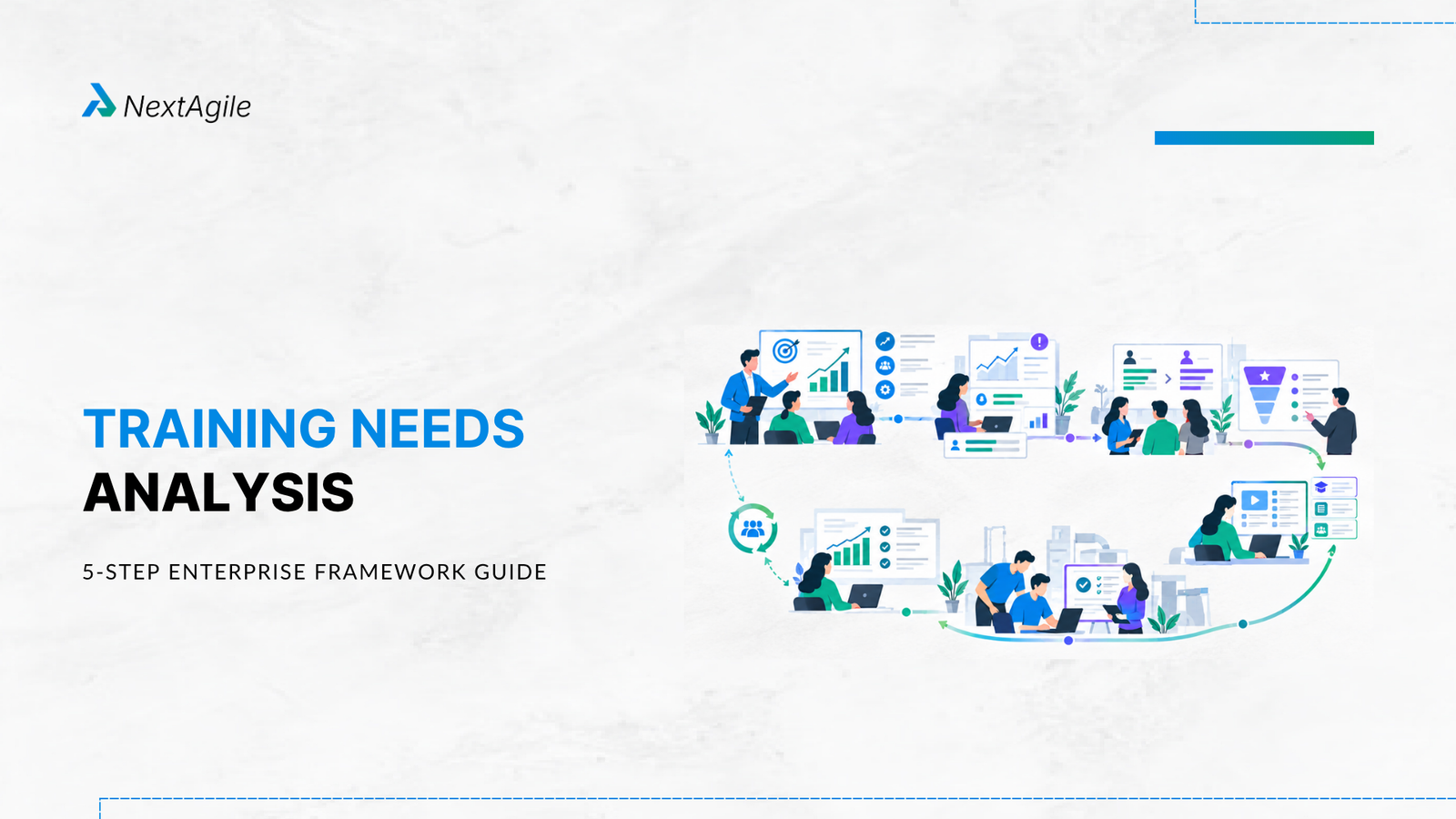
A practical enterprise Training Needs Analysis can follow five steps:
Organizational analysis to connect capability needs with business priorities Job and task analysis to define the behaviors and skills required for strong performance Person analysis to identify individual and team capability gaps Cause analysis to determine whether the problem is actually caused by a lack of training Solution recommendation and prioritization to decide what intervention should happen first The final output should be a clear action plan, not simply a list of training topics.
Key Highlights of Training Needs Analysis Training needs analysis identifies the gap between required performance and current performance. Not every performance problem is a training problem. Organizational, job, person, and cause analysis should be connected rather than treated as separate exercises. The strongest TNA starts with business outcomes instead of course requests. Skills gaps should be prioritized according to business impact, urgency, scale, and strategic relevance. Surveys alone cannot provide a reliable picture of organizational capability. Leadership and middle management gaps often require coaching, practice, feedback, and operating changes alongside formal training. A successful TNA connects learning investment to observable behavior and measurable business outcomes. A business leader says customer complaints are increasing. A functional head says managers need better communication skills. HR receives the request and begins looking for a communication training program.
This happens in organizations every day.
The problem is that the request may already contain an assumption about the solution. The organization has jumped from symptom to training without diagnosing the cause.
A customer complaint problem could involve poor communication. It could also involve unclear ownership, broken processes, inadequate product knowledge, unrealistic service commitments, or slow escalation mechanisms.
Training needs analysis creates the discipline to separate these possibilities before money and employee time are committed.
What Is Training Needs Analysis? An Enterprise Framework Training Needs Analysis is the process of identifying the knowledge, skills, behaviors, and capabilities required to achieve a desired level of performance, comparing them with current performance, and determining the most appropriate way to close the gap.
At an enterprise level, TNA should connect four things: business outcomes, required capabilities, current performance, and root causes.
The logic is simple:
Business outcome → Required capability → Current performance → Gap → Root cause → Intervention → Measurement
This sequence prevents L&D teams from starting with the course catalogue.
For example, suppose a company wants to reduce product launch delays. The initial training request may be project management training.
A proper TNA may discover that project managers already understand planning techniques.
The larger issue may be unclear decision ownership, unresolved dependencies, frequent priority changes, and weak escalation.
The organization may still need training, but training alone will not solve the problem. This is why a useful TNA is more than a learning exercise. It is a performance diagnosis.
Training Needs Analysis vs. Training Needs Assessment: What’s the Difference Training needs analysis and training needs assessment are often used interchangeably, and in many organizations they describe essentially the same activity.
There is, however, a useful distinction when designing an enterprise approach.
Training needs assessment generally refers to the broader process of identifying learning requirements across individuals, teams, roles, or the organization.
Training needs analysis goes deeper into the reasons behind those needs. It examines the performance gap, the capability required, the current state, and the causes behind the gap.
In practice, an enterprise TNA should combine both.
The assessment tells you where the organization sees a need. The analysis helps determine what is actually happening and what should be done about it.
This difference becomes particularly important when senior leaders request training based on a visible business problem.
A request such as managers needing leadership training is not yet a diagnosis.
The better questions are:
What are managers expected to do? Where is performance falling short? Which behaviors are creating the problem? Do managers have the required skills? Are organizational systems supporting those behaviors? What evidence shows that training would improve the outcome? These questions turn a training request into a business investigation.
Why Training Needs Analysis Matters for Enterprise Skills Gaps Training as a Default Reflex Instead of a Diagnosis Training is often the easiest intervention to request because it is visible, familiar, and relatively easy to organize.
A performance problem appears. Someone identifies a skill that seems related to it. A workshop is scheduled. The problem is that employees can complete training without becoming more capable in the situations that matter.
An employee may understand the principles of effective delegation but still avoid delegating because their manager keeps taking decisions back. A sales team may know the questioning techniques taught in training but struggle because the CRM process gives them too little time with customers.
The capability exists in theory. The operating environment prevents it from being used.
This is why TNA must investigate the context around performance rather than only the knowledge inside an employee.
Connecting Skills Gaps to Business Performance A skills gap becomes strategically important when it affects something the organization cares about.
That could be revenue, customer retention, delivery predictability, productivity, quality, innovation, employee retention, compliance, or leadership capacity.
Consider a manufacturing organization experiencing rising quality issues. The obvious response may be quality training.
But a deeper analysis could reveal that experienced operators already understand quality standards. The real issue may be inconsistent shift handovers, outdated work instructions, poor supervision, or equipment reliability.
The TNA changes the intervention.
Instead of sending everyone through another quality course, the organization addresses the actual causes and provides targeted capability development where it is genuinely required.
That is the difference between training activity and capability investment.
The 5-Step Training Needs Analysis Framework Step 1: Organizational Analysis: Anchor Training to Business Goals Organizational analysis starts with the business, not the employee.
The objective is to understand what the organization is trying to achieve and which capabilities are required to support those priorities.
Start by examining strategic goals, operating priorities, customer expectations, transformation initiatives, productivity targets, growth plans, and known performance risks.
For example, an organization entering a new market may need stronger commercial capability, faster decision-making, cross-functional collaboration, and local customer understanding.
Those needs are more useful than simply saying employees need sales training.
The next question is where the business strategy is currently being constrained.
Is growth limited by manager capability? Is execution slowing because teams cannot make decisions quickly? Is customer experience inconsistent because frontline employees lack authority?
Organizational analysis provides the context for everything that follows.
A useful TNA should eventually be able to answer one question clearly: What business outcome are we trying to improve through this capability investment?
If that answer is unclear, the analysis is probably starting too far downstream.
Step 2: Job and Task Analysis: Define What Good Performance Looks Like Once the business requirement is clear, examine the roles responsible for delivering it.
Job and task analysis identifies what employees actually need to do to perform effectively. This goes beyond job descriptions.
A job description may say that a manager is responsible for leading a team. That does not tell you what effective leadership looks like in practice.
The analysis should identify specific behaviors and decisions.
Does the manager set clear expectations? Make timely decisions? Delegate authority? Give useful feedback? Resolve conflict? Manage performance? Align stakeholders?
These observable behaviors create a much stronger basis for identifying capability gaps.
For technical roles, the analysis may focus on procedures, tools, systems, problem-solving, quality standards, or technical judgment.
For leadership roles, it may focus more heavily on decision-making, communication, coaching, influence, delegation, and execution.
The critical question is: What does good performance look like when the employee is actually doing the job?
This prevents organizations from designing training around abstract competencies that employees cannot connect to their daily work.
Step 3: Person Analysis: Identify Individual and Team Skills Gaps Person analysis examines who has the required capability today and where meaningful gaps exist. This can involve employees, managers, leaders, new hires, high-potential talent, specialist teams, or entire functions.
The goal is not to label people as capable or incapable. It is to understand the distance between current performance and the level required for the role.
Different employees can have different gaps even when they share the same job title.
One manager may need stronger delegation. Another may need conflict management. A third may understand leadership principles but struggle with decision-making under pressure.
That is why one-size-fits-all training can produce uneven results.
Useful evidence can come from performance reviews, skills assessments, manager observations, simulations, project outcomes, customer feedback, quality data, interviews, and behavioral assessments.
The strongest approach combines several sources rather than relying on employee self-reporting alone.
Step 4: Cause Analysis: Is Training Really the Right Solution? This is the step that separates a basic TNA from a strong enterprise diagnosis.
Before recommending training, ask why the performance gap exists. A useful diagnostic considers five possibilities.
Knowledge gap: The employee does not know what to do. Skill gap: The employee understands what to do but cannot perform the task consistently. Behavior gap: The employee has the capability but does not apply it reliably in real situations. System gap: Processes, tools, incentives, workload, or technology make the desired behavior difficult. Management or governance gap: Accountability, decision rights, priorities, or leadership practices are creating the problem, often traceable to a missing accountability framework . Consider a middle management team that repeatedly escalates routine decisions.
The initial diagnosis may be weak decision-making skills. But interviews reveal that managers are expected to take ownership while senior leaders routinely override their decisions.
That is not primarily a training problem.
The organization may need clearer decision rights, stronger delegation, and manager development at the same time.
The right question is therefore not simply whether employees need training. It is whether training is one of the interventions required to change the performance outcome.
A Practical Training vs Non-Training Diagnostic Before investing in a learning program, ask:
Does the employee know what good performance looks like? Does the employee have the knowledge required? Can the employee demonstrate the required skill? Has the employee received sufficient practice and feedback? Does the process support the desired behavior? Does the employee have the authority and resources required? Are priorities and expectations clear? Is the manager reinforcing the expected behavior? Are incentives aligned with the behavior the organization wants? If the issue is primarily knowledge or skill, training may be appropriate.
If the issue is process, authority, workload, technology, incentives, or management behavior, training should not be presented as the complete solution.
This diagnostic protects both the business and the L&D function from solving the wrong problem.
Step 5: Solution Recommendation and Prioritization Once the causes are understood, determine the most appropriate intervention.
The answer may be formal training, coaching, mentoring, job aids, simulations, manager enablement, process redesign, role clarification, technology improvements, governance changes, or a combination.
This is also where priorities must be established. Not every capability gap deserves immediate investment.
A practical prioritization model can assess each gap against four factors:
Business impact: How strongly does the gap affect a critical business outcome? Urgency: How quickly does the organization need the capability? Scale: How many people, teams, customers, or business units are affected? Strategic relevance: How closely does the capability support a major organizational priority? A small leadership capability gap affecting a critical transformation may deserve more attention than a larger but low-impact skills gap.
The objective is not to train the largest population. It is to address the capability gaps that matter most.
Methods for Gathering Data in a Training Needs Analysis Good TNA depends on good evidence.
Surveys can help identify perceived capability gaps across a large population. They are useful for scale, but they should not be treated as the complete diagnosis.
Interviews with leaders and managers can reveal where performance breaks down, what behaviors are creating problems, and what capabilities are missing.
Employee interviews can uncover barriers that managers may not see.
Performance data shows what is actually happening. Depending on the business, this could
include productivity, customer complaints, project delays, sales conversion, quality defects, employee retention, cycle time, or escalation rates.
Observation is particularly valuable for roles where performance is behavioral or operational.
An employee may report confidence in a skill, while observation reveals that the skill is not being applied effectively in real situations.
Customer and stakeholder feedback adds another perspective.
The strongest TNA combines these sources.
The objective is not to collect the maximum amount of data. It is to collect enough reliable evidence to make a confident decision.
How to Prioritize Skills Gaps by Business Impact and Urgency A long list of training needs does not help an enterprise make decisions.
Imagine an organization identifies 30 capability gaps across sales, operations, leadership, technology, and customer service.
The temptation is to create 30 training interventions. That is usually a mistake.
Start by ranking the gaps according to impact and urgency.
High-impact, high-urgency gaps should receive immediate attention. High-impact, lower-urgency gaps should enter the capability development roadmap. Low-impact gaps may be handled through self-directed learning, existing resources, or normal manager support. A second filter should ask whether training is feasible and whether it is likely to influence the outcome. This prevents L&D from investing heavily in areas where the root cause sits elsewhere.
The result should be a focused portfolio of capability priorities rather than an oversized training catalogue.
How to Turn Training Needs Analysis Findings Into a Learning Plan A TNA becomes valuable when its findings translate into action.
Each priority should be connected to a defined audience, capability, intervention, practice opportunity, manager reinforcement mechanism, and measurement approach.
For example:
Capability gap: Managers struggle with difficult performance conversations. Intervention: Manager development program combining workshops, role-play, coaching, and feedback. Practice: Managers conduct real conversations using structured preparation tools. Reinforcement: A consistent management rhythm of Monthly manager reviews with coaching. Measurement: Quality of performance conversations, employee feedback, performance improvement outcomes, and manager confidence. This is much stronger than simply scheduling a difficult conversations workshop.
The learning plan should also reflect the nature of the capability.
Knowledge-heavy needs may require digital learning or structured instruction.
Behavioral capabilities often require practice, feedback, coaching, and real-world application.
Leadership capabilities usually require a longer development cycle rather than a single event.
For enterprise programs, this may involve a blended approach combining corporate training programs , coaching, manager reinforcement, peer learning, and workplace application.
Common Mistakes Enterprises Make in the Training Needs Analysis Process Starting with a course instead of a problem A business leader requests communication training, negotiation training, or leadership training. L&D immediately searches for a program.
The problem is that the desired intervention has already been selected before the need has been diagnosed.
Start with the performance problem instead.
Treating every gap as a training gap Employees cannot perform because the process is broken. Training is introduced.
Employees still cannot perform. The organization then concludes that the training did not work.
The real mistake happened earlier. The root cause was never identified.
Relying only on surveys Surveys are useful, but people do not always accurately assess their own capability.
Someone may believe they are strong at delegation because they delegate frequently. Observation may reveal that they delegate tasks without transferring decision authority.
Multiple evidence sources provide a more reliable picture.
Ignoring the manager layer Many capability programs focus on employees while ignoring the managers responsible for reinforcing the new behavior.
An employee learns a new approach but returns to a manager who rewards the old one. Behavior quickly returns to the previous pattern.
Manager involvement should therefore be part of the learning design, not an afterthought.
Measuring completion instead of change Completion rates are easy to report. They do not prove capability. A stronger measurement model tracks learning, application, behavior, and business outcomes, the same four levels behind the Kirkpatrick training evaluation model .
The important question is not how many employees completed the program. It is what they do differently afterward and whether that difference matters to the business.
Creating a long list instead of making decisions A TNA that identifies 80 needs may look comprehensive. It may also create decision paralysis.
The real value lies in identifying the few capability priorities that deserve investment now and explaining why.
How Training Needs Analysis Should Differ by Capability Area The TNA approach should change depending on what the organization is trying to improve.
For technical capability, the analysis should examine tools, standards, procedures, technical knowledge, error rates, and practical proficiency.
For sales capability, it may examine conversion rates, customer conversations, pipeline behavior, negotiation, discovery, product knowledge, and manager coaching.
For leadership development, the focus often shifts toward decision quality, stakeholder management, delegation, conflict, communication, team performance, and behavior under pressure.
For middle management, the analysis should look closely at the transition from individual contributor to organizational leader.
Managers may understand their functional responsibilities but struggle with prioritization, delegation, cross-functional alignment, performance management, or decision ownership.
This is where a targeted middle management development approach can be more effective than generic leadership training.
How NextAgile Approaches Enterprise Training Needs Analysis NextAgile approaches TNA from the business outcome backward.
The first question is not which training program should be delivered. It is what the organization is trying to improve and which capabilities are preventing that improvement.
The analysis then examines the role, behavior, team environment, management system, and organizational conditions surrounding the performance problem.
This is particularly important for leadership and transformation programs.
For example, if leaders are struggling to make decisions quickly, the solution may involve decision-making capability development. But it may also require clearer decision rights, stronger governance, better escalation mechanisms, and greater manager autonomy.
NextAgile, therefore, does not treat learning as an isolated event.
The intervention may combine leadership learning programs , coaching, simulations, team development workshop , manager reinforcement, practical tools, and organizational changes where required.
The objective is measurable behavior change that supports business performance. That may mean helping managers delegate more effectively, helping leadership teams improve alignment, strengthening cross-functional execution, or building the capabilities required for enterprise transformation.
The final test is simple: Did the intervention change what people do when they return to work? And did that change improve the outcome the organization cared about?
That is where Training Needs Analysis creates value. This may mean helping managers delegate more effectively, helping leadership teams improve alignment, strengthening cross-functional execution, or drawing on change management consulting services for the capabilities required in enterprise transformation.
Conclusion A Training Needs Analysis should not produce a list of courses. It should produce clarity.
Clarity about the business outcome. Clarity about the capabilities required. Clarity about the current performance gap. Clarity about the root cause. And clarity about which intervention deserves investment.
The strongest TNA process recognizes that training is one possible solution, not the automatic solution.
When the diagnosis is right, training becomes more targeted, learning becomes more relevant, managers know how to reinforce it, and the organization has a much clearer path from capability development to business performance.
That is the real purpose of enterprise Training Needs Analysis. It is not about training more people. It is about developing the right capabilities to solve the problems that matter.
If your organization is investing in training but still struggling with performance gaps, inconsistent execution, or capability challenges, a structured Training Needs Analysis can help identify what needs to change and where training can create the greatest business impact. NextAgile consulting can help you diagnose capability gaps, identify the right interventions, and build a practical learning roadmap aligned with your business goals. Do reach out to us at consult@nextagile.ai and we would be happy to explore more.
Frequently Asked Questions 1. How long does a typical training needs analysis take? The timeline depends on organizational size, scope, number of roles, data availability, and complexity of the performance problem. A focused TNA may take a few weeks, while an enterprise-wide analysis can take several months. The priority should be decision quality rather than completing the process quickly.
2. Who should be involved in a training needs analysis? A strong TNA typically involves L&D, HR, business leaders, functional managers, subject matter experts, and employees from the affected roles. Customers or other stakeholders may also contribute useful evidence. Involving the business early helps connect capability gaps with actual performance priorities.
3. How often should an organization conduct a training needs analysis? Organizations should review capability needs whenever strategy, technology, roles, operating models, or market conditions change significantly. A broader review can happen annually, while critical capabilities should be monitored continuously through performance data, manager feedback, and business priorities.
4. What data should HR and L&D teams collect before starting a TNA? Useful data includes business objectives, performance metrics, role expectations, competency requirements, employee assessments, manager observations, customer feedback, performance reviews, quality data, productivity measures, and previous learning outcomes. The exact data should depend on the business problem being investigated.
5. How can organizations measure whether a training needs analysis was successful? The TNA itself is successful when it produces clear, evidence-based decisions about capability priorities and interventions. Its longer-term value should be measured through behavior change and business outcomes such as productivity, quality, customer experience, decision speed, sales performance, project predictability, or leadership effectiveness.
6. Can training needs analysis be used for leadership and management development? Yes. TNA is particularly valuable for leadership development because leadership gaps are often behavioral and contextual. The analysis can identify gaps in decision-making, delegation, feedback, conflict management, stakeholder alignment, coaching, and execution, while also identifying organizational conditions that may be limiting leadership effectiveness.
Alok Dimri is the co-founder and leads the overall business at NextAgile, where he is responsible for strategy, client and consultant partnerships, and a whole lot of other core business activities like solutioning, branding, and customer engagement.
Over the past 16 years, he has worked extensively in business strategy, new business development, and key account management initiatives across process consulting and training domains.
 Skip to content