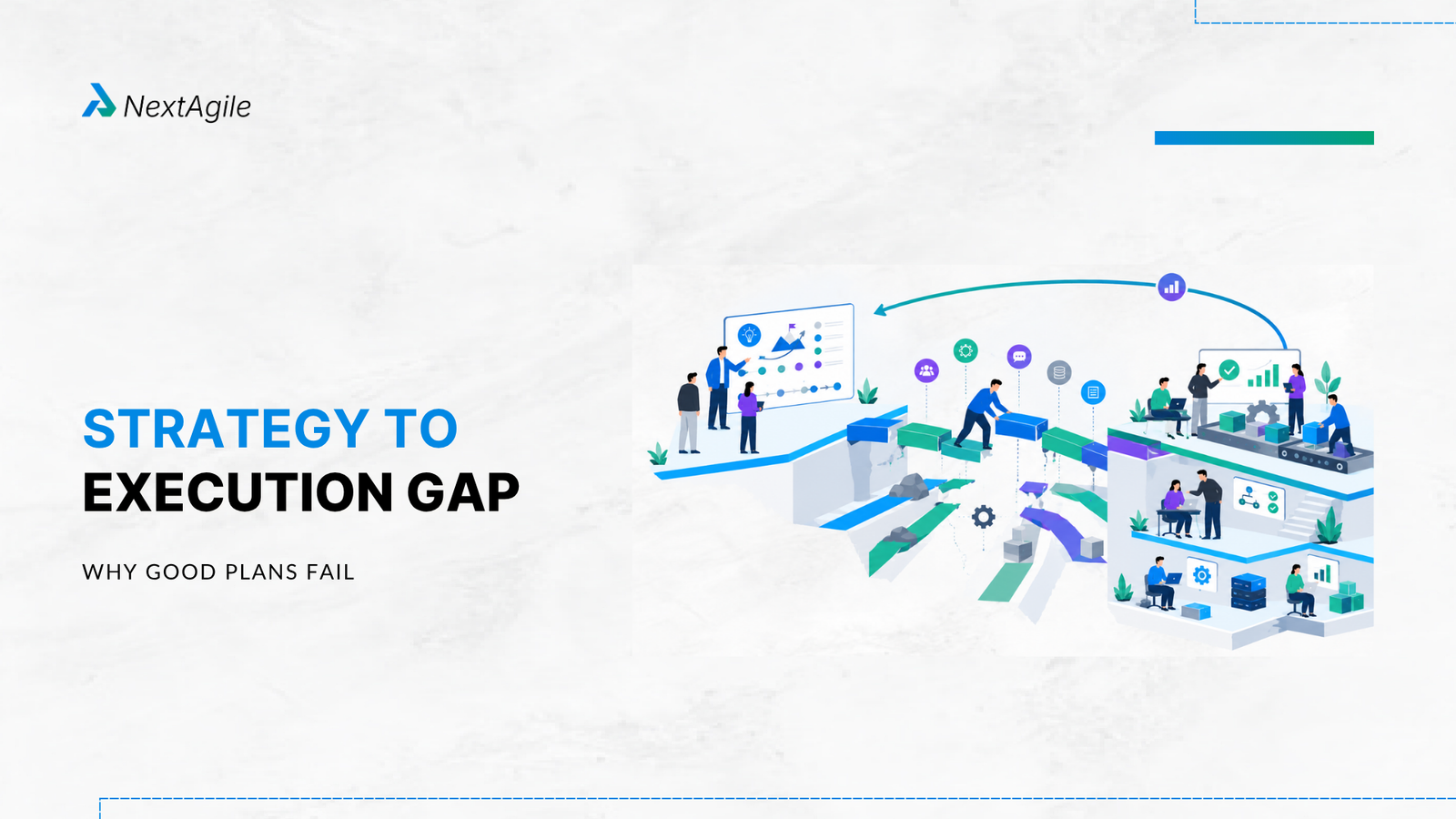
The strategy to execution gap is the disconnect between what leadership decides the organization should achieve and what teams actually deliver.
It usually appears when strategic priorities are not translated into clear ownership, decisions, resources, trade-offs, and weekly commitments.
The gap often becomes visible at the manager layer. Senior leaders define direction, while managers must turn that direction into practical work.
To close the gap, organizations need fewer priorities, clear owners, defined decision authority, measurable outcomes, and a consistent rhythm for reviewing execution.
Key Highlights of Strategy to Execution Gap A strategy to execution gap exists when strategic intent does not translate into consistent operational results. The gap often widens at the manager layer, where strategy must become practical team commitments. Too many priorities make execution slower and dilute accountability. Strategy needs to be translated into weekly commitments, not left at the level of annual goals. Every important outcome needs one clear owner. Managers need enough decision authority to influence the outcomes they own. OKRs can support strategy execution, but they cannot compensate for unclear priorities or weak management systems. Leadership should review execution regularly without constantly changing strategic priorities. Most organizations are better at creating strategy than executing it.
Leadership teams can spend weeks discussing growth, customer experience, profitability, innovation, market expansion, or operational efficiency.
The plan looks strong when it is presented. The real test starts after the presentation ends. A few months later, teams may still be busy, but strategic initiatives are moving slowly.
Managers are handling competing requests. Departments are optimizing different targets. Priorities keep changing. Senior leaders are stepping into operational issues.
Eventually, someone asks why the strategy is not working.
That question is often asked too early. The strategy may not be the problem. The problem may be the system responsible for turning strategy into action.
This is the strategy to execution gap, a pattern Harvard Business Review’s research on why strategy execution unravels has studied in depth across large organizations.
It exists in the space between what leadership wants to happen and what the organization consistently does.
A strategic objective such as improving customer retention by 15 percent sounds clear to an executive team.
But it does not tell a customer success manager what should happen on Monday morning.
Which accounts need attention? Which activities should stop? What decisions can the manager make? What should the team measure each week? Until those questions are answered, strategy remains an intention.
Execution begins when strategic intent becomes a set of choices, owners, commitments, and measurable outcomes.
5 Signs of a Strategy Execution Gap in Your Organization A strategy execution gap rarely appears as one obvious failure. It usually shows up through repeated patterns in meetings, priorities, decisions, and team behavior.
The earlier these patterns are recognized, the easier it is to correct the underlying execution problem.
Teams cannot explain the top business priorities Ask several people across the organization what matters most this quarter.
If everyone gives a different answer, the strategy has not travelled far enough into the business.
Employees may have heard the strategy during a town hall or read it in a presentation.
That does not mean they understand how it should change their priorities.
A useful strategy should help people make choices.
People should know what matters most, what can wait, and what work should stop.
When those choices remain unclear, employees protect their existing workload instead of changing it around strategic priorities.
Departments are working toward different outcomes A company can have highly productive departments and still have poor strategy execution.
Sales may optimize revenue. Operations may optimize cost. Product may optimize feature delivery. Customer Success may optimize support response times. Every department can report strong numbers while the company misses the strategic outcome.
This happens when functional goals are not connected to shared business priorities.
Bridging strategy and execution requires leaders to define how different functions contribute to the same outcome.
The question is not whether every department has goals.
The question is whether those goals reinforce one another.
Managers keep reprioritizing work Constant reprioritization is one of the most expensive hidden problems in execution.
A new leadership request arrives. A customer issue becomes urgent. Another project gets executive attention. The manager moves the team again. Eventually, teams learn that priorities are temporary.
They stop investing deeply in important work because they expect another change to arrive.
Some reprioritization is necessary in a changing business.
The problem is repeated change without a clear decision rule for what gets protected, paused, or removed.
Strategic initiatives stall after planning Planning receives attention because it creates visible outputs. There are workshops, presentations, roadmaps, budgets, and launch plans.
Execution is less visible.
Once the plan reaches the organization, someone has to coordinate resources, resolve dependencies, make trade-offs, and remove obstacles.
That is where many initiatives lose momentum.
Meetings continue. Reports are produced. Tasks are completed. Yet the strategic outcome barely moves. This is a classic execution gap.
The organization has activity without enough progress.
Leadership keeps stepping in to unblock execution Senior leaders should remove structural barriers. They should not become the default solution for routine operational problems.
When managers repeatedly escalate decisions, customer issues, resource conflicts, or delivery problems, leadership may conclude that the managers lack ownership.
Sometimes that is true.
But another possibility is that the managers have responsibility without enough authority.
Before blaming capability, examine the operating system.
Can the manager make the necessary decisions? Can they move resources? Can they change priorities within defined limits? Can they resolve cross-functional conflicts? If not, the organization may have designed an execution problem into the role.
What Is the Strategy to Execution Gap? The strategy to execution gap is the disconnect between strategic objectives and the actions, decisions, ownership, resources, and outcomes required to achieve them.
Strategy establishes direction.
Execution turns that direction into coordinated action.
The gap appears when there is insufficient translation between the two.
Consider a leadership team that decides to improve profitability. It is an important strategic outcome. But it is not an execution plan.
Managers need to know what will change.
Will pricing increase? Will low-margin customers be addressed? Will rework be reduced? Will utilization improve? Will certain costs be eliminated? Will the company change how resources are allocated? Until those decisions are made, the strategy remains broad.
The same issue appears with goals such as improving customer experience, increasing innovation, or accelerating growth.
These are outcomes.
Teams need the operating choices behind those outcomes.
This is why strategy vs execution should not be treated as two separate management activities.
Strategy determines where the organization will compete and what it intends to achieve.
Execution determines whether the organization can consistently turn those choices into results.
A strong strategy with weak execution produces limited value.
Strong execution without strategic direction can produce efficient work that moves the organization in the wrong direction.
The goal is to connect both.
Why Good Strategies Fail at the Middle-Manager Layer The manager layer is where strategic ambition meets operational reality. Executives think about markets, growth, profitability, transformation, and competitive positioning. Frontline teams think about customers, projects, tasks, deadlines, and immediate problems.
Managers have to connect these two worlds.
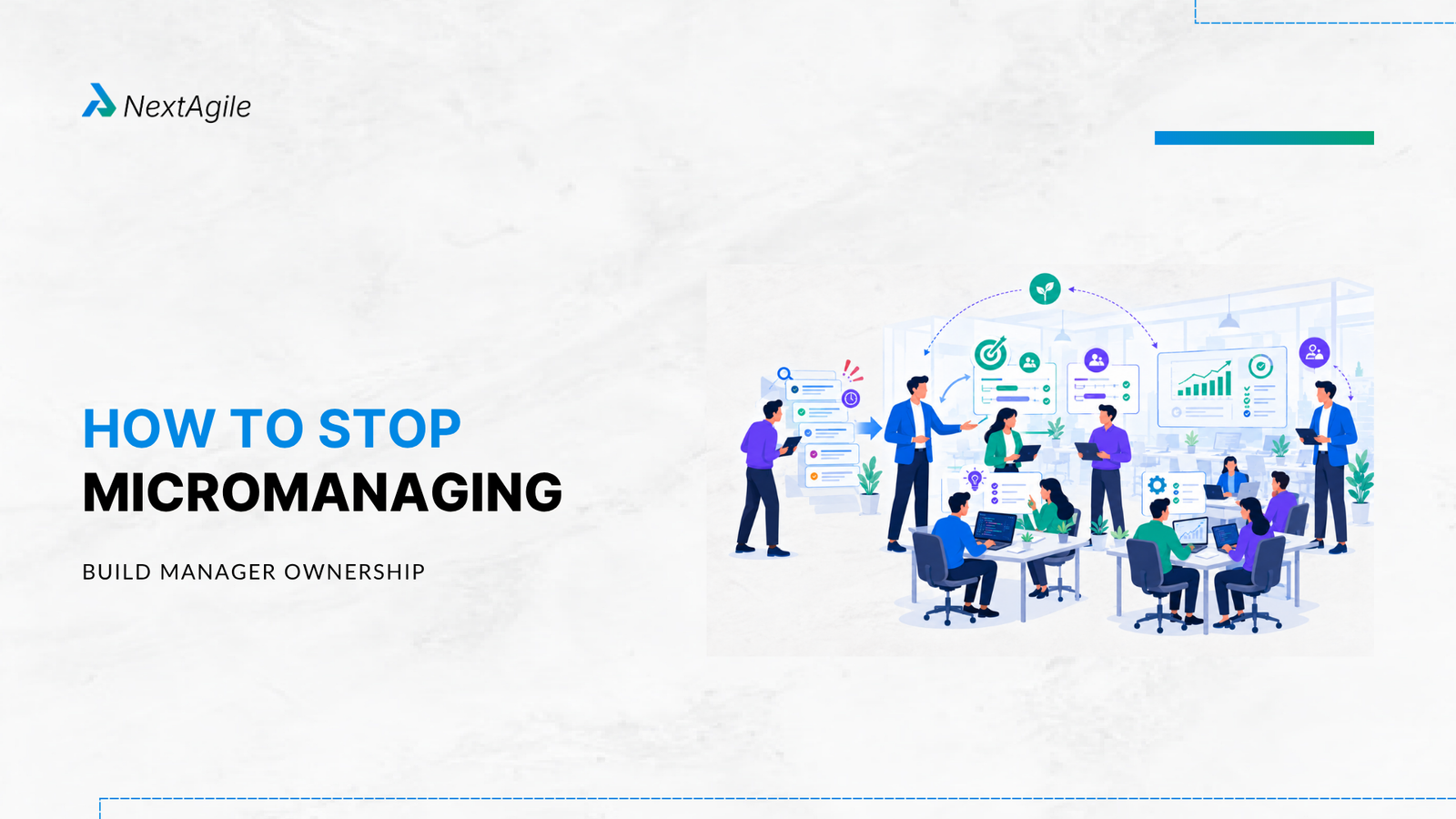
They decide what the strategy means for the team. They allocate resources. They make trade-offs. They resolve dependencies. They translate broad objectives into practical commitments. That makes the manager layer one of the most important parts of strategy implementation.
For more on this relationship, explore the role of middle management in execution .
Too Many Priorities and No Clear Trade-Offs One of the easiest ways to weaken execution is to make everything important.
A company may want faster growth, lower costs, better quality, stronger customer experience, more innovation, faster delivery, and higher employee engagement at the same time.
None of these goals are necessarily wrong. The problem begins when they compete for the same people and resources.
Managers need clear trade-offs.
If an urgent customer request conflicts with a strategic product initiative, what wins? If cost reduction threatens delivery speed, which outcome has priority? If a new executive request appears halfway through the quarter, which existing commitment should be removed? Without explicit answers, every manager makes their own interpretation. That creates inconsistent execution.
Good strategy requires prioritization. Good execution requires protecting those priorities long enough for teams to act on them, which is where a prioritization framework like RICE earns its place.
Strategy Never Reaches Weekly Team Commitments Annual strategy documents are too distant to manage daily execution. A strategic goal needs to move through several levels.
Strategic outcome becomes a quarterly priority. The quarterly priority becomes a team outcome. The team outcome becomes weekly commitments. Weekly commitments produce measurable progress.
Consider a goal to improve customer retention. The goal itself does not tell a team what to do this week.
A stronger execution translation might be to identify the highest-risk accounts, complete structured account reviews, resolve critical issues, and reduce response time within a defined period.
Now the strategy has become operational. This is where what OKRs are and how they work can provide useful structure.
The important point is that a framework cannot replace management judgment. Managers still need to decide what matters, what changes, and what the team should stop doing.
Managers Lack Ownership and Decision Authority A manager cannot reliably deliver an outcome they cannot influence. Yet many organizations create exactly this situation.
A manager owns delivery performance but cannot reallocate resources. A customer success leader owns retention but cannot approve reasonable customer exceptions. A functional head owns hiring but has limited influence over recruitment priorities. This creates accountability without control.
The solution is not automatically more training.
First, leaders need to clarify ownership and decision authority. Managers should know what they can decide independently, where they need consultation, and what genuinely requires escalation.
Once authority is clear, capability development becomes much more effective.
How to Close the Strategy Execution Gap Closing the strategy execution gap does not require another strategy document. It requires a stronger connection between strategic priorities and management routines, which is the core of what NextAgile’s Agile Consulting Services work through with leadership teams.
The objective is to make strategic progress visible in everyday work.
Three practices are especially important.
Translate Strategic Goals Into Weekly Commitments Start with the business outcome.
Then identify what must happen during the quarter to move that outcome.
Then determine what teams need to deliver this week.
A useful weekly commitment should be specific enough that progress can be observed.
Instead of saying improve customer experience, define a measurable operational commitment.
For example, reduce unresolved high-priority customer issues from five days to two days by the end of the quarter.
Now the manager can identify the work, assign responsibility, monitor progress, and intervene when execution starts moving off course.
The purpose is not to create more reporting. It is to make strategic progress visible.
Give Every Outcome One Clear Owner Shared accountability often sounds collaborative. It can also make accountability weaker, which is exactly the problem a RACI-style ownership model is designed to solve.
If five people are equally responsible for an outcome, it becomes difficult to determine who should act when progress stalls.
Assign one clear owner.
That person coordinates contributors, identifies risks, makes decisions within their authority, and escalates genuine barriers.
Other people can support the outcome. They can provide expertise, resources, or execution support. But one person should remain accountable for moving the outcome forward.
This creates a direct connection between ownership and execution, the same logic behind a working accountability framework .
Review Execution Without Constantly Changing Priorities Leadership needs a consistent execution review. The review should not become another status meeting.
The questions should be practical.
Are we moving toward the intended outcome? What has changed? What is blocking progress? Which decision is needed? What should happen next? Does the priority still matter? A stable management rhythm gives leaders visibility without forcing teams into constant reporting.
Leadership should also resist changing priorities whenever progress becomes uncomfortable.
Some initiatives need more time, better execution, or stronger decisions.
Changing direction every few weeks can create more damage than the original execution problem.
A Strategy to Execution Framework for Managers A practical way to close the gap is to manage the chain from intent to result.
Start with the strategic outcome. Define the few priorities that will materially influence it. Assign an owner to each priority. Translate the priority into team-level outcomes. Convert those outcomes into weekly commitments. Give managers the authority required to act. Review progress using a small set of meaningful measures. This creates a simple execution chain:
Strategic intent → Priority → Outcome → Owner → Weekly commitment → Measure → Review
If any link is missing, execution becomes weaker.
For example, a company may have a clear strategic objective and a strong quarterly plan. But if there is no owner, the plan remains collective responsibility.
If there is an owner but no authority, execution becomes dependent on escalation. If there is authority but no measure, leadership cannot tell whether progress is occurring.
The framework works because it addresses the practical points where strategy usually breaks.
Strategy Execution Example: When a Good Plan Failed by Quarter Two Consider a professional services company that wants to increase revenue from existing customers.
Leadership creates a strong plan.
The company will strengthen account relationships, identify expansion opportunities, improve executive engagement, and cross-sell selected services. The strategy looks convincing.
The first quarter begins.
Sales creates a campaign. Customer Success schedules account reviews. Marketing produces supporting material. Delivery prepares additional offerings. Everyone appears busy. By the second quarter, however, revenue has barely moved. The company initially assumes the strategy needs to change.
A closer review reveals something else.
Nobody owns the complete business outcome. Sales owns opportunities. Customer Success owns account health. Marketing owns campaign activity. Delivery owns utilization. Each team is managing its own work. No one is responsible for connecting those activities to the revenue outcome. The company changes the execution system.
One leader becomes accountable for the expansion outcome. The team identifies the highest-value accounts.
Weekly commitments are established and decision authority is clarified. Progress is reviewed against revenue and account-level indicators.
The strategy itself remains largely unchanged but the execution model changes.
Within the next quarter, leadership has a clearer view of what is working, where the bottlenecks are, and which decisions need intervention.
The lesson is important. When a strategy fails, do not immediately assume the strategy is wrong. First ask whether the organization actually created the conditions required to execute it.
Strategy Implementation Mistakes That Widen the Execution Gap One common mistake is treating communication as execution.
A leadership presentation can explain the strategy, it cannot create ownership. People need to understand how the strategy changes their priorities, decisions, and measures.
Another mistake is measuring activity instead of outcomes.
More meetings, more reports, more proposals, and more project tasks do not automatically mean strategic progress. Leadership needs to know whether the intended business result is moving.
A third mistake is creating too many initiatives.
Every initiative consumes attention, management capacity, and resources. When everything is a priority, teams struggle to determine what deserves protection.
A fourth mistake is adding new work without removing old work.
Managers are often told to deliver another strategic initiative while their existing workload remains unchanged.
This creates capacity problems that are later described as execution failures. If something new matters, leaders should decide what becomes less important.
A fifth mistake is escalating every problem upward.
Senior leaders should handle strategic choices, major risks, and structural barriers. They should not become the permanent solution for routine operational problems.
The final mistake is reviewing strategy too infrequently.
An annual strategy review is not enough to manage execution in a changing environment. Leaders need regular visibility into progress while maintaining enough stability for teams to deliver.
How to Measure the Strategy Execution Gap Execution should be measured through outcomes and operating signals, not just project activity.
Useful indicators include strategic initiative completion, milestone reliability, decision cycle time, priority changes, resource allocation, and achievement of strategic outcomes.
For example, if a strategic initiative repeatedly misses milestones, leadership should investigate the reason.
Is the scope unclear? Is ownership fragmented? Are dependencies unresolved? Does the manager lack authority? Are resources insufficient? Is leadership changing the priority? The metric identifies the symptom.
Management investigation identifies the cause. This is why execution measurement should not become a reporting exercise. The purpose is to improve decisions.
Organizations can also use measure execution with leadership metrics to connect execution behavior with measurable leadership outcomes.
When Strategy Execution Needs a Management System Some organizations try to solve execution problems through motivation.
They tell managers to move faster. They ask teams to take more ownership. They encourage employees to be more proactive. Those messages have value, but they rarely fix structural problems.
If priorities conflict, motivation will not create capacity. If decision authority is unclear, motivation will not create permission. If ownership is fragmented, motivation will not create accountability. If leadership changes direction every week, motivation will not create stability. Execution improves when the management system makes good execution easier. That means clear priorities, visible outcomes, decision authority, ownership, operating rhythms, and useful measures.
The behavior follows the system. This is especially important in organizations undergoing growth or transformation. As complexity increases, informal coordination becomes less reliable. The business needs stronger management mechanisms to keep strategy connected to execution, which is ultimately what it means to scale without losing control .
How Leadership Can Tell Whether the Gap Is Closing The first signs of improvement are often behavioral.
Teams can explain the current priorities without referring to a presentation. Managers make trade-offs without waiting for senior approval. Strategic initiatives have clear owners. Weekly commitments connect directly to quarterly outcomes. Leadership meetings focus on decisions and barriers rather than lengthy status updates. Teams understand what they should stop doing when priorities change. These changes should eventually appear in business results.
Initiatives move more reliably. Decision cycle times shorten. Milestone slippage decreases. Strategic outcomes improve. Senior leaders spend less time resolving operational issues. The important point is to look at both leading and lagging indicators. Business outcomes tell you whether the strategy is working. Execution signals tell you whether the organization is building the conditions required to achieve those outcomes.
Conclusion A good strategy can fail without ever being fundamentally wrong. The breakdown often happens after the strategy has been approved.
Priorities become diluted. Managers receive competing requests. Teams remain busy with work that does not directly advance strategic outcomes. Decisions move upward. By the second quarter, leadership concludes that the strategy did not work.
The real problem may have been the execution system.
Closing the strategy to execution gap requires a deliberate connection between strategic intent and weekly action.
Define fewer priorities. Translate them into measurable outcomes. Give every important outcome one clear owner. Give managers enough authority to influence what they own. Then create a consistent rhythm for reviewing progress without constantly changing direction.
Strategy should tell the organization where it is going. Execution should make that direction visible in the work happening every week.
When those two systems are connected, strategy stops being a presentation owned by leadership.
It becomes a set of choices that managers can translate, teams can act on, and the organization can measure. That is how good plans become business results.
If your organization struggles with stalled initiatives, shifting priorities, and a persistent strategy to execution gap, a structured execution approach becomes essential. NextAgile consulting can help you co-create and implement a practical strategy execution roadmap, drawing on our OKR consulting services and agile delivery experience, that connects leadership priorities with clear ownership and measurable outcomes. Do reach out to us at consult@nextagile.ai and we would be happy to explore more.
Frequently Asked Questions 1.What is the difference between strategy and execution? Strategy defines the direction and choices an organization makes to achieve a desired future outcome.
Execution converts those choices into coordinated actions, decisions, resource allocation, and measurable results.
Strategy answers where the organization is going and why.
Execution answers how the organization will move, who will act, and what progress should look like.
Both are necessary.
A strong strategy with weak execution produces limited results. Strong execution without strategic direction can produce efficient work that moves the organization in the wrong direction.
2.Why do most strategies fail even when they are well planned? Many strategies fail because they are not translated into clear priorities, ownership, decisions, resources, and management routines.
Teams may understand the strategic objective but remain unclear about what should change in their daily work.
Other problems include too many competing priorities, unclear accountability, weak decision authority, insufficient resources, and constant reprioritization.
The failure is therefore often found in strategy implementation rather than strategy design.
3.How do middle managers cause or close the execution gap? Middle managers can widen the gap when they allow competing priorities to reach their teams, avoid difficult trade-offs, or escalate routine decisions unnecessarily.
They can close it by translating strategic objectives into practical commitments, assigning ownership, making decisions within defined authority, and maintaining execution discipline.
The manager layer is critical because it connects executive direction with frontline action.
4.Are OKRs enough to close the strategy execution gap? No. OKRs can improve strategic alignment by connecting objectives with measurable outcomes.
They cannot solve unclear ownership, weak decision authority, poor management practices, insufficient capacity, or excessive priorities.
OKRs work best when supported by clear decision rights, regular execution reviews, capable managers, and a stable set of strategic priorities.
For organizations developing their OKR system, explore how to plan and cascade OKRs .
5.How often should leadership review strategic progress? Most organizations benefit from a regular monthly strategic review supported by more frequent operational execution reviews.
Weekly or biweekly reviews can focus on immediate commitments and blockers. Monthly reviews can examine strategic outcomes, risks, and major decisions. Quarterly reviews can assess whether the strategy and priorities remain appropriate. The frequency should provide visibility without creating excessive reporting overhead.
6.What is the first thing to fix when strategy execution keeps stalling? Start by identifying where the execution chain is breaking.
Ask whether teams understand the priorities, whether each outcome has one owner, whether managers have enough authority, whether resources match priorities, and whether leadership keeps changing direction.
Do not immediately create another strategy.
Find the point where strategic intent stops becoming coordinated action.
That is usually where the highest-value intervention should begin.
If your organization struggles with stalled initiatives, unclear ownership, and repeated execution breakdowns, NextAgile consulting can help you build a practical system for connecting strategy with measurable execution.
Sujith G. is an agile practitioner with expertise in setting up the agile environment by coaching and training teams, individuals and stakeholders in the area of lean agile software principles. He has overall 12+ years of exp out of which 9+ years have been in Agile and Scrum implementation and adoption. Sujith has coached 70+ teams on agile practices & implementation techniques and has extensive experience in setting up metrics, JIRA & Azure DevOps. Experienced in identifying gaps in the system, creating scrum awareness, piloting and scaling scrum.
 Skip to content