Generative AI is moving from an emerging technology topic to an increasingly relevant part of engineering education.
For universities, the challenge is not simply deciding whether to teach Gen AI. The harder question is how to integrate it into engineering curricula without creating another disconnected course, overwhelming faculty, or disrupting the existing academic structure.
A successful Gen AI curriculum needs more than a list of tools.
It needs:
Clear student competencies Relevant learning outcomes Faculty readiness A practical delivery model Hands-on learning Industry alignment Measurable assessment A structured path from pilot to scale This is where a Gen AI engineering curricula playbook becomes useful.
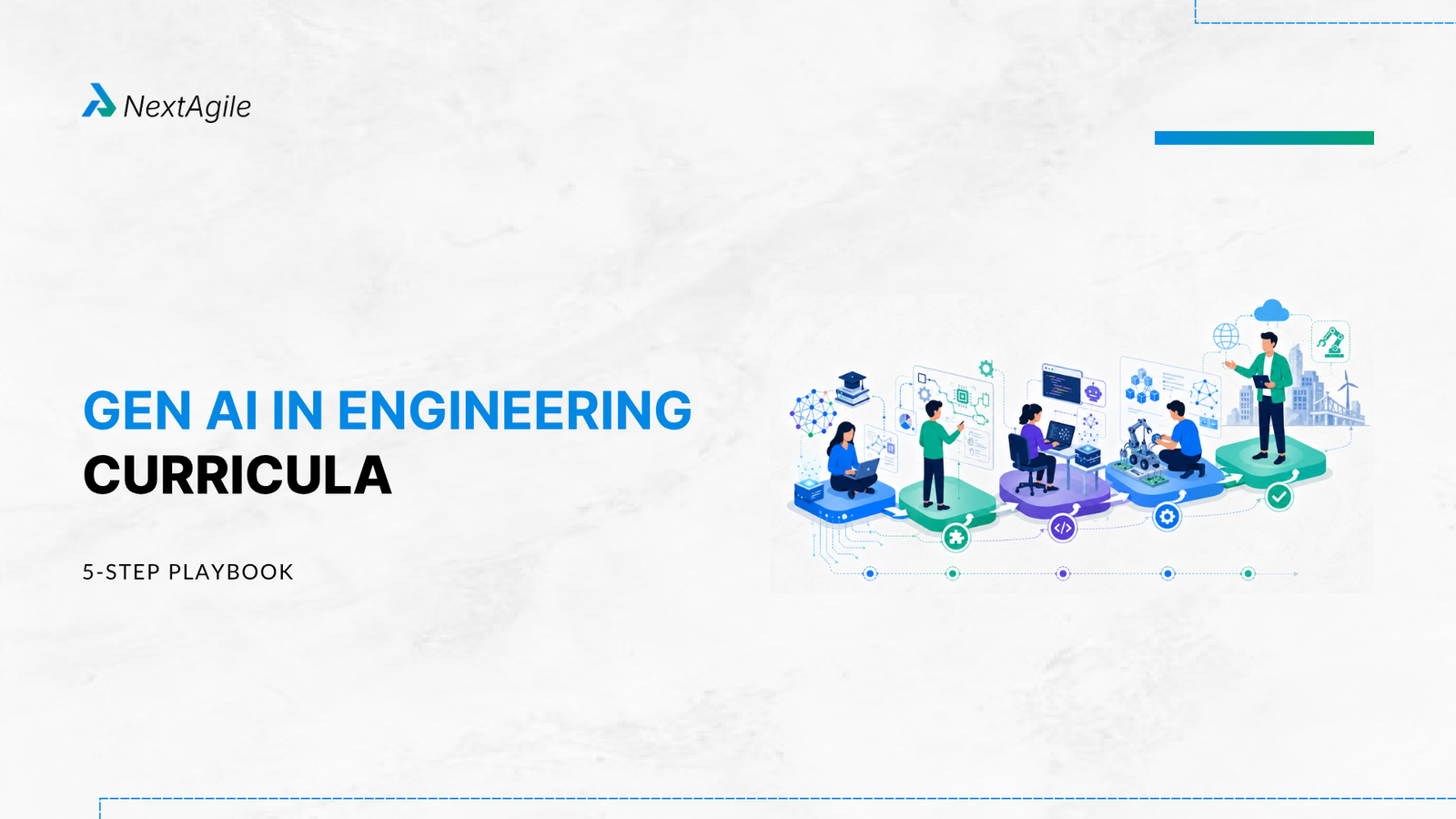
Rather than attempting a university-wide transformation immediately, institutions can follow a five-step implementation model:
ASSESS → DEFINE → CHOOSE → ENABLE → PILOT & SCALE
This approach helps universities understand their current readiness, determine what students should learn, choose the right delivery format, prepare faculty, and test the model before expanding it.
Quick Answer How can universities integrate Gen AI into engineering curricula?
Universities can integrate Gen AI into engineering curricula through a five-step process: assess institutional readiness, define student learning outcomes, choose an appropriate delivery model, train faculty, and run a measurable pilot before scaling.
The five Gen AI curriculum implementation steps are:
Assess Gen AI readiness across courses, labs, projects, faculty, infrastructure, and industry relationships. Define learning outcomes and program depth based on the Gen AI competencies students need. Choose the delivery model: standalone elective, embedded module, or industry-linked capstone/certification track. Train faculty before students so instructors can teach, guide, and assess practical Gen AI work. Pilot, measure, and scale using predefined success metrics and feedback. The objective is not to add Gen AI everywhere.
It is to introduce it where it improves engineering learning and prepares students for an AI-enabled workplace.
Key Highlights Gen AI curriculum implementation should begin with a readiness assessment, not a course purchase. Universities should first identify the Gen AI competencies for engineering students before deciding what content to teach. Not every institution needs a full-credit Gen AI course. An embedded module may be more appropriate in some programs. Faculty need practical experience with Gen AI before they can effectively teach and assess it. A focused Gen AI pilot program in higher education allows universities to test curriculum design, delivery, faculty readiness, and student engagement. Pilot metrics should measure capability and outcomes; not simply attendance or course completion. Industry input can help ensure Gen AI learning remains relevant to actual engineering roles. Successful pilots should scale through evidence, using clear criteria rather than enthusiasm alone. Introduction
Engineering curricula have always evolved in response to changes in technology and industry.
Programming became an essential part of many engineering programs. Cloud computing, data science, cybersecurity, automation, embedded systems, and other technologies subsequently found their way into courses, labs, electives, and projects.
Generative AI presents a similar curriculum challenge but with one important difference.
Gen AI can influence how students learn, how faculty teach, and how engineers perform technical work. Universities can approach this through structured Gen AI training programs that combine practical application, AI use-case design, integration, and responsible AI practices.
Students can use Gen AI for coding, research, documentation, analysis, brainstorming, debugging, and prototyping.
Faculty can use it to create examples, generate exercises, support learning, and explore new teaching methods.
Engineering organizations can use it across software development, documentation, knowledge management, research, analytics, customer support, and workflow automation.
This creates a larger question for universities: Should Gen AI be taught as a subject, integrated into existing subjects, or treated as a capability that cuts across the curriculum?
There is no universal answer.
The right approach depends on the university’s current curriculum, faculty capability, student profile, industry relationships, infrastructure, and academic objectives.
That is why implementation should begin with assessment and design; not with immediately adding another course.
Step 1 – Assess Your University’s Gen AI Readiness The first step is to understand where the university stands today.
A university Gen AI readiness assessment should look beyond whether the institution already offers an AI course.
The assessment should examine:
Existing AI and technology courses Programming and software engineering curricula Labs and infrastructure Student projects Capstone programs Faculty expertise Faculty development programs Industry partnerships Placement requirements Assessment methods Institutional policies Responsible AI considerations The goal is to identify both existing strengths and capability gaps.
A useful readiness assessment can classify the institution into three broad levels:
Readiness Level Characteristics Emerging Limited Gen AI exposure, few trained faculty, isolated student experimentation Developing Some AI courses, faculty interest, pilot projects, early industry engagement Ready to Pilot Faculty capability, suitable infrastructure, defined outcomes, project support, leadership sponsorship
The assessment should not become an administrative exercise.
Its purpose is to answer one practical question:
What can this university realistically implement now?
Audit Existing Courses, Labs, Projects, and Capstones How do you audit an engineering curriculum for AI readiness?
To audit an engineering curriculum for AI readiness, map existing courses, labs, projects, and capstones against relevant Gen AI capabilities. Identify where students already encounter AI-related concepts, where Gen AI can strengthen existing learning, and where important capabilities are missing.
Start with the existing curriculum rather than designing something entirely new.
For each course or academic activity, ask:
Does this course already use AI concepts? Could Gen AI improve a learning activity? Can students apply Gen AI to an existing lab? Could an existing project incorporate an AI component? Does the final-year project provide an opportunity for Gen AI application? Are students already using Gen AI informally? Can the activity produce an assessable Gen AI outcome? For example:
Existing Activity Potential Gen AI Integration Programming Lab AI-assisted coding, debugging, testing Software Engineering AI-assisted development lifecycle Database Systems Natural-language database interaction Data Analytics AI-assisted analysis and interpretation Technical Communication AI-assisted documentation Research Project AI-assisted literature exploration Final-Year Project Gen AI application or AI-enabled workflow Capstone Industry-linked Gen AI solution
This approach helps universities avoid unnecessary duplication.
A Gen AI module should complement the curriculum rather than simply repeat what students already learn.
Assess Faculty Readiness and Training Needs How should universities assess faculty readiness for Gen AI?
Universities should assess faculty readiness across three areas: conceptual understanding, hands-on capability, and teaching/assessment ability. Faculty should understand relevant Gen AI concepts, use the technology practically, and know how to design learning activities and assess student work.
Faculty readiness is often the hidden constraint in curriculum transformation.
A university may have a strong curriculum design and excellent infrastructure, but implementation can still struggle if instructors are not comfortable teaching Gen AI.
A faculty readiness assessment can examine:
Conceptual readiness
Understanding of Gen AI Understanding of LLMs Awareness of limitations Responsible AI knowledge Practical readiness
Prompt engineering AI-assisted development Gen AI application building RAG and retrieval AI workflows Evaluation Teaching readiness
Designing practical labs Creating assignments Evaluating AI-assisted work Preventing inappropriate AI use Guiding student projects This assessment can then determine the appropriate faculty training Gen AI program.
Not every faculty member needs to become an AI engineer.
But faculty responsible for Gen AI learning should be sufficiently confident to:
Teach → Demonstrate → Guide → Assess
Step 2 – Define Learning Outcomes and Program Depth Once institutional readiness is understood, the next step is deciding what students should actually learn.
This is where many curriculum initiatives go wrong.
Institutions sometimes begin with, “Which Gen AI topics should we teach?”
A better question is, “What should students be able to do with Gen AI after completing the program?”
This changes curriculum design from content coverage to capability development.
Define the Core Gen AI Competencies Students Should Develop What are the core Gen AI competencies for engineering students?
Core Gen AI competencies for engineering students should include AI fundamentals, prompt engineering, AI-assisted problem-solving, application development, evaluation, responsible AI, and the ability to explain technical decisions. Advanced programs can add RAG, agents, APIs, AI workflows, and deployment considerations.
A practical competency framework can include six layers.
Gen AI foundations Students understand:
Generative AI Large language models Context and tokens Model capabilities Model limitations Prompt and context engineering Students can:
Design effective prompts Provide relevant context Structure outputs Break complex tasks into steps Iterate based on results AI-assisted engineering Students can use Gen AI for:
Coding Debugging Testing Documentation Research Analysis Prototyping Gen AI application development Students can work with:
APIs Embeddings RAG Vector search Tool calling AI workflows Agents Evaluation and reliability Students can:
Test outputs Identify hallucinations Evaluate retrieval quality Detect failure modes Apply appropriate safeguards Engineering judgment Students can decide:
Whether Gen AI is appropriate Which workflow to use What should remain human-controlled How the system should be evaluated What limitations need to be communicated These competencies provide a foundation for designing meaningful Gen AI learning outcomes in engineering.
Universities can also benchmark their competency design against UNESCO’s AI competency frameworks for students and teachers , which provide broader guidance on the knowledge, skills, and human-centred capabilities needed in AI-enabled education.
Choose the Right Depth: Awareness Module vs. Full-Credit Course Should Gen AI be an awareness module or a full-credit course?
The choice depends on the desired student outcome. An awareness module is appropriate when the goal is broad Gen AI literacy, while a full-credit course is better when students need to build applications, understand technical architecture, evaluate AI systems, and complete substantial projects.
The decision should be based on:
Student year Engineering branch Existing curriculum Faculty capability Available hours Industry requirements Desired competency level A simple framework is:
Format Primary Objective Typical Depth Awareness Module AI literacy Basic Embedded Module Applied Gen AI Basic–Intermediate Elective Technical capability Intermediate–Advanced Full-Credit Course Deep application Advanced Capstone Industry application Advanced
This also helps universities make an informed decision around Gen AI elective vs embedded module.
An awareness module might teach:
Understand → Experiment → Apply
A technical elective might extend this to:
Understand → Design → Build → Evaluate
For advanced cohorts, the curriculum can move toward application development, integration, and deployment through an advanced Generative AI developer training program .
An advanced capstone can move further:
Understand → Design → Build → Integrate → Evaluate → Demonstrate
The program depth should match the expected graduate capability.
Translate Outcomes Into Assessable Student Work How should Gen AI learning outcomes be assessed?
Gen AI learning outcomes should be translated into observable student work such as projects, demonstrations, technical reports, prompt evaluations, application prototypes, architecture diagrams, and oral defenses. Assessment should focus on what students can do rather than only what they can recall.
For example:
Learning outcome: “Students can design effective prompts.” Assessable work: Students create a prompt workflow, test multiple versions, compare outputs, and explain why the final version performs better. Learning outcome: “Students can build a RAG application.” Assessable work: Students create a document-grounded application, demonstrate retrieval, test responses, and explain failure cases. Learning outcome: “Students understand responsible AI.” Assessable work: Students identify relevant risks in their application and propose appropriate safeguards. This creates alignment between:
Learning Outcome → Learning Activity → Assessment → Evidence
That alignment should exist before the curriculum goes into delivery.
Step 3 – Choose the Right Delivery Model Once outcomes are defined, universities need to determine how Gen AI will actually be delivered.
There are three practical models:
Standalone Gen AI Elective Embedded Gen AI Modules Industry-Linked Capstone or Certification Track There is no requirement for every university to choose the same model. The delivery model should follow the desired outcome.
Standalone Gen AI Elective A standalone elective provides students with concentrated exposure to Gen AI.
A possible progression is:
Gen AI Foundations → Prompt Engineering → Application Development → RAG → Agents → Evaluation → Capstone
This model works particularly well for:
Students specializing in AI Final-year students Students targeting software and technology roles Advanced engineering cohorts Its biggest advantage is depth.
Its limitation is reach.
Students who do not select the elective may receive little exposure.
Embedded Gen AI Modules Across Existing Courses An embedded approach places Gen AI inside existing engineering courses.
For example:
Programming – AI-assisted coding and debugging. Software Engineering – AI-assisted requirements, development, testing, and documentation. Database Systems – Natural-language interaction with structured data. Data Analytics – AI-assisted analysis and interpretation. Technical Communication – AI-assisted documentation and review. Final-Year Projects – Gen AI-enabled features or workflows. This approach has an important advantage: Students learn Gen AI in context.
Instead of treating Gen AI as a separate technology, they see how it applies to different engineering problems.
For universities seeking broad exposure, this can be more scalable than a standalone course.
Industry-Linked Capstone or Certification Track An industry-linked capstone can provide the strongest connection between curriculum and workplace application.
Students work on realistic problems such as:
Knowledge assistants Technical documentation systems Domain-specific RAG applications AI-enabled analytics Workflow automation Coding assistants Research assistants Customer-support copilots An industry-linked capstone program in AI can involve:
Industry Problem → Student Team → Faculty Mentor → Gen AI Solution → Evaluation → Demonstration
This creates multiple learning outcomes simultaneously:
Technical skills Problem-solving Collaboration Communication Project management AI evaluation Industry awareness A certification track can complement the capstone, but certification should not replace demonstrable project capability.
Step 4 – Train Faculty Before Students A common implementation mistake is to launch student training before developing faculty capability.
If faculty members are expected to teach, mentor, and assess Gen AI projects, they need hands-on exposure before the student program begins.
This does not mean every faculty member needs to become an advanced AI engineer.
The training should be role-specific.
Faculty should understand:
What Gen AI can and cannot do How students can use it responsibly How to design practical assignments How to evaluate AI-assisted work How to mentor Gen AI projects How to identify weak or fabricated AI outputs How to connect Gen AI to their subject area What Faculty Need to Teach, Practice, and Assess What should faculty learn before teaching Gen AI?
Faculty should develop three capabilities: the ability to teach Gen AI concepts, the ability to practice Gen AI through hands-on exercises, and the ability to assess student work. Training should therefore combine conceptual learning with practical labs and project mentoring.
A useful faculty enablement model is:
Learn → Practice → Design → Mentor → Assess
Learn – Understand Gen AI foundations, models, prompting, workflows, risks, and limitations. Practice – Use Gen AI tools to complete realistic engineering tasks. Design – Create labs, assignments, projects, and assessments. Mentor – Guide students through practical Gen AI projects. Assess – Evaluate both AI-generated output and the student’s own engineering contribution. Faculty training should also address a question that becomes increasingly important as AI enters classrooms:
How do we assess student capability when students can use AI during the learning process?
The answer is not necessarily to prohibit AI.
Instead, assessment can emphasize:
Process Reasoning Iteration Demonstration Oral defense Technical explanation Version history Evaluation Reflection This makes assessment more resilient in an AI-enabled learning environment.
Step 5 – Pilot, Measure, and Scale A pilot provides a controlled way to test curriculum assumptions before committing significant institutional resources.
The goal is not simply to prove that students enjoy Gen AI.
The goal is to determine whether the program produces the intended learning outcomes and can be delivered sustainably.
A strong Gen AI pilot program in higher education should have:
Defined scope Defined cohort Defined duration Faculty ownership Learning outcomes Practical projects Assessment criteria Success metrics Feedback mechanisms Scale-up criteria Define the Pilot Scope and Cohort How should a university define a Gen AI curriculum pilot?
A university should define a pilot around a specific student cohort, academic objective, duration, delivery model, faculty team, and project scope. Starting with a manageable cohort makes it easier to identify curriculum, faculty, infrastructure, and assessment issues before scaling.
A pilot might involve:
One department One semester One year group 30–60 students A selected faculty team 20–40 hours of structured learning Practical labs One final project The exact numbers can vary.
What matters is that the pilot is small enough to manage and large enough to produce meaningful evidence.
A useful pilot structure might be:
Phase 1: Baseline Assessment
Measure existing Gen AI knowledge and confidence.
Phase 2: Faculty Preparation
Train faculty and finalize learning materials.
Phase 3: Student Learning
Deliver concepts and practical labs.
Phase 4: Project Development
Students apply their learning to a realistic problem.
Phase 5: Demonstration and Evaluation
Students present their solutions against predefined criteria.
Phase 6: Review
Faculty, students, and industry stakeholders provide feedback.
Establish Pilot Success Metrics How should universities measure Gen AI curriculum pilot success?
Universities should measure pilot success using a combination of learning outcomes, project quality, faculty readiness, student engagement, assessment performance, and stakeholder feedback. Attendance and completion rates can be tracked, but they should not be the primary indicators of capability.
Useful pilot success metrics include:
Metric What It Measures Pre/post assessment Knowledge and capability growth Project completion Ability to apply learning Project quality Technical capability Evaluation quality AI reliability awareness Faculty readiness Delivery sustainability Student feedback Learning experience Portfolio quality Demonstrable capability Industry feedback Workplace relevance Faculty workload Scalability Adoption interest Institutional demand
This gives universities a multidimensional view of the pilot.
For example, high student satisfaction with weak project outcomes indicates a different problem from strong project outcomes with unsustainable faculty workload.
Both matter.
Build a Feedback Loop and Define Scale-Up Criteria When should a university scale a Gen AI curriculum pilot?
A university should scale a Gen AI curriculum pilot when students demonstrate the intended competencies, faculty can deliver the program sustainably, projects meet quality expectations, and stakeholders see sufficient value to justify expansion. Scale-up criteria should be defined before the pilot begins.
A feedback loop can involve four groups:
Students
What worked? What was difficult? What skills improved?
Faculty
What was teachable? What required more support? What created workload?
Industry
Are the projects and competencies relevant to workplace expectations?
Academic Leadership
Can the model be integrated sustainably?
The university can then establish scale-up gates such as:
Learning outcomes achieved Minimum project quality achieved Faculty readiness achieved Student participation sustained Industry relevance validated Delivery model proven Resource requirements understood Only after these criteria are met should the university expand the program.
Why Industry Demand Is Driving Gen AI Adoption in Engineering Curricula The reason universities are reconsidering Gen AI is not simply that the technology is popular.
The deeper issue is the changing nature of engineering work.
Engineers increasingly work alongside AI-enabled tools for:
Software development Research Documentation Analysis Automation Knowledge retrieval Prototyping Testing Communication This creates a new layer of employability.
A graduate may still need strong programming skills.
But they may also need to know how to use AI to accelerate coding, review generated code, create tests, retrieve technical knowledge, or build AI-enabled features.
A data-oriented graduate may need traditional statistics and analytical skills while also using Gen AI interfaces and AI-assisted workflows.
A non-software engineer may encounter AI through documentation, technical research, automation, analytics, or domain-specific applications.
This is why the AI skills gap among engineering graduates is becoming a curriculum consideration.
However, universities should avoid responding with a technology checklist.
The goal should not be: “Students must learn every new AI tool.”
The goal should be: “Students must develop durable competencies that allow them to work effectively in AI-enabled engineering environments.”
Those durable capabilities include:
Problem framing Prompt and context engineering AI-assisted problem-solving Application integration Evaluation Critical thinking Responsible AI Communication Engineering judgment Tools will change.
The underlying competencies will remain more durable. At the institutional level, this shift is part of a broader AI digital transformation effort, where technology adoption needs to be connected with operating models, people, capabilities, and measurable outcomes.
How NextAgile Supports Gen AI Curriculum Implementation Implementing Gen AI across an engineering curriculum requires more than delivering technical content.
Universities need support across curriculum design, faculty enablement, hands-on learning, project development, and industry alignment. NextAgile learning programs are designed around turning knowledge into practical capability and measurable outcomes.
NextAgile’s approach focuses on creating a practical pathway from curriculum planning to demonstrable student capability.
Curriculum and Program Design The first requirement is a clear curriculum architecture.
NextAgile can support universities in defining:
Gen AI competency frameworks Program learning outcomes Module structures Lab activities Project pathways Assessment frameworks Elective structures Embedded learning models Capstone designs The objective is to ensure that content, activities, and assessment work together.
A useful design progression is:
FOUNDATIONS → PRACTICE → BUILD → INTEGRATE → EVALUATE → DEMONSTRATE
This helps universities move away from content-heavy AI programs toward capability-oriented learning.
Faculty Enablement and Hands-On Learning Faculty capability is central to sustainable implementation.
A faculty training Gen AI program should therefore include hands-on learning rather than only presentations.
Faculty can work through:
Gen AI foundations Prompt engineering AI-assisted engineering Application development RAG AI workflows Evaluation Responsible AI Practical project design The objective is to help faculty move from:
“I understand Gen AI.”
to:
“I can teach, demonstrate, mentor, and assess Gen AI.”
This distinction is critical when universities want to scale beyond an externally delivered workshop.
Industry-Relevant Delivery and Projects Curriculum relevance improves when students work on problems that resemble actual engineering work.
NextAgile’s delivery approach can connect learning with:
DISCOVER → DESIGN → BUILD → INTEGRATE → DEPLOY → OPERATE → HAND OVER
Students can therefore move from understanding a problem to building and explaining a solution.
Industry-relevant projects can include:
Knowledge assistants RAG applications AI-enabled workflow automation Research assistants Technical documentation systems AI-assisted development tools Domain-specific copilots Agentic workflows The focus remains on engineering capability.
Students should be able to explain:
Why they selected Gen AI How they designed the solution How they built it How they evaluated it What can go wrong What limitations remain How they would improve it For universities, this creates a stronger connection between:
Curriculum → Faculty Capability → Student Projects → Industry Skills → Employability
Conclusion Gen AI curriculum implementation is not primarily a technology problem.
It is a curriculum design, faculty capability, delivery, assessment, and change-management problem.
Universities that approach it as simply “adding a Gen AI course” may create another isolated subject without solving the larger AI skills gap.
A more sustainable approach is to follow a structured five-step playbook:
ASSESS Understand university, curriculum, faculty, and infrastructure readiness. DEFINE Identify the Gen AI competencies and learning outcomes students need. CHOOSE Select the right delivery model: elective, embedded module, or industry-linked capstone. ENABLE Train faculty before expecting them to teach and assess Gen AI. PILOT & SCALE Run a focused pilot, measure outcomes, gather feedback, and scale based on evidence. The objective is not maximum Gen AI coverage.
It is meaningful Gen AI capability.
A successful engineering curriculum should help students understand the technology, use it responsibly, build with it, evaluate it critically, and apply it to real engineering problems.
That is how universities can move from AI awareness to AI readiness; without having to redesign the entire academic system overnight.
If your university is exploring how to integrate Gen AI into engineering curricula without disrupting existing academic structures, a practical implementation roadmap can make the transition more effective. NextAgile can help you assess curriculum readiness, define Gen AI learning outcomes, enable faculty, design focused pilots, and build an industry-aligned delivery model. Do reach out to us at consult@nextagile.ai , and we would be happy to explore how to build a practical Gen AI curriculum roadmap for your institution.
FAQs 1. How long does it take to move from assessment to a Gen AI pilot? A university can typically move from readiness assessment to a Gen AI pilot within one academic planning cycle, depending on curriculum approvals, faculty availability, and the scope of the pilot.
A practical sequence is: Readiness Assessment → Curriculum Design → Faculty Training → Pilot Preparation → Student Delivery
A focused pilot can often be designed faster than a full-credit course because it requires fewer curriculum changes.
The timeline depends on factors such as:
Academic approval processes Faculty availability Existing AI courses Student cohort Training requirements Infrastructure Assessment design The important point is to avoid rushing directly into delivery.
A short but structured planning phase can prevent larger implementation problems later.
2. Should a Gen AI curriculum pilot be graded or ungraded? A Gen AI curriculum pilot can be graded or ungraded depending on its purpose, but graded projects are generally more useful when the objective is to measure student competency and inform future curriculum decisions.
An ungraded pilot can work well when the primary objective is:
Awareness Experimentation Student engagement Early adoption A graded pilot is more appropriate when the university wants to measure:
Learning outcomes Technical capability Project quality Evaluation skills Student performance A hybrid approach can also work.
For example: Learning activities → Low-stakes assessment
Capstone → Graded project
This provides both experimentation and measurable evidence.
3. How should universities measure pilot success? Universities should measure pilot success using learning outcomes, project quality, student capability, faculty readiness, student feedback, industry relevance, and delivery sustainability.
Useful measures include:
Pre- and post-program assessments Project completion rates Project quality Technical demonstrations Evaluation capability Student feedback Faculty feedback Industry feedback Faculty workload Student portfolio quality The best pilot success metrics for AI curriculum should answer three questions:
Did students learn? Can students demonstrate the skills? Can the university deliver the model sustainably? 4. Who should own Gen AI curriculum implementation? Gen AI curriculum implementation should be jointly owned by academic leadership, departments, faculty, curriculum teams, and placement or industry-engagement stakeholders.
A useful ownership model is:
Stakeholder Primary Responsibility Academic Leadership Strategic direction and sponsorship Dean/HOD Department implementation Faculty Teaching, mentoring, assessment Curriculum Team Course and outcome alignment Placement Team Recruiter expectations Industry Partners Workplace relevance Students Learning and project development External Partner Specialized expertise and enablement
One team should coordinate the implementation, but successful adoption requires cross-functional ownership.
If Gen AI is treated only as an IT initiative, curriculum and placement considerations may be missed.
If it is treated only as a faculty initiative, institutional scalability may become difficult.
5. How much faculty training is needed before launch? The amount of faculty training required depends on the delivery model and the level of Gen AI students are expected to achieve.
An awareness module may require limited faculty preparation.
A practical Gen AI elective requires deeper capability.
An advanced application-development or capstone program requires faculty who can mentor projects and evaluate technical implementation.
A useful progression is:
Awareness → Hands-On Practice → Teaching Design → Project Mentoring → Assessment
Faculty should be confident enough to demonstrate the technology, guide students through common problems, evaluate project quality, and explain Gen AI limitations.
Training should therefore prioritize hands-on experience over presentation-only sessions.
6. Can Gen AI be integrated without adding a new standalone course? Yes. Gen AI can be integrated into engineering curricula through embedded modules, existing labs, assignments, projects, capstones, and faculty development without creating a new standalone course.
For example:
Programming → AI-assisted coding Software Engineering → AI-assisted development Data Analytics → AI-assisted analysis Technical Communication → AI-assisted documentation Research → AI-assisted information synthesis Final-Year Project → Gen AI feature or workflow This approach can be particularly effective for universities that have limited timetable flexibility.
The key is to define clear Gen AI learning outcomes for engineering students and connect them to existing academic activities.
Gen AI does not necessarily need its own box in the curriculum.
In many cases, it can become a capability layer that strengthens the boxes already there.
This version is built to target featured snippets, People Also Ask queries, and long-tail implementation searches while keeping the article useful for university decision-makers. The strongest snippet targets are the opening Quick Answer, the “How” questions under each implementation step, the delivery-model comparison, pilot metrics, and the FAQ section.
Rahul seasoned technology leader with 20+ years of experience, now dedicated to mentoring and training individuals and groups in Generative AI, advanced AI/ML system design, and production best practices. He is a hands-on tech entrepreneur and has deep industry experience in building cutting-edge AI products.
 Skip to content