Growing businesses often believe they have a people problem when they actually have a process problem.
A sales follow-up is missed because someone forgot. Customer onboarding is delayed because one approval is still pending. Purchase requests sit in inboxes waiting for reminders. Managers spend their day asking for updates instead of solving strategic problems.
Over time, reminders become the operating system of the business.
If the founder, manager, or team lead has to constantly ask, “Has this been done yet?”, the business is relying on memory instead of process. While this may work in a small team, it quickly becomes unsustainable as the organization grows.
This is where Business Process Management (BPM) becomes essential.
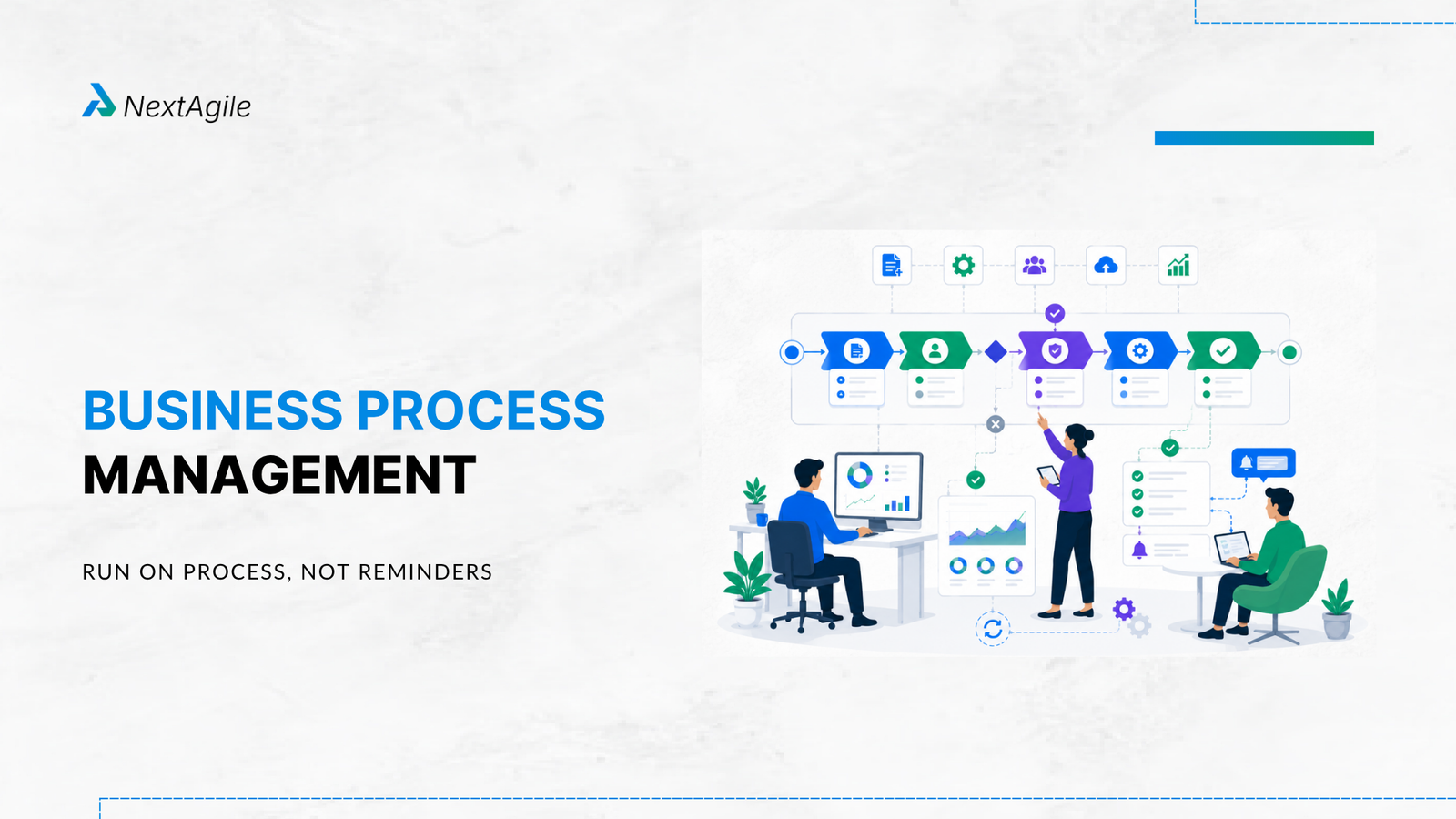
Business Process Management is not simply about documenting workflows or implementing software. It is a disciplined approach to designing, managing, improving, and optimizing the way work gets done. Instead of depending on individuals to remember every task, BPM creates repeatable systems that deliver consistent outcomes.
Organizations with mature business processes experience fewer delays, better collaboration, improved operational efficiency, and faster decision-making because responsibilities, workflows, and accountability are clearly defined.
Whether you’re leading a startup, a scaling business, or an established enterprise, Business Process Management helps create an organization that runs on well-designed systems rather than constant follow-ups.
In this guide, you’ll learn what Business Process Management is, why it matters, how the BPM lifecycle works, and a practical framework for building a business that runs on process instead of reminders.
Key Highlights of Business Process Management Business Process Management (BPM) creates repeatable systems that reduce dependence on manual follow-ups. Strong processes improve operational efficiency, accountability, and execution across teams. A process should be standardized before it is automated. Business process mapping helps identify delays, handoffs, and process bottlenecks. Every critical process should have a clearly defined owner and measurable KPIs. The BPM lifecycle consists of Design, Model, Execute, Monitor, and Optimize. Standard Operating Procedures (SOPs) document work, while BPM continuously manages and improves it. Continuous improvement ensures business processes evolve as the organization grows. Introduction As businesses grow, complexity increases faster than most leaders anticipate.
New employees join the organization. Customers expect faster responses. Departments become more specialized. Projects involve multiple teams. Yet many organizations continue operating with the same informal practices they used when they had ten employees.
Managers remind people to complete tasks. Founders follow up on approvals. Team members rely on chat messages to track commitments. Important work progresses only because someone remembers to ask about it. This approach may feel manageable initially, but it eventually creates hidden costs.
Managers spend more time chasing updates than improving performance.
Employees become dependent on reminders instead of taking ownership.
Customers experience inconsistent service because processes vary from one person to another.
As the business expands, these small inefficiencies multiply into significant execution problems.
This is precisely why Business Process Management has become a strategic capability rather than simply an operational improvement initiative.
BPM enables organizations to move from reactive management to proactive execution.
Instead of asking people to remember every step, businesses create systems that define how work flows, who owns each activity, when decisions should be made, and how performance is measured.
The result is a business that delivers consistent outcomes regardless of who performs the work.
Companies that successfully scale understand that sustainable growth depends less on individual effort and more on repeatable business systems.
Organizations scaling rapidly often discover that systems not additional managers create sustainable growth. Learn practical strategies in our guide on How to Scale a Business Without Losing Control of Execution .
That’s why Business Process Management plays a critical role in improving execution, reducing operational risk, and building organizations that can grow without becoming increasingly dependent on founders or managers.
What Is Business Process Management (BPM)? Business Process Management (BPM) is a structured approach to designing, executing, monitoring, and continuously improving the processes that drive business operations.
Rather than viewing work as isolated tasks performed by individuals, BPM looks at the complete workflow from beginning to end.
It focuses on questions such as:
How does work move through the organization? Where do delays occur? Who owns each decision? Which activities add value? Which steps create unnecessary complexity? By answering these questions, organizations create standardized processes that improve consistency, quality, and speed.
A simple example illustrates this well.
Consider a customer onboarding process.
Without BPM:
Sales closes the deal. Customer Success waits for an email. Finance sends invoices separately. Technical teams receive incomplete information. Customers experience delays because nobody owns the complete workflow. With Business Process Management:
Every activity follows a predefined workflow. Responsibilities are clearly assigned. Handoffs happen automatically. Progress is visible. Exceptions are managed systematically. Instead of depending on individual memory, the business relies on a repeatable process.
This is the core purpose of Business Process Management.
It ensures that business outcomes remain consistent even as teams grow and operations become more complex.
Unlike one-time process improvement projects, BPM is an ongoing management discipline.
Processes are continuously reviewed, refined, and optimized as business needs evolve.
Why Business Process Management matters for growing businesses Small businesses often succeed because communication is simple.
The founder knows every employee. Everyone understands priorities. Questions are answered immediately. Processes remain largely informal. Growth changes this dynamic.
As teams expand, informal communication becomes increasingly unreliable. More departments create more handoffs. More customers create more operational complexity. More managers create more decision points. Without structured processes, execution begins slowing down.
Several common symptoms start appearing:
Teams duplicate work. Approvals take longer than necessary. Customer requests fall through the cracks. Different employees complete the same task differently. Managers spend increasing amounts of time coordinating instead of leading. These issues are rarely caused by poor employee performance. More often, they indicate weak business processes.
Business Process Management addresses these problems by creating clarity around how work should flow across the organization.
Many organizations first redesign their operating model before improving individual processes. Our Business Transformation Consulting Services help businesses align processes, people, and governance to support sustainable execution.
For example, instead of relying on managers to manually coordinate every project, BPM defines:
Standard workflows Decision points Approval rules Ownership responsibilities Performance measures As a result, execution becomes more predictable.
This is particularly valuable for organizations focused on operational efficiency , where reducing delays and improving consistency directly impacts customer satisfaction and profitability.
BPM also supports long-term scalability. Businesses looking to redesign end-to-end workflows often combine BPM with Value Stream Mapping Consulting Services to identify bottlenecks, reduce waiting time, and improve flow across departments. When work depends on individual knowledge, businesses struggle whenever experienced employees leave or new team members join.
Documented and standardized processes reduce this dependency by making work repeatable and easier to transfer.
This is closely connected to removing founder dependency from daily operations . Businesses that rely on documented processes instead of constant founder involvement are far better equipped to scale sustainably.
Similarly, organizations interested in scaling a business without losing control of execution often discover that strong process management creates the operational discipline needed to maintain quality while growing.
In short, Business Process Management is not about adding bureaucracy.
It is about creating clarity.
When people understand how work flows, who owns decisions, and how success is measured, they spend less time coordinating and more time creating value.
Reminders vs Process: Why Businesses Need Systems Instead of Follow-Ups One of the clearest indicators of operational maturity is how work gets completed. In some organizations, progress depends on reminders. In others, it depends on systems.
The difference is significant.
A reminder-driven business requires constant intervention.
Managers send messages asking for updates. Founders chase approvals. Employees follow up repeatedly to keep projects moving. Every deadline depends on someone remembering to ask. A process-driven business works differently.
Responsibilities are defined before work begins. Triggers move work automatically from one stage to the next. Everyone understands their role. Performance is visible without requiring constant follow-up. Managers focus on removing obstacles instead of reminding people to do their jobs. The distinction may appear small, but its impact on execution is enormous.
The hidden cost of running a business on reminders Many organizations underestimate the true cost of reminder-based management because the problems appear manageable in isolation.
A missed follow-up here.
A delayed approval there.
Another meeting scheduled simply to check progress.
Over time, these small inefficiencies accumulate into significant operational waste.
Some of the most common consequences include:
Slower decision-making When every decision requires multiple reminders, projects move far more slowly than necessary.
Higher management overhead Managers spend valuable time tracking work instead of improving processes or coaching teams.
Increased dependency on individuals Critical knowledge remains with experienced employees rather than becoming part of the organization’s operating system.
Inconsistent customer experience Without standardized workflows, outcomes vary depending on who performs the work.
More process bottlenecks Work accumulates at approval stages because ownership and priorities remain unclear.
Ironically, businesses often respond by increasing meetings, sending more reminders, or hiring additional coordinators.
These solutions address the symptoms rather than the underlying process design.
What a process-driven business looks like A process-driven organization operates with clarity rather than constant supervision.
Instead of relying on memory, it relies on defined workflows.
Its characteristics include:
Reminder-Driven Business Process-Driven Business Managers chase updates Processes trigger the next action Tasks depend on memory Work follows documented workflows Ownership changes frequently Every process has a defined owner Delays discovered late Performance is monitored continuously Employees rely on follow-ups Employees understand standard operating procedures Problems repeat regularly Continuous improvement eliminates recurring issues
Notice that process-driven organizations are not necessarily more rigid.
In fact, they often become more adaptable because everyone understands the baseline process.
Improvements can be introduced systematically instead of creating confusion.
This mindset also supports broader organizational initiatives such as management rhythm , where consistent operating cadences reinforce execution, and organizational structure for growth , where clearly defined responsibilities reduce duplication and improve accountability.
Ultimately, the goal of Business Process Management is not to eliminate human judgment.
It is to eliminate unnecessary dependence on human memory.
When processes become the engine of execution, leaders stop acting as reminder systems and start focusing on what matters most, that is improving the business itself.
SOP vs BPM: Understanding the Difference Many organizations use SOP for business and Business Process Management interchangeably, but they are not the same.
Standard Operating Procedures (SOPs) describe how a specific task should be performed. They provide step-by-step instructions to ensure consistency.
Business Process Management, on the other hand, manages the entire workflow from end to end and continuously improves it.
SOP BPM Documents a task Manages the complete process Static instructions Continuous improvement discipline Focuses on consistency Focuses on performance and outcomes Usually owned by a team Owned by a process owner Updated occasionally Monitored and optimized regularly
Think of SOPs as one component of BPM.
For example, a customer onboarding process may include SOPs for contract creation, account setup, and training delivery. BPM coordinates all of these activities, measures overall onboarding time, identifies bottlenecks, and drives improvement across the entire workflow.
Organizations need both: standard operating procedures for consistency and BPM for end-to-end process performance.
Common Examples of Business Processes You Should Manage The best place to start with BPM is the processes that directly affect customers, revenue, compliance, or employee productivity. Below are some of the most common business process management examples.
Sales A sales process should define how leads are captured, qualified, assigned, followed up, and converted.
Typical KPIs include:
Lead response time Conversion rate Proposal turnaround time Sales cycle length Without a standardized process, opportunities are often lost because follow-ups depend on individual habits.
Customer onboarding Customer onboarding is one of the highest-impact processes for retention and satisfaction.
A well-managed onboarding process includes:
Contract handoff from Sales Account setup Invoice creation Training and enablement Go-live confirmation This is a classic example where workflow automation can eliminate manual reminders between teams.
Procurement Procurement processes should define request submission, approval thresholds, vendor selection, purchase order creation, and receipt confirmation.
Clear procurement workflows reduce approval delays and improve financial control.
Employee onboarding A standardized employee onboarding process ensures that new hires receive equipment, system access, training, and compliance documentation on time.
Strong onboarding processes shorten time-to-productivity and improve the employee experience.
Finance approvals Finance approval workflows often become major bottlenecks in growing businesses.
Defining approval rules, escalation paths, and automated routing significantly improves cycle time and reduces administrative effort.
Organizations implementing Lean governance frequently combine process redesign with Lean Portfolio Management Consulting Services to improve funding decisions, governance, and enterprise execution.
Signs Your Business Is Still Running on Reminders Instead of Processes Many leaders believe they have processes because they have checklists or shared spreadsheets. The real test is whether work continues smoothly without constant follow-up.
Your business is likely still operating on reminders if:
Managers spend significant time asking for status updates. Projects move forward only after repeated follow-ups. Employees are unsure who owns the next step. Approvals frequently sit in inboxes for days. The same operational problems occur repeatedly. Customer requests are occasionally forgotten. New employees rely heavily on verbal instructions. Founders or senior leaders become the default escalation point for routine issues. These symptoms indicate that the organization lacks a reliable process management system.
A useful rule of thumb is this:
If a task requires a reminder to happen consistently, the process is incomplete.
This is closely related to removing founder dependency from daily operations. When founders become the reminder system, the business cannot scale sustainably.
Common BPM Mistakes to Avoid Business Process Management initiatives often fail not because BPM is ineffective, but because organizations implement it incorrectly.
Documenting processes that nobody follows Documentation has little value unless it is integrated into daily work and regularly updated.
Automating a broken process Automation should improve a standardized workflow, not accelerate an inefficient one.
Creating overly complex workflows Excessive approvals and unnecessary steps increase cycle time and frustrate employees.
Failing to assign a process owner Without clear ownership, process performance deteriorates over time.
Measuring activity instead of outcomes Track business results such as cycle time, error rates, customer satisfaction, and operational efficiency rather than the number of tasks completed.
Treating BPM as a one-time project Processes must evolve as the business changes. Continuous improvement is essential.
Organizations that avoid these mistakes are far more likely to achieve sustainable business process improvement.
Benefits of Business Process Management When implemented effectively, Business Process Management delivers measurable business value across the organization.
Higher operational efficiency Standardized workflows reduce delays, rework, and unnecessary handoffs. Consistent customer experience Customers receive the same level of service regardless of which employee handles the request. Reduced operational risk Documented processes and clear approvals improve compliance and reduce errors. Faster cross-functional execution Defined workflows reduce coordination overhead between departments. Less dependency on individuals Knowledge is embedded in the process rather than residing with a few experienced employees. Better scalability Standardized processes make it easier to grow teams, onboard new employees, and maintain execution quality. BPM also supports broader transformation initiatives. Organizations pursuing Agile Consulting Services often find that agile practices deliver the greatest value when supported by well-defined operational processes. Similarly, Value Stream Mapping Consulting Services can help identify delays and waste across end-to-end workflows, enabling targeted process improvements. You can also explore our detailed blog on how value management offices bring process discipline to portfolios .
Conclusion A business that runs on reminders is a business that depends on constant human intervention.
Founders chase approvals.
Managers follow up on tasks.
Employees wait for prompts before taking action.
This model may work temporarily, but it becomes increasingly fragile as the organization grows.
Business Process Management provides a different path.
By defining workflows, assigning ownership, standardizing execution, measuring performance, and continuously improving processes, BPM creates a business that runs on systems rather than memory.
The transformation does not begin with software. It begins with understanding how work actually flows through the organization and redesigning that flow to reduce friction.
Start with one high-impact process. Map the current workflow. Remove unnecessary steps. Assign a process owner. Measure the outcome. Then improve it continuously.
Over time, these incremental changes create a profound shift: leaders stop acting as reminder systems, teams take greater ownership, and the organization gains the operational discipline required for sustainable growth.
That is the real promise of Business Process Management not just better processes, but a business that can scale without losing control of execution.
Frequently Asked Questions 1.What is the difference between business process management and workflow automation? Business Process Management is the broader discipline of designing, executing, monitoring, and improving business processes. Workflow automation is one tool within BPM that automates specific steps such as approvals, notifications, or task routing. BPM can exist without automation, but automation is most effective when it supports a well-designed process.
2.How do I know which process to document first? Start with the process that creates the greatest business impact. Look for workflows with frequent delays, customer complaints, high error rates, excessive manual effort, or constant management follow-up. These processes usually offer the highest return on improvement efforts.
3.Do small businesses need formal BPM, or is that only for large enterprises? Small businesses benefit significantly from BPM because it reduces dependence on founders and key employees. Formal BPM does not require complex software or extensive documentation. Even a simple, clearly documented workflow with defined ownership and basic KPIs can dramatically improve consistency and scalability.
4.What is a process owner and why does every process need one? A process owner is the person accountable for the performance of a specific business process. This individual monitors KPIs, resolves bottlenecks, updates documentation, and coordinates improvements. Without a clear owner, processes often become outdated and accountability becomes unclear.
5.How often should a business process be reviewed and updated? Critical processes should be reviewed at least quarterly, while rapidly changing or customer-facing processes may require monthly reviews. Additionally, any significant change in strategy, technology, regulation, or organizational structure should trigger a process review.
6.Can BPM work without expensive software? Yes. Effective BPM starts with process clarity, not technology. Many organizations begin with simple tools such as flowcharts, shared documents, spreadsheets, and task management systems. Software becomes valuable when processes are standardized and the scale of operations justifies automation and advanced monitoring capabilities.
Alok Dimri is the co-founder and leads the overall business at NextAgile, where he is responsible for strategy, client and consultant partnerships, and a whole lot of other core business activities like solutioning, branding, and customer engagement.
Over the past 16 years, he has worked extensively in business strategy, new business development, and key account management initiatives across process consulting and training domains.
 Skip to content