Most enterprises do not start their AI journey with a readiness assessment.
They start with a demo.
Someone in leadership sees a chatbot summarize reports in 12 seconds. A team experiments with a public LLM. A vendor promises “AI-powered transformation” in six weeks. Budget gets approved. A pilot begins.
Then things slow down.
The model cannot access clean internal knowledge. Legal gets nervous about data exposure. Teams disagree on ownership. Nobody knows which workflows should actually be automated. The pilot works in controlled demos but breaks under real operational conditions.
At that point, companies usually assume they picked the wrong model.
In practice, the model is rarely the main problem.
The real issue is that the organization was never operationally ready for AI deployment in the first place.
That is what an AI readiness assessment is supposed to uncover before money gets burned on tooling, licenses, or consulting-led experimentation.
At NextAgile, we use something called the AARI framework; AI Adoption Readiness Index – to evaluate whether an enterprise is realistically prepared for production AI systems, not just isolated experiments.
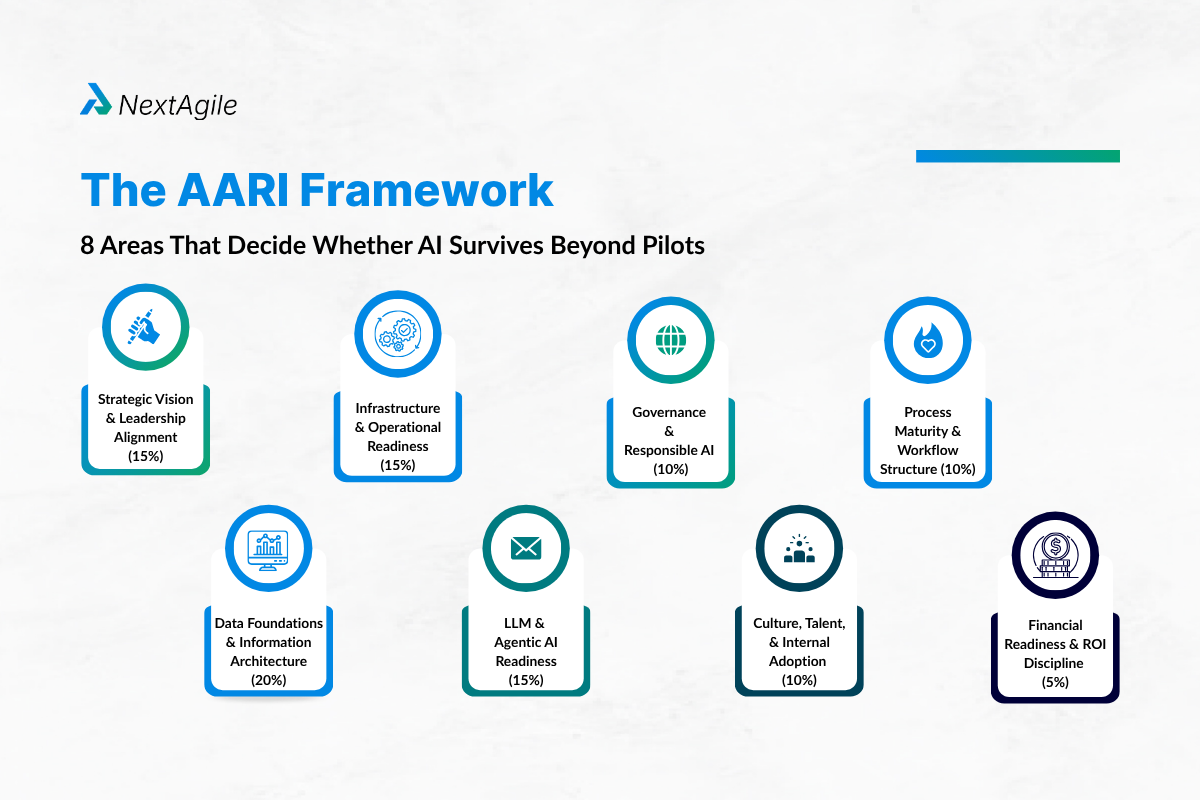
The framework looks at eight areas that repeatedly determine whether AI initiatives move beyond the pilot phase:
leadership alignment data quality infrastructure maturity governance operational processes AI capability internal adoption culture financial preparedness Some organizations score high technically but fail culturally. Others have executive enthusiasm but fragmented systems and unusable data. Occasionally, we see companies with strong engineering teams but no governance model at all.
Those projects usually stall later, not earlier.
The point of an AI readiness assessment is not to prove that your company is “innovative.” It is to identify where implementation friction is likely to appear before deployment pressure increases.
What an AI Readiness Assessment Actually Measures A proper AI readiness assessment is less about AI itself and more about organizational conditions around AI.
That distinction matters.
Many enterprises assume readiness means:
buying enterprise LLM access experimenting with copilots hiring a few AI engineers setting up a vector database launching a proof of concept Those are implementation activities. They are not readiness indicators.
We have seen organizations with expensive AI tooling still struggle to answer very basic operational questions:
Who owns model outputs? Which data sources are reliable? What happens when an answer is wrong? Can internal systems expose APIs cleanly? Who signs off on automation risk? Which workflows should never be autonomous? Those gaps become visible only after deployment pressure starts building.
An assessment helps surface those issues early.
The AARI framework evaluates eight weighted dimensions because not all readiness factors carry equal operational impact.
For example, weak branding does not kill AI initiatives.
Weak data foundations usually do.
That is why Data Foundations carries the highest weight in the model.
The AARI Framework: 8 Areas That Decide Whether AI Survives Beyond Pilots
D1. Strategic Vision and Leadership Alignment (15%) A surprising number of AI initiatives still operate without executive ownership.
The technical teams move ahead, but leadership has not agreed on:
why AI is being adopted which business outcomes matter what level of risk is acceptable whether the organization wants augmentation or automation Without alignment at that level, AI remains experimental for much longer than expected.
One common pattern: leadership wants productivity gains while operational teams fear process disruption. Nobody resolves the contradiction early, so adoption slows quietly over time.
This dimension evaluates:
executive sponsorship AI investment clarity organizational direction accountability structure long-term ownership D2. Data Foundations and Information Architecture (20%) This is usually where projects fail first.
Not because companies lack data.
Most enterprises have too much of it.
The problem is:
duplicated documentation outdated knowledge repositories inconsistent permissions fragmented ownership poor metadata inaccessible internal systems A retrieval system is only as reliable as the information ecosystem behind it.
We have seen organizations attempt enterprise search deployments while internal documentation still lived across:
email threads PDFs SharePoint folders Slack exports local spreadsheets undocumented tribal knowledge No model fixes that.
This dimension evaluates:
data accessibility governance standards freshness controls knowledge organization pipeline maturity retrieval readiness In practice, this area predicts implementation success more consistently than model selection.
D3. Infrastructure and Operational Readiness (15%) A pilot environment is not the same thing as production infrastructure.
Many companies can get an LLM running internally. Far fewer can operate it reliably at scale.
The problems usually appear later:
latency spikes API dependency issues rising inference costs monitoring gaps deployment bottlenecks inconsistent environments vendor lock-in Operational AI requires:
monitoring deployment pipelines model version control observability rollback processes cost visibility Without those systems, even successful pilots become difficult to maintain.
D4. LLM and Agentic AI Readiness (15%) This dimension looks at whether the organization actually understands modern AI architectures beyond surface-level terminology.
Right now, many enterprises use words like:
agents autonomous workflows copilots reasoning systems without operational clarity behind them.
A lot of “agentic AI” discussions are still presentation-layer optimism.
Before enterprises attempt orchestration or autonomous execution, they usually need to answer simpler questions first:
Can retrieval quality be trusted? Are prompts governed? Are outputs reviewed? Can workflows be audited? Do systems expose stable actions through APIs? Organizations that skip these fundamentals often jump prematurely into complex multi-agent experiments that create more operational noise than value.
D5. Governance and Responsible AI (10%) Governance usually enters the conversation later than it should.
Initially, teams focus on capability: “What can the model do?”
Eventually the discussion changes: “What happens if this goes wrong?”
That shift tends to happen after exposure risk becomes visible.
In regulated industries especially, governance cannot remain theoretical.
Enterprises need practical answers around:
human review audit trails explainability access controls data residency compliance obligations output accountability A common mistake is assuming governance slows innovation.
In reality, unclear governance slows deployment far more aggressively because nobody is comfortable approving production rollout.
D6. Culture, Talent, and Internal Adoption (10%) This dimension is consistently underestimated.
Technical teams often assume employees will naturally adopt AI if the tools are useful enough.
That is not how organizational behavior works.
In many companies, resistance is not explicit. It shows up quietly:
low usage process avoidance shadow workflows distrust in outputs lack of experimentation passive non-adoption Teams with strong AI literacy usually adapt faster even when tooling is imperfect.
Teams with weak adoption culture struggle even with good systems.
The organizations that scale AI most effectively tend to normalize experimentation early. Leadership uses the tools openly. Employees are allowed to test workflows without fear of looking replaceable.
That cultural signal matters more than most executives realize.
D7. Process Maturity and Workflow Structure (10%) AI systems perform poorly inside chaotic operational environments.
Before automation works well, workflows need:
clear decision paths documented exceptions system interoperability ownership boundaries measurable outcomes A surprising number of enterprises still rely heavily on undocumented manual work.
People know how processes operate, but the organization itself does not.
That creates major problems for AI deployment because agents require structured environments to operate reliably.
If workflows are inconsistent between teams, the AI layer inherits that inconsistency immediately.
D8. Financial Readiness and ROI Discipline (5%) This dimension carries the lowest weight, but it still matters.
Not because AI budgets are rare.
Because many organizations still cannot evaluate AI investment realistically.
Early-stage projections often assume:
immediate productivity gains fast automation rapid adoption lower operating costs Actual deployment timelines are usually slower.
Enterprises that succeed with AI tend to approach ROI incrementally:
narrow use cases first measurable operational improvements controlled scaling phased rollout economics Organizations chasing transformational outcomes too early often overbuild before proving operational value.
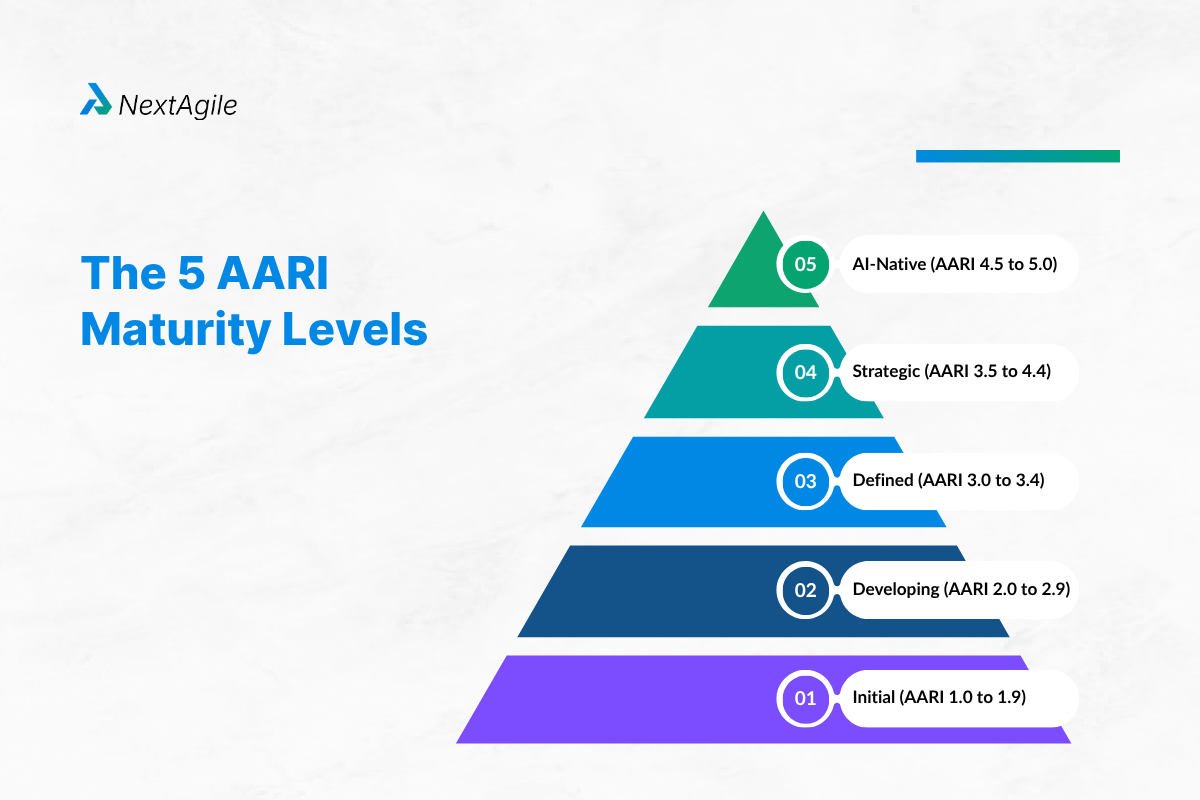
The Five AARI Maturity Levels
Level 1: Initial (AARI 1.0 to 1.9) At this stage, most AI activity is exploratory.
Teams experiment independently. Leadership discussions are still conceptual. Data environments are fragmented. Governance is either absent or informal.
This is not the stage for production deployment.
Companies here usually need to stabilize:
data ownership internal documentation leadership alignment operational priorities before scaling anything AI-related.
Level 2: Developing (AARI 2.0 to 2.9) Organizations at this stage have started building pilots.
There may be:
early RAG experiments API integrations isolated automation projects small internal AI teams The risk here is scaling too quickly before governance and operational structure mature.
A successful prototype can create false confidence.
Level 3: Defined (AARI 3.0 to 3.4) This is where organizations begin operating AI systematically instead of experimentally.
Typical characteristics include:
centralized data environments operational deployment pipelines defined governance controls monitored workflows structured evaluation systems At this stage, companies can usually support production AI use cases with controlled oversight.
Level 4: Strategic (AARI 3.5 to 4.4) AI becomes embedded into operational decision-making.
Organizations here often:
orchestrate multiple systems automate cross-functional workflows measure AI impact consistently integrate governance directly into delivery pipelines This is also the stage where organizational complexity increases significantly.
Scaling AI operationally is much harder than launching it.
Level 5: AI-Native (AARI 4.5 to 5.0) Very few enterprises are genuinely operating at this level today despite the branding language used in the market.
AI-native organizations redesign operations around AI capability instead of layering AI onto legacy structures.
That requires:
mature governance strong internal adoption highly interoperable systems disciplined operational management continuous evaluation processes Most enterprises are not there yet.
And forcing “AI-native” positioning prematurely usually creates more confusion internally than progress.
The Most Common AI Readiness Mistakes We Keep Seeing Mistake 1: Buying AI Infrastructure Before Fixing Information Quality This happens constantly.
An organization invests in:
enterprise AI licenses vector databases orchestration frameworks copilots external consulting while internal documentation remains disorganized and unreliable.
The deployment technically works.
The outputs do not.
Teams then blame the model when the underlying retrieval layer was never trustworthy to begin with.
Mistake 2: Treating AI Readiness as a One-Time Workshop Readiness changes continuously.
Teams evolve. Governance evolves. Regulations evolve. Systems evolve.
A company that was “ready” twelve months ago may no longer be ready after scaling complexity increases.
The organizations that adapt best usually revisit readiness quarterly, especially during active deployment phases.
Mistake 3: Underestimating Organizational Resistance Most enterprises assume resistance will look dramatic.
Usually it looks administrative.
People stop using the system quietly.
Managers bypass workflows.
Teams revert to manual processes because trust never formed properly.
AI adoption problems are often operational psychology problems before they become technical problems.
What Happens After the Assessment A readiness assessment should not end with a maturity score.
That is another common enterprise mistake: turning the assessment into a presentation artifact.
The useful output is the operational gap analysis.
After scoring, the next step is usually prioritization:
which risks need immediate attention which workflows are realistic candidates which systems need cleanup where governance is weakest where adoption friction is likely to emerge In most organizations, the first 90 days matter far more than the long-term AI vision deck.
Early execution quality tends to shape internal trust for the next phase of adoption.
Conclusion Most failed AI initiatives do not fail because the underlying model was weak.
They fail because the organization underestimated the operational changes required to support AI responsibly at scale.
The companies getting long-term value from AI today are usually not the ones chasing the loudest AI narrative.
They are the ones doing slower foundational work:
cleaning internal knowledge systems clarifying governance restructuring workflows improving adoption culture defining ownership properly introducing AI incrementally instead of theatrically That work is less marketable than “AI transformation.”
It is also the work that determines whether deployment survives beyond the pilot phase.
If your organization is exploring AI seriously, the readiness work cannot stay theoretical for long. At some point, leadership needs a clear view of where the operational gaps actually are; whether that is data quality, governance, workflow maturity, infrastructure, or internal adoption. NextAgile works with enterprises to assess these gaps pragmatically and build an execution roadmap that fits the organization’s current maturity instead of forcing AI transformation prematurely. If you want to evaluate where your enterprise stands today, reach out to consult@nextagile.ai and the team can help you work through the assessment and next steps.
Frequently Asked Questions 1.How long does an AI readiness assessment usually take? It depends less on company size and more on how fragmented the organization already is.
In some enterprises, the assessment moves quickly because the leadership team, data owners, and engineering teams already operate with reasonable alignment. In others, even identifying who owns critical systems takes time.
For most mid-sized and large organizations, the process usually stretches across a few weeks. The actual scoring is not the slow part. The discussions around data quality, governance gaps, workflow ownership, and deployment expectations usually take longer than expected.
If the scope is narrower, for example, evaluating only AI infrastructure readiness or governance maturity, the assessment can move faster.
2.What is considered a “good” AI readiness score? A high score matters less than an honest one.
Some organizations try to position themselves as AI-mature because leadership pressure already exists around transformation initiatives. That usually creates problems later when operational gaps begin surfacing during deployment.
In practical terms, organizations crossing the mid-level range are generally in a position to run structured production pilots with tighter controls and realistic expectations.
Lower scores are not necessarily bad news. In many cases, they prevent companies from scaling AI prematurely before the foundations are stable enough to support it.
3.Which area causes the most AI deployment failures? Data problems still cause more deployment failures than model problems.
Not because companies lack information, but because enterprise knowledge is often inconsistent, duplicated, outdated, or difficult to retrieve cleanly.
A surprisingly common scenario is this: the AI demo works well in testing, but once real internal documents enter the system, output quality becomes unreliable very quickly.
Culture-related issues are close behind. Teams that do not trust the workflows, leadership, or governance model usually slow adoption quietly, even when the technical implementation is solid.
4.How is the AARI framework different from standard AI readiness tools? A lot of readiness tools available today are designed to support a specific ecosystem or platform strategy.
The AARI framework was built more from implementation experience than from software positioning.
The focus is less on “how advanced your AI ambitions sound” and more on identifying where operational friction is likely to appear once deployment moves beyond experimentation.
The weighting model also matters. Not every dimension creates the same level of implementation risk. Weak governance and weak data foundations tend to create much larger downstream problems than organizations initially expect.
5.Does this framework work for GCCs and India-based enterprises? Yes, although the operational realities are often different from US or Europe-centric AI rollout models.
Many GCCs and Indian enterprises operate inside more layered approval structures, tighter compliance expectations, hybrid legacy environments, and stricter data movement considerations.
That changes how readiness should be evaluated.
In practice, governance, infrastructure dependencies, vendor constraints, and data residency requirements tend to play a much larger role in India-based enterprise AI programs than many global frameworks assume initially.
Rahul seasoned technology leader with 20+ years of experience, now dedicated to mentoring and training individuals and groups in Generative AI, advanced AI/ML system design, and production best practices. He is a hands-on tech entrepreneur and has deep industry experience in building cutting-edge AI products.
 Skip to content