Agile Test Automation Strategy: How Enterprises Scale QA in Agile Environments

Picture of Anuj Ojha
Anuj Ojha
Agile Test Automation Strategy Enterprise QA Guide
Table of Contents

Key Highlights of Agile Test Automation Strategy

  • A test automation strategy defines what to automate, at what layer, with which tools, owned by whom, and measured by what metrics.
  • Enterprises without an explicit strategy end up with automation debt: unmaintainable test suites, high flakiness rates, and QA that slows delivery rather than enabling it.
  • The three most common enterprise strategy failures: automating UI tests first (wrong layer), no shared ownership model (duplicate effort), and no flaky test policy (eroding suite trust).
  • QA-led agile teams that define strategy before selecting tools reduce tool switching costs by 60% in the first 2 years.
  • Gartner predicts 80% of repetitive QA tasks will be automated by 2030.

Introduction

An agile test automation strategy is the high-level plan that defines what your organization automates, at what layer of the test pyramid, using which tools, owned by which teams, and measured by which metrics. Without a strategy, test automation investments produce automation debt: expensive-to-maintain test suites that teams eventually abandon because they create more work than they save.

According to QASource’s 2026 automation strategy guide, teams without a clear strategy automate the wrong things first (UI over unit), build inconsistent frameworks across teams, and spend 40 to 60% of QA engineering time on test maintenance rather than test creation. That is not an automation program. That is a maintenance burden that grows faster than the value it produces.

This blog provides the enterprise-grade strategy framework that prevents these outcomes. It covers the 6-step strategy definition process, the governance model for multi-team environments, and how to connect your test automation strategy to your agile transformation consulting roadmap.

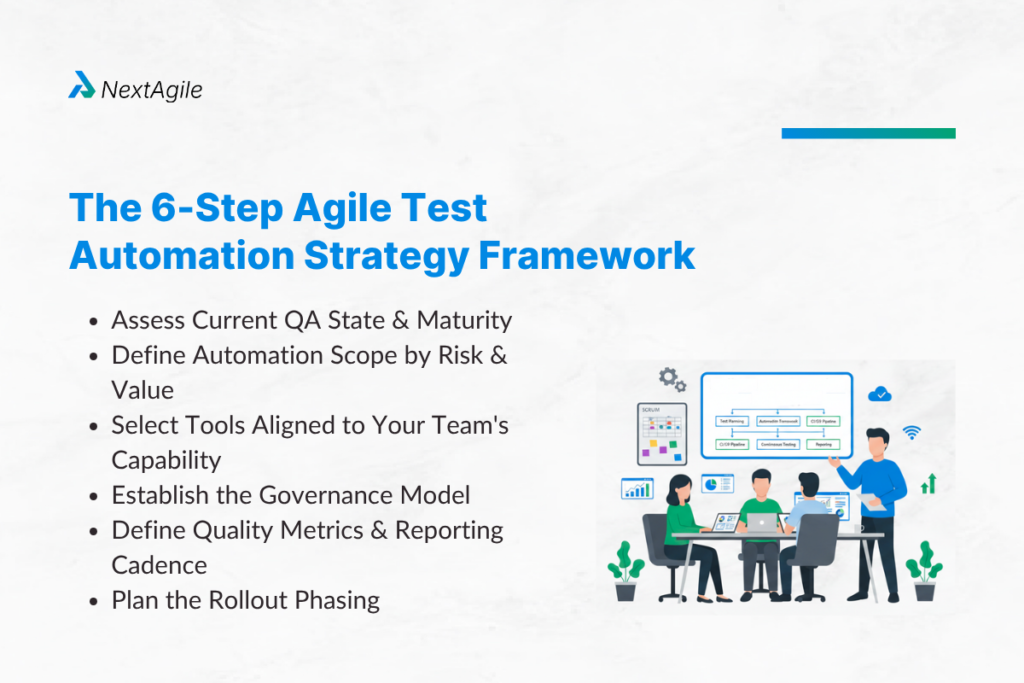
The 6-Step Agile Test Automation Strategy Framework

image 9

Step 1: Assess Current QA State and Maturity

Before defining where to go, map where you are. Conduct a QA maturity assessment across these dimensions:

Dimensions to assess:

  • Current test coverage by layer (unit, integration, UI)
  • Current suite execution time (how long does the full regression run?)
  • Current flakiness rate (what percentage of tests fail intermittently without code changes?)
  • Current manual testing volume (how many hours per sprint are spent on manual regression?)
  • Current ownership model (who maintains which tests, and is that clear?)

Use the results to identify your primary bottleneck. Most enterprises have one of three problems: no automation (start at unit tests), wrong-layer automation (too many UI tests, rebalance the pyramid), or orphaned automation (tests exist but no one maintains them, establish ownership).

Step 2: Define Automation Scope by Risk and Value

Not everything should be automated. Prioritize automation based on two criteria:

Criterion 1: Frequency of execution Tests that need to run every sprint or every commit are the highest-value automation candidates. Regression suites for core user journeys, smoke tests for deployment validation, and API contract tests for microservices all qualify.

Criterion 2: Cost of failure Automate test coverage for flows where a production defect has high business impact: payment processing, user authentication, data integrity, compliance workflows. For enterprise teams in India’s BFSI sector specifically, regulatory flows require automation as a compliance baseline, not just a delivery efficiency measure.

What NOT to automate:

  • One-time exploratory testing sessions
  • Highly variable UI layouts (visual regression tools handle these better)
  • Testing that requires human judgment about user experience quality

Step 3: Select Tools Aligned to Your Team’s Capability

Tool selection should follow scope definition, not precede it. Match the tool to the layer and the team.

Selection criteria for agile teams:

  • Does it integrate with your CI/CD pipeline (Jenkins, GitLab CI, GitHub Actions, Azure DevOps)?
  • What is the learning curve relative to your team’s programming language proficiency?
  • Does it support parallel test execution for fast pipeline feedback?
  • What is the community size and maintenance activity (abandoned tools become technical debt)?
  • Does it integrate with your test management tool (Jira, TestRail, Azure Test Plans)?

For teams using Jira as their sprint management system, NextAgile’s JIRA Training Masterclass covers test case management and automation integration within Jira workflows.

Step 4: Establish the Governance Model

Define three governance elements before writing the first automated test:

Ownership: Who owns each test layer? Developers own unit tests. QA or platform teams own integration tests. A cross-functional guild owns the shared framework.

Standards: What are the naming conventions, folder structure, coding patterns (Page Object Model for UI, contract patterns for API), and documentation requirements that all teams follow?

Flaky test policy: What happens when a test fails intermittently? Define: quarantine threshold (3 consecutive intermittent failures), assignment timeline (owner identified within 24 hours), and resolution SLA (fixed or deleted within 5 business days).

Step 5: Define Quality Metrics and Reporting Cadence

An automation strategy without metrics is not a strategy. Define these metrics before deployment:

Metric Target Reporting Frequency
Automated test coverage 70%+ for critical paths Weekly
Suite pass rate (excluding known flaky tests) 95%+ Per pipeline run
Execution time (full regression) Under 20 minutes Per pipeline run
Flaky test rate Below 3% Weekly
New test delivery per sprint Tracks coverage growth Sprint review
Defect escape rate (bugs found in production) Below 5% Monthly

Step 6: Plan the Rollout Phasing

Phased rollout prevents the most common strategic failure: trying to automate everything in Sprint 1 and producing nothing of value.

Recommended phasing:

  • Phase 1 (Sprints 1 to 6): Establish foundation. Framework selected, CI/CD integration in place, unit test coverage above 50% for all active repositories, smoke tests automated for main user journeys.
  • Phase 2 (Sprints 7 to 15): Build API and integration coverage. API test coverage above 70% for all public APIs. Cross-team integration tests for key service dependencies.
  • Phase 3 (Sprints 16+): UI automation for critical journeys only. UI tests cover the top 5 to 10 user journeys. Visual regression testing for design-critical screens.

Agile Test Automation Strategy for SAFe Implementations

SAFe implementations require test automation strategy at four organizational levels:

Portfolio Level: Define common quality standards and strategic automation initiatives. Establish which regulatory or compliance flows require automation as a baseline.

Large Solution Level: Coordinate cross-team testing approaches and system verification. Define the integration test layer that validates how products from different ARTs work together.

Program Level: Establish the automation framework standards and shared libraries for the Agile Release Train. Run program-level integration tests during IP sprints. Reference NextAgile’s SAFe Consulting Services for how this fits into the full SAFe implementation model.

Team Level: Each Scrum team implements daily testing practices within the program framework. Unit tests per story, API tests per new endpoint, CI/CD pipeline per team.

How to Integrate Test Automation Strategy with Agile Maturity

Your test automation strategy should evolve as your agile maturity grows. These are the appropriate automation investments at each maturity stage:

Agile Maturity Level Test Automation Focus Key Action
Level 1 (Initial) Manual testing, basic unit tests Establish CI/CD, write first unit tests alongside code
Level 2 (Emerging) Unit + smoke test automation Reach 50% unit test coverage, automate deployment smoke tests
Level 3 (Practicing) Unit + API automation + CI integration 70%+ unit coverage, 60%+ API coverage, full CI pipeline
Level 4 (Optimizing) Full pyramid automation + governance 80%+ across all layers, flaky test policy, ownership model
Level 5 (High Performing) AI-assisted + continuous testing AI test generation, self-healing tests, sub-15-minute pipeline

For the full team maturity assessment framework, see NextAgile’s agile maturity assessment guide.

Conclusion

An agile test automation strategy is not a test plan. It is a long-term investment framework that defines what you automate, how you govern it, how you measure it, and how you evolve it as your organization’s agile maturity grows.

The 6-step framework in this guide provides the structure enterprises need to avoid the most expensive test automation failure patterns: wrong-layer automation, no ownership model, and no measurement. For organizations implementing this strategy as part of a broader agile transformation, NextAgile’s agile consulting and training services integrate test automation governance into the transformation design. Contact us at consult@nextagile.ai.

Frequently Asked Questions

Q1. What is an agile test automation strategy?

An agile test automation strategy is a documented plan that defines what a team automates, at which layer of the test pyramid, using which tools, governed by which ownership model, and measured by which quality metrics. It is the difference between having automated tests and having automation that sustainably improves delivery quality over time.

Q2. How do you define scope for a test automation strategy?

Define scope using two criteria: frequency of execution (automate what runs every sprint or every commit) and cost of failure (automate what protects your highest-risk flows). Most enterprise teams should automate payment flows, authentication flows, and data integrity checks before anything else. Scope anything that would cause a production incident if it failed without being caught.

Q3. What metrics should you track for test automation in agile?

The six most important metrics are: automated test coverage percentage by layer, suite pass rate per pipeline run, full regression execution time, flaky test rate, new test delivery per sprint, and defect escape rate. Track these weekly and publish them at your Sprint Review or ART Sync to keep automation health visible to all stakeholders.

Q4. How does test automation strategy connect to SAFe? 

SAFe organizes test automation strategy at four levels: portfolio (standards and compliance baselines), large solution (cross-ART integration testing), program (shared frameworks and ART-level integration tests), and team (sprint-level unit and API tests). Each level has different ownership and different testing scope. The ART’s automation framework is owned by a QA guild or platform team, not by individual Scrum teams.

Q5. When should you start test automation in a new agile team?

Start automation from Sprint 1, beginning with unit tests alongside production code. Waiting until the product is “stable enough to automate” is the most expensive delay in test automation programs. The longer you wait, the more manual testing debt accumulates and the more expensive it becomes to retrofit automation into an existing codebase.

Q6. What is the most common test automation strategy mistake in enterprise agile?

Over-investing in UI end-to-end tests while under-investing in unit and API tests. UI tests are the most visible, so teams build them first. But they are also the slowest, most brittle, and most expensive to maintain. A pyramid-inverted test suite with 70% UI tests and 10% unit tests creates a negative ROI automation program that teams eventually abandon.

Talk to Our Experts

Get expert guidance within 1 business day.

expert-advice

Expert Advice

lightning

Fast Response

100% Confidential

100% Confidential


No spam. Your information stays private

call

Prefer a call?

Schedule a call with our expert after submission

Recent Posts