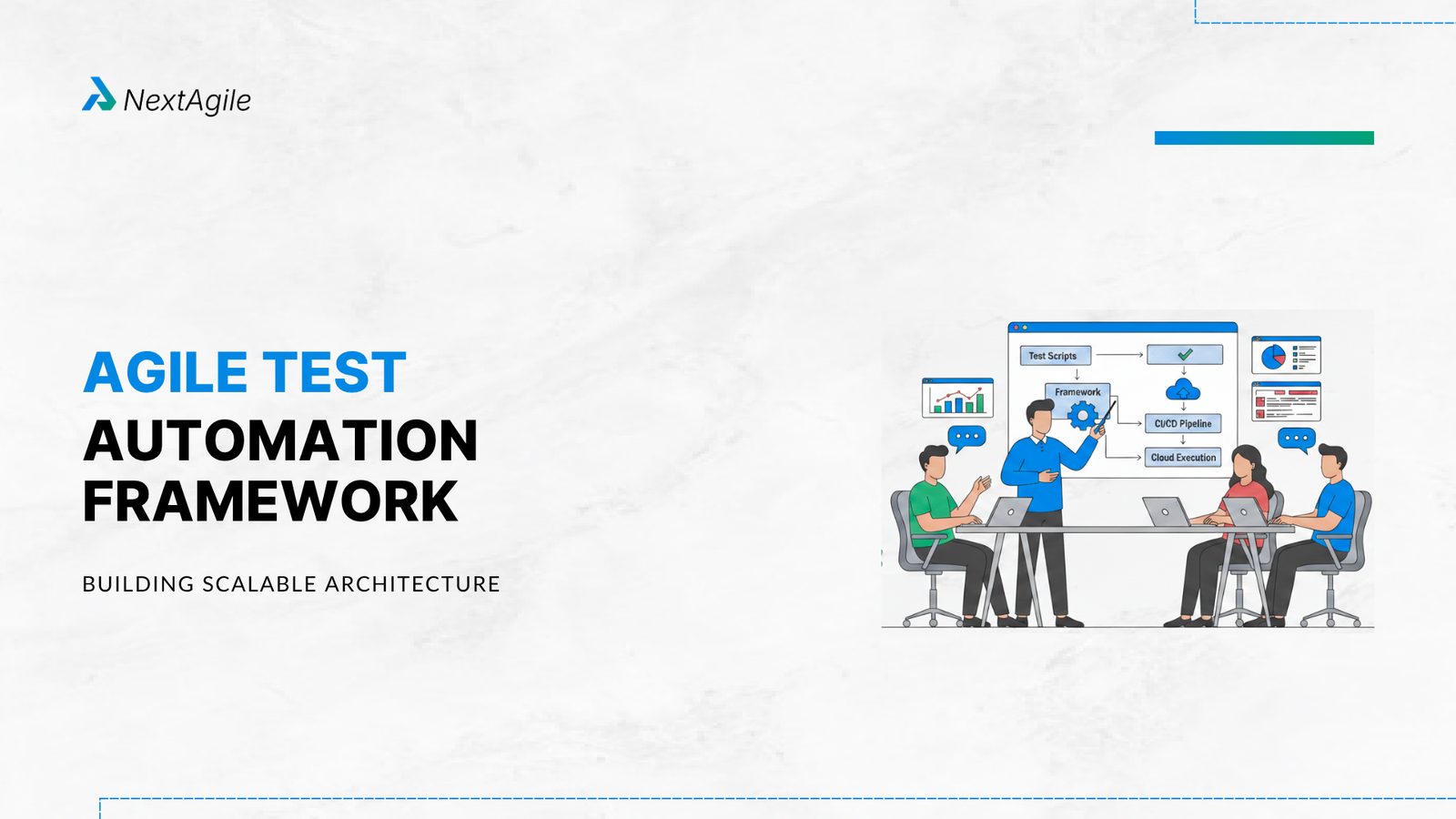
Key Highlights of Agile Test Automation Framework A test automation framework is the technical foundation: the code structure, design patterns, shared libraries, and tools that all test automation in your organization is built on. The Page Object Model (POM) is the most widely adopted design pattern for UI test automation, reducing duplication and maintenance cost by centralizing element selectors and page interactions. API contract testing with tools like Pact prevents integration failures between microservices before they reach integration testing environments. Frameworks built without modularity require complete rewrites when UI or API changes occur. Modular frameworks require updates only to the affected module. Self-healing test locators, powered by AI, reduce UI test maintenance effort by 30 to 50% compared to traditional hard-coded locators. Introduction An agile test automation framework is the technical architecture that all automated tests in your organization run on. It includes the folder structure, design patterns, shared utility libraries, configuration management, and tool integrations that standardize how automated tests are written, maintained, and executed across teams.
Without a framework, each developer and QA engineer writes tests in their own style, using their own helper functions, duplicating infrastructure setup, and creating a codebase that requires expertise to navigate and is expensive to maintain. With a well-designed framework, a new team member can write automated tests on Day 1 by following the established patterns, and a test can be updated in one place when the application changes.
This blog covers the architecture decisions, design patterns, and tool integrations that make an agile test automation framework scalable across enterprise agile delivery. For teams connecting framework design to their broader agile transformation consulting engagement, framework architecture should be designed alongside the agile delivery model, not added after teams are already working.
Core Architecture Components of an Agile Test Automation Framework Component 1: Directory Structure
A well-organized directory structure reflects the layers of the test pyramid:
/tests
/unit → developer-owned, run on every commit
/integration → API and service-level tests, run on main branch commits
/e2e → UI scenario tests, run nightly
/shared → utilities, constants, test data helpers
/fixtures → test data files and mock responses
/config→ environment configuration files
Component 2: Design Patterns
Design patterns are standardized approaches to common test automation problems. Two patterns are essential for enterprise agile frameworks:
Page Object Model (POM) for UI tests: POM centralizes all UI element selectors and page interaction methods in dedicated “Page Objects.” Tests call page object methods rather than directly accessing elements.
# Without POM (brittle)
find_element(By.ID, “login-button”).click()
# With POM (maintainable)
login_page.click_login_button()
When the UI changes, you update the page object, not every test that uses that element. For large applications, this reduces maintenance effort by 40 to 60%.
API Builder Pattern for API tests: The builder pattern creates reusable request builders for each API endpoint. Tests construct requests from building blocks rather than duplicating request construction logic.
Component 3: Configuration Management
Framework configuration covers environment URLs, credentials, browser settings, and parallel execution settings. All configuration should be:
Externalized from test code (stored in config files or environment variables) Environment-specific (dev, staging, production configurations separate) Never committed with real credentials (use environment variable injection in CI/CD) Component 4: Shared Test Utilities
Utilities are reusable functions that multiple tests need: date formatters, API authentication helpers, test data generators, screenshot capture functions, and assertion wrappers. Centralizing these prevents duplication and standardizes behavior across the suite.
Framework Selection Guide by Team Context Team Context Recommended Framework Combination Java/Spring Boot API teams JUnit 5 + REST-assured + Cucumber for BDD JavaScript/TypeScript teams Playwright + Vitest + Cucumber-js Python teams Pytest + Selenium/Playwright + Behave .NET/C# teams NUnit + Playwright + SpecFlow Low-code / non-developer QA teams ACCELQ or Testsigma (codeless automation) Enterprise Microsoft stack Playwright + Azure Test Plans + GitHub Actions
API Contract Testing for Microservices Architectures In enterprise agile teams with microservices architectures, integration failures are a leading cause of sprint blockers and release delays. A service changes its API response format; a consumer team’s tests start failing; debugging takes 2 to 3 days.
API contract testing with tools like Pact solves this by making API contracts explicit and automatically verified. The consumer team defines what they expect from the API (the contract). The provider team’s CI pipeline verifies that their API meets all existing contracts before merging any changes.
Implementation in agile sprints:
Consumer-side contract tests are written when the integration is first developed Contract is published to a broker (Pactflow or Pact Broker) Provider CI pipeline runs contract verification on every commit Any breaking change fails the provider’s pipeline before reaching integration testing For teams using NextAgile’s SAFe Consulting Services to scale across multiple ARTs, API contract testing is a critical component of the program-level integration testing strategy.
AI-Powered Framework Features in 2026 Modern test automation frameworks in 2026 increasingly incorporate AI for three high-value functions:
Self-healing locators: When a UI element’s selector changes (a button ID is updated, a class name changes), traditional tests break. Self-healing locators use AI to identify the changed element based on context and update the selector automatically, reducing maintenance-triggered test failures by 30 to 50% (Testsigma, 2026).
AI-generated test cases: Generative AI tools (TestSprite, Qodo, GitHub Copilot) can generate initial test case scripts from natural language descriptions of user stories or from existing test cases. Generated tests require human review but significantly reduce the time to first draft.
Test flakiness detection: AI-based analytics identify flaky tests by analyzing execution patterns across multiple runs, flagging tests that show non-deterministic behavior before they cause false failures in CI pipelines.
For enterprise teams evaluating AI-powered QA tools, see the tools evaluation in the Agile Test Automation pillar blog, and NextAgile’s AI for Agility Workshop for hands-on experience with AI-assisted delivery practices.
Conclusion An agile test automation framework is a long-term engineering investment that pays returns across every sprint for the life of the product. Getting the architecture right at the start, specifically the directory structure, design patterns, configuration management, and shared utilities, prevents the most expensive anti-pattern in enterprise test automation: rebuilding the framework after 18 months because it became unmaintainable.
For enterprise teams building or rebuilding their test automation framework as part of a broader agile transformation , framework architecture decisions should be made with input from senior developers, QA engineers, and the agile coaching team. NextAgile’s agile consulting experts work with enterprise engineering teams to design test automation frameworks aligned with your delivery velocity and governance requirements. Contact us at consult@nextagile.ai .
Frequently Asked Questions u003cstrongu003eQ1. What is an agile test automation framework?u003c/strongu003e An agile test automation framework is the technical u003ca href=u0022https://martinfowler.com/bliki/TestAutomation.htmlu0022u003eu003cstrongu003earchitectureu003c/strongu003eu003c/au003e that all automated tests in your organization are built on. It includes the directory structure, design patterns (like Page Object Model), shared utility libraries, configuration management, and tool integrations that standardize how tests are written, maintained, and executed across all teams. It is the difference between 10 teams building 10 different testing codebases and 10 teams contributing to one coherent, maintainable test suite.
u003cstrongu003eQ2. What is the Page Object Model and why should agile teams use it?u003c/strongu003e The Page Object Model (POM) is a design pattern for UI test automation that centralizes all element selectors and page interaction methods in dedicated u0022Page Objectu0022 classes. Tests call these methods rather than directly manipulating UI elements. When the UI changes, you update one page object instead of every test that interacts with that page. For agile teams shipping UI changes frequently, POM reduces the maintenance cost of UI automation by 40 to 60%.
u003cstrongu003eQ3. What are the best frameworks for agile test automation in 2026?u003c/strongu003e The best framework depends on your tech stack. For JavaScript/TypeScript teams: Playwright with Vitest is the leading choice for speed and reliability. For Java teams: u003ca href=u0022https://junit.org/junit5/u0022u003eu003cstrongu003eJUnit 5u003c/strongu003eu003c/au003e with REST-assured for API tests. For Python teams: Pytest withu003ca href=u0022https://playwright.dev/u0022u003eu003cstrongu003e Playwrightu003c/strongu003eu003c/au003e. For teams with non-developer QA engineers: ACCELQ or Testsigma (codeless). For BDD across any stack: Cucumber (Java/Ruby/JavaScript) or u003ca href=u0022https://specflow.org/u0022u003eu003cstrongu003eSpecFlow (.NET)u003c/strongu003eu003c/au003e. Most enterprise teams use a combination of 2 to 3 frameworks across the test pyramid layers.
u003cstrongu003eQ4. How do you share automation infrastructure across multiple agile teams?u003c/strongu003e Create a shared automation framework repository with a shared library of utilities, page objects, API clients, and test data helpers. Establish contribution guidelines (how teams add to the library), coding standards (naming, structure, documentation), and a QA guild or platform team that owns framework maintenance. Individual teams fork the framework for their product-specific tests and pull from shared libraries. This prevents each team from rebuilding common infrastructure independently.
u003cstrongu003eQ5. What is API contract testing and when should agile teams use it?u003c/strongu003e API contract testing is a technique where the consumer of an API defines what they expect from the API (the u0022contractu0022), and the provider’s CI pipeline verifies that their API meets that contract. Use it when you have microservices teams whose services depend on each other’s APIs, and when you want to catch API-breaking changes before they reach integration testing. Pact is the most widely used contract testing tool. Implement it when a breaking API change has caused a production incident or a significant sprint disruption.
u003cstrongu003eQ6. How does AI change test automation frameworks in 2026?u003c/strongu003e AI adds three capabilities to modern test automation frameworks. First, self-healing locators automatically detect and update broken UI element selectors when the application UI changes, reducing maintenance-related test failures by 30 to 50%. Second, AI test generation tools (GitHub Copilot, TestSprite, Qodo) generate initial test scripts from user stories or existing tests, reducing time to first draft by 40 to 60%. Third, AI-powered flakiness detection identifies non-deterministic test behavior patterns before they cause false failures in CI pipelines. These capabilities accelerate the feedback loop without replacing the need for human test strategy and design.
Sujith G. is an agile practitioner with expertise in setting up the agile environment by coaching and training teams, individuals and stakeholders in the area of lean agile software principles. He has overall 12+ years of exp out of which 9+ years have been in Agile and Scrum implementation and adoption. Sujith has coached 70+ teams on agile practices & implementation techniques and has extensive experience in setting up metrics, JIRA & Azure DevOps. Experienced in identifying gaps in the system, creating scrum awareness, piloting and scaling scrum.
 Skip to content