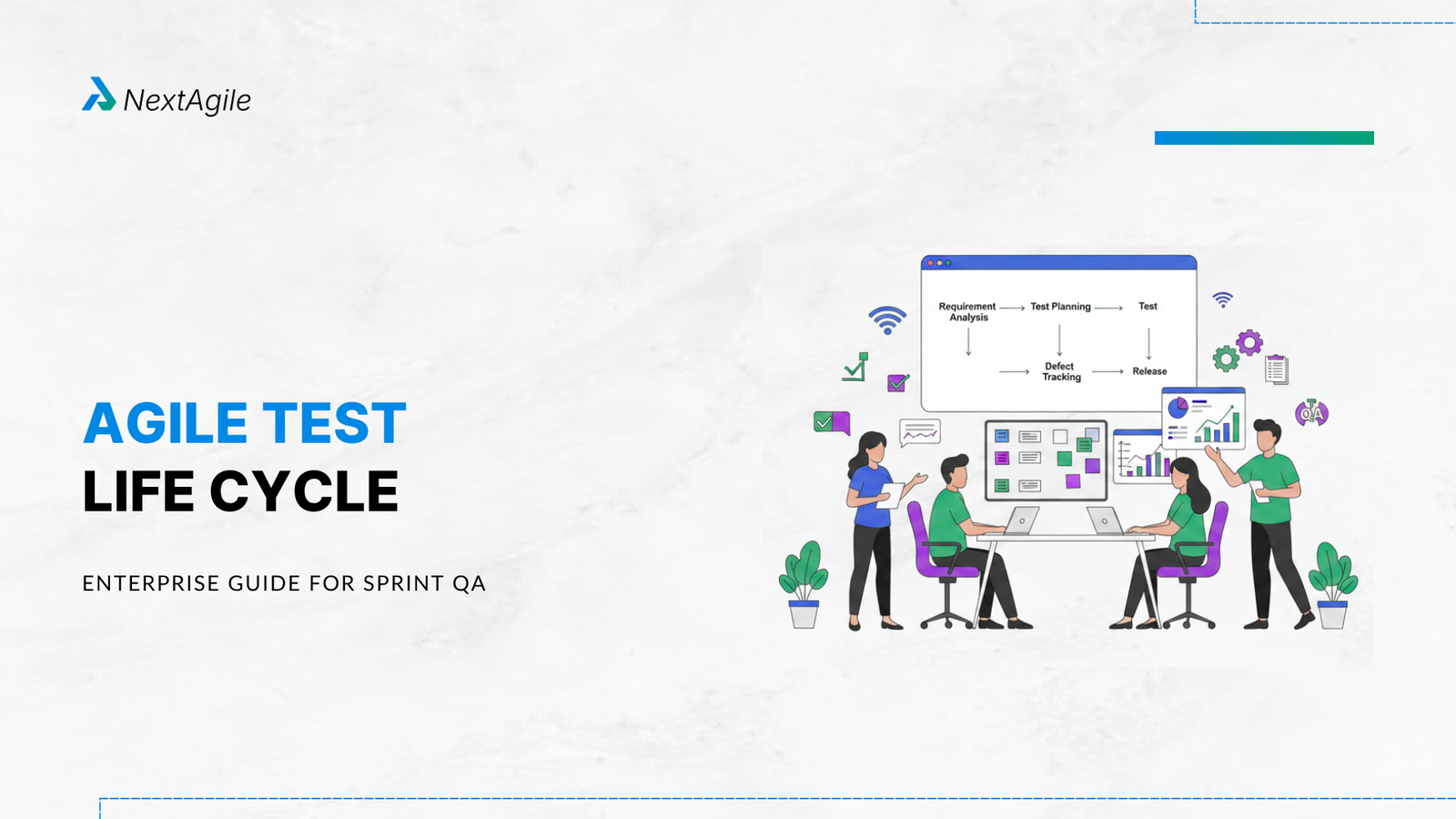
Agile Test Life Cycle in Enterprise Teams: Optimizing QA Across Sprints and Program Increments
Anuj Ojha
Talk to Expert for Free
Table of Contents
Key Highlights of Agile Test Life Cycle
The agile test life cycle integrates QA activities across 5 sprint phases: requirements, development, integration, release, and retrospective, rather than treating testing as a single end-of-sprint phase.
In enterprise SAFe environments, the test life cycle extends beyond the sprint to include program-level system testing, integration sprints (IP Sprint), and release validation across multiple teams.
Shifting testing left to the requirements phase prevents 40 to 60% of defects by catching ambiguity and gaps before code is written.
Enterprise teams in India’s IT services sector typically test 3 to 5 release environments (dev, SIT, UAT, staging, production) per sprint cycle, each requiring coordinated QA activities.
According to ThinkSys’s QA Trends Report 2026, over 60% of QA pipelines are already automation-driven, making manual testing a specialized activity rather than the default approach.
Introduction
The agile test life cycle is the end-to-end sequence of QA activities that spans from story writing to production monitoring within an agile delivery model. Unlike waterfall testing, where testing is a single phase after development, the agile test life cycle runs activities continuously throughout the sprint: requirements validation, development-stage testing, integration testing, release verification, and retrospective quality review.
For enterprise teams managing multiple agile teams, program increments, and distributed environments, the test life cycle becomes significantly more complex than what single-team agile guides describe. This blog covers the agile test life cycle at both the Scrum team level and the enterprise program level, with specific guidance for teams operating in SAFe environments across distributed India and global delivery centers.
The 5 Phases of the Agile Test Life Cycle at the Scrum Team Level
Phase 1: Requirements and Story Refinement (Pre-Sprint)
QA activities in this phase:
Review user stories for testability: can you write a passing test that verifies this story?
Write acceptance criteria in Given/When/Then format (BDD) or structured acceptance condition format
Identify automation candidates: which scenarios will need re-testing every sprint?
Estimate testing effort for each story and include in sprint capacity planning
Flag stories that lack testable acceptance criteria and block them from sprint entry
Why this phase matters most: A defect caused by an ambiguous requirement costs the least to fix here (no code exists) and the most to fix after release. Involving QA in story refinement prevents “done” from meaning “coded and not tested.”
Phase 2: Development Phase Testing (Sprint Days 1 to 7)
QA activities in this phase:
Developers write and execute unit tests alongside feature code
QA engineers write test scripts from acceptance criteria (parallel to development)
Test data created and seeded in test environments
Smoke tests run after each deployment to the development environment
Daily CI pipeline runs validate existing functionality is not broken by new work
Key metric to track: Number of automated tests written per story per day. If QA is writing tests only in the last 3 days of the sprint, the team is doing waterfall inside a sprint.
Phase 3: Integration and Acceptance Testing (Sprint Days 8 to 12)
QA activities in this phase:
Feature-level acceptance testing against user story criteria
Cross-browser and cross-device validation for UI features
Regression suite execution (automated) for all existing functionality
Exploratory testing for edge cases and user experience quality
Defect triage and priority assignment
Definition of Done checkpoint: Before closing a story: Are automated tests passing in CI? Have acceptance criteria been verified by the Product Owner? Is the defect count for this story below the team’s agreed threshold?
Phase 4: Release and Deployment Testing (Pre-Release)
 Skip to content