...

Agile Transformation Cost in India: What Companies Actually Spend in 2026

Agile Transformation Cost in India Avoid 40% Budget Mistakes
Share

Key Highlights

  • Agile transformation cost in India ranges from Rs 8 lakhs (team pilot) to Rs 2 crore+ (full enterprise, 12 months).
  • The global enterprise agile transformation market reached $57.78 billion in 2026, growing at 18.5% CAGR (The Business Research Company, 2026).
  • India’s agile transformation market is projected to reach $3.29 billion by 2031 at 21.6% CAGR (Allied Market Research).
  • Average all-inclusive cost for a mid-sized Indian enterprise: Rs 35 to 70 lakhs per year.
  • 70% of enterprises underestimate total spend by 30 to 40% by missing tools, change management, and certification costs.

Introduction

Agile transformation cost in India in 2026 ranges from Rs 8 lakhs for a focused team-level pilot to Rs 1.5 to 2 crore or more for a full enterprise program spanning multiple departments over 12 months. The difference comes down to five variables: number of teams, framework chosen, engagement duration, speed of rollout, and how much internal capability your organization builds alongside the coaching. This guide gives you phase-by-phase pricing in INR, a clear average cost by company size, the hidden expenses most enterprises miss, and a straightforward way to calculate ROI before you commit.

Why Agile Transformation in India Is Growing , and Why Cost Matters More Than Ever

The enterprise agile transformation services market crossed $57.78 billion globally in 2026, growing from $48.75 billion in 2025 at an 18.5% CAGR, according to The Business Research Company’s 2026 market report. India’s own agile services market is growing at 21.6% annually , faster than the global average , and is projected to hit $3.29 billion by 2031 (Allied Market Research).

This growth reflects a real shift. Indian enterprises in BFSI, technology, manufacturing, and healthcare are moving from agile curiosity to structured transformation programs. The 2026 challenge is not whether to transform, but how to budget for it accurately.

Most budget mistakes happen early. Organizations plan for coaching and training, then discover mid-program that change management, tool licensing, leadership workshops, and certification costs add 30 to 40% to the original estimate. This guide prevents that.

Before diving into numbers, review what a structured approach to agile transformation looks like step by step. NextAgile’s Agile Transformation Roadmap breaks this down in detail and helps you set realistic expectations before any budget conversation begins.

The Average Agile Transformation Cost in India in 2026

Before the phase-by-phase breakdown, here is the number most enterprise leaders want upfront.

Company Size Teams Covered Duration Average Total Cost (INR)
Startup / Small team 1 to 3 teams 3 to 6 months Rs 8 to 20 lakhs
Mid-sized enterprise 5 to 15 teams 6 to 12 months Rs 35 to 70 lakhs
Large enterprise 20 to 50 teams 12 to 18 months Rs 80 lakhs to Rs 1.5 crore
Very large enterprise 50+ teams, SAFe 18 to 36 months Rs 1.5 to 4 crore+

These are all-inclusive figures covering coaching, training, change management, tools, and certification costs. India-based delivery firms cost 3 to 5 times less than global consulting firms billing in USD for equivalent scope.

What You Are Actually Paying For: A Phase-by-Phase Breakdown

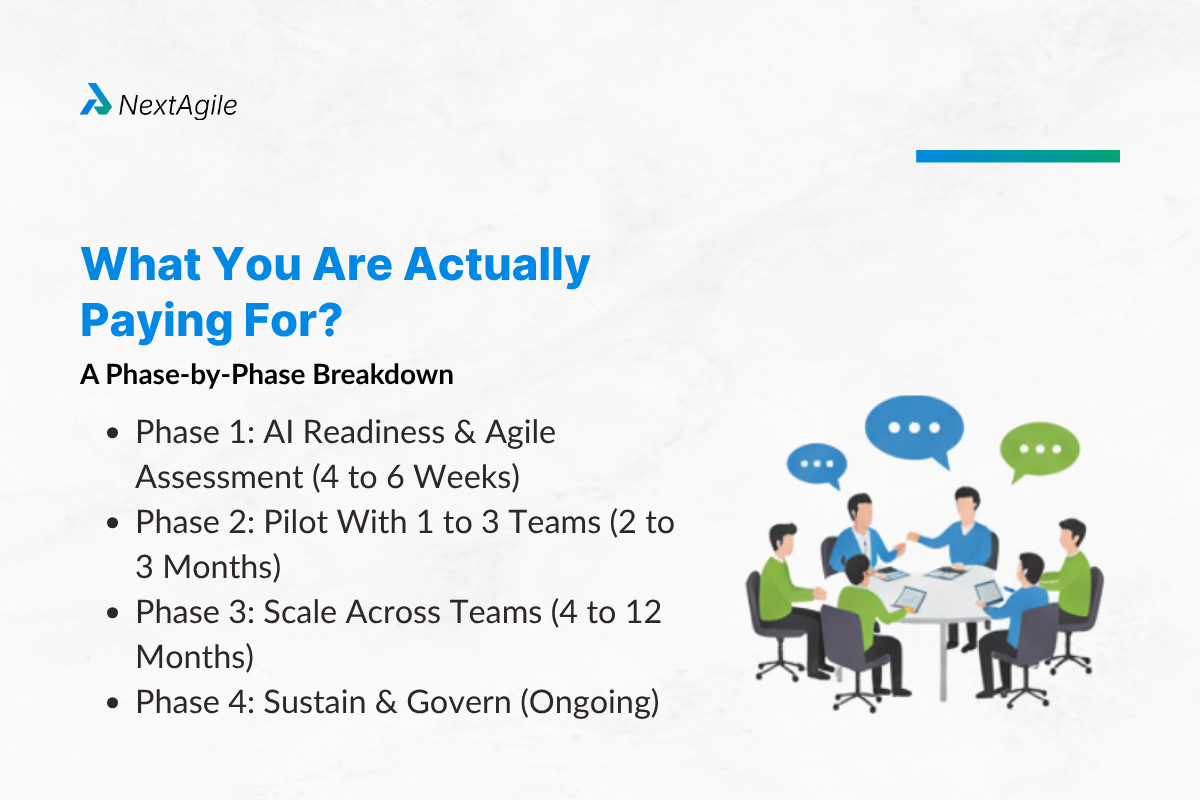
What You Are Actually Paying For A Phase-by-Phase Breakdown

Phase 1: AI Readiness and Agile Assessment (4 to 6 Weeks)

This is where a qualified consulting firm evaluates your current delivery process, team structure, leadership alignment, and change readiness. You get a maturity report, a framework recommendation, and a phased transformation blueprint before any coaching begins.

Skipping this phase is the single most expensive mistake in agile transformation. Organizations that start coaching without an assessment spend 6 to 9 months implementing the wrong framework for their context.

Average cost in India: Rs 3 to 8 lakhs Includes: Senior consultant days, maturity assessment tools, stakeholder workshops, transformation blueprint document

Explore how NextAgile’s Agile Consulting Services structure this assessment phase as the foundation of every engagement.

Phase 2: Pilot With 1 to 3 Teams (2 to 3 Months)

One to three teams run a structured pilot with embedded coaching. Sprint ceremonies are introduced, Scrum Masters are trained, and the first PI Planning (if using SAFe) runs. The goal is to validate the framework choice, produce early wins, and surface organizational blockers before the full scale-up.

Average cost in India:

  • Scrum pilot (1 to 3 teams): Rs 6 to 15 lakhs
  • SAFe first ART launch: Rs 18 to 35 lakhs

Includes: Weekly embedded coaching, ceremony facilitation, retrospective support, stakeholder progress reporting

Consider running your team through the Agile and Scrum Masterclass before or during the pilot phase. This dramatically reduces the learning curve and cuts coaching hours required in the first 6 to 8 weeks.

Phase 3: Scale Across Teams (4 to 12 Months)

This is where the bulk of transformation costs concentrate. Coaching expands across departments. Scrum Masters are trained and certified. Product Owners are embedded. Leadership sessions run quarterly. Change management workshops begin for middle management.

Average cost in India:

  • 10 to 20 teams (mid-enterprise): Rs 25 to 60 lakhs per year
  • 50 to 100 teams (large enterprise): Rs 80 lakhs to Rs 1.5 crore per year

Includes: Agile coaches embedded across teams, training programs for Scrum Masters and Product Owners, change management workshops, leadership agility sessions

Phase 4: Sustain and Govern (Ongoing)

Once the transformation stabilizes, organizations retain governance support, run OKR-aligned performance reviews, and manage new hire induction. Most enterprises on a retainer arrangement spend Rs 3 to 15 lakhs per quarter at this stage, depending on how much ongoing support is retained.

The 5 Costs Indian Enterprises Almost Always Miss

These categories add 30 to 40% to most transformation budgets. Build them in before you finalize any estimate.

  1. Change management workshops. This is the most chronically underfunded component of agile transformation in India. Structured change management programs for middle management and leadership communication campaigns are as important as technical coaching. Without them, teams do sprints while managers still operate in annual planning cycles, producing the team-organization misalignment that kills velocity. Budget of Rs 8 to 25 lakhs depending on organization size and the number of management layers involved.
  2. Tool licensing and configuration. Jira, Confluence, Azure DevOps, or Miro for PI Planning are not optional; they are the operational backbone of an agile delivery system. Setup, configuration, and annual licensing costs are routinely left out of initial budgets. Budget Rs 2 to 10 lakhs per year depending on team count and tool stack.
  3. Scrum Master and RTE certification. CSM certification costs Rs 25,000 to 45,000 per person. SAFe Scrum Master certification costs Rs 50,000 to 55,000. A Leading SAFe (SA) certification, required for Agile Release Train leadership, costs Rs 50,000 to 55,000. For an enterprise training 10 Scrum Masters, this adds Rs 3 to 6 lakhs to the budget. Build your team’s Agile capability from Day 1 with the Agile Corporate Training programs at NextAgile, which can be embedded alongside consulting delivery to reduce long-term coaching dependency.
  4. Leadership agility coaching. Agile transformations that change how teams work but leave leadership in command-and-control mode consistently stall at the team-level agility stage. Dedicated leadership coaching sessions for department heads, VPs, and CXOs add Rs 5 to 18 lakhs to the engagement budget but produce the highest leverage on transformation outcomes. The Agile Leadership Masterclass at NextAgile is built specifically for this layer.
  5. New hire induction, the attrition tax. Indian enterprises with 15 to 30% annual attrition must budget for continuous Agile induction as new hires join. An enterprise with 500 employees and 25% attrition onboards 125 new people per year. Ad hoc coaching per person is expensive. A standardized Agile Induction Training program built once and delivered repeatedly is significantly more cost-efficient.

Scrum-Only vs SAFe: What the Framework Choice Costs You

Framework selection is the most consequential cost decision in agile transformation planning.

Factor Scrum-Only SAFe Implementation
Best for 1 to 30 teams, single product 30+ teams, multiple interdependent products
Additional certifications required CSM, PSM SAFe SM, Leading SAFe, RTE, POPM
PI Planning infrastructure Not required Required (quarterly, 2-day events)
Release Train Engineer role Not required Required (Rs 25 to 40 LPA salary)
Lean Portfolio Management setup Not required Required for full business agility
Total cost premium vs Scrum-only Baseline 30 to 50% higher

Most Indian enterprises with fewer than 30 people on a single product are better served by Scrum. Implementing SAFe before your team scales justifies it creates overhead without the coordination benefits.

How to Calculate ROI Before You Commit

Use three variables to build your business case before any budget is approved.

How to Calculate ROI Before You Commit

Variable 1: Time-to-market improvement. Agile delivery typically cuts release cycles from 6 months to 6 weeks. For a product organization, 8x more delivery cycles per year means faster customer feedback, faster revenue recognition, and faster response to competitive moves. Even a 15% improvement in delivery frequency is worth quantifying in revenue terms for your specific context.

Variable 2: Productivity gains. Industry research consistently shows that structured agile teams are 25% more productive. For an enterprise with 500 employees averaging Rs 15 lakhs per year in total employment cost, a 25% productivity gain is worth Rs 18.75 crore in additional output per year without adding headcount.

Variable 3: Cost of failure avoided. 66% of technology projects exceed original budgets by an average of 27% (industry research). Agile’s iterative delivery model surfaces failures in the first sprint, when they cost a fraction of what a 12-month waterfall project failure costs at delivery. Quantifying this avoided failure cost is often the largest ROI driver in the business case.

Realistic ROI timeline:

  • Months 1 to 3: Investment phase. Process stabilization, early sprint consistency
  • Months 4 to 6: Delivery velocity improves for pilot teams. Time-to-market shortens
  • Months 7 to 12: Measurable productivity and quality gains. Defect rates drop. Customer feedback loops accelerate

Track your transformation outcomes using the Agile Metrics for Leadership framework; this gives leadership teams the measurable indicators that connect team delivery to business results.

Conclusion: What to Budget and How to Get Started

Agile transformation cost in India in 2026 is not a fixed number. It is a range that reflects your organization’s size, the framework you choose, the speed you need, and the depth of change management you invest in.

The single biggest cost mistake is underscoping the budget. Teams transformed without change management, leadership coaching, and internal capability development produce technically agile sprints inside organizationally waterfall structures. That mismatch is what creates the failure statistics, not the Agile framework itself.

For mid-sized Indian enterprises running 10 to 20 teams over 12 months, an all-inclusive budget of Rs 35 to 70 lakhs is the realistic expectation. For large enterprises implementing SAFe across 50+ teams over 18 to 36 months, the range is Rs 1.5 to 4 crore.

The right starting point is a no-commitment readiness assessment that tells you where your organization actually stands before any budget is signed. The NextAgile team offers this as the first step in every engagement. Book a 30-minute session here.

Frequently Asked Questions

Q1: How much does agile transformation cost in India in 2026?

Agile transformation cost in India ranges from Rs 8 lakhs for a 1 to 3 team Scrum pilot to Rs 2 crore or more for a large enterprise SAFe implementation over 12 to 18 months. The average all-inclusive cost for a mid-sized enterprise (10 to 20 teams, 12 months) is Rs 35 to 70 lakhs.

Q2: Is SAFe more expensive than Scrum in India?

Yes. SAFe adds 30 to 50% to the cost of a Scrum-only transformation. SAFe requires additional certifications, Release Train Engineers, PI Planning infrastructure, and Lean Portfolio Management setup. It is the right choice for organizations with 30 or more people working on interdependent products. Below that scale, Scrum delivers better ROI.

Q3: What is the ROI timeline for agile transformation in India?

Measurable improvements typically appear within 6 to 9 months of a structured engagement. Early indicators (months 1 to 3): sprint consistency and process stabilization. Month 4 to 6: delivery velocity and time-to-market improvements. Month 7 to 12: measurable productivity and quality gains.

Q4: What hidden costs do Indian enterprises miss?

The five most commonly missed costs are: change management workshops, agile tool licensing (Jira, Confluence), Scrum Master and RTE certification, leadership agility coaching, and continuous induction training for new hires.

Q5: Can a small Indian company afford agile transformation?

Yes. A focused Scrum pilot for 1 to 3 teams costs Rs 8 to 20 lakhs and shows measurable improvement within 3 months. Start small, measure results, then scale based on evidence. Do not implement SAFe before your team count justifies the overhead.

Q6: How do India-based consulting firms compare to global firms on cost?

India-based firms with local delivery teams typically charge 3 to 5 times less than global consulting firms billing in USD for equivalent scope. For a 12-month mid-enterprise program, this difference can be Rs 30 to 80 lakhs.

Leave a Reply

Your email address will not be published. Required fields are marked *