Key Highlights About AI Product Backlog Management: Backlogs are no longer just task lists. With AI, they are becoming smart decision systems that continuously prioritize work based on real customer data and delivery insights. Traditional backlog management breaks down at scale due to overload, politics, and lack of real time data. AI helps remove guesswork and brings clarity to prioritization. AI does not replace Product Owners. It supports them by suggesting priorities, identifying risks, and even drafting user stories, while humans still make the final decisions. The biggest impact of AI is improved predictability. Teams can plan better, reduce delays, and focus on work that actually delivers business value. Introduction For years, Agile teams have treated the product backlog as a structured list of work, user stories, features, bugs, and technical tasks waiting to be prioritized and delivered but in enterprise environments, this model starts to break down.
Backlogs grow into hundreds or thousands of items. Stakeholders push competing priorities. Product Owners spend more time negotiating than deciding. And despite regular refinement, teams still struggle with misaligned priorities and unpredictable delivery outcomes.
This is why AI product backlog management is now redefining how Agile teams operate.
As explored in leading AI tools for product managers
Instead of functioning as static lists, backlogs are evolving into dynamic decision systems powered by artificial intelligence that continuously evaluates backlog items based on real usage patterns, delivery risk, and business impact to define what should be built next.
As organizations adopt AI in Agile project management, the backlog is no longer just a planning artifact. It becomes the central intelligence system for product decisions.
What Is AI Product Backlog Management? (And Why It’s Not Just a Smarter Jira) A useful way to understand this shift is to see AI backlog management as the convergence of three enterprise systems: product analytics, delivery intelligence, and decision governance. Organizations that succeed here are not just augmenting Agile practices , they are building a closed-loop system where customer signals, execution data, and prioritization decisions continuously inform each other.
At a basic level, AI product backlog management refers to the use of artificial intelligence to enhance how backlogs are created, prioritized, and maintained. Backlog management is no longer a delivery hygiene activity, it is a capital allocation mechanism. Every prioritization decision implicitly determines where engineering capacity is invested and how quickly business value is realized. In this context, poorly governed backlogs do not just slow teams down but they dilute strategic outcomes and create invisible opportunity costs across the portfolio.
However, this is not about adding automation to existing tools.
AI backlog management is not simply faster ticket creation or rule-based prioritization. It represents a fundamental shift from manual backlog curation to continuous decision intelligence.
Traditional backlog management relies on:
Product Owner judgment Stakeholder negotiation Periodic prioritization sessions AI-enabled backlog systems operate differently. AI systems can analyze customer feedback and delivery data to identify which backlog items are most likely to deliver value and which ones are likely to delay delivery.
Instead of waiting for backlog refinement meetings, AI continuously evaluates:
Customer behavior and feedback trends Feature usage and adoption signals Delivery performance and bottlenecks Dependencies across teams For example, instead of manually re-prioritizing a backlog every sprint, AI can dynamically recommend priority changes based on real-time customer and delivery signals.
This transforms the backlog into a living system that evolves continuously, not just during scheduled ceremonies.
This distinction becomes critical in enterprise environments where backlog decisions must scale across multiple teams, products, and value streams. Without a system of intelligence, local prioritization optimizations often create global inefficiencies where teams optimize for sprint success while the organization underperforms on business outcomes.
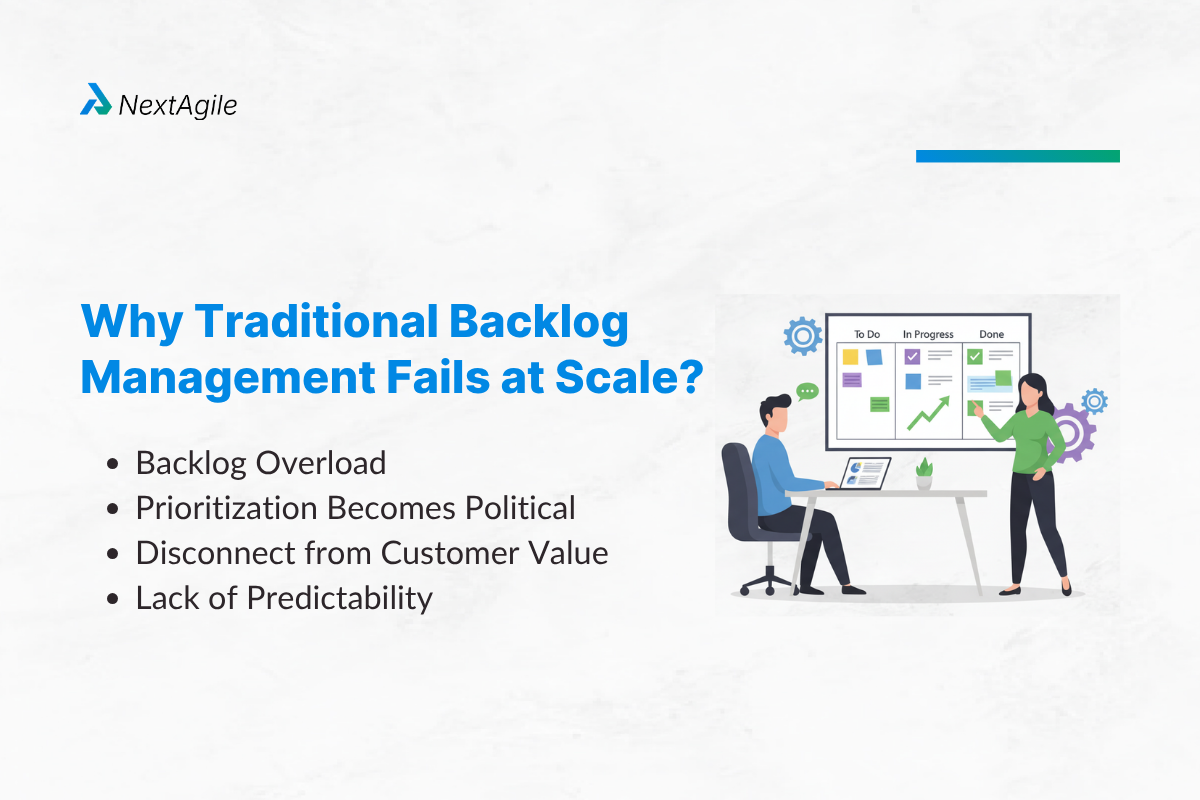
Why Traditional Backlog Management Fails at Scale? These challenges are not execution failures, they are system design limitations. Traditional backlog practices were designed for team-level agility, not enterprise-level complexity. As organizations scale, the absence of real-time decision support creates compounding inefficiencies that no amount of manual refinement can resolve.
Before understanding AI’s impact, it’s important to recognize why traditional backlog management struggles, especially in enterprise Agile environments.
1. Backlog Overload Backlogs often become dumping grounds for:
Feature ideas Stakeholder requests Technical debt Customer feedback Over time, this creates decision fatigue, where prioritization becomes slow and inconsistent.
2. Prioritization Becomes Political Without strong data signals, prioritization is often influenced by:
Stakeholder hierarchy Urgency over value Opinion-driven decisions This leads to misaligned delivery outcomes . In many large organizations, this manifests as implicit prioritization frameworks driven by influence rather than impact. Over time, this erodes trust in the backlog as a decision system and shifts teams toward reactive delivery modes, where urgency consistently overrides value.
These issues often emerge in organizations that lack a structured agile transformation roadmap
3. Disconnect from Customer Value Backlogs are rarely updated in real time based on:
Customer behavior Usage analytics Feedback patterns As a result, teams may continue prioritizing features that do not deliver actual value.
4. Lack of Predictability Teams often commit to backlog items without fully understanding:
Delivery risks Hidden dependencies Effort variability This leads to missed sprint goals and reduced trust.
AI directly addresses these challenges by introducing continuous, data-driven prioritization, turning backlog management into a decision system rather than a static list.
How AI Is Transforming Backlog Prioritisation in Agile? Backlog prioritization is one of the most critical and difficult responsibilities in Agile product management.
AI is transforming this process by replacing subjective prioritization with data-backed decision models.
Value vs Effort Scoring with ML Models Machine learning models analyze historical delivery patterns to estimate:
Effort required for backlog items Likelihood of delays Business value based on usage and impact This enables Product Owners to prioritize work based on the probability of value delivery, not just assumptions.
For example, AI can identify backlog items that appear high-value but historically lead to delays and help teams avoid planning risks.
Customer Feedback Integration into Backlog Signals One of the biggest gaps in traditional backlog management is the delay between customer feedback and backlog action .
AI bridges this gap by continuously analyzing:
Support tickets Product reviews Feature usage patterns Customer behavior AI can then:
Elevate high-impact issues Identify recurring pain points Suggest backlog adjustments This ensures that backlog priorities are continuously aligned with real customer needs , not outdated assumptions. For senior leaders, the implication is clear: prioritization is no longer a workshop activity, it is an always-on capability. Organizations that embed AI into backlog prioritization reduce decision latency, improve alignment, and create a measurable link between product investments and business outcomes.
Can AI Write User Stories? What the Evidence Says AI-powered tools can now generate user stories based on:
Feature inputs Customer feedback Product documentation This significantly reduces the time required for backlog creation.
However, AI-generated user stories often lack :
Strategic context Business alignment Clear acceptance criteria In practice, high-performing teams use AI as an assistive layer , not a replacement.
AI helps to:
Draft initial user stories Suggest acceptance criteria Identify missing scenarios But Product Owners remain responsible for ensuring that stories align with product goals and outcomes. This also signals a broader shift in the Product Owner role from writing and managing backlog items to curating decision quality. As AI takes over low-value authoring tasks, the differentiator becomes the ability to define intent, validate outcomes, and ensure strategic coherence across the backlog.
Top AI Tools for Product Backlog Management in 2026 Instead of focusing on individual tools, it’s more useful to understand the capability categories that leading Agile teams are adopting. Tooling decisions in this space should not be driven by feature comparison alone. The real question for enterprises is how well these tools integrate into the existing delivery ecosystem of CI/CD pipelines, product analytics platforms, and governance frameworks to enable end-to-end decision intelligence rather than isolated optimization.
AI Capabilities Powering Backlog Management Capability What It Does Best For Backlog intelligence engines Recommend prioritization based on data Product Owners Delivery analytics platforms Predict delays and risks Enterprise teams AI story generators Draft user stories Fast-moving teams Flow optimization tools Identify bottlenecks Kanban teams
Most high-performing teams do not rely on a single tool. They combine:
Delivery analytics Backlog intelligence AI-assisted planning This creates an integrated system for AI-driven backlog management .
Refer our blog on 25 top AI Tools for Product managers for a comprehensive list of AI Tools which will help you in product backlog management.
Organizations often align these capabilities with broader agile product management consulting
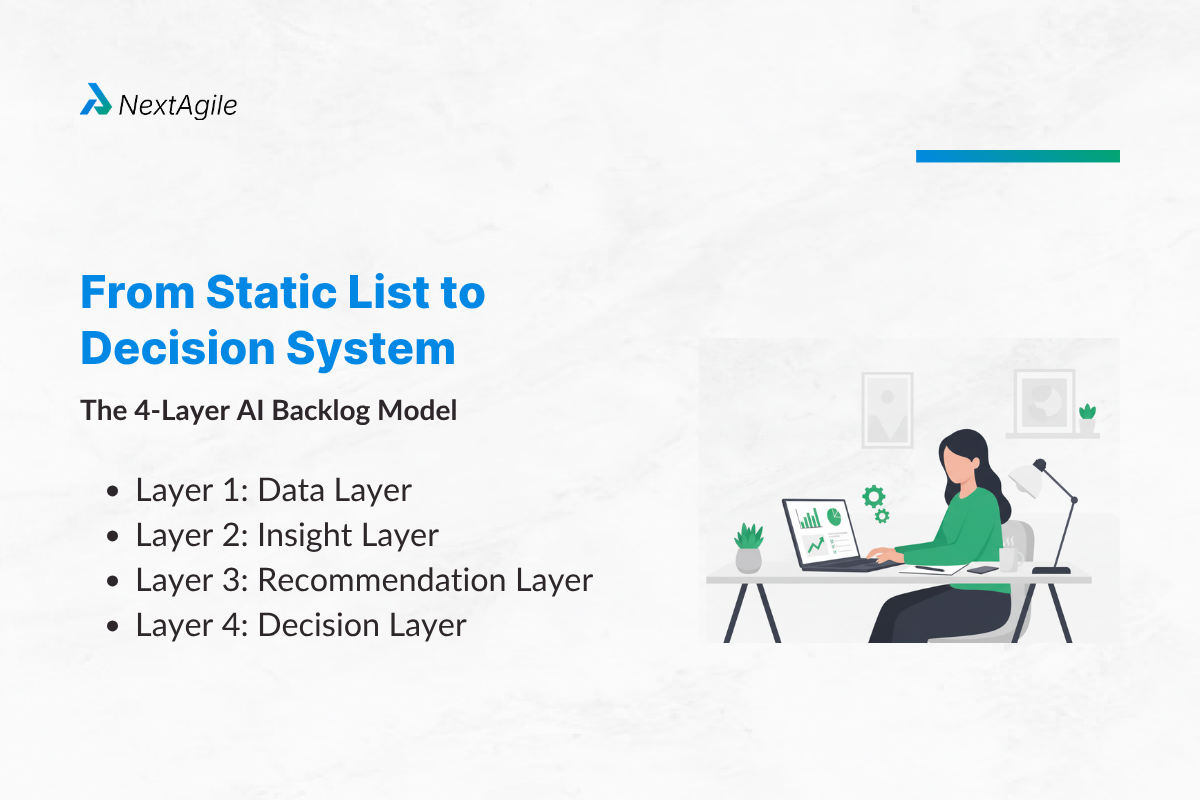
From Static List to Decision System: The 4-Layer AI Backlog Model To fully understand the transformation, it helps to view the backlog as a multi-layered decision system . This layered model also introduces an important governance construct: separation of insight generation and decision accountability. AI operates across the first three layers, but the final layer remains a human responsibility ensuring that decisions are not only data-informed but also strategically intentional.
Layer 1: Data Layer Includes:
Customer feedback Usage analytics Delivery metrics Layer 2: Insight Layer AI identifies:
Feature demand patterns Risk signals Dependency clusters Layer 3: Recommendation Layer AI recommends:
Priority changes Sprint candidates Feature sequencing Layer 4: Decision Layer Product Owners validate and finalize decisions.
Real-World Example In practice:
AI analyzes customer complaints (Data Layer) Identifies recurring issues (Insight Layer) Recommends fixes as high priority (Recommendation Layer) Product Owner approves backlog changes (Decision Layer) This model ensures that AI enhances decision-making while maintaining human accountability . At enterprise scale, this model extends beyond individual teams into portfolio-level prioritization, where similar patterns are applied to funding decisions, cross-team dependencies, and strategic initiatives effectively turning the backlog into a multi-level decision architecture.
How to Use AI in Agile Sprint Planning Without Losing Team Ownership? One of the biggest concerns with AI adoption is losing team autonomy. The concern around autonomy often stems from a misunderstanding of AI’s role. High-performing organizations position AI as a constraint-aware advisor, one that highlights trade-offs and risks while preserving the team’s authority to make contextual decisions.
However, when implemented correctly, AI strengthens, not weakens, the team ownership.
AI can support sprint planning
Suggesting backlog items based on value Predicting sprint capacity Identifying risks before planning begins But decision ownership must remain with the team.
Best Practices Use AI as a Recommendation Engine Ensure Team Validation Maintain Transparency Align with Product Strategy A practical litmus test is this: if teams cannot explain why a recommendation exists, adoption will fail. Transparency in AI-driven insights is not a technical feature, it is a prerequisite for cultural acceptance and sustained usage.
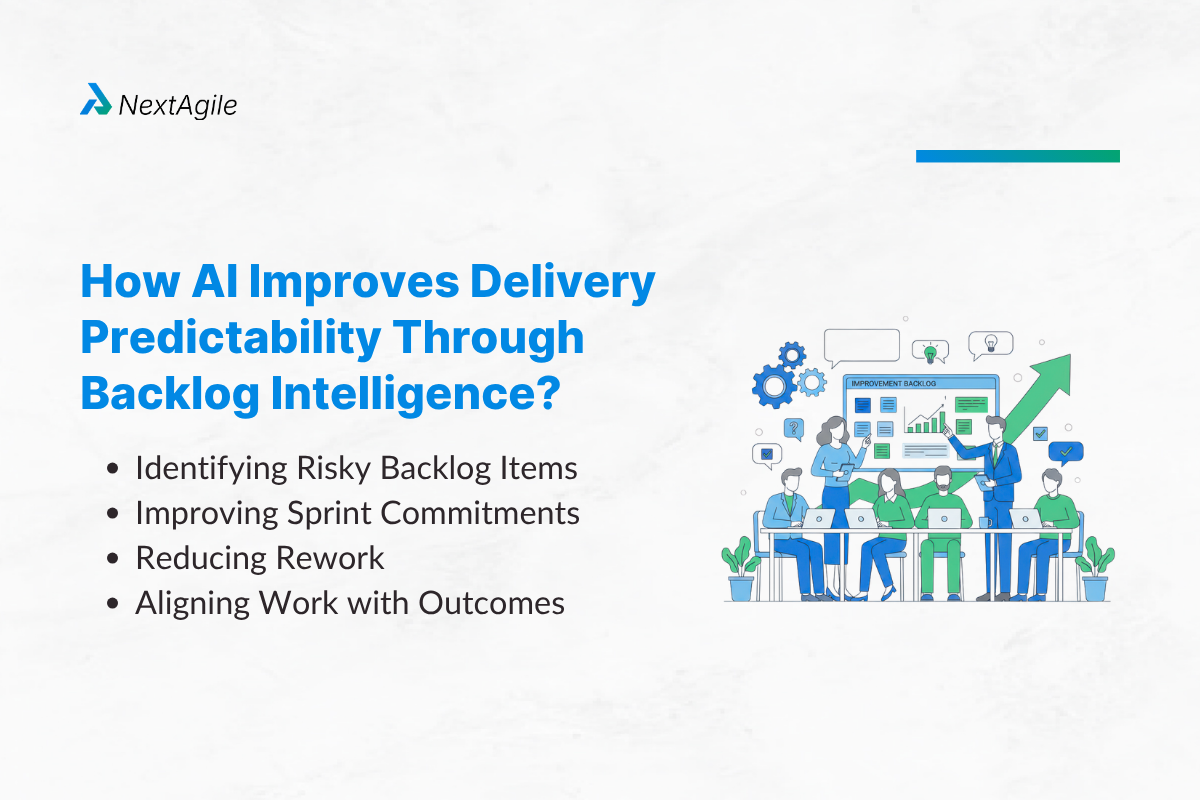
How AI Improves Delivery Predictability Through Backlog Intelligence? One of the most powerful benefits of AI in Agile project management is improved predictability.
AI enhances predictability by:
1. Identifying Risky Backlog Items AI detects items that historically lead to delays or spillovers.
2. Improving Sprint Commitments AI recommends backlog items based on realistic capacity and past performance.
3. Reducing Rework AI highlights unclear or incomplete backlog items before they enter sprint planning.
4. Aligning Work with Outcomes AI ensures that teams prioritize work that delivers measurable value.
This shifts Agile from reactive delivery to predictable execution. Predictability, in this context, is not about rigid planning, it is about reducing uncertainty in decision-making. AI enables teams to move from estimation-driven commitments to probability-informed planning, which is significantly more reliable in complex delivery environments.
The broader implication for enterprise transformation is significant. As backlog management evolves into decision intelligence, it begins to intersect with portfolio governance, funding models, and even organizational design, shifting Agile from a team-level methodology to a business-wide operating system.
Conclusion AI is fundamentally transforming how product backlogs are managed in Agile environments.
The backlog is no longer a static list of tasks; it is becoming a dynamic decision system powered by data and intelligence.
Through AI product backlog management, teams can:
Prioritize more effectively Align with customer needs Improve delivery predictability But the real transformation is deeper.
The shift is this: Teams are no longer just managing backlogs. AI is helping them manage decisions.
Organizations that successfully combine:
Human judgment Data-driven insights AI-powered recommendations will move beyond backlog management as an administrative task and turn it into a strategic capability for delivering value at scale.
If your organisation is facing AI adoption challenges and struggling to integrate and derive value out of AI adoption in Product Backlog Management, NextAgile as an agile product management consulting firm can help you diagnose the real bottlenecks and co‑create a practical adoption roadmap. Reach out to us consult@nextagile.ai for a quick discussion to explore how we can help.
Frequently Asked Questions 1. How does AI improve backlog prioritization? AI improves backlog prioritization by analyzing customer feedback, usage data, and delivery metrics to recommend which items deliver the highest value and lowest risk.
2. Does AI replace product managers in backlog management? No. AI supports decision-making, but Product Managers remain responsible for aligning backlog priorities with business strategy.
3. Can AI automatically create user stories? AI can generate user story drafts, but human refinement is required to ensure clarity, context, and alignment.
4. How can teams start using AI for backlog management? Teams should begin by adopting AI tools for prioritization insights and gradually expand usage while maintaining human oversight.
5. Where should AI backlog management be implemented first in an enterprise? AI backlog management should typically start with high-volume, customer-facing product teams where data signals are rich and prioritization complexity is high. This allows organizations to validate impact quickly before scaling across portfolios.
6. What data is required for effective AI backlog prioritization? Effective AI backlog systems rely on integrated data from product analytics, customer feedback channels, and delivery metrics. The quality and connectivity of this data are often more critical than the AI models themselves.
7. How does AI backlog management impact Agile roles and responsibilities? AI reduces manual effort in backlog maintenance, allowing Product Owners and teams to focus more on strategic decision-making, outcome validation, and cross-functional alignment rather than administrative tasks.
8. Is AI backlog management suitable for regulated industries? Yes, but with careful governance. Organizations must ensure transparency, auditability of AI recommendations, and clear human accountability for decisions to meet regulatory and compliance requirements.
Anuj Ojha is Co-Founder & Consulting Head at NextAgile. Anuj has designed & led multiple turnkey transformation journeys across industries, domains & geographies and has 16+ years of experience as an agile practitioner. He has worked with CXOs, CTOs & Key Leaders to translate their business objectives on the ground, contextualizing org transformations and creating buy-in across level, leading a team of coaches/consultants to implement agility across 150+ teams & trained more than 12k team members. Anuj’s core area of interest is business agility & working with leaders & teams to achieve long term sustainable, Agile culture & mindset.
 Skip to content