Introduction Many organisations still measure engineering performance through activity metrics: builds completed, tickets closed, or pipelines executed.
Those metrics describe effort.
They rarely describe business impact .
DevOps OKRs bridge the gap between engineering activities and measurable business outcomes, moving beyond vanity metrics like deployment counts. DevOps OKRs shift the conversation from engineering activity to customer value creation . When structured correctly, they help leadership answer three strategic questions:
How quickly can we deliver new capabilities to the market? How reliably do our systems serve customers under real-world conditions? How productive and sustainable is our engineering environment? For CTOs, product leaders, and board-level stakeholders, DevOps OKRs create a shared performance language between engineering delivery and business outcomes.
DevOps OKRs tie engineering activities directly to business outcomes, not just deployment counts, but customer reliability, time-to-value, and developer productivity. An OKR (Objective and Key Result) for a DevOps team connects the technical work your engineers do every day to goals that board members, product leaders, and customers actually care about. This article explains what DevOps OKRs are, how to write them, and how leading engineering teams in India and globally use them to accelerate delivery and reduce operational risk.
DevOps OKRs defined: A DevOps OKR consists of an Objective (a qualitative, ambitious goal such as ‘achieve carrier-grade reliability for our payment platform’) and two to four Key Results (quantifiable outcomes such as ‘reduce mean time to recovery from 4 hours to 30 minutes by Q3’). The OKR format forces engineering teams to answer: how does our pipeline, our infrastructure, and our release process create measurable value for the business?
DevOps OKR Structure at a Glance A well-designed DevOps OKR usually follows a simple structure.
Objective – A clear, qualitative ambition that describes the outcome the team wants to achieve.
Examples include:
Deliver carrier-grade reliability for core payment systems Enable weekly product experimentation through faster releases Improve developer productivity across the CI/CD pipeline Key Results – Two to four measurable outcomes that indicate progress toward the objective.
Typical DevOps Key Results include:
Deployment frequency improvements Lead time reductions MTTR reductions Change failure rate improvements The discipline of limiting Key Results forces teams to prioritise the few engineering improvements that create the largest business impact .
The four DORA metrics (deployment frequency, lead time for changes, mean time to recovery, and change failure rate) are the most reliable foundation for DevOps OKRs. Research by DORA and Google found that elite engineering teams deploy 973x more frequently than low performers, demonstrating the direct business value of optimized delivery pipelines.
Common DevOps OKR failures stem from measuring outputs (builds shipped) instead of outcomes (customer uptime, revenue impact, developer productivity).
Indian IT services, BFSI, and D2C enterprises adopting DevOps OKRs report faster release cycles and measurably improved product reliability when OKRs are tied to sprint cadences.
Why Are DevOps OKRs a Priority in 2026? Engineering leaders are under more pressure today than at any point in the last decade. Board-level conversations now include deployment frequency, system reliability, and time-to-market alongside traditional financial KPIs. Three forces are reshaping how companies think about engineering performance.
AI-assisted development is raising the velocity bar. With GitHub Copilot, Amazon CodeWhisperer, and similar tools becoming standard in Indian IT services firms, the baseline expectation for release cadence has shifted upward. Teams that once shipped biweekly are now expected to ship daily. Without OKRs that reflect this new pace, engineering managers lose the narrative around what ‘good’ actually looks like.
Hybrid and distributed teams need transparent goals. Post-pandemic hybrid work has fragmented the natural feedback loops that once existed in co-located engineering teams. A developer in Bengaluru, a QA engineer in Hyderabad, and a DevOps architect in Pune all need a shared language for success. OKRs provide that language when KPIs and sprint velocity metrics alone cannot.
Regulators and enterprise buyers now audit delivery reliability. In India’s BFSI sector especially, the Reserve Bank of India’s IT risk frameworks and SEBI guidelines have made system uptime and change failure rates board-level concerns, not just engineering concerns. Companies that align DevOps OKRs to these compliance requirements gain a measurable competitive and regulatory advantage.
According to the annual State of DevOps Report published by DORA (DevOps Research and Assessment), elite-performing engineering teams have deployment frequencies that are 973 times higher than low-performing teams, and their lead time for changes is 6,570 times faster. These are not incremental differences. They represent a structural separation between companies that treat engineering delivery as a strategic capability and those that treat it as a cost centre.
The Shift From Engineering Metrics to Engineering Outcomes
Historically, engineering organisations focused heavily on internal operational metrics.
Build success rates. Server utilisation. Ticket closure counts. While useful, these metrics rarely explain whether engineering delivery is improving business performance .
Modern DevOps OKRs focus on outcomes that matter to customers and revenue:
Faster feature delivery Higher service reliability Reduced incident recovery times Better developer experience The organisations that lead in digital delivery treat engineering performance as a strategic business capability rather than a back-office function.
What Makes a DevOps OKR Different from a DevOps KPI? Most engineering teams already track KPIs: uptime percentages, build success rates, and ticket resolution times. DevOps OKRs are not a replacement for these metrics; they are a layer above them. The distinction matters enormously in practice.
A KPI tells you where you are. An OKR tells you where you are going and why it matters to the business. Consider the difference between these two framings:
KPI: Deployment frequency is 12 per month.OKR Key Result: Increase deployment frequency from 12 to 50 per month to enable weekly feature releases for the mobile product team by Q2. The OKR version creates accountability to a business outcome (enabling the product team), sets a time-bound target, and gives engineering a clear ‘so what’ to work toward.
Why DORA Metrics Became the DevOps Standard? Few engineering measurement frameworks have been studied as extensively as the DORA metrics .
Over a decade of research across thousands of engineering teams revealed a consistent pattern:
High-performing organisations deliver software faster, more reliably, and with fewer failures.
The four DORA metrics capture these dimensions directly:
Speed of delivery Efficiency of change implementation Reliability during incidents Stability of production deployments Because these metrics are benchmarked globally, they allow engineering leaders to compare internal performance against industry standards, rather than relying only on internal targets.
The DORA Metrics as OKR Foundation The four DORA metrics are the most evidence-backed starting point for DevOps OKRs:
Deployment Frequency: How often your team successfully releases to production. Elite teams deploy on-demand, multiple times per day.Lead Time for Changes: The time from a code commit to that code running in production. Reducing this metric directly accelerates product iteration cycles.Mean Time to Recovery (MTTR): How quickly your team restores service after a production incident. Lower MTTR is directly correlated with customer satisfaction scores.Change Failure Rate: The percentage of deployments that cause a degradation requiring remediation. Elite teams maintain a change failure rate below 15%. These four metrics are extensively documented by Google’s DevOps Research and Assessment team and validated across thousands of engineering organizations globally. They are not theoretical constructs. They are the backbone of any credible DevOps OKR program.
Benchmark Ranges for DORA Metrics While every organisation differs, industry research suggests approximate ranges for engineering performance maturity.
Elite performers
Deploy multiple times per day Lead time under one day MTTR under one hour Change failure rate below 15% High performers
Deploy weekly Lead time under one week MTTR under one day Medium performers
Deploy monthly Lead time between one week and one month These benchmarks help engineering leaders translate DevOps OKRs into realistic but ambitious improvement targets.
Engineering OKRs vs. Software Engineering OKRs The terms ‘engineering OKRs’ and ‘software engineering OKRs’ are sometimes used interchangeably, but in large enterprises they can refer to different scopes. Engineering OKRs may span hardware, infrastructure, and product engineering. Software engineering OKRs focus specifically on the delivery pipeline, code quality, and developer experience. DevOps OKRs sit at the intersection of both: they address how software moves from development to production and how that process serves the business.
When Do DevOps OKRs Deliver the Most Value? DevOps OKRs are particularly powerful in organisations experiencing one or more of the following challenges:
Release cycles stretching across multiple months High incident recovery times affecting customer experience Growing friction between development and operations teams Increasing regulatory scrutiny around system reliability Difficulty linking engineering investments to business value In these environments, OKRs act as a clarity mechanism , aligning engineering priorities with measurable business outcomes.
Implementing DevOps OKRs: A Practical Framework Implementation is where most DevOps OKR programs stumble. As an OKR consulting company which has extensively worked with enterprises across India, we have seen technically sound OKR designs fail because the connection between engineering goals and business strategy was never made explicit. The most successful programs we have worked on followed a consistent four-step approach, often anchored in broader agile transformation consulting engagements that aligned OKRs with the organization’s SAFe or Scrum operating model.
Start with business outcomes, not engineering activities. Ask your product owners and business stakeholders: what does a reliable, fast-moving engineering team make possible for customers and revenue? The answer to that question is your Objective.
Select two to four measurable Key Results per Objective. Each Key Results must be quantifiable and time-bound. Avoid ambiguous language like ‘improve pipeline health.’ Prefer specific targets like ‘reduce pipeline failure rate from 18% to 5% by end of Q3.’
Map Key Results to existing DORA metrics wherever possible. This reduces measurement overhead and connects your OKRs to an externally validated benchmark.
Review at sprint cadence, not just quarterly. DevOps environments change rapidly. OKR check-ins should happen at the same frequency as sprint retrospectives so that the team can course-correct before a quarter’s progress is lost.
A critical principle: OKRs should be set collaboratively, not handed down. When DevOps engineers participate in writing their own Key Results, commitment to achieving them rises measurably. This is consistent with findings from research on goal-setting theory published in journals such as the Journal of Applied Psychology, which consistently links employee participation in goal-setting to higher performance outcomes.
DevOps OKR Examples and Engineering OKR Templates The following examples are drawn from real-world DevOps OKR programs across Indian enterprise contexts. Names and specific figures have been anonymized.
Example 1: Reliability OKR for a BFSI Engineering Team Objective: Achieve carrier-grade reliability for our retail lending platform before the festive season peak.
KR1: Reduce mean time to recovery from 4 hours to under 30 minutes by end of Q3.KR2: Bring system availability from 99.5% to 99.95% across the core transaction APIs.KR3: Reduce change failure rate from 22% to under 10% through automated rollback implementation. Example 2: Velocity OKR for a D2C E-Commerce Platform Objective: Enable the product team to iterate on the mobile experience weekly instead of monthly.
KR1: Increase deployment frequency from six per month to 25 per month by Q2.KR2: Reduce lead time for changes from 14 days to three days through pipeline automation.KR3: Achieve 90% test automation coverage on the checkout service by end of Q2. Example 3: Developer Productivity OKR Objective: Reduce engineering friction so developers spend more time building and less time waiting.
KR1: Reduce average build time from 28 minutes to under 10 minutes by Q3.KR2: Achieve a developer satisfaction score of 4.2/5 on the internal tooling survey.KR3: Reduce blocked sprint days caused by environment issues from 15% to under 4%. A note on Azure DevOps OKR tracking: teams using Azure DevOps as their delivery platform can map Key Results directly to pipeline analytics dashboards. Azure DevOps provides native metrics for build frequency, deployment success rates, and lead time, making it straightforward to instrument your OKRs without additional tooling overhead.
Using DevOps OKR Templates Across Teams Large organisations rarely operate with a single DevOps team. Instead, multiple product and platform teams contribute to delivery outcomes.
In practice, many engineering organisations use OKR templates to create consistency across teams while allowing local adaptation.
A typical structure includes:
A reliability-focused Objective for platform stability A velocity-focused Objective for delivery speed A developer experience Objective for internal productivity This structure ensures engineering improvements are balanced across speed, stability, and sustainability.
DevOps OKRs vs. DevOps KPIs: How They Work Together? A persistent source of confusion in engineering organizations is the relationship between OKRs and KPIs . They are not competing frameworks; they serve different purposes in the performance management hierarchy.
KPIs are health indicators. They tell you whether your systems and processes are within acceptable bounds. They are always-on and tracked continuously.OKRs are improvement vehicles. They define where you want to move specific metrics over a defined period, and they connect that movement to a strategic rationale. A useful framing : if your KPI is the current altitude of an aircraft, your OKR is the destination and the flight plan. One without the other leaves you either flying blind or flying without purpose.
DevOps KPIs that commonly become the basis for OKR Key Results include: pipeline efficiency (percentage of automated vs. manual steps), mean time between failures, on-call escalation rates, infrastructure cost per deployment, and security vulnerability remediation time. The selection should reflect the engineering team’s current strategic priorities, not a universal checklist.
A Practical Rule for Choosing OKRs vs KPIs A useful heuristic helps teams decide when to track a metric as a KPI and when to elevate it to an OKR.
Use a KPI when the goal is to maintain stability .
Examples include:
System uptime Security vulnerability counts Infrastructure utilisation Use an OKR when the goal is to drive improvement .
Examples include:
Reducing incident recovery time Increasing release frequency Improving deployment reliability This distinction prevents OKRs from becoming a long list of operational metrics .
DevOps OKRs in the Indian Enterprise Context India’s engineering ecosystem is unlike any other in the world, and DevOps OKR adoption reflects that uniqueness. Three sectors are at the forefront of structured DevOps OKR adoption: IT services, BFSI, and direct-to-consumer e-commerce.
Large Indian IT services firms (working with global clients across the US, UK, and Europe) face a particular challenge: client SLAs that demand high reliability, combined with internal delivery models that were historically waterfall-oriented. OKRs have become the connective tissue between client-facing service commitments and internal engineering delivery processes. Several Tier 1 firms have embedded DORA metric OKRs into their Account Delivery Scorecards.
India’s banking and financial services sector has seen the most structured DevOps OKR adoption post-2022, driven partly by regulatory pressure from the Reserve Bank of India on IT risk management. DevOps OKRs around change failure rate and MTTR are increasingly appearing in board-level technology governance reports at private banks and NBFCs.
The sharp growth of Indian D2C brands post-pandemic created engineering teams that scaled rapidly without formal delivery frameworks. OKRs focused on deployment frequency and lead time for changes have been particularly effective in these environments because they translate directly into business outcomes the founders and investors understand: how quickly can the team ship new features to capture market demand?
The post-pandemic hybrid work context adds another layer of complexity. Distributed engineering teams across Indian cities and time zones require more explicit alignment mechanisms. Quarterly OKR planning sessions, combined with fortnightly check-ins tied to sprint retrospectives, have proven effective at maintaining alignment in teams where informal co-location cues are absent.
For organizations looking to formalize their DevOps OKR practice within a broader scaled agile operating model, As a SAFe consulting company , Nextagile provides a structured path to embedding OKRs within Program Increment planning cycles, ensuring engineering goals are connected to portfolio-level business objectives.
Signs Your DevOps OKRs Are Working When DevOps OKRs are implemented effectively, several positive patterns begin to appear across engineering teams.
Engineering discussions shift from task completion to outcome measurement . Product teams gain confidence in predictable release cadences . Incident response improves as teams invest in automation and observability . Developers report higher satisfaction because internal tooling friction decreases. These signals indicate that OKRs are influencing engineering behaviour, not just reporting structures.
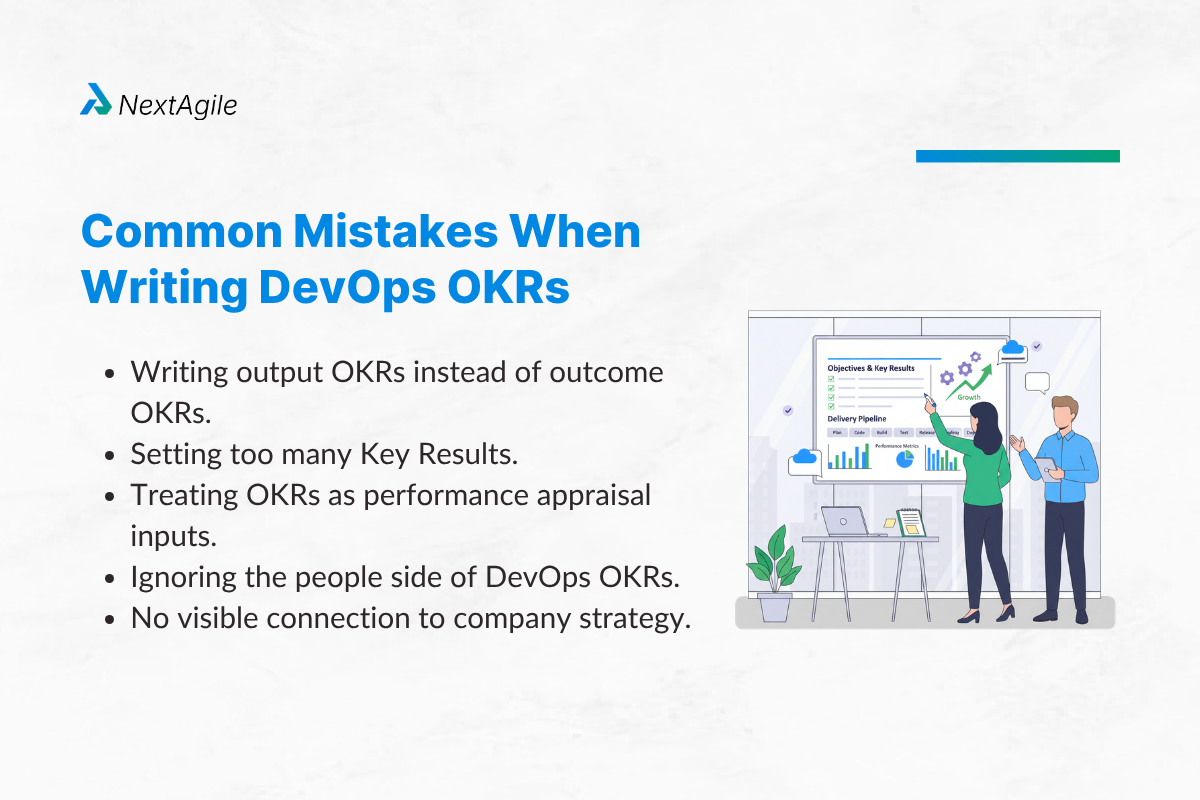
Common Mistakes When Writing DevOps OKRs After working with dozens of engineering teams on OKR implementation, the failure patterns are remarkably consistent.
Mistake 1: Writing output OKRs instead of outcome OKRs. ‘Ship the observability platform by Q3’ is a project milestone, not an OKR. The OKR version asks: what business outcome does the observability platform enable? Reframe it as: ‘Reduce mean time to detection of production issues from 45 minutes to under 5 minutes by Q3.’
Mistake 2: Setting too many Key Results. Three Key Results per Objective is the practical limit for most DevOps teams. Beyond three, the team loses focus and the OKR becomes a project checklist.
Mistake 3: Treating OKRs as performance appraisal inputs. When engineers believe their OKR scores will affect their year-end ratings, they set conservative targets that they know they can hit. OKRs are designed to be aspirational; an achievement rate of 70% on a stretch goal is often more valuable than 100% on a sandbagged one. This distinction is well-established in the original OKR literature from John Doerr’s work at Google, as documented on whatmatters.com.
Mistake 4: Ignoring the people side of DevOps OKRs. Developer satisfaction, on-call burden, and psychological safety are legitimate OKR topics. Teams that only measure technical metrics often miss the human drivers of engineering performance. Research from Google’s Project Aristotle (documented at rework.withgoogle.com) identified psychological safety as the most significant predictor of high-performing team outcomes.
Mistake 5: No visible connection to company strategy. If an engineer cannot trace their DevOps OKR to a company-level goal within three logical steps, the OKR will feel meaningless. The alignment chain must be visible, not assumed.
Building an Engineering Culture Around OKRs Successful DevOps OKR programs rarely succeed through tooling alone.
They require cultural adoption.
Engineering teams must view OKRs not as a reporting mechanism but as a shared improvement framework.
Leadership plays a critical role here by reinforcing three behaviours:
Transparency around engineering performance Learning from failures rather than penalising them Continuous experimentation with delivery improvements When these behaviours become routine, OKRs evolve from quarterly targets into a continuous engineering improvement system.
Conclusion DevOps OKRs are not a reporting exercise. They are a strategic choice to treat engineering delivery as a competitive capability, measurable in the same language that business leaders use to evaluate market position and customer trust. The teams that benefit most from DevOps OKRs are the ones that start with a business question rather than a metric dashboard: what should customers experience differently because of the work our engineers do this quarter?
The DORA metrics give engineering teams a validated, externally benchmarked measurement system that removes the subjectivity from that question. When a team commits to reducing mean time to recovery from four hours to 30 minutes, or to pushing deployment frequency from 12 to 50 releases per month, they are making a quantifiable promise about the reliability and pace their business can depend on. That specificity is what separates a DevOps OKR program that drives real change from one that produces polished slide decks at quarterly reviews.
For Indian enterprises navigating the pressures of hybrid teams, regulatory scrutiny, and accelerating product cycles, DevOps OKRs offer something rare: a shared vocabulary between engineering leaders and business stakeholders. Building that vocabulary takes deliberate effort, skilled facilitation, and the organizational will review goals at sprint cadence rather than once a year. The companies that invest in getting this right will find that their engineering teams do not just deliver faster. They deliver with a clarity of purpose that attracts talent, builds customer confidence, and compounds over time into a durable delivery advantage.
Download our free OKR sheet template OKR Consulting services to structure and implement OKRs across your business or start with NextAgile OKR Training to introduce your teams to OKRs.
Frequently Asked Questions 1. How do you write OKRs for a DevOps team? Start with the business outcome your engineering team exists to support, then work backward to the technical changes needed to achieve it. For a DevOps team, the most effective OKRs combine one aspirational Objective (qualitative, motivating) with two to four DORA-metric-aligned Key Results (quantitative, time-bound). Avoid writing OKRs that describe what the team will build; write OKRs that describe what the business will be able to do differently as a result of the engineering work.
2. What are good engineering OKRs? Good software engineering OKRs share three properties: they are outcome-oriented rather than output-oriented, they are measurable against existing data sources (pipeline dashboards, monitoring tools, customer SLA reports), and they create a visible link between engineering work and business strategy. Examples that consistently work well in practice: reliability OKRs tied to MTTR reduction, velocity OKRs tied to deployment frequency targets, and quality OKRs tied to change failure rate and test automation coverage.
3. How do DORA metrics relate to OKRs? DORA metrics (deployment frequency, lead time for changes, mean time to recovery, and change failure rate) are the most widely validated measurement framework for DevOps performance. In an OKR context, they function as the Key Results layer: they provide the quantifiable signals that tell you whether your engineering Objectives are being achieved. Many engineering teams structure their DevOps OKRs with one DORA metric per Key Result, giving them an externally benchmarked, evidence-backed measurement system rather than ad hoc internal targets.
4. Should DevOps OKRs be set at the team level or organization level? Both levels are necessary, but they serve different purposes. Organization-level DevOps OKRs set the strategic direction: what engineering reliability, velocity, or developer experience standard does the company want to achieve? Team-level OKRs define the specific technical improvements that contribute to that direction. The most common mistake is setting OKRs only at one level. Without organizational OKRs, team-level targets become disconnected from business strategy. Without team-level OKRs, organizational targets have no execution pathway. Practitioners on LinkedIn frequently debate whether a ‘pure bottom-up’ OKR model works for engineering teams; the consensus from experienced agile coaches is that a collaborative, bidirectional process produces the most durable alignment.
5. What is the difference between DevOps OKRs and DevOps metrics? DevOps metrics track operational performance continuously. DevOps OKRs define improvement goals for those metrics over a specific time period, usually a quarter.
6. How many OKRs should a DevOps team set? Most teams work best with one to three Objectives per quarter, each supported by two to four measurable Key Results.
7. Should DevOps OKRs align with product OKRs? Yes. DevOps OKRs are most effective when they support product delivery goals such as faster feature releases, improved reliability, or better customer experience.
8. How often should DevOps OKRs be reviewed? High-performing engineering teams review OKRs at sprint cadence, often during sprint retrospectives, rather than waiting for quarterly reviews.
9. Can DevOps OKRs improve developer productivity? Yes. Many DevOps OKRs focus on improving build speed, automation coverage, and internal tooling efficiency, all of which directly influence developer productivity.
Anuj Ojha is Co-Founder & Consulting Head at NextAgile. Anuj has designed & led multiple turnkey transformation journeys across industries, domains & geographies and has 16+ years of experience as an agile practitioner. He has worked with CXOs, CTOs & Key Leaders to translate their business objectives on the ground, contextualizing org transformations and creating buy-in across level, leading a team of coaches/consultants to implement agility across 150+ teams & trained more than 12k team members. Anuj’s core area of interest is business agility & working with leaders & teams to achieve long term sustainable, Agile culture & mindset.
 Skip to content