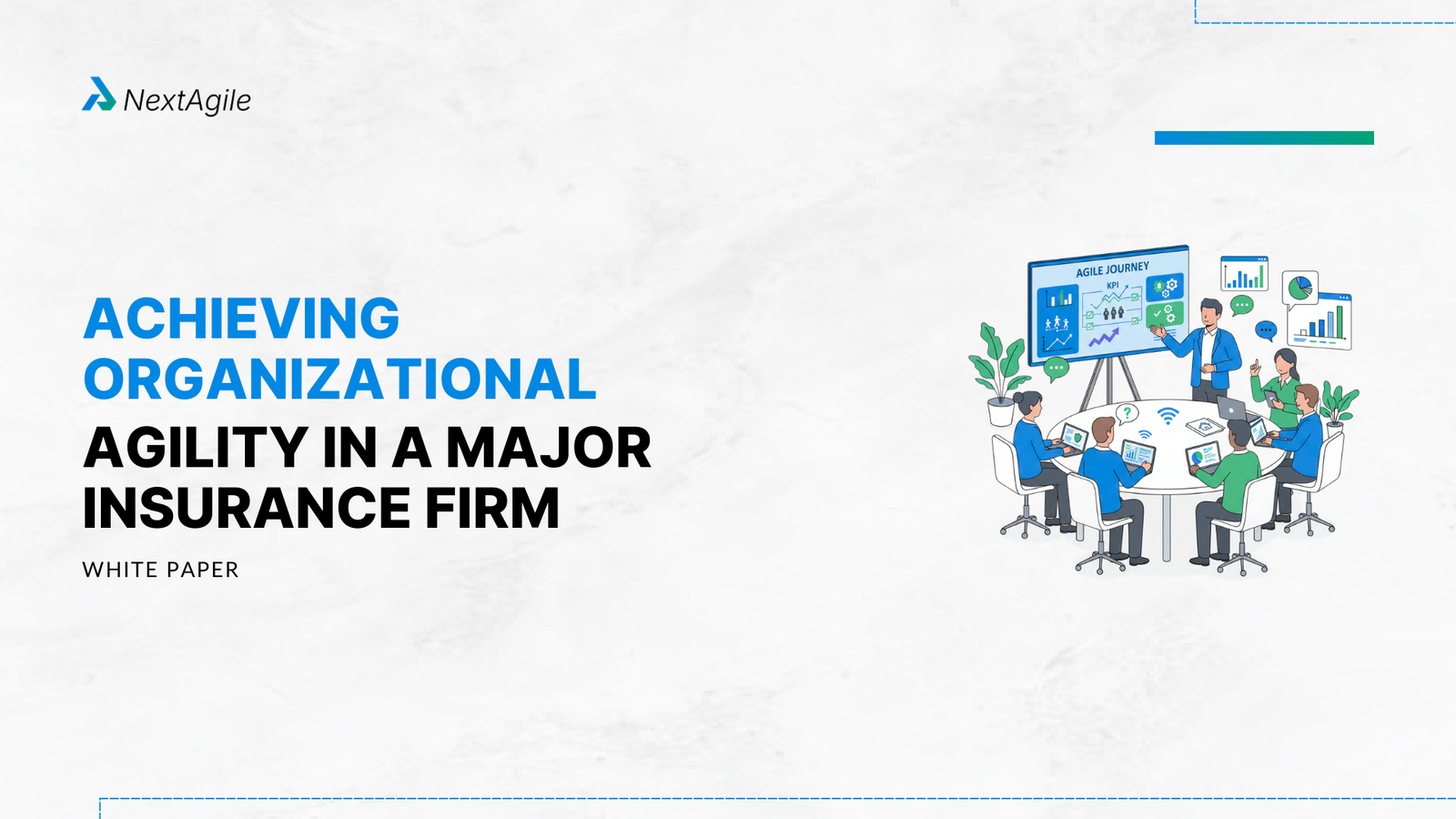
Achieving Organizational Agility in a Major Insurance Firm
Anuj Ojha
Talk to Expert for Free
Table of Contents
Executive Summary
The insurance sector is facing increasing pressure. Customer expectations are evolving rapidly, regulatory pressures are intensifying, and digital-native competitors are setting new standards for responsiveness and efficiency. Legacy operating models, siloed organization, hierarchical decision-making, waterfall-based delivery have left insurers wrestling to keep pace. Legacy models amplified risk instead of managing it.
NextAgile joined forces with a top insurance company to shatter this pattern. The goal: scale agility, increase predictability, and build real cross-functional teamwork. With pilots, POD-based organization, role-based training, governance designs, and Spotify-based scaling, the company revolutionized how scores of teams produced value. Agility was positioned as an operating model shift, not a delivery experiment.
The outcomes were concrete: smaller handover latencies, quicker decision-making, tighter accountability, open dashboards for leaders, and cultural transformation towards a “one-team” culture. This white paper describes the challenges encountered, the phasewise transformation strategy, the achievements realized, and important lessons for other businesses pursuing enterprise agility. Transparency became the foundation for trust and speed.
Problem Definition
1. Business Context & Challenges
The client, a large insurance company with several business and technology functions, was experiencing systemic delivery issues. The challenges were structural, not individual performance issues:
Siloed, hierarchical organizations: Business, IT, vendors, and compliance functions operated in silos. Dependencies and conflicting priorities hindered delivery. Escalations were addressed more through relationships than defined ownership. Dependencies multiplied while accountability diluted.
Weak ownership and responsibility: When several functions were engaged, no one actually “owned” results. Teams buck-passed rather than fixing blockers. Escalations replaced empowered decision-making.
Low visibility and gaps in governance: Leadership did not have trustworthy dashboards or measures. Dependencies, bottlenecks, and speed were opaque. Risk management was reactive, not proactive. Risks surfaced late, when options were already limited.
Legacy delivery models: Old-fashioned, waterfall-like SDLC with much documentation and hand-offs. Loops of feedback took long, hindering responsiveness. Feedback latency directly impacted customer and regulatory responsiveness.
Remote work stress: COVID-forcings dispersed work revealed shortcomings in teamwork and meeting discipline. Time-boxing and formal feedback did not exist. Distributed work exposed the absence of disciplined collaboration norms.
The net result was inevitable: delayed value delivery, disappointed stakeholders, ineffective collaboration, and a lack of responsiveness to customer or regulatory requirements. Delivery friction became the organization’s default state.
2. Strategic Objectives
Objectives were defined to reset ownership, speed, and trust. To turn this around, the client established precise strategic results:
Increase certainty in execution by detailing ownership, minimizing dependency slowdowns, and harmonizing priorities.
Create a “one-team” culture within business, IT, vendors, and compliance.
Improve visibility and transparency through governance structures, dashboards, and quantifiable KPIs.
Shorten feedback loops to drive greater adaptability and minimize rework.
Establish cultural readiness for agility, with internal champions and communities of practice.
Each objective reinforced execution certainty and regulatory confidence.
Analysis: What We Did & Why It Mattered?
Transformation was approached as a system change, not isolated initiatives. NextAgile created and led a phased, structured Agile Transformational journey.
Located and initiated pilot PODs (~50 members) to pilot agile ways of working in digital program initiatives. Pilots created psychological safety for experimentation.
Delivered awareness and training to 80+ employees, including Scrum Masters, Product Owners, and stakeholders. Shared vocabulary reduced misalignment across roles.
Scoped out transformation issues through baseline maturity surveys and role mapping. Data replaced assumptions in diagnosing change needs.
Why It Mattered?:
Pilots facilitated safe experimentation while showcasing quick wins.
Agile Training developed common language and awareness among leadership and teams.
 Skip to content