Key Highlights of Agile for Startups Agile helps startups to ideate, build, test products at lightning speed and further on help them in adapting to changing market trends Stay assured, approaches like Scrum, Kanban, and Lean can be tailored to any startup, be it tech or non-tech Simple tools and regular feedback loops is what small teams thrive on & this is exactly what agile ways of working brings on table For startups to sustain, avoiding costly detours matters and as startup scale the same cost spike further and implementing agile ways of working stepwise could be savior Mistakes (like over-planning or skipping retrospectives) are common, but avoidable What Is Agile for Startups and Why It Works Definition and Key Principles Tailored to Startup Teams Agile for startups is actually an operating mindset that stuffs feedback and adaptability in iterations, which at the core of bringing agility. Agile methodology for startups refers to organizing work for any of the focus groups (whether tech, business, or team processes) around continuous cycles of planning, building, showcasing, and adjusting. Could they inculcate the core ingredient of agile which is embracing change at every turn? It is a very tough journey and could be endless till they want to be in the game because change is inevitable.
I believe the core principles apt for startup teams from Agile Manifesto are:
Building in small steps, shipping early and often Welcoming changes, even late in the process Regular adaptation & reflections is key hence agile approaches encouraged in getting real feedback, not just internal opinions Everyone shapes outcomes hence building self organizing teams by empowering them and imbibing cross-functionality Why Agile Is Preferred for Startups Compared to Traditional Models? If I say to anyone from the current generation of startups, that we use to specify everything upfront and stick to the plan then that person will laugh and might also call me a dinosaur. Today’s startups operate in a world of rapid change. Customer needs shift, priorities evolve, and solutions may need to be radically rethought. In my city, we now get groceries and other items delivered to our home in less than 10 min which if I compare before ie. a year back used to take 30 min (that’s relatively traditional), 5 years back used to take 2-3 hours and a decade back used to take half a day or next day to receive. Agile’s built-in process for responding to change makes it a perfect fit for startups, where the cost of stubbornness is survival.
How the Agile Mindset Aligns with Product-Market Fit and MVP Cycles? ‘Build, measure, learn’ directly complements the process of finding product-market fit, which is a call-out of the Lean Startup mindset. Building a “minimum viable product” (MVP) is not a one-and-done step, it actually requires a series of experiments like making on-demand releases, gathering user reactions, and improving relentlessly. Agile ensures that teams are always learning, avoiding wasted time on features nobody wants – a pursuit to be relevant all the time.
Choosing the Right Agile Methodology for Startups Overview of Scrum, Kanban, Lean, and Hybrid Models Scrum Kanban Lean Startup : It’s like a cycle process which is apt for teams who are looking for rapid experimentation, validated learning and at the same time mindful or minimizing waste.Hybrid models : Many startups blend these frameworks depending on stage and team style. Which Agile Methodology Fits Your Startup Stage and Team Size? Early-stage, small teams : Kanban, Lean Startup or a lightweight Scrum often works best—minimal overhead, fast feedback.Growing teams (10+) : Scrum can help implement clear rhythms and roles.Non-tech, business, or marketing functions : Kanban’s flexibility often fits non-developer teams well. Differences Between Agile for Tech Startups and Non-Tech Startups Agile in tech emphasizes the ‘continuous everything’ mantra i.e. short cycles of just-enough planning, design, code, deploy, and feedback; in non-tech startups, it may mean marketing sprints, customer discovery interviews, or rapidly iterated business model pivots. The core is the same – structured experimentation and relentless improvement. All in all, to stay relevant it is important for tech and non-tech to find their own ways to respond to change and stay proactive to sense the future trends and start preparing for it.
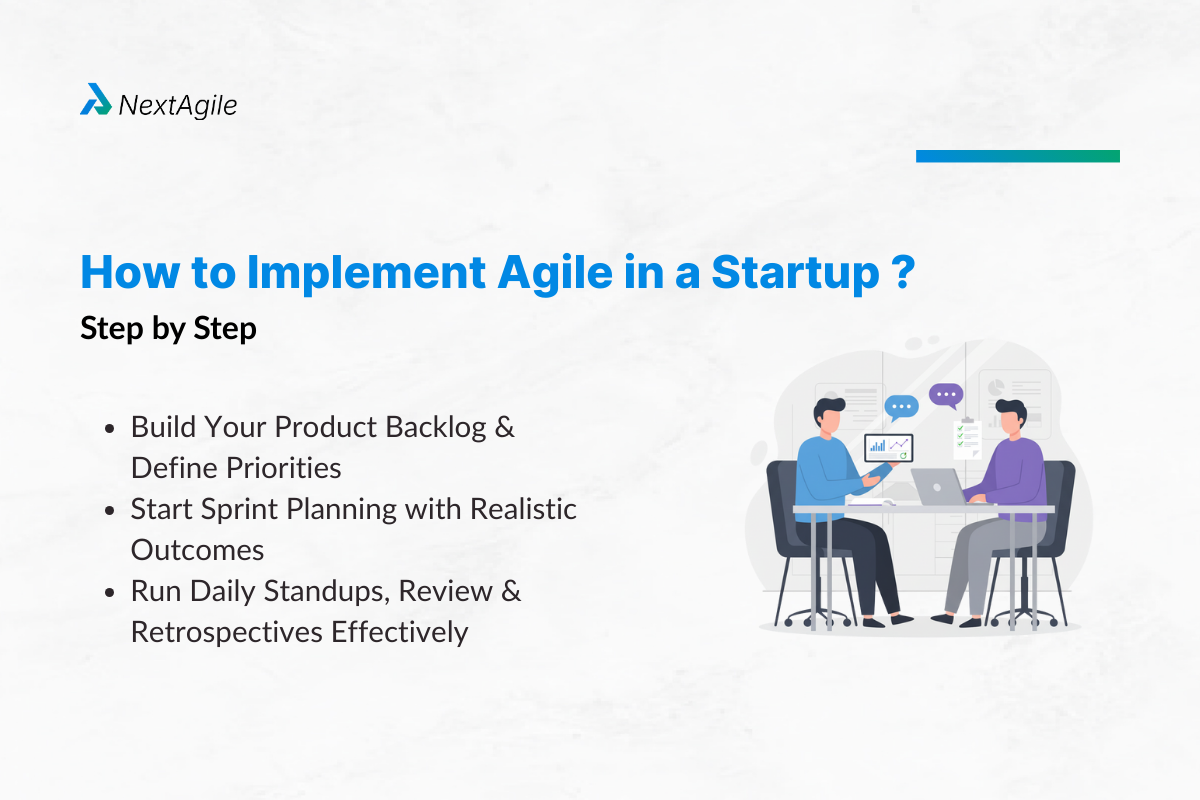
How to Implement Agile in a Startup Step by Step?
Build Your Product Backlog and Define Priorities First step is to conduct product discovery Start with identifying personas or potential customers Conduct empathy maps to understand the personas well like knowing their goals, current challenges, expectations, feelings, likes and dislikes etc. Determine their current journey to solve the problem, what are they finding good or bad or ugly at each step and finally identify the opportunities to build solutions or services to make each step of the journey effective or possibly challenge the status quo and redesign a new journey all together Once you get the hang of the new journey, which we also call as ‘To-Be’ flow, then it’s time to collect all the ideas required to build those solutions and services that you have identified earlier You may go one step further, identify your MVP and also attempt to prepare future increments or go-to market strategy Once this is all done, then come preparing of the backlog Create a prioritized list of features, tasks, or hypotheses, based on the ideas collected from stop map & this is your product backlog. For each item, clarify its value and how you’ll know it’s “done.” Prioritize ruthlessly by asking questions like ‘What’s most crucial to get customer validation fast? ’ Remember, TIME is your currency. Pick a short sprint cycle (1–2 weeks for early startups). Do not play safe by choosing the simple items but take the critical problem/s to solve first Identify the tasks that you truly believe can be completed within that sprint. Get buy-in from the whole team & remember the idea is to create a self-organizing team where the commitments are owned, not assigned. Run Daily Standups, Review and Retrospectives Effectively Daily Standup (or Daily Scrum or Daily sync) as the name suggests is an event that happens everyday, timeboxed to 15 minutes, focused on progress, plans, and blockers. The important question to know at the offset of each instance is to know how confident we are in achieving the goals of the sprint and what we should do to achieve the goal?On the last day, at sprint review we present our outcomes to the invited stakeholders to seek their feedback and to learn about their expectations to course-correct in future sprints A retrospective event is intentionally planned at the end of each sprint cycle, the intention is for the team to openly discuss what went well, what needs improvement & then act on it. In my experience I have observed that teams that acquired best of agility aren’t those who have experts but those who have preferred consistency over perfection. The best agile teams simply make reflection and adjustment non-negotiable.
Growing teams often invest in agile training for companies to scale faster
Tools That Support Agile for Startup Teams Lightweight and Budget-Friendly Agile Tools Compared Startups who want to make their mark are either bootstrapped or have limited budgets and rarely need expensive, enterprise-class software. I have experienced that in many large organizations who can afford any tool they could are not using that software at par and teams are using just a limited few capabilities of the tool. So, the best agile tools are ones your team will actually use which have simple UI, good mobile support, and maybe integrations with your existing stack. My suggestion is to ask you teams with just-enough features they find useful for tracking progress and then gradually append other features which we might require.
Features to Look for as a Small Team Visual tracker for task management (easy to create, drag & drop, clear columns) Easy backlog and sprint creation plus ability to create different issue types like features, tasks, bugs etc Collaborative features (comments, checklists, tags) Affordable pricing and/or generous free tiers Trello vs ClickUp vs Jira vs Notion Tool Strengths Pricing Limitations Trello Visual, simple, flexible Free; low-cost Fewer advanced features ClickUp Customization, automation Free; paid tiers Can get complex as you scale Jira Deep agile features, reporting Paid (has free) Steeper learning curve Notion All-in-one docs + kanban Free; paid tiers Limited agile templates
How Agile Helps Startups Innovate Faster? Reducing Risk with Iterative Development Iterations give us the comfort of not knowing everything but focusing on one problem at a time. It gives us the opportunity to fail faster. The feedback loop creates positive tension and at the same time reminds us that change is inevitable. By releasing in increments, startups catch mistakes early & avoid risking months of wasted effort. This “fail small, learn fast” approach is why agile is so often credited with reducing product and market risk.
Speeding Up User Feedback and Learning Loops Agile approaches like scrum bakes the constant feedback into the process (with customer demos, usability tests, and analytics). This loop means teams validate ideas with real users by creating a potentially shippable increment, not just gut instinct, and course-correct before sizable investments.
Case Examples of Agile Helping with Fast Pivots Plenty of iconic startups began with one idea and, through quick cycles of agile experimentation, discovered another (Instagram’s pivot from a check-in app, Slack’s start as a game builder). In India, Zomato app was earlier for checking the restaurant reviews and now a food-delivery app. Likewise, we at NextAgile started with turnkey transformation applying simple agile approaches like Scrum then further up we started growing our team and implemented SAFe framework and now we are helping our customers with OKR implementation, Design thinking and also providing support with new age AI competencies. The constant feedback and short release cycles made these pivots possible.
Common Mistakes Startups Make When Using Agile
Over-Planning or Applying Enterprise-Level Structure Startups sometimes try to implement full-scale agile frameworks meant for large enterprises or they could be impatient enough to understand what it brings and go-ahead adopting it as they might have heard the success stories. This bogs teams down in meetings, paperwork, and dogma instead of speed and learning. Not just startups but any size organization function well when they stay lean.
Treating Agile Like a Rigid Checklist Agile is a trait developed by cultivating a mindset, not a set of forms or rituals. Running “standups” or “sprints” without open communication and ongoing learning misses the point. The teams end up finding it as a mini-waterfall which is more stressful. It’s important to stay open and collaborative throughout.
Skipping Retrospectives or Not Acting on Feedback The anti-patterns observed in many teams are either they skip retrospectives or ignore their lessons. At times they continue doing retrospective but the same concerns repeat in every sprint. The heart of agile is adjusting as you learn and this is where teams actually get faster and smarter.
Real Challenges of Agile in Startups Maintaining Agility While Scaling Fast Startups continuously work on their ideas, seek feedback, pivot and keep doing that until they get funding to scale further or a sudden spike in demand. Scaling rapidly can lead to layers of process and sometimes slowing down decision-making and taking away autonomy. The key is to keep focus on outcomes, not just process and at the same time we need to focus on building small teams who are empowered and own problems and stay autonomous in their solutioning approach.
Managing Async Workflows in Remote Teams Trust is the most crucial aspect when it comes to remote distributed teams. Without trust it is not possible to build quality products and deliver faster. Creating an effective communication channel needs greater discipline and to keep it upbeat it requires clear documentation, reliable updates, and scheduled (not endless) meetings.
Balancing Process and Flexibility in Chaotic Phases Especially in early-stage chaos, the temptation is to throw out all structure as it’s understandable that everybody has high stakes to prove the idea is worth risk and put their high stakes. We strongly recommend the startups to at least stick with minimal, essential agile routines to keep learning fast.
Agile vs Lean for Startups: Which One Should You Choose Key Similarities and Differences Explained Aspect Agile Lean Focus Iterative delivery, adaptability Eliminating waste, maximizing value Origins Software/project management Manufacturing/startup innovation Key practices Scrum, Kanban, XP Build-Measure-Learn, MVPs
Can Agile and Lean Work Together in One Startup Process? Yes. Many founders combine lean startup experimentation which promotes hypothesis-driven MVPs with agile workflows i.e. short, structured work cycles to deliver these MVPs and that way they could continuously improve and serve evolving customer needs. It actually blends with the natural need of budding startups because there is a lot of confusion around what could and should be part of the product, whereas Agile and Lean approaches provide exactly the clarity they require.
When to Choose One Over the Other? If your challenge is what to build (unclear product/market fit), start with Lean’s rapid experiments. When you’re scaling delivery and optimizing processes, add more agile structure. Scrum approach is helpful when you want to incrementally build a solution, seek feedback incrementally and deliver value continuously. Overall you have an idea of what you are building. In situations where you can not plan well like in cases of maintenance projects or production support environments, Kanban is helpful.
Should You Consider Agile Coaching for Startup Teams? When Internal Coaching Is Enough? If your founder or early team has experience with agile (and there’s high trust), internal coaching often suffices. Just one strong advocate can seed the right habits. Still it is important to seek advice from experts who could bring the out of the box perspective.
Signs Your Team Needs External Agile Coaching Support
The decisions are biased by internal conflicts and not taken rationally Confusion about process or goals within the workforce Regularly missed releases and overtime work to fix some critical issues happened due to lack of guidelines No improvement despite retrospectives Blame-game Internal Coach is submissive to co-founders and not to business growth External coaches can help diagnose process bottlenecks or dysfunctional culture and aren’t burdened by local biases.
What Agile Coaching Looks Like at a Startup Scale? A startup needs hands-on practitioners who have skin in the game and are sharing the same passion and zeal like everyone else. Good coaches work with the team (not just leaders), mentor rather than dictate, and prioritize lightweight frameworks that address real needs and not just theory.
How to Measure Agile Success in Your Startup? Key Delivery Metrics: Velocity and Cycle Time Velocity is about how much work the team truly completes per sprint & complete means meeting the Definition of Done Cycle time is about how quickly a task moves from start to finish Defect Removal Efficiency is about capability of figuring out most of the bugs before production or Live environment DORA metrics to evaluate technical efficiency and staying relevant to the core of agility These metrics give you hard data for honest improvement.
Learning Indicators: Fast Pivots or Quick Validation It is important to constantly ask questions like did you actually learn something new about your users, market, or hypotheses this sprint? Seeking feedback is not just in sprint review but also after the consumers start using it. We should constantly be in touch with our users be it directly reaching out or by automating the ways to understand their experience. Agile success means not just moving fast, but in the right direction.
Outcome-Driven Metrics Linked to Product-Market Fit The ultimate metric is the real validation i.e. is your product solving real problems for real customers? Track retention, engagement, or other metrics core to your business value and not just “story points”, velocity etc.
Conclusion Agile for startups is not an option but a necessity and something which will easily blend with their desire to succeed, as agile ways of working advocate practical ways to stay close to customers, learn fast, and make the most of every hour. Choosing the right framework is key to rapidly changing dynamics in startups and that requires lightweight tools to track progress, a mindset that improvises with changing priorities and customer feedback. It is also needed to understand both the ability of startups to prove their worth and the power of agile to accommodate changing demands, which will help teams to innovate, adapt, and grow.
Struggling with agile adoption at a start up or have questions about what might be the best framework for your context? Reach out to us at NextAgile Agile Consulting Services to curate a contextual agile transformation journey for your organization.
Frequently Asked Questions About Agile for Startups 1. Can marketing or business teams in startups use agile too? Absolutely! Agile works for any function that benefits from cycles of planning, execution, review, and adjustment which its popularity is more related with IT. Marketing teams could use it for iterating on their campaign strategy to conduct A/B testing. Business Teams could use it to validate their strategic hypothesis to evaluate future positionings.
2. How does agile impact startup culture? Agile approaches help in bringing resilience by not reacting but responding to changing requirements. By promoting the critical traits like transparency, accountability, and constant improvement. Empowering teams and open culture brings the ability to learn from mistakes and not fear them.
3. Is agile worth adopting if we don’t have a product yet? Yes. Agility is not just limited to product development but also before it when we use agile to run discovery sprints to learn about customer needs through interviews, or early-stage experiments.
4. Is it okay if our agile process changes every few weeks? Adapting is the point and not getting stuck to a certain set of rituals that you put yourself around. Of course you need to reason why you are doing it. Document your learning and don’t change just for the sake of novelty but back your act with a thoughtful reason.
5. Can agile work in a startup without full-time developers? Yes, it is not about full time, part time, collocated or remote, but checking if you have a committed team, who is willing to own and iterate their work in cycles.
6. How do we prioritize features in agile if we have limited customer feedback? The best thing is to start with hypotheses based on what you think will matter most. Then, build the smallest possible test, launch, and then use whatever feedback you gather to refine your backlog. Look out options to seek ways to connect your customer and remember that is quite important to stay relevant.
Anuj Ojha is Co-Founder & Consulting Head at NextAgile. Anuj has designed & led multiple turnkey transformation journeys across industries, domains & geographies and has 16+ years of experience as an agile practitioner. He has worked with CXOs, CTOs & Key Leaders to translate their business objectives on the ground, contextualizing org transformations and creating buy-in across level, leading a team of coaches/consultants to implement agility across 150+ teams & trained more than 12k team members. Anuj’s core area of interest is business agility & working with leaders & teams to achieve long term sustainable, Agile culture & mindset.
 Skip to content