Introduction Project Management Methodologies play a crucial role in executing and delivering projects successfully in today’s fast-paced environment, where customer requirements tend to change, and they seek to be involved and updated on the progress, effective project management becomes essential. Project management techniques
This comprehensive blog aims at offering insights into various project management methodologies while exploring what each methodology is, when to use them, and who should use them. Whether you are managing software development projects, product launches, marketing campaigns, or research and development initiatives, this blog will help you select the methodology that best aligns with your project needs.
What Is a Project Management Methodology? Project management methodologies are a systematic approach to delivering projects. These methodologies include planning, executing, controlling and delivering the projects. They provide a structured framework which includes processes, best practices, and guidelines which help teams manage tasks effectively and efficiently from initiation of the project to its completion.
Project management methodologies can be broadly categorized into two types:
Traditional / Waterfall Methodology, also sometimes referred to as Predictive methodology, which follows a structured and linear process with defined stages. Where one step leads to another and the latter step is dependent on the former, which means only once one step is completed the next step can start. Due to the high dependency of one step to move to another, there is little to almost no room for change while the project is being worked upon and is not delivered yet.Agile methodology, also referred to as adaptive methodology, is a new age and systematic way of project management. It offers a flexible way of delivering and managing projects, allowing teams to adapt to changes quickly, even in the middle of the project. While following Agile methodology, the work is divided into small tasks, and teams develop and deliver projects in an iterative manner. These iterations can be 2,3, or 4 weeks in duration, also called sprints, and at the end of each sprint/iteration, the customer receives value in each release, usually called sprints. By following Agile, delivery teams respond to change effectively by keeping customer’s concerns at center. Choosing the correct methodology for a project ensures that teams stay on track, deliver quality results, and meet stakeholder expectations efficiently.
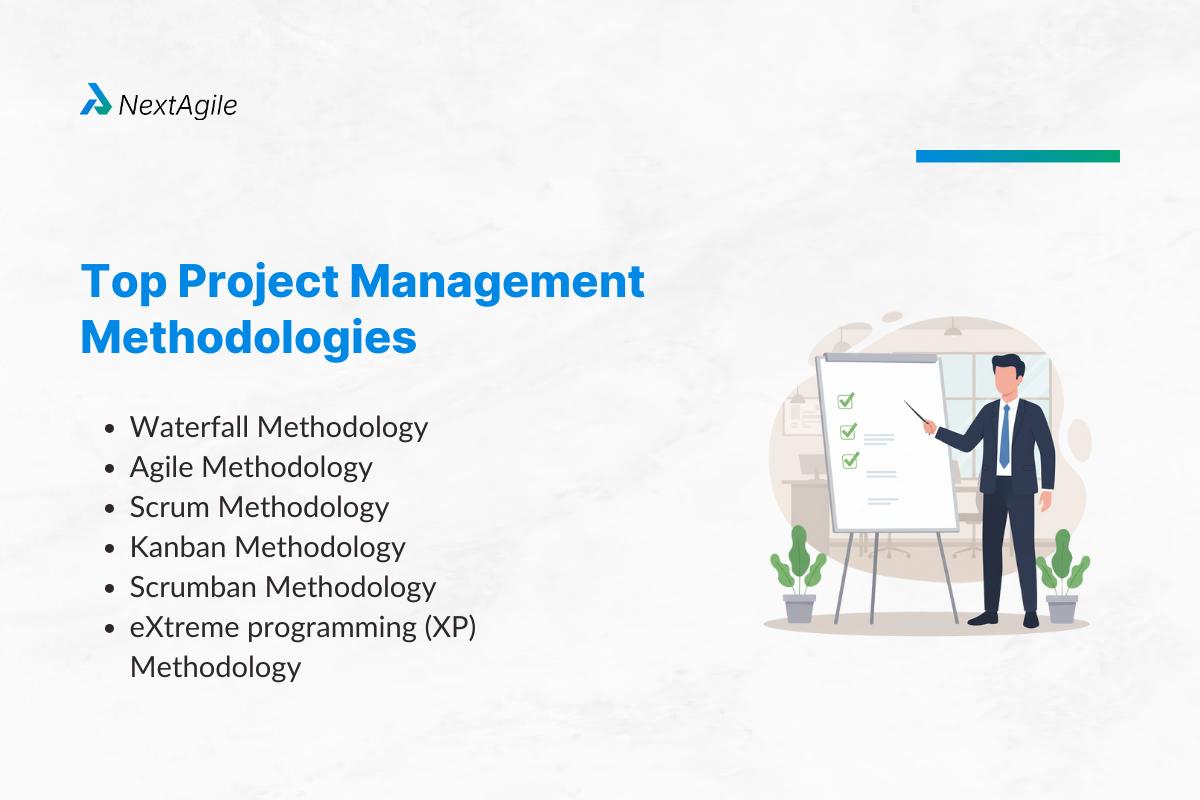
Top Project Management Methodologies Different project management methodologies offer different benefits that are suited to different industries and project types. Lets have a look at the most popular methodologies and get an understanding of when and who should use them.
Enterprises navigating change often benefit from expert consulting agile support.
1. Waterfall Methodology The Waterfall methodology, which is often referred to as the ‘traditional approach’ to project management, is a singular driven process of managing projects. A waterfall can be compared to a staircase. In order to lower at a step or a fall, the water has to pass through the previous one. In the same way, every phase in a project must be fully completed before progressing to the next one. In order for there to be effective handoff from one step to the other, there is a need for a great deal of documentation in each phase.
In this model, there is a defined regimen that must be adhered to. The teams must start with requirements gathering, then move on to design, development, testing, deployment, and then finally move to maintenance. Waterfall methodology is often chosen for projects that have clearly scoped out requirements and there is certainty with respect to the deliverables, i.e. the possibility of project scope change is highly unlikely once the project has commenced.
To analyze and understand more about waterfall methodology, consider the example of a car manufacturing process that follows the Waterfall model. The process starts with the design team and engineers finalising the blueprint of the car. Once that is done, they work on assembling the chassis with the frame of the car. And only after that, the engine, and wiring are fitted. Then the car is painted following which the seats and dashboard are installed. Only after the painting and interior assembly is complete, safety tests and performance evaluation is conducted.
Lastly when the car passes all the tests, its production is scaled and is shipped to different locations. In this example, each phase must be completed fully before the next step can commence, this is how the waterfall methodology works.
2. Agile Methodology Agile allows changes to be made at any point, and is both flexible and iterative in nature. Agile collaboration works both ways, customer feedback can be acted upon by the team, which makes the work adaptable and facilitates improvement over time. Implementation of Agile is done by breaking the project into smaller manageable parts known as “iterations” or “sprints” that yield functional results step by step.
Agile ways of working involves working closely with the customer, who is provided with working demonstrations of the functional increment(s) at the end of each iteration for input and adjustments, if necessary. This repositioning allows the client to modify project scope in order to ensure that the end result delivers maximum value to the customer and the market, while remaining competitive.
This approach is best suited for software development projects or in any industry where change is welcomed. Agile can be utilized by innovative teams or any organization that requires rapid responsiveness and flexibility.
Many leaders evaluate agile vs traditional project management before choosing a model.
3. Scrum Methodology Scrum is one of the most well known frameworks of Agile. While following scrum framework, development is accomplished in increments through time-boxed sprints of 2-4 weeks depending on how often the development team would like feedback on the product being developed.
Scrum focuses on teamwork, accountability and progress checks. Scrum allows flexibility and fosters improvement by following ceremonies such as sprint planning, daily stand-ups, sprint reviews and retrospectives. While implementing scrum, teams have specific roles like Scrum Master and Product Owner, and use artifacts like product and sprint backlogs. Each development team is a cross functional and self-organizing team that can deliver results autonomously.
Scrum is preferable for projects with frequent checkpoints, and the customer’s expectation is likely to change as the work progresses.
4. Kanban Methodology Kanban is one of the many frameworks used for Agile adoption
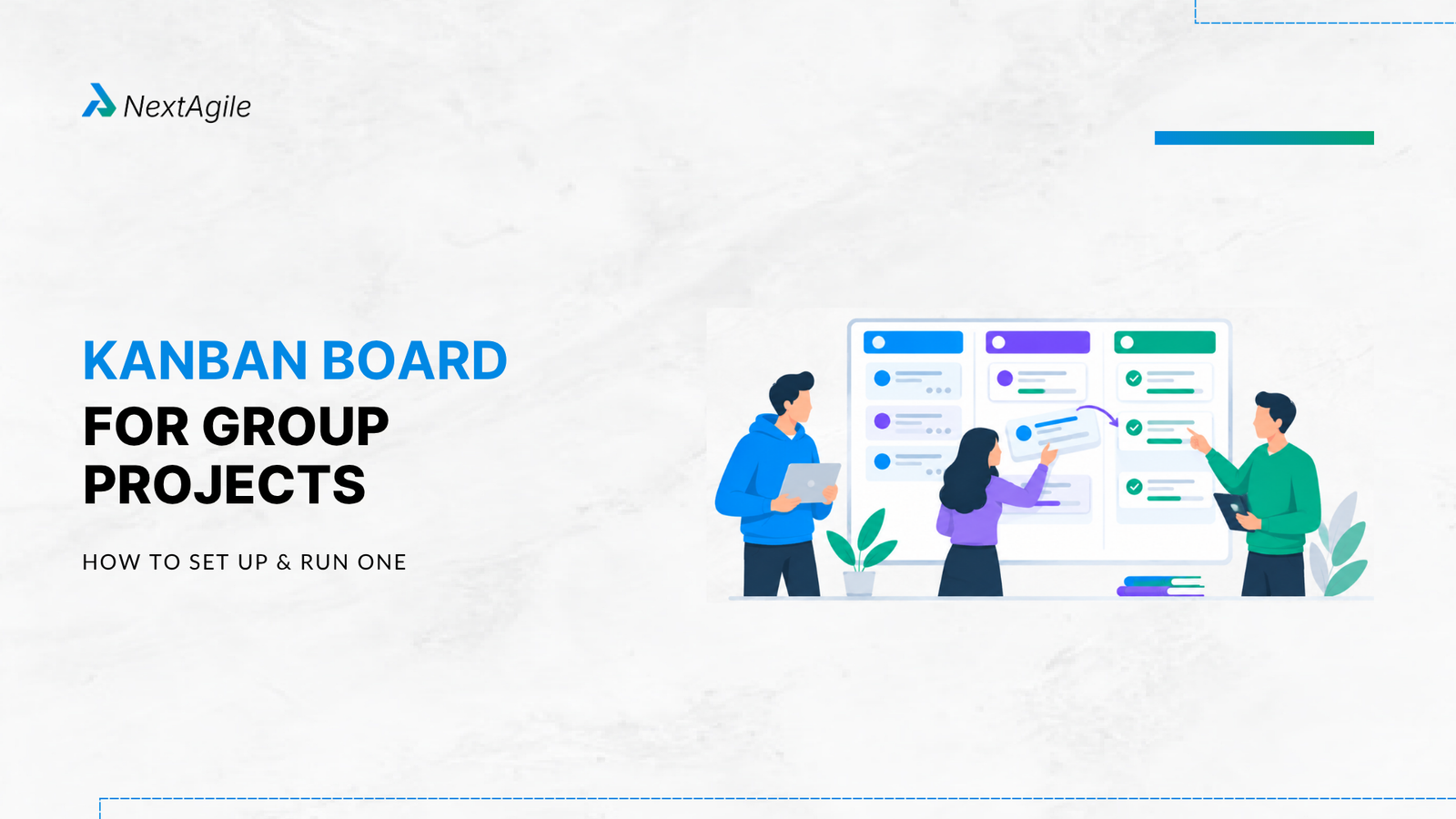
Kanban is predominately visualized using boards, with three main columns indicating to-do, in-progress, and done. These boards help teams keep track of tasks and progress as they move through different stages. It is also possible to have more columns depending on the steps involved in a given project. The overarching objective is to enhance efficiency, minimize bottlenecks, and optimize workflow by ensuring work is continually delivered.
Various teams working on the same project or with constant tickets can dynamically take a view of the workload. Frequently employed by operations, IT support and even manufacturing teams, a helpful example is a customer support team using a Kanban board to ensure ticket resolution in which urgent tickets take priority.
5. Scrumban Methodology Scrumban combines Scrum’s sprint planning structure with Kanban’s visual workflow tools to create a hybrid Agile methodology. Scrum’s structured approach with Kanban flexibility allows teams to maximize this methodology through continuous improvement. Teams achieve efficient management of structured tasks and spontaneous work through this methodology.
Teams transitioning from Scrum to Kanban or those needing both structure and flow while handling complex projects with changing priorities will find Scrumban to be the perfect methodology. e.g. The digital marketing team organizes campaigns in sprint cycles yet they manage content approvals through a Kanban board.
6. eXtreme Programming (XP) Methodology eXtreme Programming (XP) functions as a specific branch of Agile software development methodology concentrating on technical excellence while continuously integrating customer feedback. XP promotes regular software releases and pairs developers to review and adjust each other’s code instantly along with test-driven development (TDD) which requires writing automated tests before product development and continuous integration which involves developers merging their code into a main repository on a regular basis. XP strives to enhance both the quality of software and its adaptability to evolving requirements. Tech projects that experience fast-paced requirement changes benefit most from this approach.
Projects requiring both rapid adaptability to changing specifications and high-quality software delivery are well-suited by this methodology.
By implementing XP techniques such as pair programming and continuous integration, fintech businesses can maintain their apps’ security and relevance while achieving minimal customer downtime.
7. Adaptive Project Framework (APF) Methodology APF enables teams to adjust their approach by incorporating feedback and previous project experiences through its flexible iterative process. The Adaptive Project Framework (APF) provides a flexible iterative approach specifically for projects that require adjustment to requirements during their entire life cycle.
It allows teams to adjust strategies based on continuous feedback received from team members and customers and changing project needs, fostering creativity and innovation in uncertain environments.
It is ideal for innovative projects with evolving goals, for projects where requirements may evolve over time. Teams handling innovative or exploratory projects like R&D teams and organizations working on experimental projects can make the best out of this methodology.
8. Lean Methodology Lean project management is based on the principle of creating value while minimizing waste. The process reduces waste by identifying inefficiencies, optimizing workflow and automates non-essential work. Considering the various departments within an organization, customer service is one example. They would go through a process until the customer receives the solution.
Lean methodology aims to identify and eliminate steps that add time to the final outcome. The team endeavors to pinpoint the tickets that remain unresolved while Managers aim to improve efficiency. Continuous improvement and customer satisfaction are the key focuses of Lean. While it can be applied to various industries where additional processes cannot be eliminated or replaced, it is most effective for manufacturing, product development, and service industries. However, despite its limitations, this methodology can yield excellent results for startups and organizations striving for lean operations. It’s well-suited for tasks requiring cost optimization.
9. Critical Path Method (CPM) Resource availability is the primary concern of CPM, a methodology that endeavors to ensure project delivery. The CPM scheduling approach enables teams to determine the order of dependent tasks in a project. The guideline establishes the shortest duration for carrying out the project and specifies essential tasks to be completed. The application is appropriate for projects with numerous interconnected functions. CPM can be used by a construction team to ensure that foundation work, electrical installations, and roofing are completed in synchronized time. Large-scale engineering projects and event planning are examples of industries that can benefit from CPM. This is particularly useful for projects that have limited resources and require a lot of time.
10. Critical Chain Project Management (CCPM) CCPM improves CPM by taking into account resource limitations. This ensures that projects are completed on schedule and teams utilize the most efficient resources, including labor, machinery, and materials.
E.g. Specified engineers and manufacturing units are used by an aerospace company to schedule tasks.
11. Package Enabled Reengineering (PER) An approach to business process recombination using software packages. PER’s enterprise software solutions are predominantly designed to be easily customized. Why? Business operations are made easier by the use of pre-existing solutions like ERP systems. It is the most suitable option for ERP implementations and extensive system upgrades, and is primarily utilized by IT managers and ERP specialists.
12. Outcome Mapping Instead of focusing on project deliverables, Outcome Mapping is used to measure behavioral change in stakeholders. This tool enables teams to monitor the long-term effects of their work. NGOs, non-profit organizations and social development/research organisations use it as an instrument of development and other social change projects.
E.g. Health awareness campaigns monitor changes in community behavior over time, rather than just counting the distribution of brochures.
13. Six Sigma Six Sigma, which is based on data, is used to improve process optimization and defect reduction. Statistical analysis and structured problem-solving techniques are employed to improve efficiency and performance. Quality assurance teams and process managers use it as a key tool for manufacturing and business process improvement. Six Sigma is the most suitable method for projects that require error reduction and process improvement. For instance, a manufacturing plant can utilize it to reduce production defects while increasing the plant’s overall efficiency with improvements in equipment and processes.
14. PMBOK PMBOK is a set of project management guidelines developed by the Project Management Institute (PMI). It is primarily concerned with standard project handling practices. The document outlines guidelines, terms, and principles that are applicable to project managers in diverse areas. For example, Starting from concept to completion, planning, monitoring, and finalizing with the provision of all project details. Suitable for structured project management methods necessitating standard procedures, it is used by certified project managers and large organizations.
15. PRINCE2 The process-driven approach to project management, PRINCE2 (Projects IN Controlled Environments), offers a structured approach for managing projects. It breaks down projects into manageable stages, ensuring precise tasks and step-by-step progression. PRINCE2 concentrates on risk management, business rationalization, and ongoing improvement….
It can be utilized for tasks that demand strict governance and meticulous documentation. The use of PRINCE2 enables large enterprises and project managers to maintain strict control over project scope and risks.
16. Rapid Application Development (RAD) Methodology. The RAD approach emphasizes rapid prototyping and iterative testing instead of comprehensive planning. It emphasizes the importance of collaboration, flexibility, and speedy delivery. Here, the teams plan and gather just enough information to quickly develop a prototype and move forward.
For software development projects that require it quickly, this is the ideal solution.
Organizations modernizing delivery often seek agile project management consulting .
How to Choose the Right Project Management Methodology There is no one “perfect” approach to manage projects. Some project managers make the mistake of thinking they need to use the same project management methodology for every project, while some businesses and teams prefer a certain approach over others. There are various factors that help in deciding on the right methodology for a project.
Here are some factors one should consider when choosing a project management methodology:
1. Project Requirements To start with, understand the requirements of your project like scope, duration, complexity, size and purpose it would solve. Some methodologies might work better for a kind of one kind of project, while others would be more suitable for other flexible and adaptable projects.
e.g. a structured and sequential methodology like Waterfall works well for projects that have well-defined requirements. On the contrary, an Agile way of working would work better for projects where the customer is not sure what they are seeking and the entire scope is still not defined. Projects where the scope is evolving and customers would make more decisions towards the completion of the project as and when they see the demo of what has been developed so far.
2. Project Team It’s important to analyse and understand a project team’s skills and experience. Some methodologies require special skills or training. Assessing whether a team has the necessary capabilities to implement and adhere to a particular methodology effectively and ensuring whether the team understands and is comfortable with the chosen method is crucial.
3. Flexibility vs. Stiffness Understand the level of flexibility required for your project. Agile methodologies like Scrum, known for their adaptability, iterative approach, and frequent feedback, make them suitable for projects with evolving requirements. On the other hand, traditional methodologies such as Waterfall provide a more structured and sequential approach, which can benefit projects with stable and well-defined requirements.
4. Stakeholder Engagement Determine the level of involvement and collaboration required from project stakeholders. Some methodologies such as Agile, emphasise regular stakeholder interaction and feedback throughout the project life cycle. In contrast, other methodologies may involve stakeholders at certain milestones. Assess the importance of stakeholder engagement in your project to choose the appropriate method for your project.
5. Time and Resource Constraints Consider your project’s time and resource constraints. Agile methodologies are the best to use when working on projects with changing priorities and tight timelines. Its iterative nature allows for gradual progress and the ability to adapt to evolving needs. However, traditional methodologies like Waterfall are better for projects that have precise requirements, sufficient resources, and a need for predictability.
6. Type of Industry and Project Consider industry and project type when choosing a methodology. Different industries may have specific methods that are commonly used and have proven successful.
Research industry best practices and consult with professionals in your field to identify methodologies that align with your industry needs.
7. Risk Tolerance Value Evaluate your organisation’s risk tolerance. Agile methodology embraces change and has built-in mechanisms to deal with risks and problems as they arise.
An Agile methodology may be preferred if your organisation thrives in an environment that encourages innovation and adaptation. On the other hand, if your project demands a risk-averse approach with careful planning and documentation, a traditional methodology may be more suitable.
8. Scalability Determine whether the methodology can be scaled to accommodate larger or multiple concurrent projects. Some methods are well-suited for smaller projects or specific workflows, such as Kanban or Lean, while others, such as PRINCE2 or PMBOK, are designed for larger, more complex initiatives. Also, consider whether the methodology can accommodate the growth of your project or handle multiple projects running in parallel.At the end of the day, whether a team thrives with a visual system like Kanban or a structured approach like Waterfall, the right method makes all the difference.
How Consulting Firms Are Helping Organizations Consulting firms come with an extensive experience of working with various types of projects across industries. Due to their expertise and exposure, they approach any engagement with assessing the project’s requirements and goals. Then upon evaluating the organizational needs, project goals, their current ways of project management and understanding its drawbacks, they help organizations in adopting the right project management methodology.
In the initial phase, they facilitate the necessary training and coaching to all the team members involved in the project. They then introduce the project management tools like Jira, Trello, and Asana, which are used for real-time tracking of project progress.
Once the pilot project is successful, they scale this training and coaching to the firm wide as per the scope of the engagement and support each team member until the organization is well transformed.
Need Expert Guidance for Your Organization? From methodology selection to tool setup and team training, NextAgile consultants transformation journey .
Conclusion A project’s success is largely dependent on the project management methodology. Knowing the advantages, disadvantages and uses of each methodology is the key whether it’s the flexibility of Agile or the structured approach of Waterfall. Organizations can apply these techniques which would help them increase their productivity, team collaboration and also better the outcomes by evaluating and understanding the project requirements, team dynamics and industry standards.
This can further be simplified by working with consulting firms which make sure that the methodology they pick, fits the organization’s and project’s objectives. With the right mentorship, and thoughtful analysis of the project and business needs, organizations can pick the right methodology to overcome the challenges regarding project management so that every project is able to deliver the desired outcomes and satisfy its stakeholders.
Frequently Asked Questions About Project Management: 1. What are the main types of project management? The most commonly used project management methodologies are Waterfall and Agile. There are many other sub types both in Agile and Waterfall viz. Scrum, Kanban, Six Sigma, Lean, Prince2, XP, Scrumban etc. All of these plus many other methodologies are already explained in the blog.
2. Which PM method is used most often? In the current scenario, Agile is the most popular project management methodology used, globally, especially in the software development industry as it allows teams to adapt quickly to changes which helps them deliver projects with quick speed to market. However, many other industries like construction and manufacturing still rely heavily on traditional methods like Waterfall.
3. What are project tools? Project tools or project management tools
4. What is the scope of a project? Scope of a project refers to the detailed outline of all the work that needs to be completed to call the project as “complete” or it is the list of everything that we know about what is expected out of the project like its objectives, deliverables, milestones, constraints like exclusions, timelines and budget allocated to a project.
5. Who is a project management consultant? A project management consultant is an external expert who helps organizations in planning, executing, and improving their project management processes. A project management consultant assesses the current project management strategies of the organization and identifies areas for improvement. They implement the best project management methodology, set up the right tools or softwares to optimize the project delivery at org level.
They are also responsible for providing training and coaching to the team members to help them bring clarity about their roles and responsibilities. They set up metrics at project level and then scale it to organizational level while bringing standardized project management processes in the organization.
Sahil is an Agile consultant at NextAgile. Sahil has overall 11+ years of experience as an Agile practitioner with 5+ years of experience in agile coaching. He has been part of two organization-wide Agile transformations and coached 35+ teams across geographies. His expertise lies in fostering “One Team” mindset, collaboration and flexibility to enable a high-performing team culture led by Agile ways of working.
 Skip to content