Skip to content


Introduction
“The journey of a thousand miles begins with a single step.” – Lao Tzu
Similarly, the journey of a successful product begins with a well-groomed Product Backlog. I remember a time, early in my Agile career, when our backlog resembled an archaeological dig site. User requests, half-baked ideas, and ancient bugs lay buried beneath layers of outdated priorities. Sprint Planning felt like wading through mud, each item requiring extensive excavation and clarification. We spent hours just trying to understand what we were supposed to build, let alone how long it would take. Our velocity was sluggish, and frustration was palpable. It was not until our new Product Owner, Daksha, joined and introduced consistent backlog refinement – that regular “polishing of the gems” – that we started to see a real difference. Suddenly, the top items shone with clarity, estimations became more accurate, and Sprint Planning transformed from a grueling ordeal into a focused, efficient event. Our “thousand-mile journey” finally had a clear starting path, one carefully paved through effective backlog refinement.
So, What is Product Backlog Refinement? It’s an ongoing event, not a rigid meeting or a burdensome ceremony, where the Scrum Team, primarily led by the Product Owner, collaboratively reviews, discusses and prepares Product Backlog Items (PBIs) for upcoming Sprints. Think of it as a continuous grooming process, ensuring that the most important items are clear, well-understood, estimated, and ready to be pulled into Sprint Planning. This isn’t about detailed planning for months ahead; it’s about creating a healthy, transparent, and manageable backlog that empowers the team to deliver value efficiently and effectively.
Understanding the essence of this event is a vital activity and is paramount for any Agile team. It’s the engine that fuels successful Sprint Planning and ultimately drives the delivery of a valuable product. But why is Product Backlog Refinement Important? Let’s delve into its key benefits.
Why is Product Backlog Refinement Important?
The time and effort invested in effective backlog refinement yield significant returns across the entire product development lifecycle:
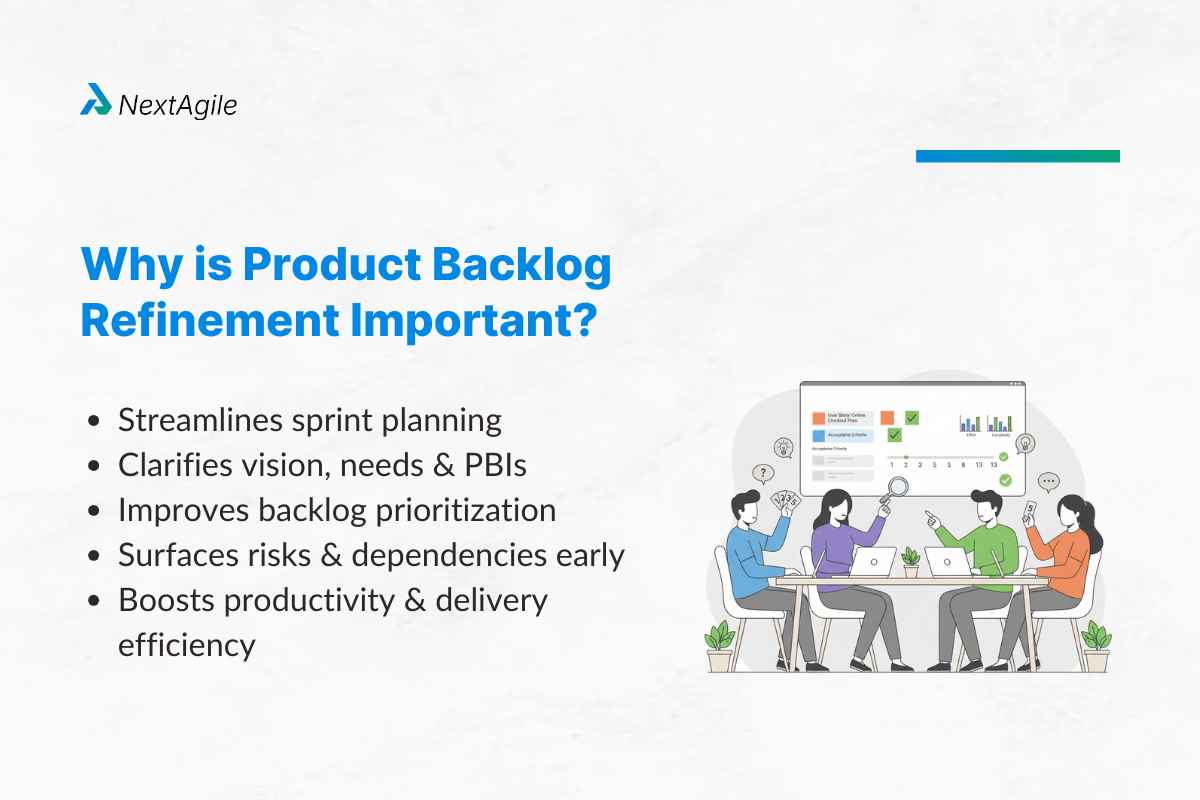
A well-refined backlog significantly streamlines Sprint Planning. When the team arrives at the planning event, the top items are already clear, estimated, and understood. This reduces lengthy discussions, minimizes ambiguity, and allows the team to confidently commit to a realistic amount of work for the Sprint. Instead of spending valuable planning time dissecting unclear stories, the focus shifts to strategizing how to best deliver the ready items.
Refinement builds a shared understanding of the product vision, user needs and the specific requirements for each Product Backlog item or PBI. Through collaborative discussions, the team can ask clarifying questions, challenge assumptions and gain a deeper insight into the “what” and the “why” behind each item. This shared understanding minimizes misinterpretations and ensures everyone is on the same page before development begins.
The refinement event provides a regular opportunity to revisit and validate the prioritization of the backlog. The Product Owner can present the latest business context, market feedback, or stakeholder input, allowing the team to collectively assess the value and urgency of each item. This ensures that the team is always working on the most important things that will deliver the greatest value to the customer and the business.
During refinement, the team can proactively identify potential risks, dependencies between backlog items, and any technical challenges that might arise. By surfacing these issues early, the team can plan mitigation strategies, address dependencies, and reduce the likelihood of unexpected roadblocks during the Sprint. This proactive approach contributes to more predictable and smoother Sprint execution.
When the team works on well-defined and understood items, they experience fewer delays and less rework. Clarity reduces confusion, and accurate estimations lead to more realistic Sprint commitments. This increased focus and reduced friction directly translate to higher team productivity and a more efficient delivery process.
Key Roles in Backlog Refinement
In my early days of Scrum Master role for a team, I witnessed firsthand the power of collaborative Product backlog refinement. Initially, our refinement sessions felt like a disjointed symphony, with each instrument playing its own tune. The Product Owner, Arun, would present items, but the developers often lacked the technical depth to estimate accurately. Designers felt their usability concerns were addressed too late and the QA frequently raised testability issues only when stories were nearly complete.
I realized my role wasn’t just about keeping time. I started actively facilitating, ensuring each voice was heard. I used to prompt the developers with “From a technical standpoint, what complexities do you foresee?“, drawing out crucial insights early. I used to specifically ask Sarita, our designer, “How does this align with our user experience principles?” before estimation. Sujith from QA would get dedicated time to discuss testability and help shape acceptance criteria. Sometimes, when we hit a roadblock on a key feature, I would suggest inviting our lead stakeholder, Sudha, to provide crucial business context.
Over time, the disjointed symphony transformed into a harmonious orchestra. Arun’s vision, the developers’ technical expertise, Saita’s user-centric approach, and Sujith’s quality focus all blended together during refinement. It wasn’t just Arun driving; it was a collective effort, each role contributing their unique perspective. As the conductor, I simply ensured everyone played on time and that the resulting “music” – our refined backlog – was clear, well-understood, and ready for the next Sprint.
Step-by-Step Guide to Product Backlog Refinement
To conduct effective product backlog refinement, follow these key steps:
- The Product Owner should constantly review and update the product backlog based on new information
- Using techniques like value vs. effort, MoSCoW (Must have, Should have, Could have, Won’t have), or WSJF (Weighted Shortest Job First), the Product Owner ensures the most valuable items are at the top of the backlog and ready for refinement
- Identify and discuss any dependencies between backlog items to ensure a smooth flow of work during the Sprint
- The team discusses the top backlog items to ensure everyone has a clear understanding of the desired functionality, user needs, and business value
- Break down large items like Epics or large user stories into smaller, more manageable user stories that can be completed within a single Sprint. This makes estimation more reliable and reduces the risk of carrying over unfinished work
- Define clear and concise acceptance criteria for each user story. These criteria outline the conditions that must be met for the story to be considered complete and provide a basis for testing
- Discuss potential risks associated with implementing each story and brainstorm mitigation strategies
- The team collaboratively ensures that the top backlog items meet the agreed-upon Definition of Ready. This includes having clear requirements, defined acceptance criteria, initial estimates, and identified dependencies
- The Development Team collaboratively estimates the effort required to implement each user story. Story points are a common unit of estimation that represent the relative complexity, effort, and risk associated with a story
- Based on the discussion and breakdown, update the size or complexity estimates for the backlog items
- The Product Owner updates the backlog with any new information, refined user stories, acceptance criteria, and updated estimates
- Product Owner eliminates unnecessary items that are no longer relevant, valuable, or aligned with the product vision from the backlog
- Ensure readiness for sprint planning and ready to be pulled into the upcoming Sprint Planning event