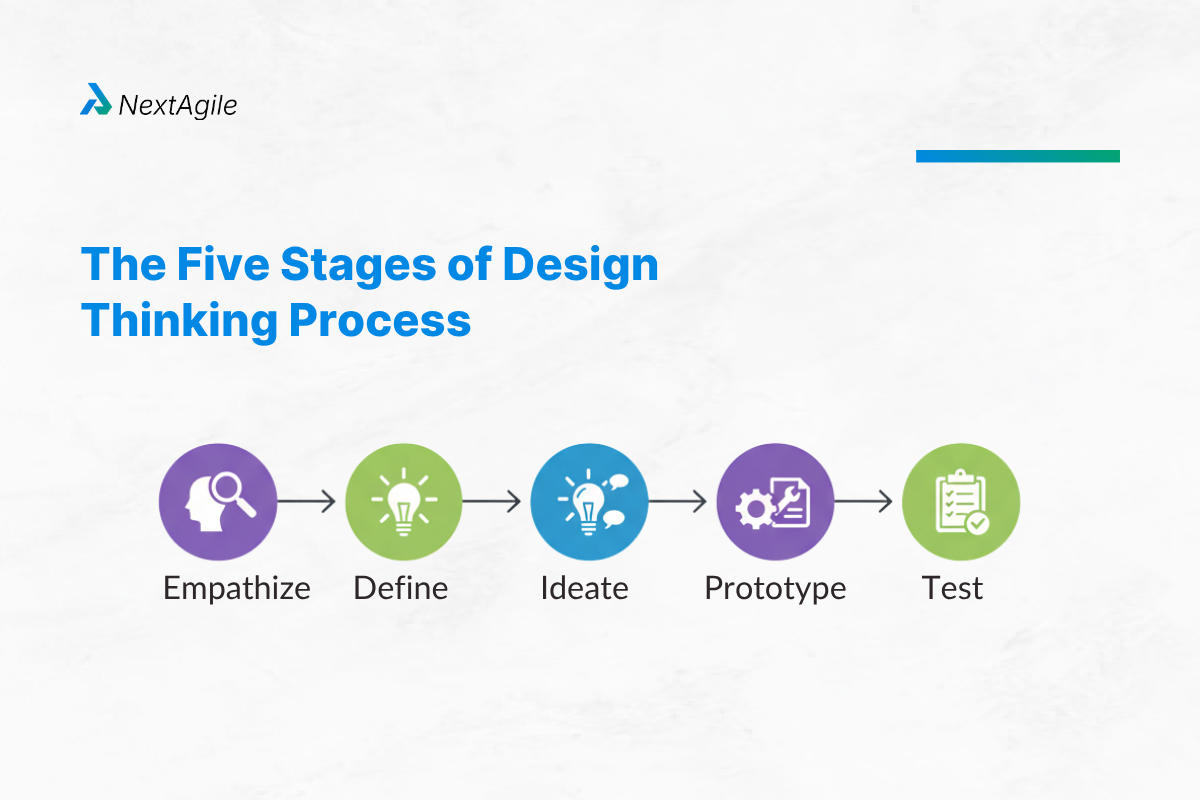
The Five Stages of Design Thinking Process [Design Thinking Step by Step Guide] The stages of Design Thinking offer a structured way of solving user centered problems. These stages involve understanding the user needs, coming up with solutions and pivoting the designs with real time feedback from the users to create perfect outcomes.
Here’s a detailed explanation of the five stages of the Design Thinking process, with an example activities for each stage which can be used a Design Thinking step by step guide.
Empathize Empathize stage is the first of the steps in Design Thinking and it focuses on deeply understanding the user needs/challenges from the user’s standpoint or from their view. This requires putting yourself in the user’s shoes and understanding their perspective. This is one of the most crucial stages in Design thinking process steps.
Ways to do it
User Interviews – Face to face or virtual interviews with real users to understand their challenges, goals, motivationsObservation: Closely observe the users as to how are they using the product or service naturally without any influenceSurveys and Questionnaires: Collect data on user preferences, habits, and expectations. Example: A design team for a new fitness app might interview gym-goers, observe workout routines, and collect survey data on fitness challenges.
Define Once the data is gathered in the Empathize stage on the current state, emotions, where are they stuck etc, it becomes easy for us to narrow down on the actual problem to solve. Redefining the concise problems comes post gathering the data and this is done in the Define stage of Design Thinking process.
Ways to do it
Affinity Mapping: Collate and group similar data points from the empathize stageUser Personas: Create persona documents by grouping users based on roles, age, geography etcProblem Statement: Formulate a problem statement that captures the essence of the challenge. There are multiple frameworks like, elevator pitch, fishbone analysis etc to redefine the problem Example: Based on insights, the fitness app team defines the problem as: “Busy professionals need a way to stay motivated and fit despite a lack of time and access to personal trainers.”
Ideate In the ideate phase of Design Thinking, we diverge on various ideas and solutions that could potentially solve the problem, once the precise problem statement is formed in the previous define stage. Ideas may not purely solve the problem yet, however, explore all possible solutions .
Ways to do it
Brainstorming Sessions: Everyone in the team to come up with multiple ideas without getting influencedMind Mapping: Keep track of all the aspects of the problem and trace it visuallySCAMPER Technique: Substitute, Combine, Adapt, Modify, Put to another use, Eliminate, and ideate innovative solutions Example: The fitness app team brainstorms features like daily motivational notifications, AI-driven personalized workout plans, and quick 5-minute workout videos.
Prototype In this stage of the design thinking process, the team actually created working prototypes of the solution based on the output from the ideation phase, which are implementable. For example – creating prototypes with low code platforms. This could potentially be just the flow without any functionality added. These prototypes should give the user the feel and experience of the real product so that they could give feedback.
Ways to do it
Sketching and Wireframing: Create low-fidelity sketches or wireframes to visualize ideas.Mockups: Develop screens and visual designs which depicts the fields and the flowInteractive Prototypes: Build clickable prototypes or simple models that users can interact with. Example: The team creates a wireframe for the fitness app interface and a clickable prototype of the main features for initial testing.
Test This is the last of the steps for Design thinking process. Once the prototype is ready, take it to the real users, simulate scenarios for the users to take the feedback and observe the users use the app in real time. Feedback from the users could be used to build the actual product.
Ways to do it
Usability Testing: Understand and observe how easy it is for the users to use the app in terms of navigation, number of clicks etcSurveys and Interviews: Collect quantitative data, heat maps, number of clicks etc to understand user’s experience with the prototypeA/B Testing: Compare different versions of the prototype to determine which one performs better. Example: The fitness app team conducts usability testing sessions with potential users, gathering feedback on navigation, design, and content, leading to refinements before launching the final product.
Design Thinking Frameworks
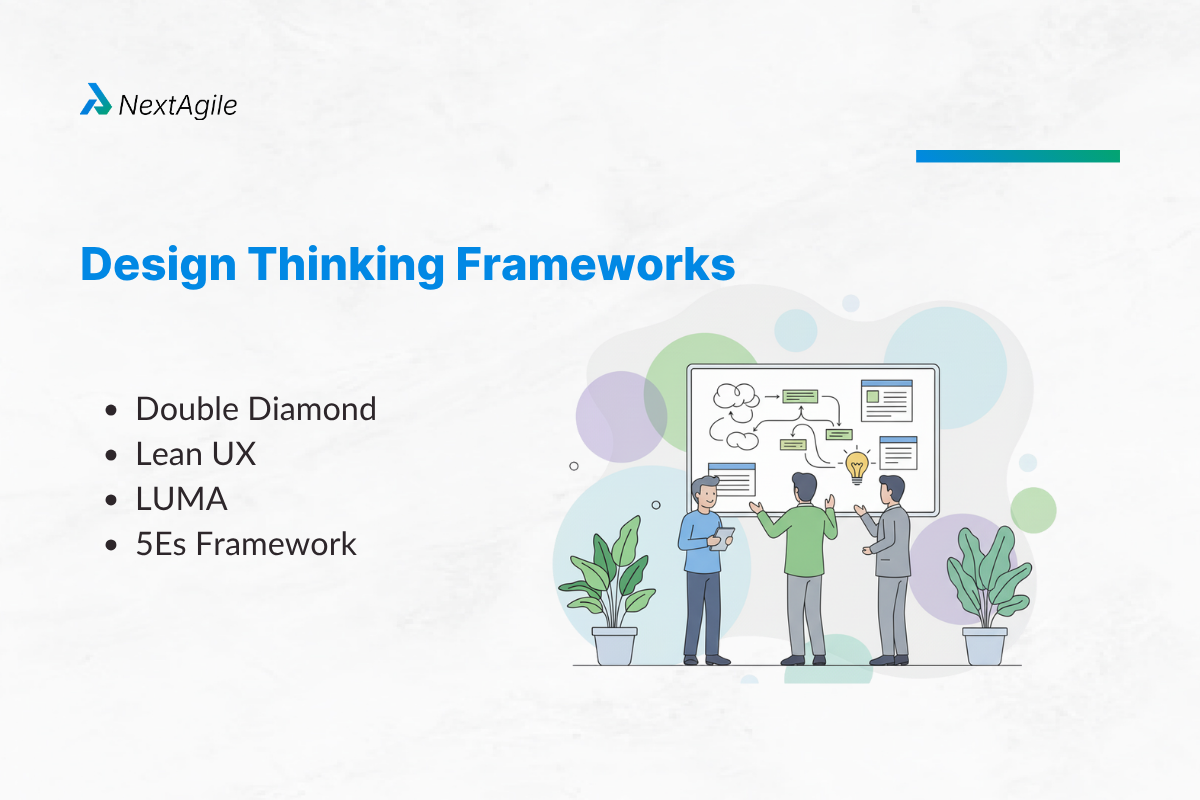
Design thinking as an approach helps teams create the best solution by understanding the user’s problems precisely, coming up with multiple solutions. These frameworks provide a step-by-step methodology to understand users, define problems, ideate solutions, prototype concepts, and test them with real users. While conceptually all design framework solves the same purpose, there are several frameworks when it comes to Design Thinking, some of them include:
Double Diamond Stages include, discover, define, develop and deliver Focusses on divergent thinking to explore wider possibilities and convergent thinking to come up with best solution Lean UX Stages include think, make and check Focuses on reducing waste by quickly iterating with MVPs LUMA Stages include looking, understanding and making Focuses on 36 methods that help teams, understand, analyze and deliver human centered solutions 5Es Framework Stages include, Experiences, Explore, Expectations, Entanglements, and Ends Helps in creating customer journey before, during and after the engagement for service designs Design thinking vs Agile methodology Design Thinking and Agile methodology are different but complementary. Design Thinking focuses on understanding user needs and creating innovative solutions through empathy, ideation, and prototyping. It is user-centered and often applied in the early stages of product development to define and explore problems.
Agile methodology ,
While Design Thinking helps frame and design solutions, Agile efficiently develops and iterates on them.
Here’s a comparison of Design Thinking and Agile Methodology :
Aspect Design Thinking Agile Methodology Purpose Focuses on understanding user needs and creating innovative solutions. Focuses on delivering solutions efficiently through iterative development. Approach Human-centered, empathy-driven, problem-solving process. Iterative, incremental, and adaptive project management framework. Stages/Phases 1. Empathize
2. Define
3. Ideate
4. Prototype
5. Test
1. Planning
2. Development (Sprints)
3. Testing
4. Review
5. Release
Focus Understanding the problem and finding the best solution by exploring various ideas. Developing and delivering solutions quickly and adapting to changes. Key Activities User research, brainstorming, prototyping, testing, and iteration. Sprint planning, daily stand-ups, development, testing, and feedback loops. Mindset Creative and explorative, encourages thinking outside the box. Adaptive and responsive to change, emphasizes collaboration and speed. Team Involvement Involves multidisciplinary teams, including designers, researchers, and stakeholders. Involves cross-functional teams, including developers, testers, and product owners. Outcome Innovative solutions that meet user needs and solve the right problems. Working software or product increments that evolve over time. When to Use Early stages of product development or problem definition. When developing and delivering a product or service incrementally. Tools & Techniques Empathy maps, personas, brainstorming, journey mapping, prototyping. Scrum boards, Kanban , user stories, sprints, burndown charts. Strengths Fosters creativity and innovation; deeply understands user needs. Enhances flexibility, quick delivery, and adaptation to feedback.
This table highlights the distinct roles and complementary nature of Design Thinking and Agile Methodology in product development.
How Consulting Firm Can help to implement Design thinking Process A consulting firm can play a crucial role in helping organizations implement the Design Thinking process by providing expertise, structured guidance, and a fresh perspective. Below are a few ways in which consultants can help teams,
Subject Matter Experts – Having worked with multiple organizations and domain, consulting firms bring vast knowledge and hands-on experience in Design Thinking principles and methodologies, ensuring a smooth transition from traditional problem-solving methodsCreating Awareness – They conduct workshops and training sessions to educate employees on the five stages of Design Thinking — Empathize, Define, Ideate, Prototype, and TestTailoring the Framework – consultants help in identifying key challenges, biases and resistance and opportunities within the organization by conducting assessments, interviews, and observations. This helps in tailoring the Design Thinking approach to fit the organization’s specific needs, ensuring more relevant and impactful solutionsCoaching and Handholding – Consulting firms facilitate cross-functional collaboration by breaking down silos and encouraging diverse teams to work together. They provide tools and frameworks to guide brainstorming, ideation, and rapid prototyping, promoting creativity and experimentation.Building internal capabilities – Consulting firms are experts who can train the teams in upskilling with design thinking concepts, best practices, tools etc. They can also create center of excellence teams for various aspects of the framework who can further drive the adoption within the organization Conclusion The Idea behind design thinking framework is to understand the user’s real problems and challenges and to solve it with the best possible solution. Each stage of design thinking is tailored to different aspects of providing the best fit solution to a user’s problem. It is important that all five phases of design thinking process – empathizing with the user, defining the actual precise problem statement, coming up with multiple solutions to cater to the problem, quickly prototyping with the best fit solution and taking the feedback from the user to validate is followed in the right context.
A step by step Design thinking process proves to be the best approach in avoiding to build a solution which we think is the solution.
Though there are several design thinking models that are constantly evolving, all the models cater to solving user centric problems. Choosing the best fit model is the key that caters and is tailored to your organization’s business. This is where even the consultants come into picture to understand, analyze and then recommend the best model with their expertise.
With this our blog on “5 Stages of Design Thinking process explained” comes to an end and we sincerely hope this has helped you.
Please write to consult@nextagile.ai for any suggestions and feedback.
Frequently Asked Questions About Design Thinking Process 1. What Is The Need Of Design Thinking Design Thinking is needed because it helps solve problems in a way that best understands and serves the user’s needs. Rather than straight away jumping into solutions which may not be relevant to the users, this approach promotes exploring the real problem, defining the problem, exploring multiple solutions, prototyping the best fit and taking feedback from the user which promotes higher customer satisfaction.
2. What Is The Goal Of Design Thinking Process The goal of Design Thinking is to understand the user’s real needs, pain points, challenges and to come up with a solution that best fits them. It helps teams in creating innovative, user centric solutions that address real time problems. It is an approach that reduces the gap between what users want and what teams provide.
3. During Which Stage Of The Design Thinking Process Is A Problem Statement Formed? A problem statement is formed during the Define stage of the Design Thinking process. This stage follows the Empathize stage, where teams gather deep insights into users’ needs, challenges, and experiences. The Define stage focuses on synthesizing these insights to create a clear, concise, and actionable problem statement.
4. Which Stage Of The Design Thinking Process Involves Learning About Customers’ Challenges? Learning about customers’ challenges occurs during the Empathize stage of the Design Thinking process. This is the first step of the 5 steps in design thinking and is dedicated to gaining a deep understanding of the users and their experiences. It involves engaging with customers directly through various methods such as interviews, observations, and surveys to uncover their needs, pain points, and motivations.
5. What Problems Can Design Thinking Solve? Design Thinking can solve a wide range of problems by providing a structured, user-centered approach to innovation and problem-solving. It is particularly effective in addressing complex, ambiguous challenges that require deep understanding and creative solutions.
Design thinking promotes solving user experience problems by analyzing and solving the real needs of the users. In service design, it helps in creating a more efficient process which is user friendly. It also helps in social impact projects by helping design solutions that cater to community needs in the real world.
6. Which Stage Of The Design Process Is Most Important? In the Design Thinking process, no single stage is universally the most important, as all the five phases of design thinking play a crucial role in achieving effective outcomes. However, the Empathize stage is often considered foundational because it sets the groundwork for all subsequent stages. By deeply understanding users’ needs, pain points, and experiences, the Empathize stage ensures that the solutions developed are genuinely relevant and address real problems.
Without thorough empathy, the Define stage may lack depth, leading to misaligned problem statements and less impactful solutions. The insights gained during Empathize inform the Define stage, guiding the creation of a clear problem statement. This, in turn, drives meaningful ideation, effective prototyping, and successful testing. Therefore, while every stage is vital, the Empathize stage is critical for ensuring that the design process is grounded in a true understanding of the users, leading to solutions that are both innovative and user-centered.
7. What Are The 4 P’S Of Design Thinking? The 4 P’s of Design Thinking — People, Process, Product, and Place — offer a comprehensive framework for understanding and implementing the Design Thinking approach.
People : This refers to the users or customers whose needs and challenges drive the design process. Understanding their experiences, motivations, and pain points is crucial for creating solutions that truly address their needs.Process : This involves the structured stages of Design Thinking — Empathize, Define, Ideate, Prototype, and Test. The process provides a systematic approach to problem-solving, ensuring that solutions are developed through iterative learning and continuous feedback leveraging all the phases of design thinking.Product : The tangible outcome of the Design Thinking process, whether it’s a physical product, digital service, or system. The product should be designed to meet user needs effectively and provide value.Place : This encompasses the environment where Design Thinking takes place, including the physical space and organizational culture. An environment that fosters collaboration, creativity, and experimentation supports effective application of Design Thinking principles. 8. What are the five phases of Design Thinking? The five phases of Design Thinking are empathize, define, ideate, prototype and test. They are also called the design thinking 5 steps or 5 stages of design thinking.
9. What are the five steps of Design Thinking (5 steps of Design Thinking)? The five steps of Design Thinking (5 steps of Design Thinking) are empathize, define, ideate, prototype and test. They are also called the 5 stages in Design thinking or the 5 phases of Design thinking
Sujith G. is an agile practitioner with expertise in setting up the agile environment by coaching and training teams, individuals and stakeholders in the area of lean agile software principles. He has overall 12+ years of exp out of which 9+ years have been in Agile and Scrum implementation and adoption. Sujith has coached 70+ teams on agile practices & implementation techniques and has extensive experience in setting up metrics, JIRA & Azure DevOps. Experienced in identifying gaps in the system, creating scrum awareness, piloting and scaling scrum.
 Skip to content


![5 Stages of Design Thinking Process [Step by Step Guide]](/blogs/wp-content/uploads/2024/11/5-Stages-of-Design-Thinking-Process-Step-by-Step-Guide.png?seraph_accel_ai=m.481qz70liw008cwswsgc480gk-120&n=bYCYyoobAkVKPeN5LD8A)