How To Build A Self-Organizing Agile Team: Complete Guide
Anuj Ojha
Talk to Expert for Free
Table of Contents
Introduction to Self Organizing Team
A self organizing team is a group of individuals who collectively take ownership of goals, decisions, and processes. They collaborate, share responsibilities and adapt to changing circumstances without external direction. In order for the teams to self-organize, the external environment should enable them to experience autonomy to decide, collective ownership to dissolve siloed working, shared decision-making to respect everyone’s opinion, develop cross-functional skills and competency for building effective solutions and a mindset to continuously improve.
The benefits are endless if we attain such a state. We have observed, in our capacity as an agile transformation services firm, that the agile self organizing teams show maximum tendency to innovate. They develop the ability to think outside of the box. They are aligned to the end-goal and collaborate through each step of the process from identifying the problem to creating solutions that last and satisfy customer needs. Team effectiveness is usually measured on the scale of productivity and in case of self organizing teams, we have observed that the productivity is relatively higher and we believe the key reason for this is their ability to make better decisions and provide greater job satisfaction.
There are a lot of popular Frameworks that promote such traits like Scrum, Kanban, Lean approaches and various others that fall under the Agile umbrella. Promoting, sustaining and scaling agile self organizing teams is a big factor in a successful agile transformation journey.
What is a Self Organizing Team in Scrum?
In Scrum, a Self Organizing Team is a cross-functional group of 10 or few members who collectively take ownership of goals, decisions and processes. There are 3 focused roles – One Product Owner, One Scrum Master and Developers. This group of people are self managing which gives them autonomy to decide who does what, when and How.
An Agile self organizing team assumes comprehensive responsibility for all product-related activities, encompassing stakeholder collaboration, requirements verification, maintenance, operations, experimentation, research and development.
Empowered by the organization, the agile self organizing teams self manage their work, ensuring adaptability and responsiveness to changing priorities. By working in focused Sprints at a sustainable pace, the Scrum Team achieves enhanced concentration on priorities, improved consistency in delivery and increased productivity and efficiency. This structured approach enables the team to thrive, drive innovation, and deliver high-quality products that meet stakeholder expectations.
Why are Self Organizing Teams Needed?
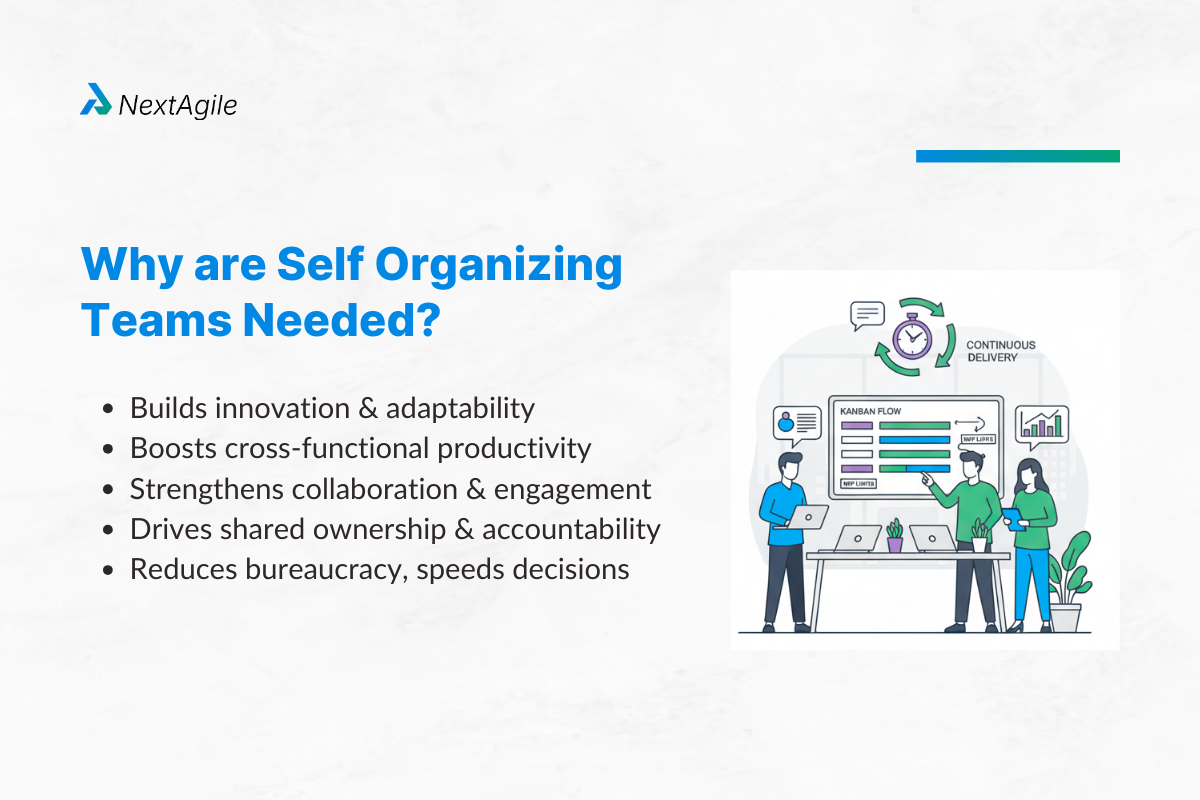
In organizations who are looking to be future-ready we suggest they start cultivating the traits to develop self organizing teams instead of an indispensable layer of people, process, practices and other governance structures. The key benefits of self organising teams are as follows –
It fosters a culture of innovation and resilience to develop adaptability
Cross-functional trait improves productivity and efficiency
Close collaboration enhances employee engagement and satisfaction
Shared decision making increases accountability and ownership
Flat structure reduces bureaucracy and decision-making latency
Shared ownership of goals enables faster response to change and uncertainty
Autonomous mindset and self-sufficiency drives continuous learning and improvement
How to Build Self Organizing Teams?
To build something, one needs to break that barrier which is creating hindrance in its pursuit. We have observed that trust is the most important aspect without which aspiring for inculcating a self organizing culture in the organization is a utopian idea. This is followed next by the ability to resolve mutual conflicts. The bias that forces people to defend their turf even when they are wrong and a lack of integrity adds load on other members in the team and makes the overall culture heavy and lacking accountability and ownership.
It is important that the teams should collectively decide, stay accountable and stay away from command and control, this doesn’t occur from outside of the team. The teams are the main drivers of a self organizing culture within the organization, which should be encouraged and enabled by the top leadership.
Traditional Team Vs Self Organizing Team
Sno.
Traditional Team
Self Organizing Team
1
Hierarchical structure
Flat structure
2
Clear roles and responsibilities
Shared responsibilities
3
Managerial control
Collective ownership
4
Directed work
Autonomous decision making
5
Focus on individual performance
Focus on team performance
6
Top down command & control
Collaborative working
7
Formal communication
Open dialogues
8
Teams are structured
Flexible roles
9
Centralized decision making
Distributed decision making
10
Manager driven execution
Team driven execution
11
Limited team input
Consensus based
12
Most of the problems are solved by Manager
Team solves the problem
13
Escalate, if something doesn’t work
Collaborate & develop coping mechanism
14
Limited innovation
Increased innovation
15
Slow adaptation
Faster adaptation
16
Clear accountability
Requires trust
17
Efficient execution
Demands collaboration
Self Organized Teams in Agile – An Example
Let’s take an example of the importance of a self organized team in agile from one of our agile transformation journeys as an agile consulting firm. Team Maurya, a software development team at one of our client’s places, was tasked with delivering a critical project within tight deadlines. They met a typical challenge that traditional teams usually face in terms of requirements clarity, insufficient resources and stringent deadlines.
We did a two day session with the team on the fundamentals of agile and felt that a lack of self organizing culture was a major roadblock for the teams to adopt agile ways of working and leverage agility. We decided to pivot our approach to coach them on the fly.
 Skip to content