Agile Coaching 101: What It Is and Why It’s a Game Changer
Anuj Ojha
Talk to Expert for Free
Table of Contents
Introduction to Agile Coach
Bringing change through agile coaching is a 3 step journey –
Know agile: In this state, the intention is to create awareness and bring everyone on the same page. It happens by trainer led workshops, customized Agile trainings, watching videos, listening to podcasts, reading books or blogs & other sources
Do agile: Once we have the awareness in place, it is important to apply the practices diligently and repeat them till it becomes the habit and we start seeing those traits mastered by the team. Already, an individual or team will start reaping the benefits
Be agile: After implementing the practices, team reaches the state where they start finding the gaps in their current process, identifies the opportunities of improvement and collectively develop a goal-focused mindset which drives them to create the ‘right mix’ which meets the objectives and enables the to a continuous evolution journey
An agile coach helps a target area to attain the different levels till that focused group becomes self-organizing, self-managing and high performing.
This Blog aims at understanding
What exactly is Agile Coaching?
What do the Agile Coaches do? What are their skills?
Difference between Scrum masters and Agile Coaches
Why is Agile Coaching important?
What do External Agile coach consultants bring to the table?
What is Agile Coaching?
Agile coaching is an act of helping organizations and teams adopt and improve their overall Agile practices and inculcate agility. Agile coaches work with organizations and teams to help them understand the agile mindset, principles, frameworks and to apply these in their areas of work.
Agile coaching typically involves working with organizations and teams to identify their unique challenges, needs, and to help them implement the most effective agile practices for their particular situation. This may involve agile training and mentoring team members, facilitating agile ceremonies such as sprint retrospectives, and helping organizations and teams adopt agile frameworks such as Scrum, Kanban, Extreme programming or lean.
The goal of agile coaching is to help organizations and teams become more agile if they are already embracing agile, and introduce agility across teams, thereby delivering better results and achieving higher levels of productivity, quality, and customer satisfaction. Agile coaches continuously improve the team’s agile practices over time, adapting to changing needs and conditions as they move forward.
Who is An Agile Coach?
An agile coach is not a manager or a decision-maker, but rather a supportive and collaborative partner who helps teams improve their agile practices over time. A good agile coach has a deep understanding of agile methodologies and a passion for helping organizations and individuals achieve their goals through agile.
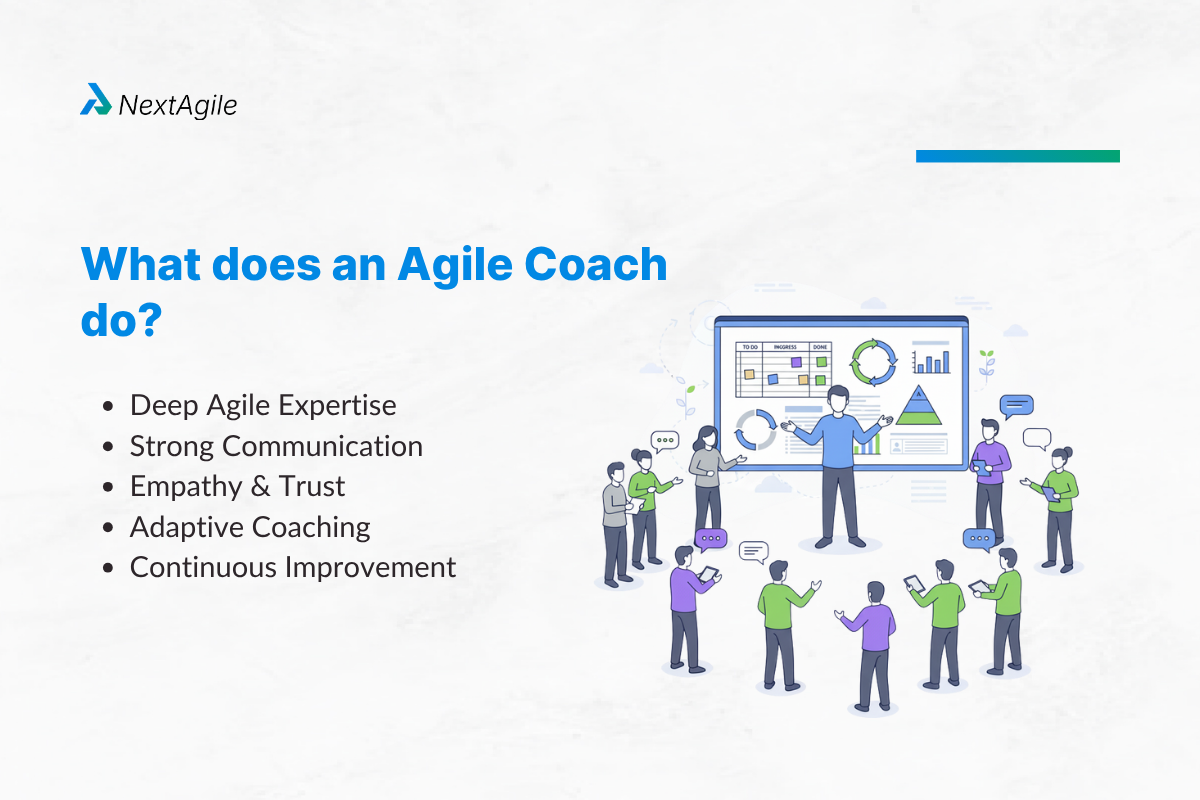
What does an Agile Coach do?
An Agile Coach is a professional who helps organizations and teams adopt and improve their agile practices. The main responsibilities of an agile coach include:
Additionally, a good agile coach should have the following key characteristics:
Deep understanding of Agile: A good agile coach should have a deep understanding of agile principles, practices, and methodologies, and be able to apply this knowledge effectively in a variety of situations
Strong communication skills: A good agile coach should be an effective communicator, able to articulate complex ideas in simple terms and engage teams in constructive dialogue
Empathy and emotional intelligence: A good agile coach should be able to understand and empathize with the perspectives and experiences of others, and use this understanding to build trust and facilitate collaboration
Adaptability: A good agile coach should be able to adapt their approach to the needs of different organizations and teams, and be able to modify their coaching style as needed
Facilitation skills: A good agile coach should be skilled in facilitating agile ceremonies, such as sprint retrospectives, and be able to engage teams in productive discussions and problem-solving
Experience in coaching and mentoring: A good agile coach should have experience coaching and mentoring individuals and teams, and be able to provide guidance and support to help teams improve their practices
Passion for continuous improvement: A good agile coach should have a passion for continuous improvement and be able to inspire and motivate teams to continuously improve their practices
Technical knowledge: A good agile coach should have a good understanding of technical concepts and be able to work effectively with development teams and stakeholders
Commitment to transparency and ethics: A good agile coach should be committed to transparency and ethics in their coaching practices, and be willing to hold themselves accountable for their actions and decisions
In short the role of an Agile Coach is to help organizations and teams effectively adopt and improve their Agile practices and also to ensure that teams don’t go back to old ways of doing things.
Achieve success with agile project management consulting. Expert guidance for efficient planning, execution, and delivery. Explore our services now.
 Skip to content