Skip to content


KEY HIGHLIGHTS OF AGENTIC AI COMPANIES IN INDIA
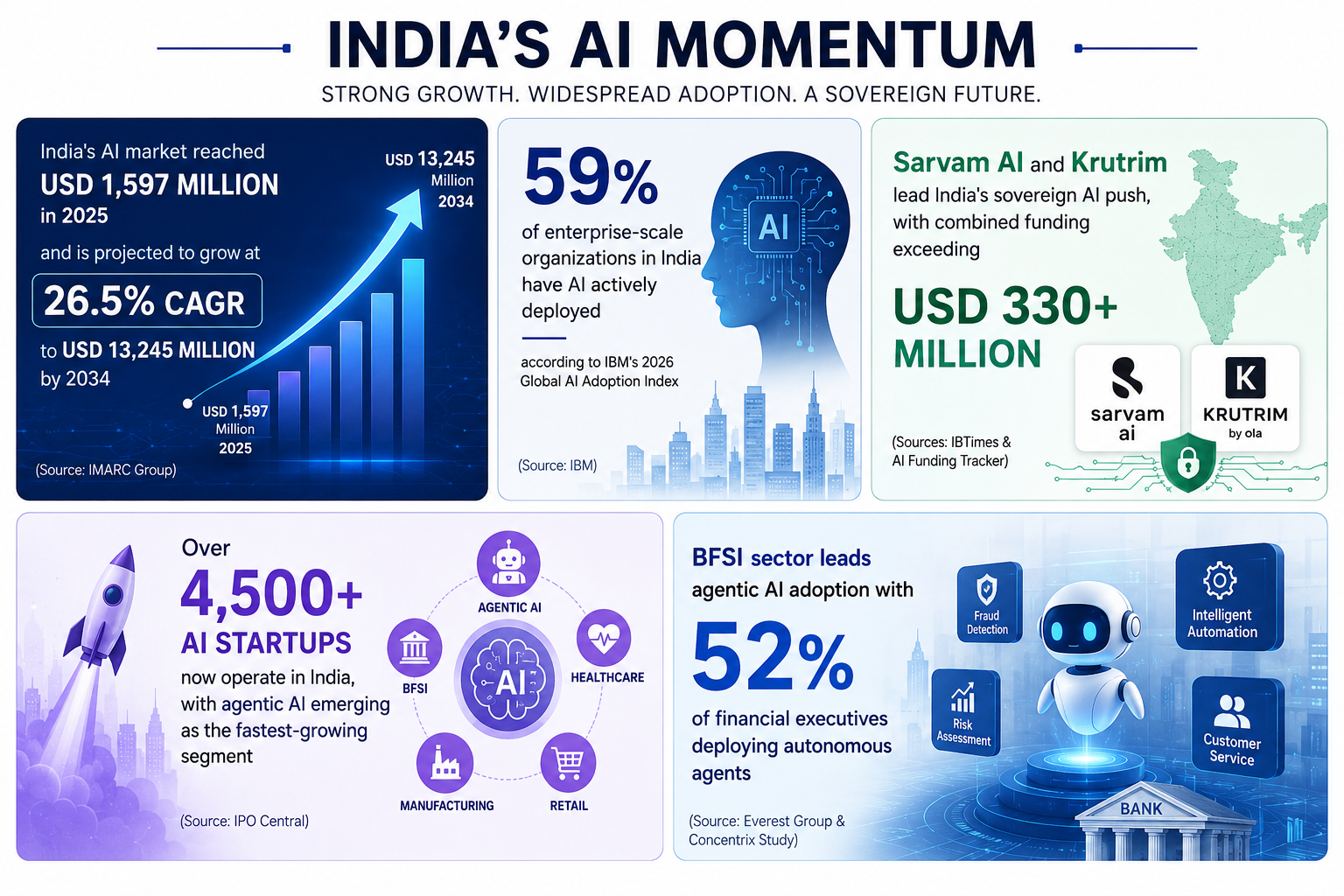
- India’s AI market reached USD 1,597 million in 2025 and is projected to grow at 26.5% CAGR to USD 13,245 million by 2034 (Source: IMARC Group)
- 59% of enterprise-scale organizations in India have AI actively deployed, according to IBM’s 2026 Global AI Adoption Index
- Sarvam AI and Krutrim lead India’s sovereign AI push, with combined funding exceeding USD 330 million (Sources: IBTimes & AI Funding Tracker)
- Over 4,500 AI startups now operate in India, with agentic AI emerging as the fastest-growing segment (Source: IPO Central)
- BFSI sector leads agentic AI adoption with 52% of financial executives deploying autonomous agents (Source: Everest Group & Concentrix Study)
Top Agentic AI Companies and Startups in India (2026)
| Company | Focus Area | Key Agentic AI Capabilities | Industry Use Cases |
| Krutrim | Foundational AI Models | Autonomous AI agents, multilingual LLMs, enterprise copilots | Mobility, customer support, enterprise automation |
| Yellow.ai | Conversational AI Agents | AI customer service agents, workflow automation | BFSI, retail, telecom, healthcare |
| Haptik | AI Assistants & Automation | AI chat agents, voice automation, enterprise AI workflows | E-commerce, banking, travel |
| Gnani.ai | Voice-Based AI Agents | Autonomous voice bots, speech analytics | Contact centers, banking, insurance |
| fluid.ai | Enterprise Agentic AI for Banking | AI agents for customer support, KYC, onboarding, sales, and voice automation | Banking, financial services, customer experience |
| CoRover | Bharat AI Agents | AI assistants for citizen services and enterprises | Government, public sector, customer engagement |
| Sarvam AI | Generative & Agentic AI | Multilingual AI agents, enterprise copilots | Enterprise productivity, digital platforms |
| Mad Street Den | Retail AI Automation | Autonomous retail intelligence systems | Fashion retail, merchandising |
| Observe.AI | AI Workforce Agents | AI-powered QA and autonomous support workflows | BPO, CX operations |
| Uniphore | Enterprise AI Agents | AI orchestration, conversational automation | Customer experience, sales enablement |
| Skit.ai | Voice AI Agents | AI phone agents for customer interactions | Banking, collections, insurance |
| Niramai | AI Diagnostics | Autonomous medical analysis systems | Healthcare diagnostics |
| Fractal Analytics | Enterprise AI Systems | Decision intelligence, autonomous analytics agents | Retail, healthcare, financial services |
India has emerged as a global powerhouse for agentic AI innovation in 2026. With over 1,700 AI-focused companies driving autonomous intelligence across banking, healthcare, retail, and IT services, the nation is rapidly transitioning from AI consumer to AI creator. According to the India AI Adoption Edge 2026 report by Zinnov, OpenAI, and Z47, India now ranks second globally in AI adoption with 100 million weekly ChatGPT users, yet it places 76th in per-capita penetration, highlighting the massive untapped opportunity that lies ahead.
Agentic AI represents a fundamental shift from reactive chatbots to autonomous systems that can plan, reason, execute multi-step workflows, Organisations exploring autonomous systems often begin with structured agentic AI implementation strategies before scaling enterprise adoption and making decisions without constant human oversight. These AI agents do not just answer questions. They take actions across your business operations, from processing insurance claims and detecting fraud in real-time to managing supply chains and automating customer service end-to-end.
The business case is backed by data. Gartner forecasts that by 2028, at least 15% of day-to-day work decisions will be made autonomously by agentic AI systems. Deloitte reports that more than 80% of Indian organizations are now exploring autonomous agent development, with 70% pursuing GenAI-driven automation. Many organizations rely on enterprise generative AI consulting support to move from experimentation to production deployments. The market opportunity is equally compelling. India’s AI market is expected to exceed USD 17 billion by 2027, according to Boston Consulting Group, fueled by government support through the IndiaAI Mission, record venture capital inflows exceeding USD 2.9 billion, and explosive growth in sovereign AI infrastructure.
Large-scale AI adoption often succeeds when aligned with broader enterprise AI transformation initiatives across teams.
Top Agentic AI Companies in India: 2026 Leaders
Quick Answer: The top 15 agentic AI companies in India for 2026 are: Sarvam AI (sovereign AI infrastructure, USD 53.8M funding), Krutrim (India’s first AI unicorn, USD 1B+ valuation), Neysa (GPU infrastructure, USD 1.2B funding), Yellow.ai (conversational AI, 135+ languages), Haptik (enterprise intelligence), Qure.ai (medical diagnostics, IPO 2026), Uniphore (emotion AI, USD 2.5B valuation), Fractal Analytics (decision intelligence), Infosys Topaz, TCS, Wipro AI360, Agentic India, Mad Street Den, Gnani.ai, and CoRover.
The Indian agentic AI landscape comprises three distinct categories: sovereign infrastructure builders developing foundational models and compute, enterprise platform companies delivering production-ready AI solutions, and specialized development studios building custom autonomous agents for specific industries.
Sovereign AI Infrastructure Leaders
1. Sarvam AI: India’s Flagship Sovereign AI Company
Founded: 2023 | Funding: USD 53.8M | Website: sarvam.ai
Sarvam AI is widely regarded as India’s flagship sovereign AI company. According to IBTimes’ Top 10 AI Companies report, Sarvam raised USD 53.8 million from Lightspeed, Peak XV Partners, and Khosla Ventures. The company’s Sarvam-105B model scored 84.3% on olmOCR-Bench, surpassing Gemini 3 Pro (80.2%) and ChatGPT (69.8%). BW Disrupt ranks Sarvam among India’s Top 100 AI Startups with strength in foundational models.
2. Krutrim: India’s First AI Unicorn
Founded: 2022 | Valuation: USD 1B+ | Website: krutrim.ai
Founded by Ola co-founder Bhavish Aggarwal, Krutrim became India’s fastest unicorn according to AI Funding Tracker. The company launched Krutrim-2, a 12-billion-parameter model trained on 2+ trillion tokens. TechCrunch reported in May 2026 that Krutrim generated Rs 3 billion (USD 31.52M) in FY 2026 revenue with first annual net profit, serving 25+ enterprise customers across telecom, BFSI, and healthcare.
3. Neysa: AI Infrastructure at Scale
Funding: USD 1.2B Series B (Feb 2026)
Neysa raised a massive USD 1.2 billion Series B in February 2026, according to IPO Central, positioning as India’s answer to CoreWeave. The company provides GPU-accelerated cloud infrastructure, enabling Indian AI startups to scale without dependency on Western providers.
4. Yellow.ai: Global Conversational AI Leader
Founded: 2016 | Languages: 135+ | Website: yellow.ai
BW Disrupt ranks Yellow.ai among top AI startups accounting for disproportionate capital. The company deployed 120 GenAI bots globally with 30% in India, supporting 135+ languages. Economic Times reports Yellow.ai plans US IPO by 2026-2027.
5. Fluid AI
Website: fluid.ai
Fluid AI is an enterprise agentic AI platform built for banks and financial institutions, deploying production-ready AI agents for customer support, KYC and onboarding, sales, and voice. Headquartered in Mumbai, Fluid AI works with leading global banking and financial clients.
6. CoRover: Multilingual AI Agents
BW Disrupt ranks CoRover among second-tier top AI startups. CoRover deploys multilingual agents across Indian Railways, airports, state governments, focusing on vernacular language support.
7. Qure.ai: AI-Powered Medical Diagnostics
Founded: 2016 | IPO: 2026 | Website: qure.ai
BW Disrupt lists Qure.ai among prominent Top 100 AI Startups. Deployed across 80+ countries for tuberculosis detection and medical imaging. IPO planned for 2026.
8. Haptik: Enterprise Conversational Intelligence
Parent: Reliance Jio | Founded: 2013
Haptik provides industry-specific conversational AI with best-in-class NLU engines. Acquired by Reliance Jio, Haptik expanded across India’s digital ecosystem in retail, telecom, and BFSI.
Additional Leading Companies
- Mad Street Den: Computer vision for retail, serves Myntra, Ajio
- Gnani.ai: 14B parameter voice-first model for Indian languages
- Uniphore: USD 2.5B valuation, emotion AI for contact centers
- Infosys Topaz: Enterprise AI platform across industries
- TCS: AI transformation, Tata Steel predictive maintenance case
- Wipro AI360: Autonomous IT operations and analytics
- Agentic India: Purpose-built multi-agent orchestration
- Fractal Analytics: IPO Feb 2026, Rs 144.5B valuation target
Why India Is Becoming a Hub for Agentic AI Companies
Quick Answer: India ranks first globally in AI skill penetration, hosts 1,600+ Global Capability Centers, received USD 2.9B+ in AI funding (2024-2026), and benefits from government support through the Rs 10,300 crore IndiaAI Mission. These structural advantages position India as a global hub for agentic AI innovation.
Robust Technology Ecosystem and Talent Pool
India ranks first globally in AI skill penetration, according to the India AI Adoption Edge 2026 report. The nation produces over 1.5 million engineering graduates annually. Of the world’s top 100 AI companies, 20 have an Indian co-founder, yet only one in 20 is India-domiciled, according to Zinnov data. This gap is rapidly closing as founders choose to build from India.
Government Support Through IndiaAI Mission
The Government of India launched the IndiaAI Mission in March 2024 with an initial allocation of Rs 10,300 crore (USD 1.25 billion) over five years. In April 2025, the government selected Sarvam AI under the IndiaAI Mission to build India’s first homegrown sovereign large language model. As adoption accelerates, enterprises are also investing in enterprise GenAI training programs for workforce readiness.
Explosive Investment Growth
Indian AI companies raised USD 780.5 million in 2024, representing a 39.9% year-over-year increase. According to SenseAI Ventures’ State of AI Report 2026, global AI investment reached USD 800 billion in 2025, with India emerging as a key applications hub. IBM reports that 59% of enterprise-scale organizations in India had AI actively deployed in 2026.
Global Capability Centers Driving Enterprise AI
India hosts over 1,600 Global Capability Centers. According to the EY GCC Pulse Survey 2025, 83% of GCCs in India are actively engaging with GenAI adoption, and 58% are developing agentic capabilities. A task-level analysis reveals that 24% of enterprise tasks are fully automatable, while 42% can be significantly augmented.
Industries Using Agentic AI in India
Quick Answer: Top industries: BFSI (52% adoption – fraud, underwriting), Healthcare (80% of pharma – diagnostics), E-commerce (inventory, personalization), IT Services (67% beneficial), Manufacturing (predictive maintenance).
BFSI Sector
Inc42 analysis reports BFSI as biggest beneficiary. Everest Group study found 52% of financial executives deployed agentic AI for fraud detection, underwriting, and KYC automation. Financial institutions often adopt AI-powered workflow automation frameworks to improve operational efficiency.
Healthcare
80% of pharma/life sciences companies integrated AI per Upgrad. Qure.ai enables TB detection. Clinical documentation agents automate notes and billing.
E-commerce and Retail
Inc42 reports Amazon deploys agents for end-to-end shopping. Kore.ai confirms inventory management and return automation.
IT Services
Deloitte reports 67% found GenAI beneficial across SDLC, 70% met ROI estimates.
Benefits of Agentic AI for Businesses
Quick Answer: 90% reduction in resolution time (McKinsey), 24% tasks automatable + 42% augmentable (EY), 30% conversion increase (Axis Bank), 70% meet ROI (Deloitte).
Efficiency and Cost Reduction
McKinsey reports 90% reduction in customer service resolution time, 30-50% cut in service backlogs.
Reduced Manual Work
EY GCC Survey shows 24% tasks fully automatable, 42% augmentable. Axis Bank achieved 30% conversion increase with GenAI assistant Siddhi per Inc42.
Challenges and Risks of Agentic AI
Quick Answer: Key challenges include AI hallucinations requiring governor agents, governance/accountability frameworks, data privacy in regulated industries, compliance with 94% of Indian orgs requiring explainability (IBM), and change management for employee adoption. Understanding common reasons AI transformation initiatives fail can help organizations avoid costly deployment mistakes.
AI Hallucinations
LLMs can generate plausible but incorrect responses. Mitigation requires governor agents monitoring in real-time, confidence thresholds, and comprehensive logging.
Compliance Challenges
IBM survey reports 94% of Indian organizations consider AI decision explainability important, demanding interpretable reasoning and audit trails.
Future of Agentic AI Companies in India
Quick Answer: By 2030: India will exceed USD 17B AI market (BCG), host multiple unicorns, face 7GW compute gap requiring 3.3M GPUs (Zinnov), with 15% of work decisions autonomous (Gartner) and USD 200B+ infrastructure commitments. Long-term AI success also depends on how organizations train teams on AI models for enterprise readiness.
Multi-Agent Systems
Deloitte reports 50% of organizations identified multi-agent workflows as key focus in 2026.
Autonomous Workflows
Gartner predicts by 2028, 15% of day-to-day work decisions made autonomously by agentic AI systems.
Infrastructure Expansion
Zinnov India AI Adoption Edge 2026 reports India faces 7GW sovereign compute gap by 2030, requiring GPU count rise from 216K to 3.3M. India AI Impact Summit 2026 secured USD 200B+ in infrastructure commitments.
Many enterprises are also exploring ways AI improves developer productivity and efficiency across teams.
How to Choose the Right Agentic AI Company
Quick Answer: Evaluate: Industry expertise (BFSI/healthcare domain knowledge), tech stack (LangChain, AutoGen, CrewAI frameworks), custom AI vs API wrappers, security compliance (ISO 27001, SOC 2), pricing (Rs 25-50L for MVP, Rs 2Cr+ for enterprise), and integration support (3-6 month realistic timeline).
Assess Technology Stack
Leading firms work with LangChain, LangGraph, AutoGen, CrewAI per The AI Journal. Verify Model Context Protocol integration and production monitoring stacks. Businesses evaluating vendors should assess LangChain and AI orchestration capabilities for scalable implementations.
Security and Data Sovereignty
For BFSI/healthcare, verify private cloud deployments, Indian data residency, ISO 27001, SOC 2 certifications. IBM reports 94% of Indian orgs require AI explainability. Production-ready AI systems also depend on advanced prompt engineering practices to improve reliability and accuracy.
Conclusion
India has firmly established itself as a global hub for agentic AI innovation in 2026. With 1,700+ AI-focused companies, USD 2.9 billion in venture funding, and 59% of enterprise organizations actively deploying AI systems, the nation transitions from AI consumer to AI creator.
The companies profiled represent diverse approaches: Sarvam AI and Krutrim building sovereign infrastructure, Neysa addressing compute gaps, Yellow.ai/Haptik/Uniphore delivering production-ready platforms, Qure.ai/Mad Street Den proving vertical AI advantage, Infosys/TCS/Wipro bringing enterprise governance, and Agentic India/InnovationM serving mid-market.
Measurable outcomes validate the business case: McKinsey reports 90% reduction in customer service resolution time, EY shows 24% tasks fully automatable + 42% augmentable, Deloitte confirms 70% meet ROI estimates. These are documented production results, not theoretical benefits.
By 2030, India will exceed USD 17 billion AI market (BCG), host multiple unicorns, and demonstrate that autonomous intelligence built for India creates solutions applicable to emerging markets worldwide. The IndiaAI Mission plus USD 200 billion in private commitments provides the foundation.
Enterprise success requires: high-volume use cases with clear ROI, production-grade vendor expertise, comprehensive governance frameworks, and iterative rollouts building confidence before expanding scope.
The agentic AI revolution in India is already here. Business leaders must decide deployment speed before competitors gain advantages in efficiency, customer experience, and cost structure. Companies and leaders moving decisively now will shape India AI-powered future for the next decade. Businesses seeking faster adoption can leverage custom Agile consulting and implementation services to accelerate measurable outcomes.
Next Steps: Partner with NextAgile for Agentic AI Success
NextAgile specializes in helping enterprises navigate the agentic AI landscape through strategic consulting, custom development, and hands-on implementation support. Our team combines deep technical expertise with practical business understanding, ensuring your AI investments deliver measurable results.
Whether you are exploring agentic AI for the first time, scaling existing pilots to production, or transforming enterprise operations with autonomous intelligence, NextAgile provides the guidance and execution capabilities you need.
Contact NextAgile: Visit https://nextagile.ai to schedule a consultation and discover how agentic AI can transform your business operations.
Frequently Asked Questions About Agentic AI Companies in India
1: What are agentic AI companies?
Agentic AI companies build autonomous AI systems that perceive environment, plan multi-step actions, make decisions, and execute tasks independently without constant human oversight. Unlike traditional AI creating reactive chatbots, agentic companies develop systems managing complete workflows autonomously.
2: Which are top agentic AI companies in India 2026?
Top 15 include Sarvam AI (USD 53.8M, sovereign infrastructure), Krutrim (USD 1B+ valuation, first unicorn), Neysa (USD 1.2B, GPU infrastructure), Yellow.ai (135+ languages), Haptik, Qure.ai (IPO 2026), Uniphore (USD 2.5B valuation), Fractal Analytics, Infosys Topaz, TCS, Wipro AI360, Agentic India, Mad Street Den, Gnani.ai, CoRover.
3: How is agentic AI different from generative AI?
Generative AI creates content (text, images) reactively. Agentic AI takes autonomous actions executing multi-step workflows proactively. Generative responds to single prompts; agentic plans and executes strategies across multiple decisions, tool calls, and system integrations without human intervention at each step.
4: Which industries use agentic AI most in India?
BFSI leads (52% of executives adopting per Everest Group), followed by Healthcare (80% of pharma companies per Upgrad), E-commerce (Amazon, major platforms), IT Services (67% beneficial per Deloitte), and Manufacturing (Tata Steel case per Inc42).
5: How much does agentic AI cost in India?
Exploration/POC: Rs 25-50 lakhs (USD 30-60K). Product development: Rs 50 lakhs to Rs 2 crores (USD 60-240K). Enterprise transformation: Rs 2 crores+ (USD 240K+). Total cost includes ongoing inference, infrastructure, maintenance beyond initial development.
6: Is agentic AI secure for enterprises?
Yes, with proper safeguards: private cloud/on-premises deployments, comprehensive audit trails, governor agents monitoring in real-time, role-based access controls, and explainability mechanisms for regulated industries. 94% of Indian orgs require explainability per IBM.
7: What are measurable benefits?
90% reduction in customer service resolution (McKinsey), 24% tasks fully automatable + 42% augmentable (EY), 30% conversion increase (Axis Bank Siddhi case), 70% meet/exceed ROI estimates (Deloitte), scalable automation without linear cost growth.
8: Are Indian startups leading innovation?
Yes. 4,500+ AI startups, USD 780.5M raised in 2024 (+39.9% YoY), Sarvam/Krutrim building sovereign models, Neysa raised USD 1.2B for infrastructure, vertical AI grew 2.5x in funding (37% of total), 20 of top 100 global AI companies have Indian co-founders per Zinnov.
9: What is future outlook by 2030?
USD 17B+ AI market (BCG), multiple unicorns, 7GW compute gap requiring 3.3M GPUs (Zinnov), 15% of work decisions autonomous (Gartner), USD 200B+ infrastructure commitments (India AI Summit), Indian companies serving global emerging markets.
10: Which companies use agentic AI?
India: Axis Bank (Siddhi assistant, 30% conversion increase), Tata Steel (predictive maintenance), major e-commerce/BFSI/telecom platforms. Globally: Amazon (shopping agents), financial institutions (fraud/underwriting), healthcare providers (clinical documentation/claims automation).