Skip to content


Key Highlights Aout Agile Story Point Estimation
As the NextAgile Expert Team, we’ve seen how mastering agile estimating transforms projects. Here’s what you need to know about story points:
- Story points measure the relative effort needed to complete work, not the time it takes.
- They account for the complexity of the work, the amount of work, and any potential risks.
- Using a relative estimation scale like the modified Fibonacci sequence simplifies the process.
- Planning Poker is a popular technique for achieving team consensus during sprint planning.
- Reviewing estimates in sprint retrospectives helps improve accuracy for the product backlog over time.
Understanding Agile Story Points
With over 15 years of experience, we at NextAgile know that story points are a powerful unit of measurement in agile development. Instead of guessing how many hours a task will take, you use story points to estimate the relative size and effort of a product backlog item. This approach was popularized by agile expert Mike Cohn.
Think of story points as a way to compare tasks. A task with two story point values should require about twice the amount of work as a one-point task. It’s all about understanding the relative effort, not tracking exact time.
Defining Agile Story Estimation
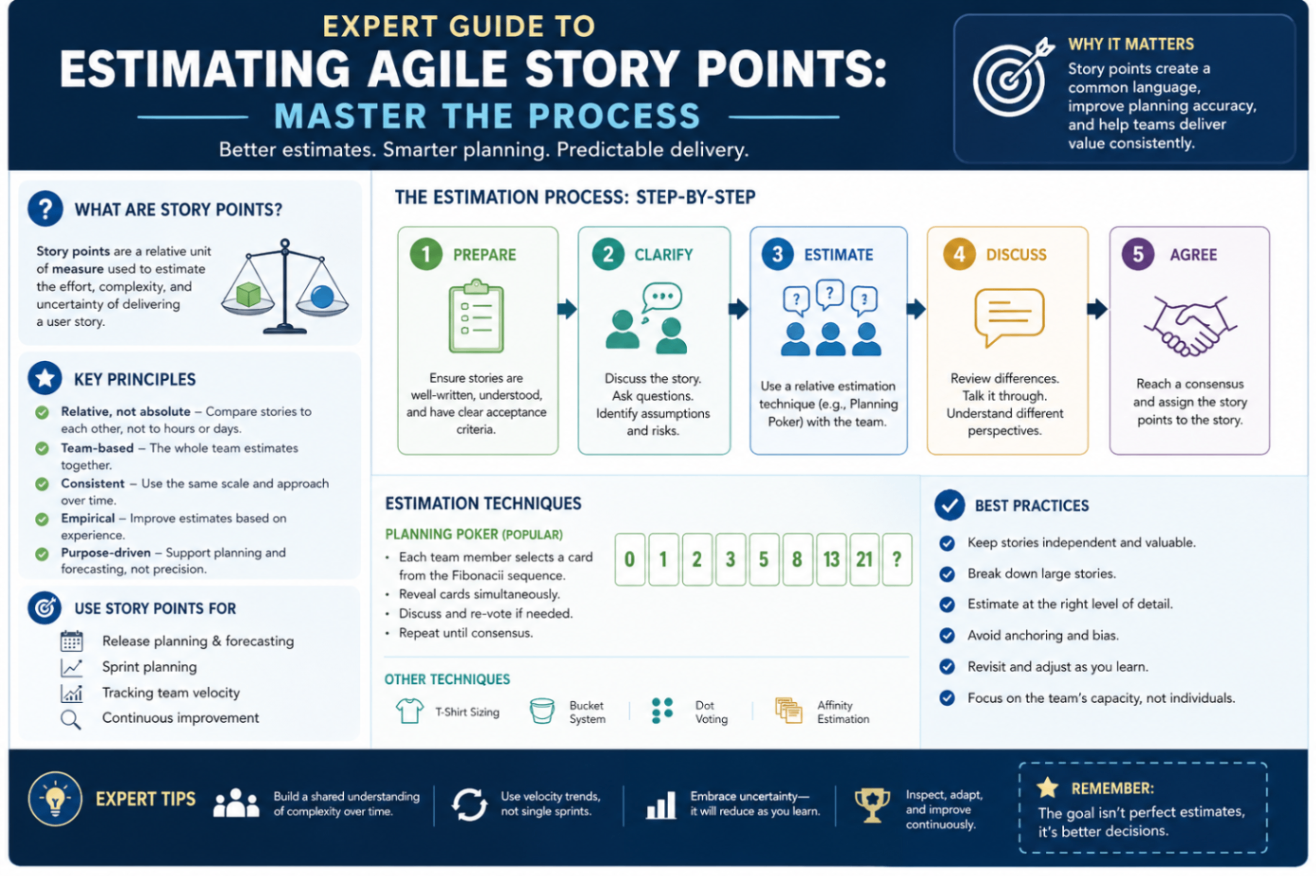
Agile story estimation is the process your team uses to assign a value to a product backlog item, representing the relative effort required to complete it. This isn’t about calculating the exact amount of time a task will take. Instead, it’s a collaborative discussion to gauge how big a piece of work is compared to other tasks.
During this process, the team thinks about the task’s complexity, the amount of work involved, and any uncertainties. The goal is to land on story point values that reflect this combined effort.
This method of estimation helps your team better understand the work ahead. It’s a fundamental part of planning that leads to more predictable and manageable sprints.
Story Points vs Time-Based Estimation Methods
You might wonder why agile teams often prefer story points over estimating in terms of time, like hours or days. Time-based estimates can be misleading because an hour of work for a senior developer is different from an hour for a junior team member. This is a core reason story points were developed.
Story points focus on relative estimation, which removes individual skill levels from the equation. Instead of asking, “How long will this take you?” the question becomes, “How big is this task for us as a team?” This shift encourages collaboration and results in a more consistent agile project management approach.
Here’s a quick comparison:
- Story Points: Account for complexity, risk, and team effort.
- Time-Based Estimates: Focus only on duration and can vary by individual.
- Relative Sizing: Story points use numerical values to show relative size, not a direct time commitment.
Why Story Points are Essential in Agile Projects
From our extensive experience at NextAgile, we’ve seen that story points are crucial for agile teams. They provide a shared language for the scrum team to discuss the effort needed for items in the sprint backlog. This method of relative sizing helps everyone get on the same page quickly during planning sessions.
By using story point values, your team can make more informed decisions about how much work to take on in a sprint. This leads to more predictable delivery and less stress. Now, let’s explore the specific value of using points and how they improve sprint planning.
The Value of Estimating in Points Rather Than Hours
Choosing to use story points instead of hours is a strategic move that saves your team from a lot of wasted time. Estimating the exact amount of time a task will take is difficult and often inaccurate. People with different experience levels work at different speeds, which makes hour-based estimates inconsistent.
The main reason story points work so well is that they are a relative unit of measure. Your team can agree that one task is twice as much effort as another without getting bogged down in debating the precise hours.
This approach acknowledges that effort is about more than just time; it includes complexity and uncertainty. By shifting the focus away from the clock, your team can have more productive conversations and create more reliable plans.
How Story Points Simplify Sprint Planning
Story points make sprint planning meetings much more efficient and effective. When your team uses story point values, you create a shared understanding of what each task involves. This alignment is key to building a realistic and achievable sprint backlog.
Instead of debating hours, your team can quickly sort tasks by their relative size. This makes it easier to select a balanced amount of work for the upcoming sprint. You can see at a glance if you’re taking on too many large, complex items.
Here’s how story points help:
- Faster Prioritization: Quickly gauge the effort for each item.
- Improved Capacity Planning: Use your team’s velocity (average story points per sprint) to know how much to include in the sprint backlog.
- Clearer Communication: Everyone on the team understands the scope of work represented by the story point values.
Key Factors That Influence Story Point Assignment
As agile experts, we always emphasize that assigning story points isn’t a random guess. Several key factors determine the final number. The primary considerations are the complexity of the work, the total amount of effort required, and any potential risks or uncertainties involved in completing the task.
Your team needs to think about all these elements together. A task might seem small in terms of the amount of work but could be highly complex, leading to a higher story point value. We’ll now look closer at these factors and how team experience also plays a role.
Complexity, Effort, and Risk Considerations
When your team creates relative estimates, it’s about more than just the volume of work. You need to consider three distinct factors. The first is the amount of work itself, the sheer quantity of things to do. The second is the complexity of tasks, which refers to how difficult they are to solve.
Finally, you must account for potential risks and uncertainty. Does the task depend on a third party? Is the technology new to the team? These elements can significantly affect the effort required. A task might be the same physical “size” as another but get a higher estimate due to its complexity or risk.
Here’s a breakdown of what to consider:
- Amount of Work: The volume of tasks to be completed.
- Complexity: How intricate or challenging the work is.
- Risk & Uncertainty: Unknowns or dependencies that could cause delays.
- These components combine to form the final relative estimate for a piece of work.
Team Experience and Historical Data in Story Estimation
Your team’s collective experience is a vital asset in story estimation. An experienced team that has worked together for many sprints will naturally be better at estimating than a new one. The presence of a junior team member might also influence how the team perceives the effort for a task.
Historical data from previous sprints provides a powerful guide. By looking at your team’s velocity, the average number of story points completed per sprint, you can get a realistic idea of what you can accomplish. This data helps ground your estimates in reality, not wishful thinking.
Agile teams should regularly review their past performance to refine their estimation process. This practice helps you learn from your successes and mistakes, leading to more accurate and reliable forecasts over time.
Step-by-Step Guide to Agile Story Estimation
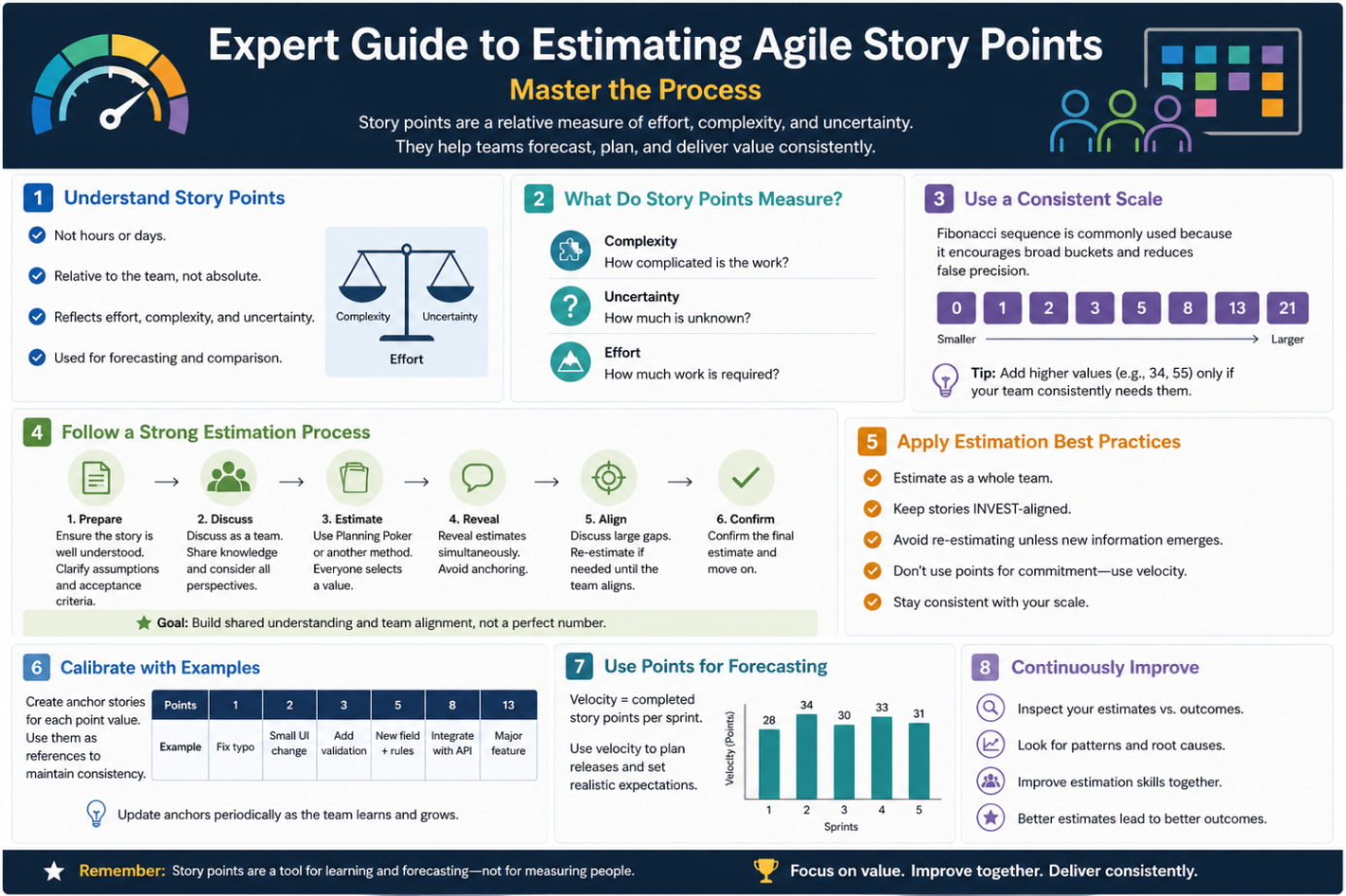
At NextAgile, we guide teams through a structured agile estimating process to ensure consistency and accuracy. The entire team, including developers, the scrum master, and the product owner, should be involved. The core idea is to use relative estimation to assign story point values.
A common tool for this is a scale like the modified Fibonacci sequence, which helps keep estimates distinct. In the following sections, we will walk you through setting up a scale, establishing baseline stories, and breaking down work for clearer estimation.
Setting Up a Standardized Story Point Scale
To get started with story points, your team needs a consistent scale. Using a standardized scale ensures that everyone has the same frame of reference. The modified Fibonacci sequence (1, 2, 3, 5, 8, 13, 20, etc.) is a popular choice for a reason. The increasing gaps between numbers reflect the greater uncertainty that comes with larger tasks.
This prevents teams from getting stuck debating small differences, like whether a task is a 7 or an 8. The actual numerical value isn’t as important as its position on the scale. These numbers are abstract units of measure, not direct translations of time.
Here’s an example of a simple scale and what the values could represent:
| Story Point Value | Represents |
|---|---|
| 1 | A very small, simple task |
| 3 | A small task with some complexity |
| 5 | A medium-sized task |
| 8 | A large, complex task |
| 13+ | A very large task that may need to be broken down |
Establishing Baseline User Stories for Reference
Once you have your scale, the next step is to create a shared understanding of what those numbers mean in practice. The best way to do this is by establishing baseline user stories. These are reference points that your team can use for comparison when estimating new work.
Start by finding a product backlog item that the team agrees is small and straightforward. You might assign this a 2. Then, find another story that feels about twice as big and call it a 5. Having these concrete examples makes future estimation much easier.
Key steps for setting a baseline include:
- Find a small, well-understood story to be your starting point (e.g., a 2 or 3).
- Identify a larger story that is roughly double the effort (e.g., a 5 or 8).
- Use these stories as anchors for all future relative estimations.
Breaking Down User Stories for Clearer Estimation
Sometimes, user stories are too big or complex to estimate accurately. When a story gets a very high point value, like 20 or 40, it’s often a sign that it needs to be broken down into smaller, more manageable pieces. This practice is essential for accurate story point estimation.
Breaking down large stories helps the team better understand the amount of work and uncover hidden complexity. Each smaller story can then be estimated individually, leading to a more precise overall picture of the effort involved.
This process isn’t about creating a detailed task list but about splitting a large requirement into smaller, valuable chunks. This ensures that your team can deliver value incrementally and that your estimates remain reliable.
Running an Effective Story Estimation Session
A well-run story estimation session is the key to successful sprint planning. As the NextAgile Expert Team, we’ve facilitated hundreds of these meetings. The goal is to bring the entire team together to collaboratively assign story points to backlog items. The scrum master typically facilitates the session to keep things on track.
These sessions are not just about assigning numbers; they are about fostering discussion and creating a shared understanding of the work. We’ll explore a popular technique called Planning Poker and discuss how to achieve consensus among all team members.
The Planning Poker Technique Explained
Planning Poker is a fun and collaborative method for agile estimation. It ensures every team member’s voice is heard, preventing a few dominant personalities from influencing the outcome. The process is simple and is usually facilitated by the scrum master.
First, the product owner presents a user story. After a brief discussion, each team member privately selects a card with a story point value that they feel represents the effort. On the count of three, everyone reveals their card. If the estimates match, the team moves on.
If they don’t match, the process encourages discussion:
- The team members with the highest and lowest estimates explain their reasoning.
- This conversation often uncovers hidden risks or simpler approaches.
- The team then re-estimates until they reach a consensus on the relative estimation.
Achieving Consensus Among Team Members
The goal of any estimation session is to reach a consensus, not just an average. When your scrum team discusses a user story, differences in story point values are an opportunity for learning. It’s a sign that team members have different assumptions about the work.
During sprint planning, if estimates vary widely, the team should pause and discuss. The person with the high estimate might be aware of a risk others missed, while the person with the low estimate might see a shortcut. This conversation is more valuable than the final number itself.
Through this collaborative dialogue, the team builds a shared understanding and eventually settles on relative estimates that everyone can support. This process ensures the team is aligned and confident in the plan before the sprint begins.
Best Practices for Accurate Story Estimation in Agile
Achieving accurate story point estimation is a journey, not a destination. At NextAgile, we teach that continuous improvement is key. Your team won’t be perfect from day one, but you can refine your agile estimating skills over time.
Regularly reviewing your team’s velocity and discussing estimates during the sprint retrospective are crucial habits. These practices help you learn from past sprints and adjust your approach for better accuracy in the future. Let’s look at how to calibrate your process and use retrospectives effectively.
Calibrating the Team’s Estimation Process Over Time
Your team’s estimation process should evolve. What works for a new team might not suit a more mature one. Calibration is about regularly checking in and adjusting how your agile team approaches estimation. A great way to do this is by analyzing your team’s velocity from previous sprints.
Is your velocity stable, or does it fluctuate wildly? If it’s inconsistent, it might be a sign that your relative estimates are not aligned. Use this data to start a conversation. Are you over- or under-estimating certain types of tasks?
Don’t be afraid to revisit your baseline stories or even your estimation scale if they no longer serve your team. The goal is to create an estimation process that feels natural and produces reliable results, helping you forecast future work more effectively.
Using Retrospectives to Refine Estimation Accuracy
The sprint retrospective is the perfect opportunity to improve your estimation accuracy. This is the time for agile teams to reflect on the completed sprint and identify what went well and what could be better. Discussing story point values should be a regular part of this meeting.
Look at the stories from previous sprints. Did a 3-point story end up taking much more effort than expected? Why? These discussions help uncover misunderstandings and refine the team’s shared sense of effort.
To make these conversations productive:
- Compare the initial story point values to the actual effort.
- Discuss any surprises or unexpected challenges.
- Use these insights to adjust your approach for the next sprint.
Common Mistakes in Story Estimation and How to Avoid Them
Even experienced teams can fall into traps when estimating with story points. Recognizing these common mistakes is the first step to avoiding them. A frequent error is trying to relate story points directly to hours, which defeats the purpose of relative estimation.
Other pitfalls include inconsistent estimates or letting estimates become inflated over time. By being aware of these issues, your team can maintain a healthy and effective estimation process that accurately reflects the complexity of tasks. The following sections will detail how to steer clear of these problems.
Pitfalls Like Comparing Story Points to Hours
One of the most common and damaging mistakes is to create a direct conversion between story points and a unit of time, like hours. For example, saying “one story point equals four hours” undermines the entire estimation process. This forces your team back into thinking in terms of time, which is what story points are designed to avoid.
The beauty of story points is that they are abstract and relative. They account for effort, complexity, and risk, not just the amount of time spent. Equating them to hours is a waste of time and negates their benefits.
Here are the key reasons to avoid this pitfall:
- It ignores the varying skill levels within the team.
- It fails to account for non-obvious complexity and risk.
- It puts pressure on the team to meet an arbitrary time-based deadline.
Overcoming Inconsistent or Inflated Estimates
Over time, teams can fall into bad habits, leading to inconsistent or inflated estimates. “Story point inflation” happens when the team starts assigning higher point values to tasks that would have received lower estimates in the past. This can skew your team’s velocity and make planning unreliable.
To overcome this, your team should regularly recalibrate. Revisit your baseline stories to ensure everyone still has a shared understanding of what a 2, 5, or 8-point story looks like. Consistent communication is key to maintaining an accurate story point estimation process.
If you notice estimates becoming inconsistent, address it in your next retrospective. A frank discussion can help get everyone back on the same page and restore confidence in your estimation process.
Conclusion
In conclusion, mastering agile story point estimation is crucial for successful project management in the agile domain. By utilizing story points over time-based estimation methods, you can simplify sprint planning and ensure accurate estimations. Factors like complexity, effort, and team experience play key roles in assigning story points effectively. Setting up a standardized scale, breaking down user stories, and conducting estimation sessions using techniques like Planning Poker are essential steps in this process. Continuous calibration and refinement through retrospectives help improve estimation accuracy over time. Avoid common pitfalls like comparing story points to hours to ensure more precise estimations. For expert guidance and support in agile story estimation, reach out to the NextAgile Expert Team today.
If you have any queries or need assistance, don’t hesitate to get in touch with us – we’re here to help you succeed in your agile endeavors!
Frequently Asked Questions
Can story points be directly converted to hours?
No, you should avoid converting story points directly to hours. Story points are a relative unit of measurement that accounts for effort, complexity, and risk, not just the amount of time. Trying to link them to hours undermines their purpose and can lead to inaccurate planning.
What should we do if our team constantly underestimates stories?
If your agile team consistently underestimates, use your sprint retrospectives to analyze why. Compare your initial story point values to the actual effort from previous sprints. This will help you adjust your estimation process and improve your team’s velocity and accuracy over time.
How often should our team revisit and adjust our estimation techniques?
Your team should revisit your estimation process regularly, ideally during every sprint retrospective. This allows team members to discuss what’s working and what isn’t, ensuring your accurate story point estimation evolves and improves continuously. This helps maintain consistency in story point values.