...

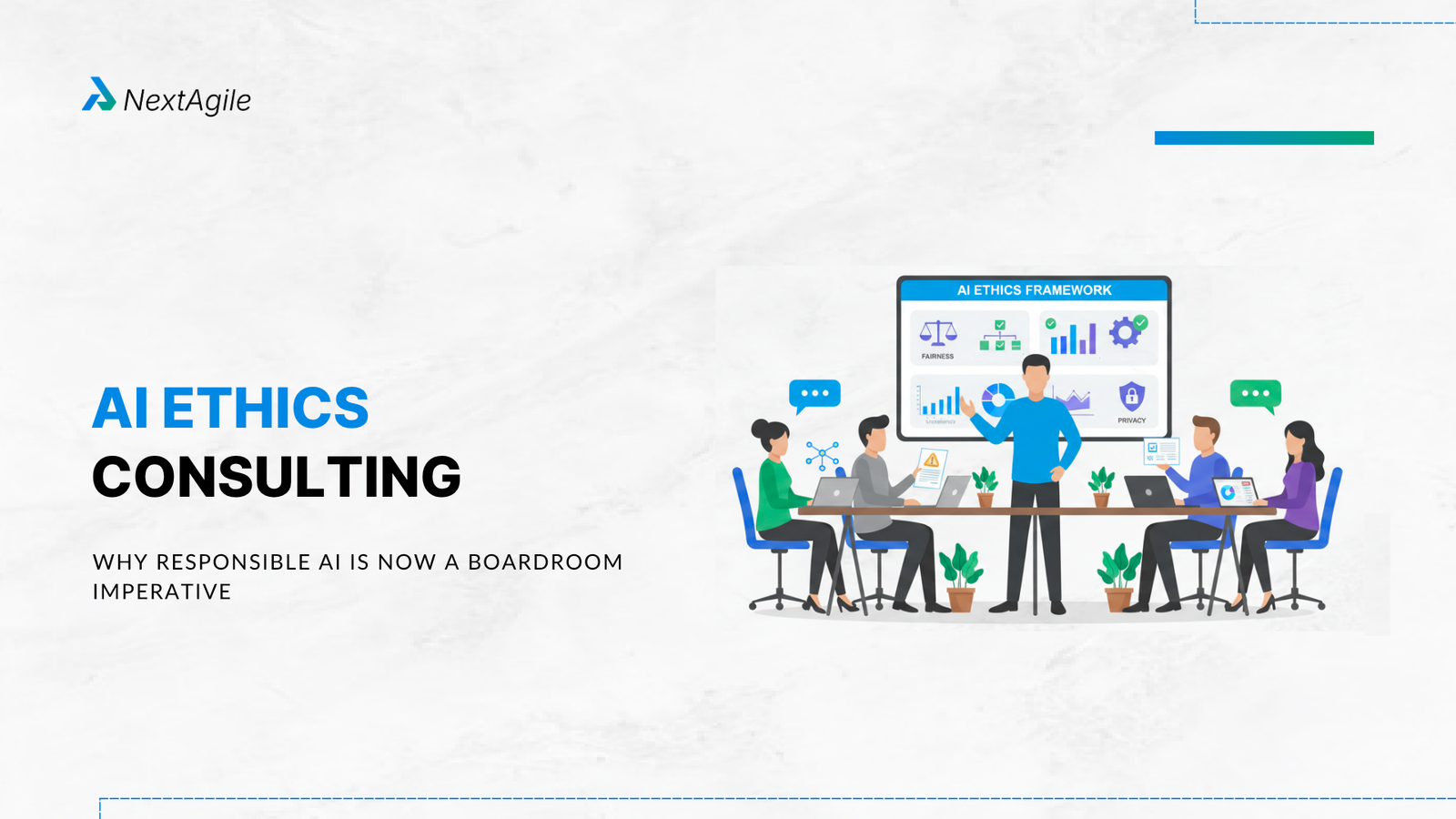
AI Ethics Consulting: Why Responsible AI Is Now a Boardroom Imperative

AI Ethics Consulting Why Responsible AI Is Now a Boardroom Imperative

Key Takeaways from AI Ethics Consulting

  • AI ethics consulting helps enterprises reduce legal, reputational, and regulatory risks while scaling AI responsibly
  • Responsible AI ensures fairness, transparency, and accountability in critical use cases like hiring, lending, and compliance
  • Bias detection, explainable AI (XAI), and model governance are essential for building trustworthy AI systems
  • Generative AI introduces risks like deepfakes and misinformation, requiring strong safeguards and clear disclosure
  • Embedding ethics across the AI lifecycle, from data collection to deployment and monitoring,  prevents costly failures
  • Enterprises investing in responsible AI gain a competitive advantage through trust, faster adoption, and regulatory alignment

Five years ago, business leaders rarely discussed AI ethics. It was something academics debated or activists raised concerns about. Today, AI ethics is a boardroom priority because enterprises have learned that ignoring ethics is expensive. Reputational damage. Legal liability. Regulatory attention. Loss of customer trust.

The enterprises winning now understand that responsible AI isn’t a constraint on progress. It’s a prerequisite for sustainable success. This is why AI ethics consulting has become critical. Many enterprises partner with specialist Generative AI Consulting Services teams to scale innovation with the right guardrails in place.

Why AI Ethics Matters to Business Leaders

The ethical concerns about AI are no longer theoretical. They’re manifesting in real harm to real people. Hiring systems that discriminate against certain groups. Lending systems that perpetuate historical bias. Content recommendation systems that radicalize vulnerable people. Surveillance systems that enable government oppression. These are not hypothetical risks. They’re happening now.

When enterprises build AI systems that harm people, the consequences extend beyond the individuals harmed. There are legal consequences as regulators investigate and impose penalties. There are reputational consequences as media covers the story and customers lose trust. There are operational consequences as the enterprise has to pause or rebuild the system. There are financial consequences as the cost of fixing the problem exceeds any savings the system generated.

More importantly for boards, there are strategic consequences. If customers believe your enterprise doesn’t care about ethical implications of your technology, they’ll take their business elsewhere. If employees believe your enterprise is willing to harm people for profit, they’ll leave for competitors with better values. If regulators believe your enterprise can’t be trusted to police itself, they’ll impose regulations that constrain what you can do.

Leading enterprises often connect AI governance with measurable business outcomes using frameworks like How CXOs Align OKRs with AI Strategy.

Smart business leaders recognize that responsible AI is good business. It enables you to deploy AI more aggressively because you’re not worrying about ethical disasters. It builds customer trust because people know you’re thinking about implications of your technology. It attracts talent because people want to work for organizations they believe are doing good. It protects you legally and reputationally because you’re not cutting corners that create liability.

What Responsible AI Actually Means

Responsible AI is sometimes used as a vague concept that sounds good but doesn’t mean much. AI ethics consulting is about translating that vague aspiration into concrete practices and decisions.

Responsible AI means designing and building AI systems that consider impacts on all stakeholders, not just your bottom line. It means thinking about customers who depend on your systems. It means thinking about employees whose work is affected by automation. It means thinking about communities impacted by your systems. It means thinking about vulnerable populations who might be disproportionately harmed.

It means being transparent about what your AI systems do, how they work, and what their limitations are. It means not pretending your systems are more capable or objective than they actually are. It means being honest about what you don’t know and what risks might exist.

It means building AI systems that make decisions in ways humans can understand and challenge. Not every AI system needs to be perfectly interpretable, but consequential decisions should be made in ways you can explain. If your AI system denies someone a loan or job, they should be able to understand why and have a mechanism to challenge the decision.

It means preventing AI systems from discriminating against or systematically disadvantaging groups of people. This is harder than it sounds because bias can hide in training data, in how you define the optimization problem, or in how you measure success.

It means thinking about security and privacy. AI systems are targets for attacks. Attackers want to corrupt training data to poison the model. They want to manipulate inputs to cause the system to make bad decisions. They want to extract training data to access sensitive information. Responsible AI includes protecting systems against these threats.

It means building governance processes that make these decisions explicit and enforce them over time. Responsible AI isn’t a one-time effort. It’s an ongoing practice integrated into how AI systems are developed, deployed, and maintained.

The Ethics Implications of Different AI Capabilities

Different AI capabilities create different ethical challenges that need different approaches.

Generative AI that produces text or images creates challenges around authenticity and deception. Systems that can generate convincing text can be used to create disinformation. Systems that can generate images can be used to create deepfakes. These capabilities can be used for legitimate purposes like creative writing assistance or content generation. But they can also be misused. Responsible AI in this context means building systems that make it clear when content is AI-generated and implementing safeguards against obvious misuses.

Machine learning systems that make decisions create challenges around bias and fairness. If your model was trained on historical data that reflected bias, the model will likely perpetuate that bias. If your model optimizes for business metrics without considering fairness, it might make decisions that are technically optimal but ethically problematic. Responsible AI in this context means actively testing for bias, understanding what fairness means in your context, and making deliberate choices about how to balance accuracy against fairness.

Systems that automate perception create challenges around accuracy and reliance. A face recognition system that’s wrong 1% of the time might seem acceptably accurate until that 1% error means someone is arrested because they were misidentified. A medical diagnostic system that’s wrong 1% of the time might seem acceptable in testing but creates dangerous situations when deployed. Responsible AI in this context means understanding error rates, knowing when the system is uncertain, and having humans verify decisions when stakes are high.

Systems that interact with humans create challenges around manipulation and autonomy. A recommendation system that’s very good at recommending content people will click might recommend increasingly extreme content that polarizes people. A chatbot that’s very good at seeming human-like might manipulate people into decisions they would regret. Responsible AI in this context means thinking about how systems might manipulate humans and building safeguards against that.

If your business is evaluating enterprise GenAI use cases, this guide on What Is Generative AI Consulting? explains how expert partners help deploy AI responsibly.

Building Ethics Into AI Development Processes

The best way to do responsible AI is integrating ethics into your development processes from the beginning, not as an afterthought.

In the problem definition stage, ask explicitly: could this AI system cause harm? To whom? What’s the worst thing that could happen? What safeguards do we need? These questions aren’t always dealbreakers that kill projects. Sometimes you proceed with clear-eyed understanding of risks and mitigation strategies. But sometimes the harm potential is high enough that you shouldn’t build the system or you should build it very differently.

In the data collection and preparation stage, examine your data for bias. What populations is your data collected from? Are there systematic differences? If you’re building a system to make hiring decisions and your training data is mostly decisions from the past, you’re likely training the system on historical bias. Does your data include protected characteristics? If so, how are you preventing the model from learning to discriminate based on those characteristics?

In the model development stage, explicitly test for bias. Don’t just measure overall accuracy. Measure accuracy across different demographic groups. If accuracy is much worse for some groups, that’s a problem worth understanding. Is it because your model is getting confused on characteristics correlated with protected attributes? Is it because the problem is genuinely harder for some groups? Is there something about how you framed the problem that’s causing bias?

In the deployment stage, think about how the system will be used. Who will use it? For what decisions? What’s the cost of a wrong decision? Do you need human review of borderline cases? Do you need transparency about the system’s reasoning? Do you need fallback mechanisms if the system fails?

In the monitoring stage, track whether the system is causing the harms you were worried about. Is it treating different groups of people differently in concerning ways? Is performance degrading over time? Is it being misused in ways you didn’t anticipate? Are there complaints from people affected by decisions?

This integrated approach requires your organization to have people with different expertise working together. Data scientists need to understand the technical aspects of bias. Product teams need to understand usage context and potential harms. Domain experts need to understand whether the system is making decisions consistent with how humans would think about fairness. This collaboration doesn’t happen naturally. It requires deliberate structure and leadership emphasis.

Navigating the Evolving Regulatory Landscape

Governments around the world are writing regulations governing AI. The European Union’s AI Act. Executive orders from various governments. Industry-specific regulations. The landscape is evolving rapidly and it’s hard to keep up.

Responsible AI consulting helps enterprises navigate this landscape. The good news is that what responsible enterprises should be doing anyway largely aligns with what regulations will likely require. If you’re thinking about fairness, testing for bias, being transparent about limitations, and monitoring for harms, you’re already doing most of what responsible regulation will require.

The key is thinking about regulation not as constraint but as clarification of good practices. Regulations are usually written because some enterprises cut corners that caused harm. Responsible enterprises that don’t cut corners aren’t much constrained by regulation.

The enterprises that struggle with regulation are the ones that are barely compliant with the letter while violating the spirit. They do the minimum testing for bias required by regulation but don’t actually care about fixing bias. They make decisions explainable technically but not in ways humans can actually understand. They say they’re monitoring systems but don’t actually build monitoring infrastructure. When regulations tighten, these enterprises struggle because they have to actually do the work.

The solution is building responsible AI practices that go beyond what’s legally required. When you have a strong internal commitment to responsible AI, regulation becomes less of a constraint and more of a baseline.

Stakeholder Engagement and Transparency

One of the most important practices in responsible AI is engaging stakeholders affected by your systems and being transparent about how those systems work.

This means different things for different stakeholder groups. For customers using your systems, it means clear communication about what the system does, how to use it effectively, and what to do if the system makes a mistake. For employees affected by automation, it means involvement in design and transparency about how the system will change their work. For communities affected by large-scale systems, it means dialogue about concerns and commitments to addressing harms.

Transparency is more than documentation. It’s about making information accessible in ways people can actually understand. Technical documentation of machine learning models is useful for engineers but useless for customers trying to understand whether they should trust a system. You need different levels of transparency for different audiences.

Stakeholder engagement is not a one-time conversation. It’s ongoing dialogue. You engage stakeholders early when you’re designing systems to understand their concerns. You engage them during development to test whether design addresses those concerns. You engage them after deployment to understand whether the system is working as intended and what adjustments might be needed.

This engagement creates two-way learning. You learn from stakeholders about risks and concerns you might have missed. Stakeholders learn from you about technical constraints and what’s actually possible. Both perspectives are valuable.

The Business Case for Responsible AI

There’s sometimes a perception that responsible AI is more expensive and slower than irresponsible AI. In the short term, there’s some truth to this. Testing for bias takes time. Designing for transparency takes effort. Building governance infrastructure costs money. But over a longer time horizon, responsible AI is usually cheaper because you’re not paying for damage control after ethical failures.

The enterprises that get this right invest in responsible AI practices upfront and see those investments pay off through:

  • Reduced legal and regulatory risk. When an AI system causes harm, companies face investigations, lawsuits, and fines. Responsible AI practices reduce this risk.
  • Faster deployment. When you have clear ethical frameworks and governance processes, you can move faster because you’re not second-guessing decisions and reworking systems after discovering problems.
  • Better product quality. When you think about how systems might be misused or might cause harm, you design better systems. You’re not just optimizing for accuracy or profit. You’re optimizing for a broader set of values.
  • Stronger brand and customer trust. Customers increasingly care about responsible business practices. Companies known for responsible AI attract more customers and charge premium prices.
  • Better talent attraction and retention. People want to work for companies they believe are doing good. Companies with strong responsible AI practices attract stronger talent.

The businesses case isn’t just altruism. It’s good business.

Many of these governance gaps lead to stalled initiatives. We explore them further in AI Transformation Failure: 3 Root Causes and How to Fix Them.

Conclusion

Responsible AI is no longer optional for enterprises adopting AI at scale. Businesses that prioritize ethics early build stronger trust, reduce risk, and move faster with confidence.

AI ethics consulting helps turn broad principles into practical governance, better systems, and long-term competitive advantage.

Ready to build AI responsibly? Explore our Generative AI Consulting Services or join the Generative AI for Enterprise Workshop to create a scalable and trusted AI roadmap.

Frequently Asked Questions

Q1: How do we know if our AI systems are ethical?

By asking hard questions and seeking honest answers. Are you testing for bias across different demographic groups? Do you have processes for people to challenge AI decisions? Are you monitoring for unintended consequences? Are you being transparent about capabilities and limitations? Are stakeholders affected by your systems involved in design? If you’re doing these things and taking the results seriously, you’re probably on the right track.

Q2: What should we do if we discover our AI system is biased?

First, acknowledge the bias and understand its scope. How many people was it affecting? For how long? Then understand the root cause. Was it in the training data? In the model design? In how the system is being used? Then fix it. Sometimes that means retraining the model. Sometimes it means changing how the system is used. Sometimes it means building additional guardrails. And then communicate to affected people what happened and what you’re doing about it.

Q3: How much testing for bias is enough?

At minimum, test across demographic groups you identify as potentially vulnerable. If your system makes hiring decisions, test for gender and racial bias. If it makes lending decisions, test for disparate impact on protected groups. If it makes healthcare decisions, test for bias by age and health status. Test not just overall accuracy but accuracy across subgroups. Be honest about where you find bias and what you’re doing about it.

Q4: How do we build AI ethics into our culture?

By making it a leadership priority. When the CEO and board care about responsible AI, organizations build the practices to support it. By rewarding people who raise ethical concerns instead of punishing them. By including ethics evaluation in how you assess AI projects. By celebrating when you catch and fix problems instead of hiding them. By connecting responsible AI to your organizational values and mission.

Q5: How do we handle conflict between business goals and ethical concerns?

By being transparent about the tradeoff and making deliberate choices. Sometimes business value is worth some ethical concern. But those should be conscious choices made by leadership, not something that happens accidentally because nobody thought about ethics. Document what you’re trading off and why. Set guardrails for how much harm is acceptable. Monitor whether you’re exceeding those guardrails. Be honest with stakeholders about the tradeoffs you’re making.