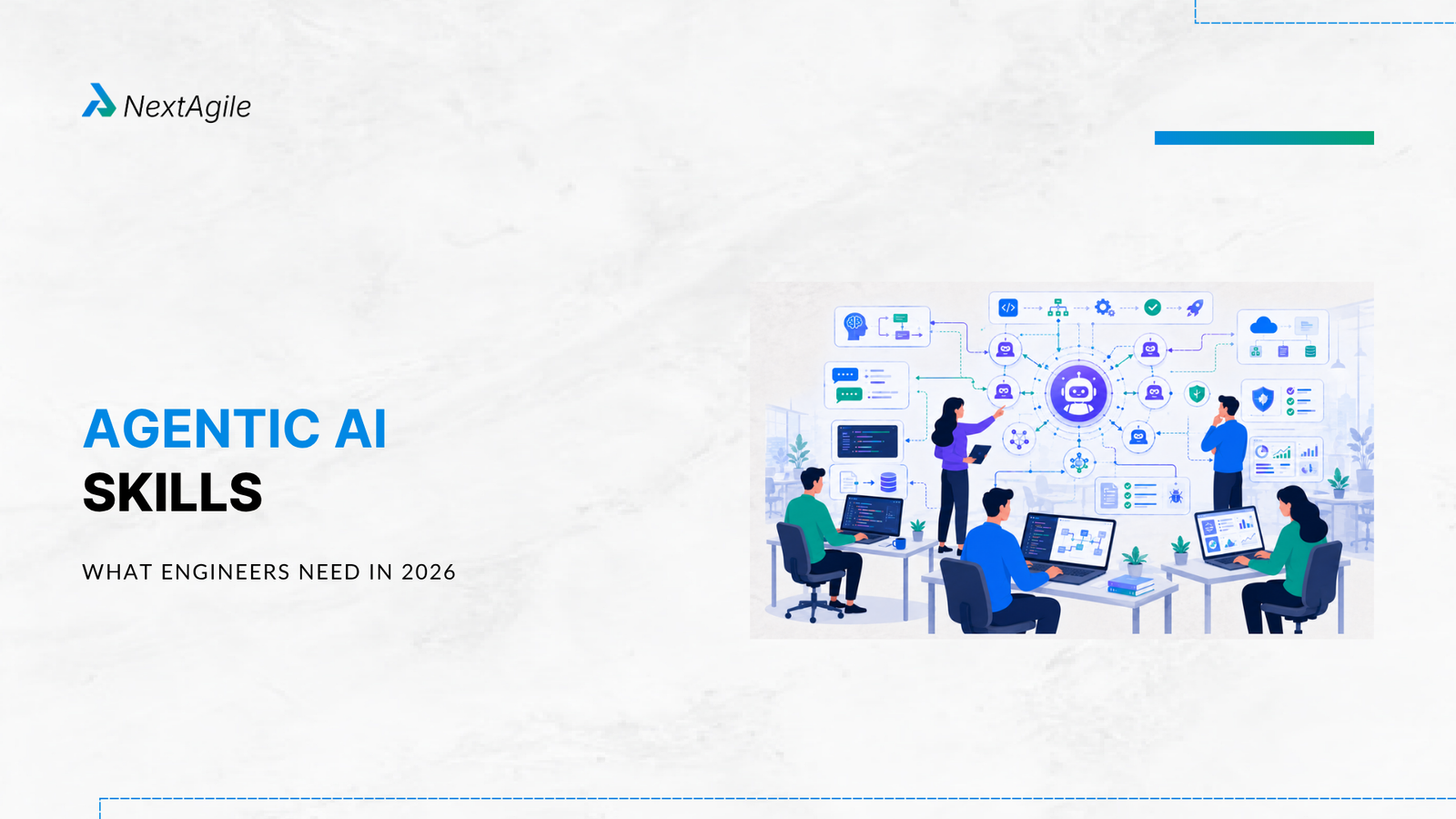
The most important agentic AI skills in 2026 go beyond prompt engineering. Engineers need to understand LLMs, context engineering, tool and API orchestration, agent design, evaluation, observability, security, governance, and engineering judgment.
An engineer building an AI agent must understand how a model interacts with tools, data, memory, APIs, and other agents. They also need to know how to test an agent, monitor its behavior, control its cost, and keep it safe in production.
The goal is not to make every software engineer an AI researcher. It is to build practical AI skills for engineers based on their role. Junior engineers need strong foundations, while senior engineers and architects need deeper skills in system design, reliability, governance, and multi-agent systems.
Key Highlights of Agentic AI Skills Agentic AI requires a wider skill set than basic LLM or prompt knowledge. Engineers need to understand both AI behavior and traditional software engineering. Tool use, API orchestration, evaluation, and observability are becoming core engineering skills. Multi-agent design should be learned after engineers understand single-agent systems. AI safety and governance must be treated as engineering concerns, not only compliance tasks. Different engineering roles need different levels of agentic AI capability. Companies should build common skills internally and hire selectively for highly specialized expertise. Real projects are one of the best ways to assess and develop agentic AI skills. Agentic AI is changing the way software systems are built.
Traditional software follows rules written by developers. A conventional AI application may use a model to generate text, classify information, summarize documents, or answer questions.
An AI agent can do more.
It can interpret a goal, decide what steps are needed, call tools, retrieve information, use APIs, maintain context, and continue working until a task is completed or requires human input.
That change creates a new skills requirement for engineering teams.
Knowing how to call an LLM API is useful, but it is not enough to build a reliable agent. Engineers must understand what happens when the model chooses the wrong tool, uses poor information, enters an unnecessary loop, produces an unsafe action, or consumes far more tokens than expected.
Modern agent frameworks already reflect this shift. For example, current Microsoft Agent Framework capabilities include tools, memory, workflows, multi-agent orchestration, checkpoints, human-in-the-loop support, and observability. OpenAI’s current agent tooling , described in OpenAI’s Agents SDK documentation , similarly focuses on tools, orchestration, guardrails, tracing, and long-running tasks.
For engineering leaders, the question is therefore not simply: “Does our team know AI?”
The better question is: “Can our team engineer AI systems that are useful, reliable, secure, observable, and maintainable?”
That is the real meaning of agentic AI skills in 2026.
What Are Agentic AI Skills? Agentic AI skills are the technical and decision-making capabilities engineers need to design, build, test, deploy, and operate AI systems that can perform multi-step tasks with some degree of autonomy.
These skills combine traditional software engineering with AI-specific capabilities.
An engineer may need to understand:
LLM behavior and limitations Prompt and context engineering Retrieval and knowledge grounding Tool calling API orchestration Agent workflows Memory and state Evaluation Observability Security and governance Cost and performance Human approval and escalation The important point is that agentic AI engineering is not a completely separate discipline from software engineering.
It builds on software engineering and adds new forms of uncertainty.
Building an AI Agent vs Integrating an AI API Integrating an AI API can be relatively simple, which is part of why the distinction between an AI copilot vs AI agent confuses so many engineering teams early on.
An application sends a request to a model, receives a response, and displays or processes that response.
Building an agent is different.
An agent may need to decide whether to search a database, call an API, use a calculation tool, ask for clarification, or hand work to another agent.
The engineer therefore has to design the environment in which the model operates.
This includes defining:
Available tools Tool permissions Instructions Context Memory Error handling Approval points Evaluation criteria Monitoring The difference is similar to the difference between calling a function and designing a system that decides which functions to call and when.
How Agentic AI Skills Differ From Traditional AI Skills Traditional AI skills often focus on models, data, machine learning, and prediction.
Agentic AI adds a strong systems dimension.
Engineers must understand how models interact with external systems and how those interactions affect reliability, security, cost, and user experience.
This means that strong agentic AI engineers need both AI knowledge and engineering judgment.
Agentic AI Skills Your Engineering Team Needs in 2026 LLM and AI Foundations Engineers do not necessarily need to become machine learning researchers.
However, they need a practical understanding of LLM foundations.
They should know what tokens and context windows are, why models can produce different answers, how temperature and model selection affect behavior, and why hallucinations happen.
They should also understand model limitations.
For example, an LLM does not automatically know which information is correct, whether a tool action is safe, or whether a generated answer meets a business rule.
These foundations help engineers make better architecture decisions.
They also help teams understand when to use an LLM and when a traditional software component is the better solution.
Prompt Engineering and Context Engineering Prompt engineering remains important, but its role is changing. However, agentic systems also require context engineering vs prompt engineering as two distinct disciplines engineers need to master separately.
Engineers need to write clear instructions, define expected behavior, provide examples, and structure model inputs.
However, agentic systems also require context engineering.
This means deciding what information the model receives, when it receives it, how much context is included, and how information is retrieved or compressed.
Good context can improve an agent’s performance without simply increasing the size of the prompt.
Engineers should learn to manage:
Instructions User context Retrieved information Tool results Conversation history Memory Structured outputs The skill is not simply writing a better prompt. It is designing the right information environment for the model.
Tool and API Orchestration Tool use is one of the most important skills to build AI agents.
An agent becomes useful when it can interact with the systems around it.
That may include databases, search systems, business APIs, ticketing platforms, cloud services, code repositories, or internal applications.
Engineers need to understand how to expose these capabilities safely.
They should know how to:
Define tool interfaces Validate tool inputs Handle tool failures Control permissions Manage authentication Handle retries Set timeouts Record tool activity Prevent unsafe actions Tool use is therefore both an integration skill and a reliability skill.
Agent and Multi-Agent Design Engineers should first understand single-agent patterns before moving into multi-agent design.
A single agent may handle planning and execution.
A multi-agent system may divide work among specialized agents, for example, one agent researches information, another analyzes it, and another prepares the final result.
This can be useful, but adding agents also adds complexity.
More agents can mean:
More model calls More latency Higher cost More failure points More difficult debugging More complex state management Engineers therefore need to learn when multi-agent architecture is justified and when a simpler workflow is better.
Current agent frameworks increasingly support explicit workflows and multi-agent orchestration, including sequential, concurrent, and handoff patterns. ( Microsoft Learn )
Evaluation and Testing Traditional software can often be tested against predictable expected outputs.
Agents are different.
The same request can sometimes produce different paths or responses.
Engineers therefore need agent evaluation frameworks and structured testing practices.
Evaluation should cover more than the final answer.
Teams may need to evaluate:
Task completion Answer quality Grounding Tool selection Tool input accuracy Safety Consistency Latency Cost Evaluation should begin early and continue after deployment. Current agent evaluation guidance recommends starting with a small set of test cases, establishing a baseline, expanding coverage, and eventually operationalizing evaluation as a continuous process. ( Microsoft Learn )
This is an important shift:
AI testing is not a final QA activity. It is part of agent development.
Observability and Cost Management When a traditional application fails, developers can usually inspect logs and trace the execution path.
Agents can be harder to debug because their behavior may involve several model calls, tool calls, retrieval steps, and decisions.
This is why agent observability matters.
Engineers should be able to see:
Which tools were called What information was retrieved Where an agent failed How many model calls were made How much latency each step added How many tokens were consumed Where an agent deviated from the expected path Modern agent observability tools focus on tracing these execution steps because the final answer alone often does not explain why an agent failed. ( LangChain )
Cost management is closely connected.
Engineers need to understand model pricing, token usage, caching, routing, retries, and unnecessary agent loops, a failure mode explained in more depth in why AI agents need loop engineering .
AI Safety and Governance An agent with access to business systems can do more than generate text.
It may retrieve sensitive information, modify records, send messages, execute code, or trigger business processes.
This makes security and governance essential.
Engineers should understand:
Access control Data privacy Prompt injection Tool permissions Sensitive data handling Human approval Audit logs Output validation Safe failure mechanisms Governance should not sit completely outside engineering. Engineers need to build systems that make governance possible, which is the engineering side of any AI governance framework .
Engineering Judgment This may be the most important skill of all.
AI tools can make development faster, but they do not remove the need for engineering judgment.
Engineers must decide:
Should this task use an agent at all? Should it be deterministic? Does it need one agent or several? Where should a human approve an action? What happens when the model is wrong? What data can the agent access? What level of autonomy is acceptable? The best agentic AI engineer skills therefore combine technical knowledge with the ability to make sound system decisions.
Which Agentic AI Skills Belong to Which Engineering Role? Not every engineer needs the same skill depth.
Skills for Junior Engineers Junior engineers should build strong foundations.
Key skills include:
LLM fundamentals Prompt engineering API integration Structured outputs Basic RAG Tool calling Basic evaluation Responsible AI The objective is to help them safely build small AI features and understand how AI systems differ from traditional applications.
Skills for Mid-Level Engineers Mid-level engineers should move from using AI components to building complete AI applications.
They should develop skills in:
RAG architecture Tool orchestration Agent workflows Context management Evaluation Testing Error handling Basic observability Security They should be able to build and improve production-oriented AI features with limited supervision.
Skills for Senior Engineers Senior engineers need deeper system-level skills.
They should understand:
Agent architecture Multi-agent design Evaluation strategies AI observability Reliability Security Model selection Cost optimization Human-in-the-loop patterns Production operations Their role is increasingly about making AI systems reliable rather than simply making them work.
Skills for AI and Platform Architects Architects need the broadest view.
They should understand model strategy, AI platform architecture, data integration, security, governance, cost, observability, deployment, and operating models.
They also need to know when to use an agent, when to use a deterministic workflow, and when not to use AI at all, decisions grounded in a clear agentic AI architecture framework .
Which Agentic AI Skills Should You Hire For vs Build Internally? Skills That Are Difficult to Hire Organizations may need to hire when they require scarce expertise such as:
Advanced AI architecture AI platform engineering Complex model optimization Large-scale AI infrastructure Deep evaluation expertise AI security leadership Hiring can bring experience that would take years to develop internally.
Skills That Can Be Developed Through Reskilling Many application-level capabilities can be developed within existing engineering teams.
These include:
LLM application development Prompt and context engineering RAG Tool integration Agent workflows Evaluation Observability Responsible AI practices Existing engineers already understand software design, APIs, testing, databases, and cloud infrastructure.
That foundation can make reskilling faster than building an AI engineering team entirely from scratch, which is the premise behind NextAgile’s gen AI engineering program .
A Hire-vs-Build Decision Framework Use three questions:
Is the skill strategically important? If yes, consider building internal capability.
Is the skill already close to the team’s existing capabilities? If yes, reskilling may be more practical.
Is the skill rare and difficult to develop quickly? If yes, hiring or external expertise may make more sense.
For many companies, the answer will be a combination of hiring and internal development.
How to Assess Your Engineering Team’s Agentic AI Skills Create a Role-Based Skills Matrix Start by listing the capabilities required for each role.
For example, RAG may be a basic skill for a mid-level engineer but an advanced architectural capability for a senior engineer.
The matrix should include both technical skills and engineering judgment.
Score Current Capability Levels A simple four-level scale can work:
Level 1 – Awareness: Understands the concept. Level 2 – Assisted: Can use the skill with guidance. Level 3 – Independent: Can apply the skill to real projects. Level 4 – Advanced: Can design, review, and improve systems using the skill. This makes the skills gap visible.
Identify Critical Skills Gaps Not every gap requires immediate action.
Prioritize skills based on business plans.
If the organization plans to deploy tool-using agents, tool orchestration, security, evaluation, and observability become more important than advanced model training.
This prevents training from becoming a collection of disconnected courses.
Tools and Technologies Engineers Should Know The goal should not be to train engineers on every new AI tool.
Tools change quickly. Transferable engineering concepts last longer.
Agent Frameworks Engineers should understand at least one major agent development approach deeply enough to build and debug a working system.
Depending on the organization’s technology stack, this may include tools such as OpenAI’s Agents SDK, Microsoft Agent Framework, LangGraph, or other enterprise frameworks, and framework comparisons like LlamaIndex vs LangChain can help teams choose.
The important skills are not framework-specific syntax. Engineers should understand agents, tools, workflows, state, memory, handoffs, guardrails, and execution patterns.
Microsoft’s current framework, for example, separates open-ended agent behavior from explicit workflows and supports tools, MCP, state, memory, and multi-agent workflows. ( Microsoft Learn )
Evaluation and Observability Engineers should also be familiar with evaluation and observability tools.
The focus should be on creating test sets, defining acceptance criteria, measuring agent behavior, tracing execution, identifying failures, and improving systems over time.
These capabilities matter more than knowing the name of a particular tool.
How to Build Agentic AI Skills Without Slowing Engineering Delivery Start With a Real Engineering Use Case Do not begin with a large training program disconnected from business work.
Choose a practical use case.
For example:
Automated test analysis Internal knowledge retrieval Code review assistance Incident investigation Documentation generation Developer workflow automation A real problem gives the team a reason to learn.
Combine Learning With Hands-On Projects Use short learning sessions followed by practical work.
An engineer might learn tool calling in the morning and build a tool-enabled agent in the afternoon.
This approach turns concepts into capability.
It also allows engineering managers to see whether employees can apply the skill independently.
Measure Skill Development Against Business Outcomes Skill development should ultimately connect to business value.
Measure:
Number of engineers who can build AI applications independently Time taken to deliver AI features Reduction in repetitive engineering work Quality of AI-generated outputs AI project delivery speed Reduction in dependency on specialist teams Production reliability Cost per AI workflow This turns AI training from a learning activity into a measurable engineering capability.
Conclusion: Build Transferable Agentic AI Skills The most valuable agentic AI skills in 2026 are not limited to knowing a particular model or framework.
The technology will continue to change.
What engineers need are transferable capabilities: understanding LLMs, managing context, orchestrating tools, designing agents, evaluating behavior, observing production systems, managing cost, applying security, and making sound engineering decisions.
Organizations should therefore avoid building training programs around tools alone.
Instead, build capability around engineering outcomes.
Junior engineers can learn the foundations. Mid-level engineers can build complete AI applications. Senior engineers can take ownership of reliable agentic systems. Architects can establish the technical and governance foundations for enterprise adoption.
This creates a stronger path toward AI workforce transformation. The objective is not simply to have engineers who can build an AI agent. It is to have engineers who know when to build one, how to build it responsibly, how to test it, and how to make it work in a real production environment.
If your engineering teams are struggling to build the skills needed for agentic AI adoption, a structured capability-building approach can help close critical AI skills gaps. NextAgile consulting can help you assess your team’s current capabilities and build practical, role-based AI learning programs through our agentic AI training program aligned with your engineering goals. Do reach out to us at consult@nextagile.ai , and we would be happy to explore more.
Frequently Asked Questions 1. What are the most important agentic AI skills to learn in 2026? The core skills include LLM foundations, prompt and context engineering, tool and API orchestration, agent design, evaluation, observability, AI security, governance, cost management, and engineering judgment.
2. Do software engineers need Python for agentic AI? Python is widely used in AI development and is valuable to learn, especially for engineers working directly with AI frameworks and data. However, Python is not the only option. The more important skill is understanding agent architecture, APIs, tools, evaluation, and production engineering.
3. Is prompt engineering still an important skill in 2026? Yes, but prompt engineering is only one part of the skill set. Engineers also need context engineering, structured outputs, tool design, evaluation, and system-level thinking. Good prompts alone cannot make an unreliable agent production-ready.
4. How long does it take to learn agentic AI skills? The timeline depends on existing engineering experience. A developer with strong API, cloud, and software engineering skills can learn basic agent development relatively quickly. Building advanced production systems requires deeper experience with evaluation, security, observability, and architecture.
5. Can a traditional software engineer become an agentic AI engineer? Yes. Traditional software engineering provides a strong foundation. Skills such as programming, APIs, databases, testing, cloud, and system design are directly useful. The engineer then needs to add AI-specific skills such as LLMs, context engineering, agents, evaluation, and AI safety.
6. Which agentic AI skills are most valuable for getting a job? Employers are likely to value engineers who can demonstrate that they can build and operate real AI systems. Strong combinations include software engineering plus LLM application development, RAG, tool orchestration, agent design, evaluation, observability, and cloud deployment.
Rahul seasoned technology leader with 20+ years of experience, now dedicated to mentoring and training individuals and groups in Generative AI, advanced AI/ML system design, and production best practices. He is a hands-on tech entrepreneur and has deep industry experience in building cutting-edge AI products.
 Skip to content