Quick Answer The ADKAR model is a change management framework developed by Prosci that identifies five outcomes people need to achieve for change to succeed: Awareness, Desire, Knowledge, Ability and Reinforcement. It helps organisations diagnose why employees are not adopting a new process, technology or way of working. By identifying the earliest unresolved barrier, leaders can choose targeted interventions and measure whether the expected behaviour becomes part of everyday work.
Key Takeaways from This Blog The ADKAR model focuses on individual adoption, helping organisations turn planned changes into sustained workplace behaviour. Its five stages are Awareness, Desire, Knowledge, Ability and Reinforcement. Each stage addresses a different adoption barrier. Low adoption does not always indicate resistance. Employees may lack clarity, confidence, practical skills, resources or reinforcement. A structured ADKAR assessment helps leaders identify the barrier, select the right intervention and assign accountability. In an AI rollout, training alone will not resolve concerns about job security, output quality or changes to existing workflows. ADKAR complements Kotter and Lewin by providing a more individual-focused view of change. Adoption metrics should measure actual usage, proficiency and business impact, not just attendance or completion rates. Introduction An organisation can deploy a new technology across thousands of employees and still see little improvement in productivity. The software works, training is complete and the implementation team has closed its tasks. Yet employees continue using spreadsheets, repeating manual work and following the old process.
The problem is not always the technology. It may be the gap between introducing a change and helping people adopt it. When that gap persists, the organisation pays for the new system without receiving its expected business value.
Leaders often respond with more communication, additional training or stricter instructions. These interventions can help, but only when they address the actual barrier. An employee who does not understand the reason for the change needs a different response from someone who understands it but cannot perform the new task.
The ADKAR model helps leaders make that distinction. It provides a practical way to examine what employees need to understand, accept, learn and practise before a new way of working becomes sustainable. For organisations managing technology implementations, restructuring or Agile transformation, this makes change adoption a management responsibility rather than a communication exercise.
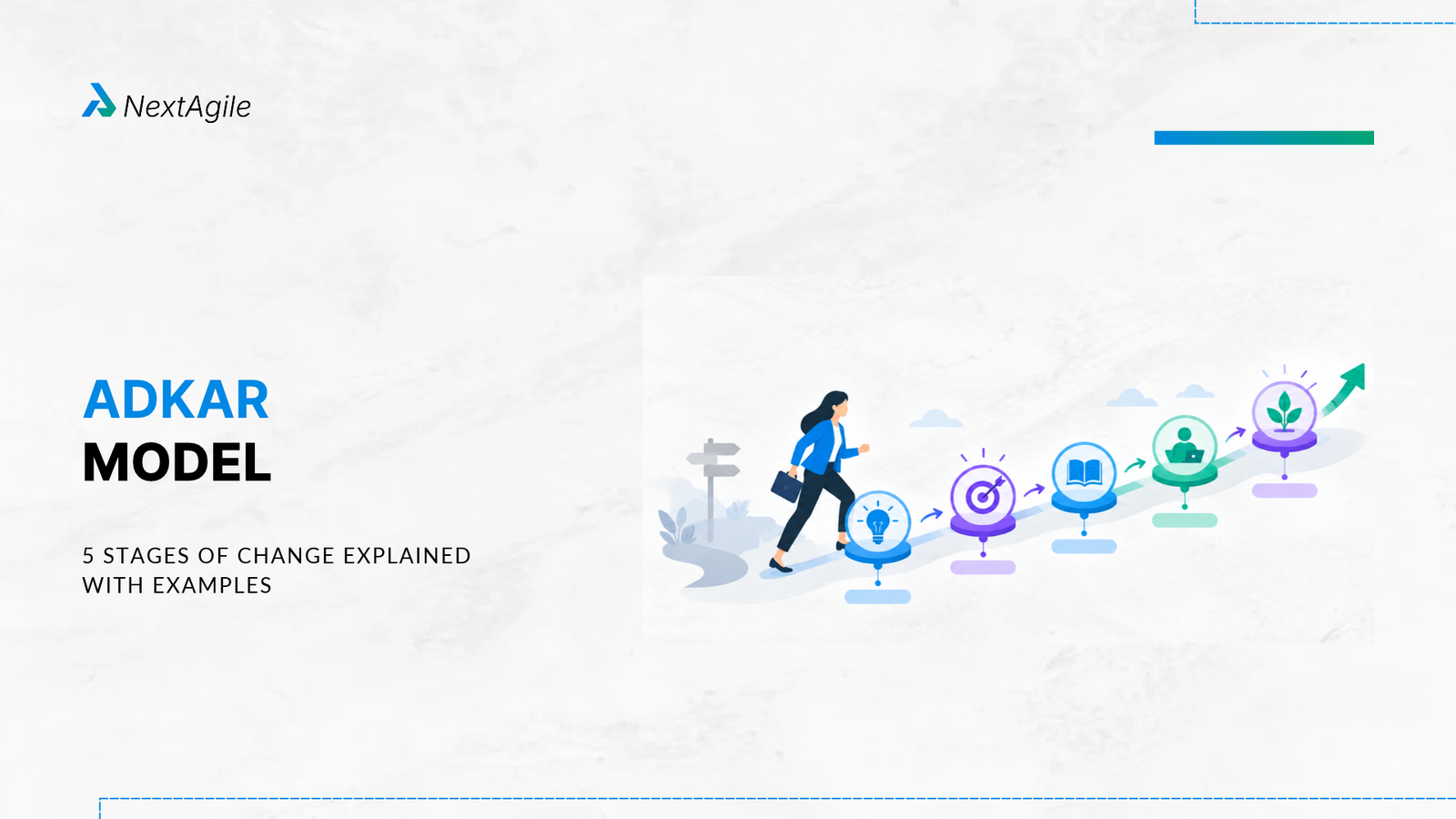
What Is the ADKAR Model? And What Is It Not? ADKAR is an individual change management model associated with Prosci. It describes five outcomes needed for successful change: Awareness of the need for change, Desire to participate, Knowledge of how to change, Ability to implement the change and Reinforcement to sustain it.
The framework connects individual behaviour with organisational outcomes. A business may redesign its operating model, but the intended benefits will remain limited if managers continue making decisions through the old governance structure or teams keep following outdated workflows.
ADKAR helps identify where that transition is breaking down. It is not a project plan, a communication calendar or a training checklist. Completing activities across all five stages does not prove that employees have adopted the change. The focus must remain on observable outcomes.
Origin and the Prosci connection The ADKAR model was developed by Jeff Hiatt and is closely associated with Prosci’s change management methodology. Its five outcomes provide a common language for understanding the people side of organisational change.
Organisations can use the framework’s core concepts to structure change conversations and diagnose adoption barriers. Formal Prosci training and certification, however, relate to the provider’s specific methodology and programmes. Using the acronym does not automatically make a practitioner Prosci-certified.
For enterprise leaders, the practical value is consistency. When managers and change teams use the same diagnostic language, they can identify barriers, agree on interventions and evaluate whether adoption is improving.
Individual change versus organisational change Organisational change concerns what the business is changing, such as its technology, structure, strategy or operating process. Individual change concerns what employees must understand and do differently to make that transition work.
Consider a company implementing a central customer relationship management system. The organisational project may include data migration, software integration, testing and deployment. Employees must also learn how to maintain records, manage opportunities and document customer interactions through the new platform.
The system can be technically ready while employee adoption remains weak. ADKAR addresses this individual transition, while project governance and operational management ensure the wider implementation is properly designed and delivered.
The Five ADKAR Stages, Each With a Workplace Example The five stages represent distinct outcomes rather than five communication or training activities. Each stage helps leaders answer a different question about readiness and adoption.
1. Awareness: Do employees understand why change is necessary? Awareness means understanding the business reason for change. Employees need to recognise the problem with the current approach and understand why a different way of working is needed.
A company introducing a standard project tracking system may explain that all teams must use the new platform. That communicates the instruction, but it does not explain why the change matters. Employees need to understand how inconsistent tracking creates duplicated work, unreliable forecasts and delayed customer commitments.
Leaders should connect the change to operational evidence, explain what will change and invite questions. If employees cannot explain the business rationale in their own words, the organisation should strengthen understanding before assuming that training will solve the problem.
2. Desire: Are employees willing to participate? Awareness does not guarantee commitment. Employees may understand the business case and still worry about workload, job security, loss of autonomy or how their performance will be judged during the transition.
Imagine a company introducing AI-assisted reporting. Employees understand that the tool can reduce repetitive work, but some fear that automation will make their roles less valuable. Repeating the productivity benefits will not address that concern.
Leaders need to listen, clarify how roles may change and explain where human judgement remains essential. Meaningful involvement, credible answers and appropriate support can improve willingness to participate. Desire cannot be created through pressure alone, although clear expectations and accountability still matter.
Not every employee who questions a change is resisting progress. Sometimes employees recognize consequences that were overlooked during planning. A new reporting process may increase administrative work without improving decisions. A centralized approval mechanism may reduce local autonomy while creating longer customer response times. An AI tool may accelerate one activity while introducing additional verification and rework elsewhere.
In such situations, low Desire may be a rational response to a poorly designed change rather than an attitude that needs correcting.
Leaders should therefore distinguish between reluctance caused by uncertainty and objections supported by operational evidence. The first may require communication, involvement, or reassurance. The second may require redesigning the proposed change itself.
A mature change-management approach does not simply ask how to make employees accept a decision. It also asks what employee concerns reveal about the quality of that decision.
3. Knowledge: Do employees know what to do differently? Knowledge concerns the information and instruction required to implement the change. Employees may support a new process but still lack the steps, standards or practical guidance needed to follow it correctly.
For example, a sales team may agree to use a central CRM system but remain uncertain about how to record interactions, update opportunities or maintain customer data. Generic demonstrations may not prepare every role for these tasks.
Provide role-specific instruction, realistic examples, accessible job aids and opportunities to practise. Check understanding through task completion rather than attendance records. Knowledge means employees understand how to perform the required work, not simply that they have seen the new system.
4. Ability: Can employees perform the change in real conditions? Ability is the capacity to translate Knowledge into actual performance. Employees may understand the process but struggle to apply it under time pressure, within existing workflows or when unexpected situations arise.
A customer support team may complete training on a new case management system but struggle to resolve live cases because the workflow is unfamiliar and experienced colleagues are unavailable. The gap is practical performance, not necessarily motivation.
Leaders should provide supervised practice, coaching, timely feedback and access to support. They should also remove operational barriers such as inadequate permissions, conflicting procedures or unrealistic workloads. Asking employees to try harder will not resolve a system constraint that prevents them from doing the work.
5. Reinforcement: Will the new behaviour continue? Reinforcement helps sustain change after the initial launch. Employees may use a new process during a pilot or while senior leaders are monitoring progress, then return to familiar habits when attention moves elsewhere.
Suppose project teams initially follow a standard review process, but managers gradually stop using its data to make decisions. Teams return to informal updates because the new approach no longer influences how work is managed.
Leaders must embed the behaviour into regular operating reviews, decision-making and accountability. They should recognise effective adoption, address recurring problems and demonstrate the expected behaviour themselves. If the organisation continues rewarding the old way of working, the new process is unlikely to last.
Employees learn what an organization genuinely expects by observing how their managers make decisions, not only by listening to transformation announcements.
Consider a company introducing a transparent work-management platform. Employees are trained to update progress, risks, and dependencies in the system. However, senior managers continue requesting separate presentations, spreadsheets, and status emails before making decisions.
Employees quickly discover that maintaining the new platform does not eliminate the old reporting work. It simply adds another obligation.
The resulting adoption problem may appear to be weak Reinforcement, but the underlying cause is contradictory managerial behaviour.
Sustainable adoption therefore requires leaders to identify which existing routines, reports, approval mechanisms, and incentives must change or disappear when the new way of working is introduced.
How to Score ADKAR and Find the Barrier Point A useful ADKAR assessment goes beyond asking whether employees feel ready for change. It identifies the specific outcome that remains weak, the evidence behind that assessment and the action required to improve it.
The following five-point scale is an illustrative internal assessment method. It is not presented as an official Prosci assessment instrument.
Score Meaning Evidence to examine 1 Not established Employee cannot explain or demonstrate the outcome 2 Weak Significant uncertainty, reluctance or performance gaps remain 3 Developing Partial understanding or inconsistent behaviour 4 Strong Outcome is demonstrated in most situations 5 Sustained Outcome is demonstrated consistently with minimal support
Assess each stage separately. Do not average all five scores into one readiness number that hides the source of the problem. A strong Awareness score cannot compensate for an employee who cannot perform the new task. Scores should be interpreted within the context of the affected role and the specific change; they should not be treated as standardized measures for comparing unrelated teams or transformation initiatives.
Find the earliest unresolved barrier Start with Awareness and move through the stages in sequence. If employees cannot explain why change is necessary, investigate the business case and communication. If they understand the reason but remain unwilling, explore trust, incentives and perceived risks.
If employees support the change but do not know how to implement it, improve instruction. If they know the process but cannot perform it reliably, provide practice and remove operational barriers. If they adopt it temporarily and then revert, investigate reinforcement and competing priorities.
Use the earliest unresolved stage as the starting point, while recognising that several barriers can exist at once. Validate the diagnosis with employee feedback, observed behaviour and operational data.
ADKAR assessment worksheet Use this worksheet to convert scores into accountable action.
Assessment field What to record Employee group Which roles or teams are affected? ADKAR stage Where is the main barrier? Score and evidence What is the rating, and what supports it? Diagnosed cause Why is the outcome weak? Intervention and owner What will change, and who is responsible? Success measure What observable result will demonstrate improvement? Review date When will progress be reassessed?
For example, employees may score highly on Awareness but poorly on Desire because they believe the new process will increase workload. The intervention should address workload and process concerns, not repeat the business case. The team should then review employee feedback and actual participation to determine whether the barrier has reduced.
An ADKAR score is useful only when it helps leaders make a better intervention decision.
A low Ability score, for example, does not explain whether employees lack practice, access permissions, suitable tools, managerial support, or sufficient time to perform the new task. Each cause requires a different response.
The assessment should therefore connect three elements: the observed adoption problem, the evidence explaining its cause, and the specific organizational action expected to remove it.
When leaders revisit the assessment, they should examine whether the barrier has actually reduced rather than simply whether the reported score has improved. Demonstrated behaviour and operational evidence provide a stronger basis for judging progress than self-reported confidence alone.
Worked Example: Applying ADKAR to an AI Tool Rollout Consider an Indian services company introducing an AI assistant for report drafting, document summaries and client updates. The expected benefits include less repetitive work and faster turnaround. The organisation provides platform access and runs an introductory demonstration.
Six weeks later, usage remains inconsistent. Some employees use the assistant regularly, while others continue completing tasks manually. Management initially assumes that employees need more training.
The change team reviews employee feedback, usage patterns and the quality of completed work. Its illustrative assessment looks like this:
ADKAR stage Score Finding Awareness 4 Most employees understand the productivity objective Desire 2 Concerns about job security and output reliability remain Knowledge 3 Basic prompts are understood, but approved use cases are unclear Ability 2 Employees struggle to verify outputs and fit them into workflows Reinforcement 1 Managers rarely review usage, quality or business outcomes
These scores demonstrate how an assessment can be structured. They are not industry benchmarks or evidence of a measured company result.
Match the intervention to the barrier First, leaders address employee concerns and clarify how AI will support work, where human judgement remains necessary and what responsible use requires. Second, the learning team provides task-specific guidance, approved examples and practice in evaluating AI-generated content.
Third, managers provide time for practice and feedback. The company checks whether permissions, approval rules or existing workflows make adoption unnecessarily difficult. Finally, managers incorporate usage, output quality and lessons learned into regular team reviews.
Each action addresses a different barrier. Another generic demonstration would not resolve employee concerns or remove workflow constraints. Although ADKAR provides a useful sequence for diagnosing change barriers, real adoption is not always linear. Employees may demonstrate Ability in one workflow while still questioning the value of the wider change. New responsibilities or leadership decisions can also create fresh barriers after initial adoption. The model should guide diagnosis and intervention, not become a rigid checklist through which every employee must progress identically.
Measure adoption, proficiency and business impact The company tracks three levels of performance. Adoption measures whether employees use the tool for appropriate tasks. Proficiency measures whether they produce acceptable work with manageable rework. Business impact measures whether turnaround time or cost per task improves.
Baseline data should be collected before implementation where possible, then compared across relevant periods and employee groups. The company should also check whether usage continues after the initial launch.
This is the difference between completing an AI rollout and managing its adoption. Organisations exploring AI tools for change management should connect technology use with employee capability, workflow design and measurable business outcomes.
AI adoption introduces an additional complication: greater usage does not necessarily mean better performance.
Employees may use an AI assistant frequently while spending considerable time correcting inaccurate outputs. A reporting team may produce drafts faster but require additional reviews before information can be shared with customers. Usage statistics may look encouraging even when total workflow effort has barely changed.
Leaders should therefore measure the complete workflow rather than the AI-assisted activity in isolation. Relevant measures may include end-to-end turnaround time, rework, quality, cost per completed outcome, and the proportion of outputs requiring human correction.
The objective is not to maximize AI usage. It is to improve the work that AI was introduced to support.
ADKAR vs Kotter vs Lewin: Which to Use When ADKAR, Kotter’s 8-Step Change Model and Lewin’s Change Model address different dimensions of change. ADKAR focuses on individual adoption, Kotter provides a broader approach to mobilising organisational change, and Lewin frames the transition from an existing state to a new one.
Dimension ADKAR Kotter Lewin Primary focus Individual adoption Organisational mobilisation Preparing for and stabilising change Structure Five outcomes Eight steps Unfreeze, Change, Refreeze Best use Diagnose adoption barriers Align leaders and build momentum Frame the overall transition Limitation Does not replace project governance Requires sustained coordination Broad phases need practical supporting tools
ADKAR vs Kotter Kotter emphasises urgency, a guiding coalition, a clear vision, broad mobilisation and sustained change. It helps leaders organise an enterprise-wide effort and align stakeholders around a shared direction.
ADKAR helps determine whether individuals understand, support and can implement that direction. An organisation might use Kotter to mobilise a new operating model and ADKAR to diagnose why managers are still following old decision-making practices.
Use Kotter when the central challenge is organisational alignment and momentum. Use ADKAR when the immediate question is why people are not adopting the expected behaviour. Complex transformations can benefit from both.
ADKAR vs Lewin Lewin’s model describes three broad phases: Unfreeze, Change and Refreeze. It helps leaders think about preparing for a transition, implementing new practices and stabilising the resulting state.
ADKAR offers more detail about individual readiness and adoption barriers. It can help distinguish employees who do not understand the need for change from those who understand it but lack practical ability.
Use Lewin to frame the overall transition and ADKAR to diagnose individual adoption. The models need not compete; the right combination depends on the change challenge.
Where ADKAR Falls Short and What to Pair It With ADKAR cannot resolve every cause of change failure. Employees may understand the change, support it and possess the necessary skills, yet still be unable to adopt it because the organisation has not provided the right resources, authority or operating conditions.
A technically broken system, conflicting priorities or unclear decision rights requires operational intervention. More communication or coaching will not correct a process that prevents employees from completing the expected task.
ADKAR also does not determine whether a proposed change is strategically sound. Leaders must validate the business case, define the intended outcomes and manage project risks separately. Assessment scores should be treated as diagnostic signals, not proof that a change initiative will succeed or fail.
For complex initiatives, combine individual adoption assessments with project governance, executive sponsorship, process design and outcome measurement. Change management consulting can help organisations connect these elements rather than treating employee adoption as a standalone activity.
One overlooked cost of organizational change is the period during which employees must operate both the old and new systems.
A new CRM is introduced, but existing spreadsheets remain mandatory. Agile teams begin using visual workflow management, while leadership continues requiring traditional project status reports. AI-assisted processes are deployed, but employees must still reproduce every output manually for approval.
Some parallel operation is necessary during migration, validation, or risk-controlled transitions. The problem arises when temporary arrangements become permanent.
Leaders should therefore define not only what employees must start doing but also what they will be allowed to stop doing once the new approach proves reliable.
Otherwise, adoption may increase while productivity declines because the organization has added new practices without retiring the old ones.
Driving Change Adoption in Indian Enterprises Indian enterprises may implement change across multiple locations, business units and levels of management. A centrally approved process can be interpreted differently across branches, while employees may receive inconsistent guidance from local managers.
A practical example is a multi-location services company introducing a standard customer onboarding process. Headquarters defines the new workflow, but regional teams face different customer volumes, staffing constraints and access to support. A single organisation-wide readiness score would conceal these differences.
Assess affected groups separately. Give local managers clear guidance, explain the business rationale and establish a route for escalating operational barriers. Where language, workflow or access differences matter, adapt implementation support without weakening the required standards.
Managers also need the capability to lead the transition. Strong change management skills for leaders help them address uncertainty, coach employees and reinforce new behaviours. For an Agile transformation, Agile transformation consulting can help connect adoption with leadership practices, governance and execution.
The objective is to make the change workable in everyday operations. Adoption should be reviewed alongside measures such as cycle time, process compliance, rework, customer response and decision turnaround, depending on the intended business outcome.
Conclusion The ADKAR model helps leaders understand why a change that looks complete on paper may still be failing in practice. Awareness, Desire, Knowledge, Ability and Reinforcement represent distinct outcomes, and each requires a response matched to the actual barrier.
Before launching another training session or communication campaign, identify which employee groups are struggling, examine the evidence and locate the earliest unresolved outcome. Assign an owner to address the barrier, then measure whether behaviour and business performance improve.
Change becomes sustainable when the new behaviour is not only understood and practised, but supported by the decisions, incentives, workflows, and operating conditions employees encounter every day.. If your transformation initiatives are struggling to turn implementation into adoption, NextAgile can help align change leadership, employee capability and operating practices with business goals. Contact consult@nextagile.ai to discuss a practical change management approach.
Frequently Asked Questions 1. Do you need Prosci certification to use ADKAR? You do not necessarily need Prosci certification to understand and apply the five ADKAR outcomes in internal change discussions. Certification is relevant for formal training in Prosci’s methodology and tools. Check the applicable programme requirements if your organisation requires certified practitioners.
2. Can ADKAR be used alongside an Agile transformation? Yes. ADKAR helps assess whether employees and leaders understand, support and can apply new Agile practices. It complements transformation planning by identifying individual adoption barriers. Organisations must also address operating model design, governance, leadership behaviour and delivery measures.
3. How long does a team typically spend in each stage? There is no universal timeline for each ADKAR stage. Duration depends on the scale of change, employee readiness, role complexity and available support. Assess progress through evidence of understanding and behaviour rather than assigning fixed time periods to each stage.
4. What happens if the Desire stage is skipped? Employees may understand the change and receive training but still avoid using the new approach. They may comply only when monitored or return to old habits under pressure. Leaders should investigate concerns, trust, incentives and perceived risks before investing further in training or enforcement.
5. Who should run ADKAR assessments: managers or change teams? Both can contribute. Change teams can establish consistent assessment questions and identify patterns across the organisation, while managers provide context about daily behaviour. Employee feedback and operational data help validate findings and reduce the risk of relying on assumptions.
6. Can ADKAR be used for personal or career change? Yes. The five outcomes can help individuals understand a personal transition, such as developing a leadership skill or changing career direction. Awareness clarifies the reason, Desire supports commitment, Knowledge identifies what to learn, Ability builds practical competence and Reinforcement helps sustain the new behaviour.
Anuj Ojha is Co-Founder & Consulting Head at NextAgile. Anuj has designed & led multiple turnkey transformation journeys across industries, domains & geographies and has 16+ years of experience as an agile practitioner. He has worked with CXOs, CTOs & Key Leaders to translate their business objectives on the ground, contextualizing org transformations and creating buy-in across level, leading a team of coaches/consultants to implement agility across 150+ teams & trained more than 12k team members. Anuj’s core area of interest is business agility & working with leaders & teams to achieve long term sustainable, Agile culture & mindset.
 Skip to content