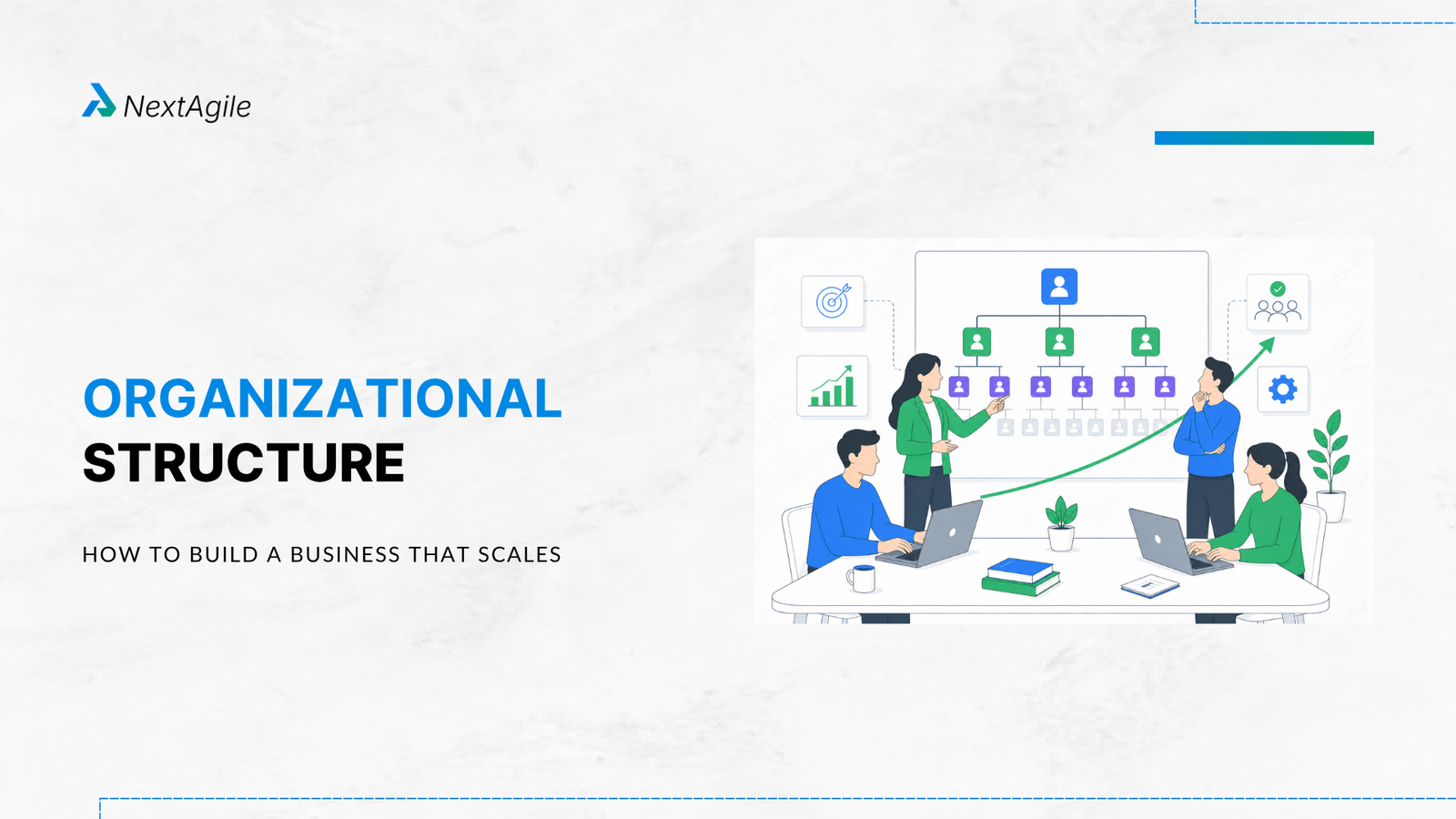
Key Highlights Organizational structure becomes a growth constraint when decision-making, accountability, and communication fail to scale with the business. Most growth challenges that appear to be people problems are often structural problems in disguise. The right organizational structure improves accountability, accelerates decisions, strengthens execution, and supports sustainable growth. Growing businesses should design structures around value creation, not just reporting lines. The NextAgile SCALE Framework provides a practical approach to redesigning organizational structures for growth. Organizational design is not about creating hierarchy. It is about creating clarity. Businesses that continuously evolve their structure are better positioned to scale, innovate, and respond to change. Introduction Most growing companies do not fail because demand disappears. They struggle because the structure that enabled growth eventually becomes the constraint that slows it.
In the early stages of a business, coordination happens naturally. Founders sit close to teams. Information moves quickly. Decisions are made in real time. Problems are solved through conversation rather than process.
Growth changes that reality.
New departments emerge. Leadership layers are added. Teams become specialized. More decisions require alignment across multiple stakeholders.
What once felt simple starts feeling complicated.
Projects take longer to complete. Decisions get delayed. Teams duplicate work. Leaders become overwhelmed by operational questions that should not require their involvement.
Many organizations respond by hiring more people.
Few stop to ask whether the structure itself is creating the problem.
The truth is that growth introduces organizational complexity. Without a structure designed to manage that complexity, performance begins to decline.
The challenge is not headcount.
The challenge is organizational design.
This is why organizational structure becomes one of the most important strategic decisions a growing business can make.
A well-designed structure creates clarity, accountability, and alignment.
A poorly designed structure creates friction, confusion, and bottlenecks.
This guide explores how organizational structure affects growth, why many companies outgrow their existing operating model, and how leaders can redesign their organization to scale effectively.
Why Organizational Structure Becomes Critical as a Business Grows Growth creates opportunities but it also creates complexity. The systems that worked when the company had twenty employees rarely work when it has two hundred.
Communication pathways increase. Dependencies multiply. Decision-making becomes more complicated. The organization becomes harder to coordinate. Many leaders experience these challenges without recognizing their root cause.
They see missed deadlines. Slower execution. Conflicting priorities. Customer dissatisfaction. Employee frustration. What they are often seeing is the consequence of an organizational structure that has stopped supporting growth. As businesses expand, structure becomes the mechanism that determines how work gets done.
It influences how decisions are made. How information flows. How accountability is assigned. How quickly teams can respond to changing business needs. When structure is ignored, complexity grows faster than capability. Eventually, growth itself becomes difficult to sustain.
The Hidden Costs of Operating Without a Defined Structure Poor organizational structure rarely causes a dramatic failure. Instead, it creates small inefficiencies that accumulate over time.
A decision waits three days for approval. Two teams unknowingly solve the same problem. Managers spend hours clarifying ownership. Projects stall because responsibilities are unclear. Each issue appears minor. Together, they create organizational drag.
The hidden costs often include:
Slower decision-making. Duplicated effort. Leadership overload. Reduced productivity. Employee disengagement. Customer delays. Missed growth opportunities. The financial impact can be substantial. Yet these costs rarely appear on a balance sheet. They appear through lost momentum. The larger the organization becomes, the more expensive these structural inefficiencies become.
Signs Your Current Organizational Structure Is Limiting Growth Most organizations experience warning signs before structural problems become critical. Teams become increasingly dependent on leadership for decisions.
Projects require excessive coordination meetings. Employees are unsure who owns key outcomes. Cross-functional initiatives move slowly. Customers experience inconsistent service. Departments optimize for local goals rather than organizational objectives. Decision-making becomes concentrated among a small group of leaders. As a result, executives become bottlenecks.
The organization waits. Opportunities are missed. Growth slows. When these patterns appear consistently, it is often a signal that the structure needs redesign rather than the people.
What Is an Organizational Structure and Why Does It Matter? Organizational structure defines how responsibilities, authority, communication, and accountability are distributed within a company. Many people think organizational structure is simply an organizational chart. It is much more than that.
An organizational chart shows reporting relationships. Organizational structure determines how work actually happens.
It influences how teams collaborate. How decisions are made. How resources are allocated. How strategy is executed. Every business has a structure. The question is whether that structure is helping or hindering performance.
The strongest organizations intentionally design structures that support their strategic objectives. The weakest organizations allow structure to evolve accidentally.
Over time, accidental structures create confusion and inefficiency. Intentional structures create alignment and focus.
How Organizational Structure Supports Accountability and Execution Organizational structure determines who owns what. Without clear ownership, accountability becomes difficult. People assume someone else is responsible and work falls through the cracks.
Priorities compete for attention. Execution suffers. A well-designed structure reduces ambiguity. It creates clear expectations. Employees understand their responsibilities and leaders understand decision rights. Teams understand dependencies. This clarity improves execution because less energy is spent navigating confusion. More energy is spent delivering value.
Organizational Structure vs Organizational Design: What Is the Difference? These terms are closely related but not identical. Organizational structure refers to the arrangement of roles, reporting relationships, and authority.
Organizational design is broader. It includes structure, governance, decision-making, culture, workflows, and operating models.
Think of organizational structure as the framework. Organizational design determines how the entire system functions.
A company may have a well-defined structure and still struggle if its design creates excessive bureaucracy. Likewise, a strong organizational design usually includes a structure aligned with business goals. This distinction matters because growth challenges rarely originate from reporting lines alone. They often emerge from how the broader system operates.
Why Most Organizational Structures Fail During Growth Organizations rarely redesign structure proactively. Most wait until problems become visible. By then, complexity has already accumulated. What worked in one stage of growth becomes increasingly ineffective in the next.
This happens because growth changes the nature of work. Small organizations rely on informal coordination whereas growing organizations require scalable systems.
As headcount increases, communication becomes more difficult. Dependencies increase. Decision-making becomes distributed. The organization needs new mechanisms to maintain alignment.
Many companies continue using structures designed for a much smaller business. The result is predictable.
Leaders become bottlenecks. Teams operate in silos. Execution slows. The business becomes harder to manage. The challenge is not growth itself. The challenge is failing to evolve the operating model alongside growth. Organizations that scale successfully recognize that structure is dynamic so it must evolve as the business evolves.
The NextAgile SCALE Framework Many organizations redesign structure by moving boxes on an organizational chart. That approach rarely solves the underlying problem. Effective organizational design requires a more systemic view.
The NextAgile SCALE Framework provides a practical model for designing structures that support growth.
The framework focuses on five critical dimensions. Together, they create the foundation for sustainable scaling.
S: Simplify Accountability Growth often creates overlapping responsibilities. Multiple teams become involved in similar work.
Ownership becomes unclear.
Decision-making slows.
The first priority is simplifying accountability. Every critical outcome should have a clearly identifiable owner. When ownership is ambiguous, execution becomes inconsistent. When ownership is clear, teams move faster. Leaders spend less time resolving conflicts. Organizations become easier to manage.
Simplified accountability reduces friction and creates focus. It ensures people know what they own and how success will be measured.
C: Clarify Decision Ownership Many growing businesses suffer from decision congestion. Work moves quickly until it reaches a decision point.
Then progress stops. Employees wait for approvals. Managers escalate issues. Executives become overloaded. The problem is often unclear decision ownership.
Effective organizational structures define who can make which decisions. Not every decision should move upward. The most scalable organizations push decisions closer to the people doing the work. This increases speed while reducing leadership bottlenecks.
Decision clarity is one of the strongest predictors of organizational agility.
A: Align Around Value Streams Traditional structures often organize teams around departments.
Marketing reports to marketing. Operations reports to operations. Technology reports to technology. While specialization is important, excessive departmental focus creates silos. Growing businesses benefit from aligning teams around value creation. This approach helps organizations focus on customer outcomes rather than internal functions.
Many organizations use techniques such as value stream thinking to understand how work flows across departments.
The goal is not simply efficiency. The goal is better customer value and stronger business performance.
L: Link Teams Through Shared Outcomes As organizations grow, interdependencies increase. No team operates in isolation. Success requires collaboration across multiple functions. Yet many structures unintentionally create competing priorities. Each department optimizes for its own goals. The organization loses alignment.
High-performing organizations connect teams through shared outcomes. They create mechanisms that encourage collaboration rather than competition. This strengthens execution and reduces organizational friction.
E: Enable Future Growth Many organizations design structures for current conditions. The problem is that growth changes those conditions rapidly. A structure that works today may become a constraint tomorrow.
Effective organizational design anticipates future complexity. It creates flexibility. It allows new capabilities to emerge without requiring constant reorganization.
Scalable structures evolve with the business. They provide stability without becoming rigid. This balance is essential for long-term growth.
Types of Organizational Structures for Growing Businesses Most discussions about organizational structure begin with organizational charts. That approach often misses the real question.
The goal is not choosing a structure. The goal is choosing a structure that supports your growth strategy.
Different organizational structures solve different business problems. Understanding those trade-offs is critical.
Types of Organizational Structures for Growing Businesses Most leaders search for the best organizational structure. In reality, there is no universal answer. Every structure creates advantages in one area and constraints in another. The objective is not to find a perfect model.
The objective is to select a structure that supports the company’s strategy, growth stage, customer needs, and operating environment. The most successful organizations periodically redesign structure as their business evolves. They understand that structure is a business capability, not a permanent decision.
Functional Organizational Structure The functional organizational structure is one of the most common models used by growing businesses.
Employees are grouped according to expertise. Marketing sits within marketing. Finance sits within finance. Technology sits within technology. Operations sits within operations. This structure creates deep specialization. Knowledge develops quickly and standards become easier to maintain.
Career progression is often clearer. The challenge emerges as the business grows.
Departments can become isolated from one another.
Teams optimize for functional objectives rather than customer outcomes.
Work requires increasing coordination across departmental boundaries.
Decision-making often becomes slower as dependencies increase.
Functional structures work best when organizations require operational consistency and specialized expertise. They become less effective when customer responsiveness and cross-functional collaboration become strategic priorities.
Divisional Organizational Structure A divisional structure organizes teams around products, markets, customer segments, or business units. Each division operates with a greater degree of autonomy. Functions such as marketing, operations, and technology may exist within each division.
This approach improves focus. Teams align more closely with customer needs. Decision-making often becomes faster because authority sits closer to the work.
The trade-off is duplication.
Capabilities may be replicated across divisions.
Costs can increase.
Knowledge sharing may become more difficult.
Divisional structures often work well for organizations serving multiple markets or managing diverse product portfolios.
Matrix Organizational Structure Matrix structures attempt to balance specialization with collaboration.
Employees typically report to more than one leader. A team member may report to both a functional manager and a business leader. The intention is to improve coordination across the organization. Resources can be shared more effectively. Expertise can be leveraged across multiple initiatives.
However, matrix structures introduce complexity. Employees may receive competing priorities. Decision-making can become unclear. Conflict resolution often requires strong leadership discipline.
Many organizations adopt matrix structures believing they will solve collaboration challenges. Without clear governance, they frequently create new ones.
Flat and Hybrid Organizational Structures Flat structures minimize hierarchy.
Decision-making authority sits closer to teams. Communication pathways are shorter. Organizations can respond quickly to change. This model often works well in smaller companies. As businesses grow, maintaining a purely flat structure becomes increasingly difficult.
Leadership capacity becomes constrained.
Coordination requirements increase.
Hybrid structures have become increasingly popular. They combine elements from multiple models. Organizations retain functional expertise while creating cross-functional delivery capabilities. Hybrid structures provide flexibility and often align more effectively with modern business environments.
Which Organizational Structure Works Best for Your Business? The answer depends on your growth stage.
A startup focused on speed may benefit from a flatter structure. A growing organization with specialized capabilities may require a functional model. A diversified enterprise may benefit from divisional structures.
Many modern organizations adopt hybrid approaches that combine specialization with cross-functional collaboration.
The most important question is not which structure is fashionable. It is whether the structure enables strategic execution. A structure should support growth rather than slow it.
The Growth Stage Organizational Model One of the biggest mistakes leaders make is assuming the same organizational structure can support every stage of growth.
Growth changes coordination requirements. It changes decision-making complexity. It changes how work flows across the business. The structure must evolve accordingly.
Stage One: Founder Driven Most early-stage companies operate through direct communication.
Founders make key decisions. Teams work closely together. Processes remain informal. Speed is high.
This stage works because complexity remains low. As growth accelerates, however, founder dependency becomes a constraint.
Stage Two: Functional Growth Organizations begin creating specialized departments.
Responsibilities become more clearly defined.
Functional leadership emerges.
This stage improves consistency and capability development. The challenge is preventing departmental silos from forming.
Stage Three: Cross-Functional Coordination As the business expands, value creation increasingly depends on collaboration across departments.
Organizations introduce mechanisms to improve alignment.
Many businesses begin exploring concepts such as an internal agile team structure to improve flow and responsiveness.
The focus shifts from departmental efficiency to business outcomes.
Stage Four: Value Stream Alignment Organizations begin organizing around customer value.
Cross-functional teams become more common.
Decision-making moves closer to the work.
Customer responsiveness improves.
Many enterprises also establish structures such as a lean-agile center of excellence to support alignment and continuous improvement.
Stage Five: Adaptive Enterprise At this stage, organizational design becomes a strategic capability.
The structure evolves continuously.
Teams adapt to changing market conditions.
Decision-making remains distributed.
Innovation accelerates.
The organization becomes resilient because adaptability is built into the system.
Common Challenges Growing Companies Face with Their Existing Structure Structural problems often emerge gradually. The symptoms appear long before leaders identify the root cause.
Unclear Ownership and Duplicated Responsibilities When accountability is unclear, work slows.
Teams assume someone else owns the outcome and important decisions are delayed.
Projects become vulnerable to confusion and rework. Growth amplifies these issues because complexity increases faster than clarity.
Slow Decision-Making Across Departments Many organizations unintentionally centralize decision-making.
Leaders become approval gateways and teams spend more time waiting than executing. The organization becomes dependent on a small number of individuals. This creates bottlenecks that limit scalability.
Teams Outgrowing Informal Communication Informal communication works remarkably well in small organizations. Browth changes the equation.
More teams. More stakeholders. More dependencies. Information becomes harder to manage. What once felt agile begins to feel chaotic. This is often the point where leaders realize their structure must evolve.
Business Transformation Examples Example One: Growth Created Leadership Bottlenecks A technology company doubled revenue within two years.
Headcount increased rapidly. New teams were added. Despite strong market demand, delivery performance declined. The issue was not capability.
Every significant decision required executive involvement.
Leadership became the bottleneck.
The organization redesigned decision ownership and clarified accountability.
Teams gained greater autonomy.
Decision speed improved significantly.
Executives shifted focus from operational approvals to strategic priorities.
Example Two: Departmental Silos Slowed Innovation A financial services organization invested heavily in product innovation.
The business had strong talent across departments. Results remained inconsistent. Analysis revealed a structural challenge. Marketing, operations, product, and technology teams operated independently. Customer value moved slowly across organizational boundaries. The organization introduced cross-functional structures focused on customer outcomes.
Collaboration improved.
Delivery cycles shortened.
Innovation moved faster because the structure supported the strategy.
How Organizational Structure Supports Business Agility Many organizations pursue agility through process changes. The real constraint often sits elsewhere.
Business agility depends on how decisions are made.
How information flows. How teams collaborate. How accountability is distributed. All of these are structural questions.
Organizations seeking agility must examine structure before expecting meaningful improvement.
A rigid structure limits adaptability regardless of methodology. A well-designed structure enables responsiveness regardless of framework.
This is why organizational design and business agility are closely connected. The ability to adapt is largely determined by how the organization is built.
How to Redesign Your Organizational Structure for Sustainable Growth Structural redesign should begin with business objectives. Too many organizations start with reporting lines. They move boxes around an organizational chart. The underlying problems remain unchanged. Effective redesign focuses on value creation. Define Business Functions Before Assigning Departments Start with the work. Identify the capabilities required to execute strategy. Understand how value is created. Only then should departments and reporting structures be considered. Structure should support the business model. Not the other way around. Create Clear Reporting Lines and Decision Ownership Every critical decision requires ownership. Every important outcome requires accountability. Clear reporting relationships reduce confusion. Clear decision rights improve execution. This clarity becomes increasingly important as organizations grow. Balance Specialization With Cross-Functional Collaboration Specialization improves expertise. Collaboration improves outcomes. Growing organizations need both. Many businesses strengthen collaboration by focusing on building high-performing teams that align around shared objectives rather than departmental priorities. Build a Structure That Can Scale With Future Growth The best structures anticipate future complexity. They provide enough stability to support execution. They remain flexible enough to evolve. Organizations should design for the next stage of growth rather than current conditions alone.
A Step-by-Step Framework to Implement a New Organizational Structure Step 1: Assess Your Current Organizational Structure Understand how work currently happens. Map reporting relationships. Evaluate decision-making pathways. Identify bottlenecks. Focus on reality rather than assumptions. Step 2: Identify Capability and Ownership Gaps Examine where accountability is unclear. Identify duplicated responsibilities. Understand where leadership bottlenecks exist. Look for areas where growth has outpaced structure. Step 3: Design the Future-State Organizational Chart The organizational chart should reflect strategic priorities. Reporting lines should support accountability. Team structures should support value creation. Decision ownership should be clearly defined. The goal is alignment rather than complexity. Step 4: Roll Out the New Structure With Minimal Disruption Change management matters. Communicate clearly. Explain why changes are being made. Provide support during transition. Leaders should reinforce new behaviors consistently. Successful implementation depends as much on adoption as design.
Common Organizational Structure Mistakes That Slow Business Growth Several mistakes appear repeatedly across growing organizations. Designing structure around personalities rather than business needs.
Centralizing too many decisions.
Creating unnecessary management layers.
Ignoring cross-functional dependencies.
Confusing reporting relationships with accountability.
Treating organizational design as a one-time exercise.
The most successful organizations view structure as an evolving capability not a static document.
Key Metrics to Measure Whether Your New Structure Is Working Structural changes should improve business performance. Measurement helps determine whether that is happening.
Important indicators include:
Decision cycle time Employee engagement Cross-functional delivery speed Customer satisfaction Time to market Leadership span of control Employee turnover Strategic initiative success rate Internal collaboration effectiveness Improvement across these areas often signals that the structure is supporting growth effectively.
Organizational Structure Readiness Checklist for Growing Businesses Use this checklist to assess organizational readiness.
Accountability is clearly defined. Decision ownership is understood. Reporting lines support execution. Cross-functional collaboration is effective. Organizational priorities are aligned. Leadership bottlenecks are minimized. Teams understand roles and responsibilities. The structure supports future growth. Customer value flows effectively across departments. Continuous improvement is embedded in the operating model. Conclusion Most growth challenges blamed on people are often structure problems in disguise.
Organizations do not become slower because employees lose capability.
They become slower because complexity grows faster than the systems designed to manage it.
Organizational structure determines how decisions are made, how accountability flows, and how quickly the business can respond to change.
The right structure reduces organizational friction, allowing leaders to spend less time coordinating work and more time creating value.
Businesses that scale successfully recognize that organizational design is not an administrative exercise.
It is a strategic capability.
If your organization is experiencing leadership bottlenecks, unclear accountability, slow decision-making, or challenges scaling execution, a structured organizational design approach can help create clarity and alignment. NextAgile helps organizations redesign operating models, strengthen business agility, and build structures that support sustainable growth. Through our agile transformation consulting , leadership enablement, and organizational design expertise, we help businesses scale with confidence. Reach out to us at consult@nextagile.ai and we would be happy to explore how we can support your growth journey.
Frequently Asked Questions 1. Can a small business benefit from a formal organizational structure? Yes. Even small businesses benefit from clear accountability, decision ownership, and reporting relationships. Structure reduces confusion and creates a foundation for future growth.
2. What is the difference between an organizational structure and an organizational chart? An organizational chart shows reporting relationships. Organizational structure defines how authority, accountability, communication, and decision-making operate across the business.
3. How does organizational structure affect company culture? Structure influences behavior. It affects collaboration, decision-making, accountability, and communication patterns, all of which shape organizational culture. Businesses seeking stronger alignment often complement structural redesign with initiatives such as an organizational culture workshop .
4. Should startups use the same organizational structure as established companies? No. Startups typically require greater flexibility and speed. As complexity increases, structures should evolve to support scale, coordination, and accountability.
5. How often should an organizational structure be reviewed as a business grows? Organizations should review structure whenever significant growth, strategic shifts, acquisitions, or operational challenges emerge. Many growing businesses benefit from an annual structural review.
6. What tools can help document and manage an organizational structure? Organizations commonly use organizational charts, capability maps, governance frameworks, operating model documentation, workforce planning tools, and collaboration platforms to manage organizational design effectively.
Alok Dimri is the co-founder and leads the overall business at NextAgile, where he is responsible for strategy, client and consultant partnerships, and a whole lot of other core business activities like solutioning, branding, and customer engagement.
Over the past 16 years, he has worked extensively in business strategy, new business development, and key account management initiatives across process consulting and training domains.
 Skip to content