Design Thinking succeeds when it reduces uncertainty, not when it produces artifacts
Small experiments create disproportionate learning and impact
Empathy without action leads to stalled innovation
Iteration is a leadership responsibility, not a design task
Design Thinking scales through governance and culture, not workshops
Some organizations consistently create products and services that people adopt quickly, recommend willingly, and stay loyal to over time. Others invest heavily in innovation initiatives yet struggle to see meaningful outcomes. The difference is rarely talent or budget. It is how problems are framed, explored, and validated before solutions are scaled.
Design Thinking has become one of the most widely referenced approaches for tackling complex, ambiguous problems. Yet its real value only becomes visible when theory meets constraint. Real users. Real timelines. Real trade offs.
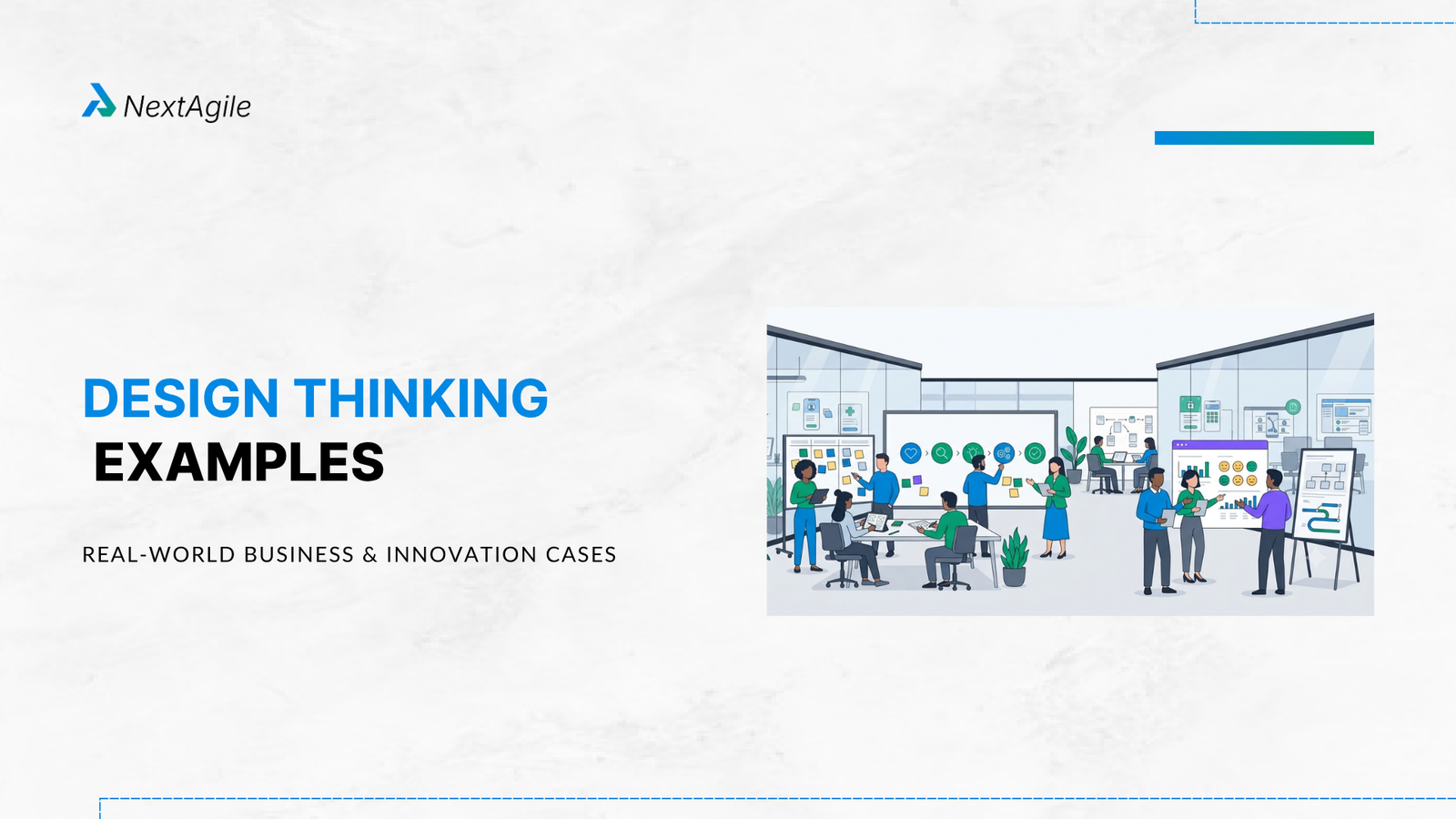
This blog explores real world design thinking examples to show how teams move from insight to impact. Not through polished artifacts or one off workshops, but through disciplined learning, small experiments, and leadership intent. These examples reveal how Design Thinking works in practice, where it breaks down, and what separates surface adoption from lasting capability.
Understanding Design Thinking Beyond the Framework
Design Thinking is often introduced as a five step process. Empathize. Define. Ideate. Prototype. Test. While this model is useful for orientation, real application is rarely linear. Teams loop back, reframe assumptions, and revisit earlier insights as new information emerges.
If you’re new to the methodology, it helps to first understand what Design Thinking is and why organizations use it to solve complex customer and business challenges.
At its core, Design Thinking is a way of reducing uncertainty before making irreversible decisions. It shifts teams from debating opinions to testing hypotheses. When applied well, it changes how organizations learn.
Empathize This stage is about observing real behavior rather than validating assumptions. Teams immerse themselves in the user context to understand motivations, constraints, and unmet needs. Strong empathy work surfaces tensions users may not articulate directly.
Define Insights are synthesized into a focused problem statement. A well defined problem creates clarity without narrowing creativity. Poorly defined problems almost always lead to over engineered solutions.
Ideate Teams generate a wide range of possibilities without early judgment. The goal is not immediate feasibility but cognitive breadth. Evaluation comes later.
Prototype Ideas are translated into low cost representations that allow learning. Prototypes exist to answer questions, not to impress stakeholders.
Test Real users interact with prototypes. Feedback reshapes direction. Failure becomes data, not a setback.
These activities follow the structured Design Thinking process, where teams move from empathy to experimentation while continuously refining solutions.
Design Thinking works because it prioritizes learning before scale. Traditional approaches optimize for predictability. Design Thinking optimizes for insight.
Why Real World Design Thinking Examples Matter More Than Theory
Frameworks explain how Design Thinking should work. Examples show how it survives reality.
Real world examples reveal constraints that theory often ignores. Limited time. Organizational resistance. Conflicting incentives. Legacy systems. When teams succeed despite these conditions, their decisions offer transferable lessons.
Examples also build confidence. Leaders are more likely to support experimentation when they see evidence that small tests can lead to meaningful outcomes. Organizations that consistently innovate also realize measurable benefits of Design Thinking, including reduced delivery risk, stronger customer alignment, and faster learning cycles.
 Skip to content