Key Highlights AI governance is now a business-critical capability, not just compliance, driving trust, risk reduction, and scalable AI adoption Strong governance frameworks define decision authority, risk management, explainability, and continuous monitoring AI bias and ethical risks must be addressed proactively across data, model design, and deployment stages Future-ready enterprises align governance with evolving regulations, reducing legal exposure and accelerating compliance Effective AI governance integrates data privacy, accountability, and cross-functional ownership across teams A risk-based governance approach enables faster innovation while ensuring responsible and secure AI at scale A few years ago, AI governance was something that only heavily regulated industries worried about. Today, every enterprise faces governance decisions that matter. Who decides if an AI system is ready to deploy? What happens when an AI model makes a decision that harms a customer? How do you prevent bias in hiring or lending systems? How do you comply with regulations that are still being written? These aren’t technical questions. They’re governance questions, and getting them wrong carries business risk.
To effectively operationalize governance, enterprises need a structured foundation like an AI operating model that defines ownership, accountability, and decision flow.
Why AI Governance Is No Longer Optional? The pace of AI implementation has outrun governance maturity at most enterprises. Teams are deploying models into production faster than governance can keep up. Nobody has a clear answer to basic questions.
Who owns the risk if an AI model recommends something that turns out wrong? If we train an AI system on historical data that contains bias, who’s responsible? What happens if a regulatory body decides our AI practices violate the law? For many enterprises, AI governance was an afterthought. Some teams might have had a checklist for model validation, but true governance spanning risk assessment, ethical considerations, and regulatory compliance didn’t exist. This created exposure.
The organizations that suffered real damage from AI governance failures learned expensive lessons.
A financial services company had an AI system approve loans with unintended gender bias. A retail company’s algorithm made pricing recommendations that turned out to be price fixing under antitrust law. A healthcare provider’s predictive model made decisions that systematically disadvantaged certain patient populations. In each case, the technical AI system worked fine. The problem was nobody had governance in place to catch these issues before they caused harm.
The enterprises winning now recognize that governance isn’t slowing down AI progress. It’s enabling it.
Clear governance structures let teams move faster because they know what they can do safely. Governance provides liability protection. Governance builds customer and stakeholder trust. Governance helps you navigate the evolving regulatory landscape. Most of these issues stem from execution gaps that are well documented in AI transformation failure reasons and fixes , especially when governance is not aligned with deployment strategy.
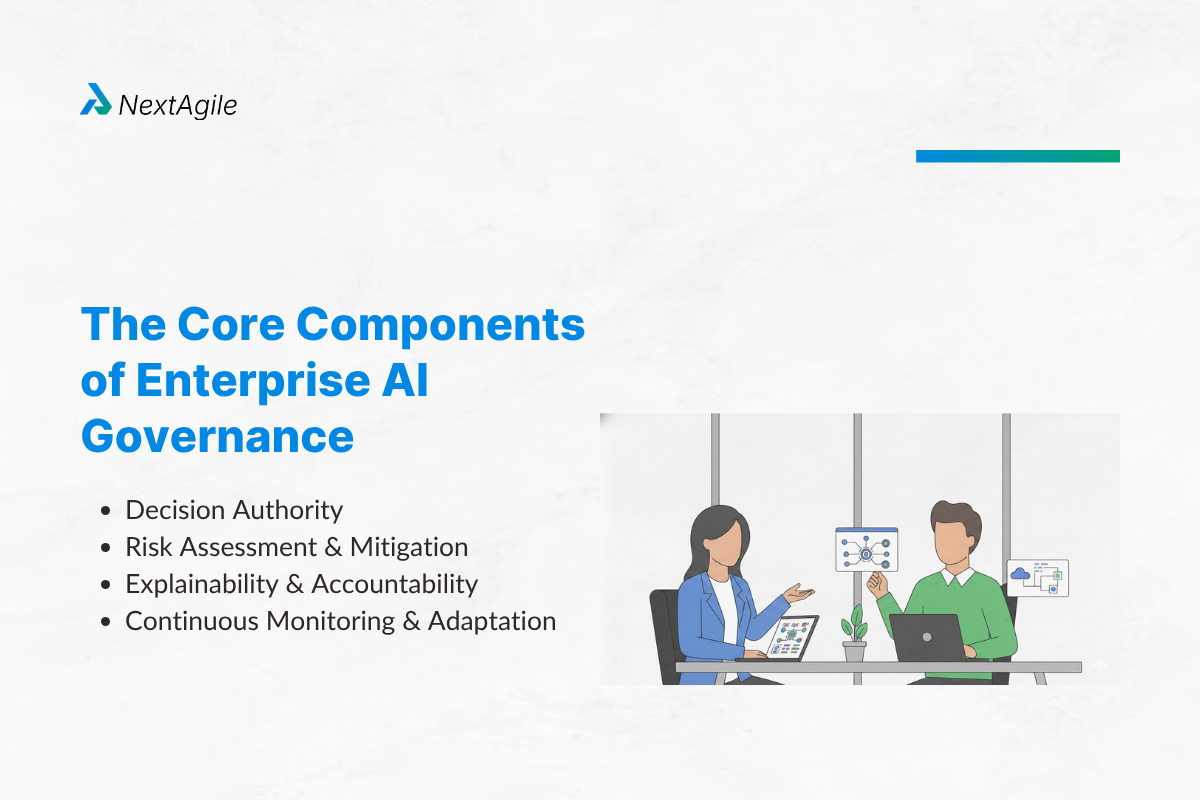
The Core Components of Enterprise AI Governance Mature AI governance has four interdependent components that work together.
Decision Authority The first component is decision authority. Who gets to decide whether an AI system moves from development to production?This is similar to how modern enterprises align governance with execution using AI and Agile methodology , ensuring iterative control and faster decision-making. Who decides what guardrails it operates within? Most enterprises struggle with this because it doesn’t fit traditional governance structures. It’s not purely a technology decision, so IT alone shouldn’t decide. It’s not purely a business decision, so business leaders alone shouldn’t decide. The best enterprises create joint governance bodies with representation from technology, business, risk, compliance, and ethics. These bodies have clear decision rights and escalation paths.
Risk Assessment & Mitigation The second component is risk assessment and mitigation. What could go wrong with this AI system and what are the consequences? What’s the potential impact on customers, employees, regulators, and shareholders? What’s the likelihood of different failure modes? What controls can you put in place to reduce risk? This discipline mirrors financial risk management or operational risk management but specifically for AI. It’s systematic, documented, and updated as circumstances change.
Explainability and Accountability The third component is explainability and accountability. When an AI system makes a consequential decision, someone needs to be able to explain why it made that decision. Not just to engineers, but to customers, regulators, or legal teams if needed. This doesn’t mean every model needs to be perfectly interpretable, but it means you understand the tradeoffs. Sometimes a more complex model with better accuracy but lower interpretability is acceptable. Sometimes you need a simpler model even if it’s less accurate because explainability matters more. These are governance decisions, not just technical decisions.
Continuous Monitoring and Adaptation The fourth component is continuous monitoring and adaptation. AI systems don’t stay static. Their performance degrades. Their environment changes. Their societal context shifts. Good governance includes monitoring how models perform over time, what’s changed about their input data, whether their underlying assumptions still hold, and whether their impact on the world has shifted in ways you need to address.
The Problem of AI Bias in a Governance Context AI bias is perhaps the most discussed AI governance issue, and with good reason. A biased AI system can systematically disadvantage groups of people. It can violate employment law. It can damage your brand. It can create legal liability.
But most discussions of AI bias oversimplify the problem. People often assume bias comes from bad intent or negligence. Sometimes it does, but more often bias comes from training data that reflects historical patterns of discrimination. It comes from incomplete feature sets that force AI systems to use imperfect proxies. It comes from optimizing for business metrics that don’t account for equity implications. It comes from feedback loops where a biased system makes biased decisions which then create more biased data.
Governance that addresses bias needs to work upstream.
In the problem definition phase, ask explicitly: could this AI system disadvantage any group? In the data collection phase, examine whether your data reflects historical bias that you’re trying to move beyond. In the model development phase, test explicitly for bias across demographic groups. In the deployment phase, monitor for bias indicators. None of this happens automatically. It requires governance discipline and often, domain expertise about the specific equity implications of what your AI system does.
The best practices for bias governance include diverse teams building and reviewing AI systems. Homogeneous teams miss bias that people from different backgrounds would catch immediately. It includes documentation of design decisions and their implications. It includes before-deployment audits and after-deployment monitoring. It includes clear processes for investigating complaints or concerns. It includes accountability for outcomes.
Regulatory Landscape and Governance Readiness The regulatory environment for AI is evolving rapidly. The European Union’s AI Act. Executive orders from governments. Industry-specific regulations for banking, healthcare, and other sectors. Your governance framework needs to anticipate where regulation is heading, not just respond to what exists today.
Most enterprises make the mistake of treating AI regulation as a compliance function, like they do with GDPR or SOX. They have their compliance team update policies to match new regulations and think they’re done. This doesn’t work for AI because AI governance is fundamentally about business capability, not just legal requirements.
Effective governance frameworks anticipate regulatory direction. If you’re building AI systems used in decision-making that affects people’s rights or opportunities, assume that transparency and explainability will be required. If you’re using personal data to train models, assume stricter data governance will be required. If you’re creating systems with potential for discrimination, assume you’ll need to prove non-discrimination.
The enterprises that build governance around anticipated future regulations don’t have to scramble when regulations arrive. They’re already doing what will be required. This gives them competitive advantage because competitors scrambling to comply will be slower.
Building an AI Ethics Function Many enterprises have added ethics committees or chief ethics officers. This is progress, but the real question is whether ethics is integrated into how AI decisions actually get made or whether it’s a separate function that reviews projects after major decisions have been made.
Mature AI governance integrates ethics into the development process itself.
Data scientists learn to think about equity implications as they design models. Product teams consider fairness impacts as they design features. Business leaders understand the ethical dimensions of AI decisions before they commit to them. Ethics isn’t a separate review step. It’s built into how work gets done.
This requires different skills than traditional ethics work. An AI ethics function needs people who understand both the technical details of machine learning and the ethical frameworks that apply. They need to be able to talk to engineers in their language and to business leaders in theirs. They need enough credibility that people actually listen to their concerns, not dismiss them as obstacles to progress.
The best AI ethics functions report directly to senior leadership and have real authority. They can slow down or block deployment of systems they judge to be unacceptable. They work with teams from the beginning of projects, not just at the end. They balance innovation with responsibility, not treating ethics as an obstacle but as a requirement for sustainable AI.
Data Governance and Privacy in an AI Context Data governance is foundational to AI governance, but it’s different from traditional data governance. Traditional data governance focuses on data quality and accuracy. AI data governance adds dimensions around fairness, privacy, and appropriate use.
The best AI data governance frameworks include data lineage tracking that shows where data came from and how it’s used. They include privacy impact assessments for any data used in AI systems. They include controls to prevent models from learning to discriminate based on protected characteristics, even if those characteristics aren’t explicitly in the data. They include audit trails for model development and deployment decisions. Privacy is particularly complex in an AI context. Traditional privacy approaches focus on preventing unauthorized access to data. AI privacy needs to prevent models from inverting back to sensitive training data or inferring sensitive characteristics that weren’t explicitly included. This requires different technical approaches and governance frameworks.
The enterprises that handle this well treat data governance as a shared responsibility.
Data owners are accountable for the quality and appropriateness of data. Technical teams are accountable for using data appropriately. Business leaders are accountable for ensuring their AI systems operate within legal and ethical boundaries. No single function owns governance. It’s distributed across the organization with clear accountability.
To operationalize these governance principles at scale, many enterprises rely on Generative AI consulting services to design secure, compliant, and scalable AI systems.
Governance That Enables Speed, Not Just Control Too many enterprises approach AI governance as a way to prevent bad things from happening. That’s important, but incomplete. The best governance frameworks also enable speed because they clarify what’s safe and encourage experimentation within clear boundaries.
When teams know exactly what they’re accountable for and what approval processes they need to go through, they can move faster. When governance is clear and consistent, teams don’t waste time and energy guessing what’s acceptable. When governance processes are streamlined, teams can get decisions quickly instead of waiting weeks for approvals.
The key is distinguishing between different types of AI projects based on their risk.
A low-risk model used internally for recommendations might need minimal governance. A high-risk model used in lending decisions needs extensive governance. A medium-risk model used in customer-facing applications needs moderate governance. When governance is proportionate to risk, teams working on low-risk projects move fast while high-risk projects get appropriate oversight.
This risk-based approach requires your governance function to understand your business deeply. You need to think about not just technical risk but business risk. Impact on customers. Impact on employees. Impact on brand. Impact on regulators. This understanding guides how much governance different projects need.
Building Organizational Culture Around Responsible AI Ultimately, AI governance is about culture more than structure. You can have excellent governance frameworks and processes, but if your organizational culture doesn’t support responsible AI, governance becomes theater.
The best organizational cultures around AI include psychological safety to raise concerns without fear of retaliation. They include transparent communication about failures and what was learned. They reward people who identify potential problems early, not just people who ship products. They build diverse teams because diversity brings different perspectives to bear on potential risks.
They also include patience with speed. Leaders accept that responsible AI sometimes moves slower than it could because time is invested in thinking through implications. They reward teams that build slowly and carefully over teams that cut corners. They celebrate learning even when experiments fail because those learning cycles are how organizations develop maturity.
Building this culture takes time and consistent leadership commitment. It requires hiring and promoting people who value responsibility alongside innovation. It requires performance management systems that reward responsible behavior. It requires leaders who model the behavior they want to see and hold themselves accountable to the same standards they hold others to.
Building this capability requires structured enablement through Gen AI training services , helping teams understand both technical and ethical dimensions of AI systems.
Conclusion AI Governance Consulting is no longer just a compliance requirement, it is a core business capability for scaling AI safely and responsibly. Enterprises that invest early in governance frameworks are better positioned to manage risk, reduce bias, and accelerate production deployment without regulatory setbacks. In a fast-evolving AI landscape, strong governance is what separates experimental AI initiatives from enterprise-wide success.
Ready to build a responsible and scalable AI governance framework for your enterprise?
Partner with NextAgile to design governance models, reduce AI risk, and accelerate safe AI adoption across your organization. You can also reach out to us at consult@nextagile.ai to explore how we can help.
Frequently Asked Questions 1. How do we know if our AI governance is working? You’re finding and addressing problems early in the development process rather than discovering them after deployment. You’re making governance decisions quickly without excessive delays. Your teams understand what’s expected of them without constant clarification. Your stakeholders including customers and regulators see you as trustworthy. Your governance isn’t blocking innovation but enabling it by clarifying boundaries.
2. What’s the difference between AI governance and AI ethics? AI governance is the structure and processes for making decisions about AI systems and managing risk. AI ethics is one component of governance that focuses on fairness, responsibility, and alignment with values. You can have governance without deep ethics work, but responsible enterprises integrate ethics into governance. Ethics without governance structures often remains aspirational rather than operational.
3. Who should lead your AI governance function? Ideally someone with credibility across technical and business domains. Not purely technical because governance requires understanding business impact. Not purely business because technical decisions have governance implications. This person should report to a senior leader who can enforce governance decisions. They should have genuine authority, not just advisory status.
4. How do we balance innovation and responsibility in AI governance? By being clear about risk. High-risk applications need high governance. Low-risk applications need low governance. By moving governance decisions early into the development process so teams aren’t blocked at the end. By being transparent about why certain applications are blocked or modified. By celebrating innovation that happens within governance boundaries. By recognizing that responsible AI that wins customer trust is actually a competitive advantage.
5. How do we approach AI governance in a regulated industry versus a less regulated industry? All industries face similar core governance questions: fairness, explainability, data protection, and appropriate use. Regulated industries need to add regulatory compliance to the core requirements. But the foundation is the same. You assess risk, build appropriate controls, monitor impact, and adjust. Enterprises in unregulated industries sometimes move faster early on, but they catch up to building mature governance as they grow and face stakeholder expectations.
Alok Dimri is the co-founder and leads the overall business at NextAgile, where he is responsible for strategy, client and consultant partnerships, and a whole lot of other core business activities like solutioning, branding, and customer engagement.
Over the past 16 years, he has worked extensively in business strategy, new business development, and key account management initiatives across process consulting and training domains.
 Skip to content