What Is a Spike in Agile? Examples, Types, and SAFe Best Practices (2026)
Anuj Ojha
Talk to Expert for Free
Table of Contents
Quick Answer
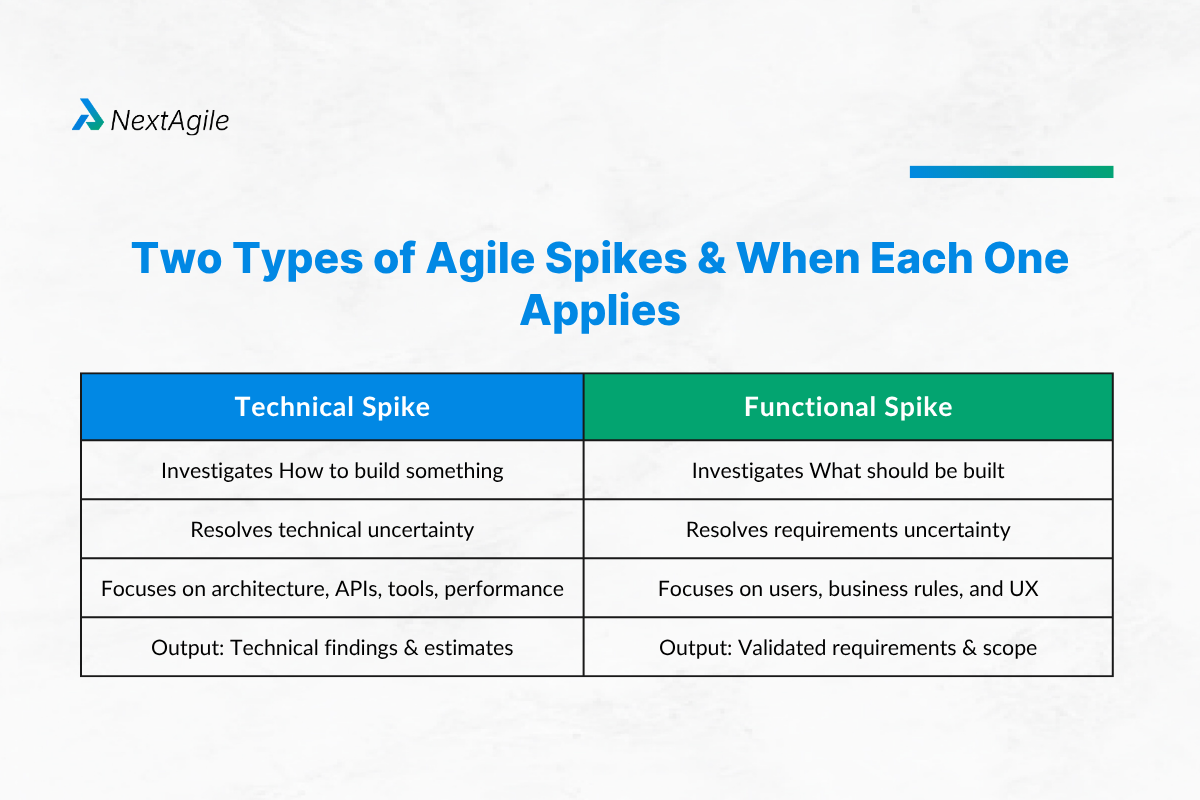
A spike in Agile is a time-boxed research or investigation activity that helps a team reduce uncertainty before committing to delivering a user story. It produces knowledge, not working software. Spikes are either technical (exploring how to implement something) or functional (clarifying what a user actually needs). In SAFe, spikes are treated as Enabler Stories with explicit PI-level linkage.
When to use a spike: when a user story cannot be estimated because the team lacks understanding of the implementation approach, the API behavior, the UX interaction pattern, or the feasibility of an integration.
Common mistake: running spikes without a time box or a defined outcome, turning investigation into open-ended research that never ends.
Your team is refining the backlog and hits a story that nobody can estimate. One engineer says two days. Another says two weeks. A third is not sure whether the thing is even possible with the current stack. This is precisely the situation a spike is designed to resolve. A spike converts that uncertainty into a bounded investigation with a specific output: enough knowledge to estimate and plan the actual delivery work.
Spikes are one of the most misunderstood and misused practices in Agile. Some teams run them too liberally, turning every difficult story into a spike and never building the confidence to commit. Other teams skip them entirely, committing to complex stories without adequate understanding and absorbing the cost in rework and missed sprint goals. This guide explains exactly when a spike is the right call, how to write one properly, and how to connect it to your team’s velocity accounting and PI Planning process.
For teams working within a SAFe structure, understanding how spikes relate to Enabler Stories and PI Planning is critical for program-level predictability. If your team is implementing or maturing its SAFe practices, the NextAgileSAFe PI Planning Workshopcovers backlog structure, Enabler Stories, and capacity allocation for research work across the PI cadence.
Why Experienced Agile Teams Use Fewer Spikes Than New Teams
One interesting pattern emerges as Agile teams mature: they usually create fewer spikes over time.
Newly formed teams often encounter unfamiliar technologies, evolving architectures, and unclear business domains, making investigation work a regular necessity. As knowledge accumulates and architectural standards stabilize, uncertainty reduces and the need for dedicated spikes naturally declines.
Conversely, teams that continue creating spikes for routine implementation work sprint after sprint should examine whether they have deeper issues around technical capability, Definition of Ready, or backlog refinement quality. In many organizations, an increasing number of spikes is not a sign of healthy exploration but an early indicator of growing delivery uncertainty.
What Is a Spike in Agile: The Definition Teams Often Get Wrong
A spike is a special type of story in Agile that exists to reduce uncertainty, not to deliver software. The output of a spike is knowledge. Specifically, the knowledge needed to estimate, design, or confidently commit to the real work that follows.
The term comes from Extreme Programming (XP), where it described a focused, time-boxed experiment to answer a specific question. In modern Scrum and SAFe contexts, spikes are written as backlog items with the same visibility as user stories but with a clearly different acceptance criteria format: the output is a documented finding, a decision, a proof-of-concept, or an architecture recommendation, not a working feature.
The confusion teams often experience comes from blurring spikes with tasks. A task is a unit of work within a story. A spike is a standalone investigation that precedes a story. Running a quick exploratory session during a sprint without writing it up as a backlog item is a task. Writing a time-boxed investigation into the backlog with defined output criteria and a story point estimate is a spike.
A Spike Is an Investment Decision, Not a Delay
One misconception is that creating a spike delays delivery. In reality, a well-designed spike accelerates delivery by reducing expensive rework later.
Enterprise teams frequently discover that a one-day investigation prevents weeks of redesign after implementation has started. The objective is not to eliminate uncertainty completely but to reduce it enough that the team can make informed planning and architectural decisions.
Viewed through Lean thinking, a spike represents a small investment that minimizes downstream waste, making it an enabler of flow rather than an interruption to it.
Why the Time Box Is the Most Important Part of a Spike
A spike without a time box is research with no exit condition. It runs indefinitely, consumes capacity, and rarely produces the clean conclusion the team hoped for. The time box forces a decision: at the end of the allocated time, the team documents what they found and makes a decision based on available information. If the investigation reveals that more research is needed, that becomes a new, explicitly prioritized spike, not an extension of the current one.
Most teams use one to three days as the time box for a spike. For complex architectural or feasibility investigations in a SAFe program, spikes can span a full sprint or a portion of a PI quarter, but they should always have an end date and a defined output commitment.
 Skip to content