Introduction Have you ever thought about why some presentations linger in your memory long after the meeting has concluded while others evaporate almost immediately? It all comes down to two factors: storytelling and presentation ability.
In modern workplaces, information alone is no longer a competitive advantage because everyone has access to data. The differentiator is the ability to translate information into meaning. Professionals who can frame ideas through stories create stronger influence, deeper trust, and faster alignment across teams and stakeholders.
Whether you’re pitching a product, leading a workshop, or defending a thesis in college, your ability to weave compelling stories into your presentations can change outcomes. Think about it: people don’t just remember statistics; they remember stories about people, conflicts, and resolutions. A well-told story persuades, inspires, and connects.
In this complete guide, we’ll break down what storytelling and presentation skills really mean, explore the five core elements of storytelling, highlight delivery techniques that separate average speakers from unforgettable ones, and provide real-world examples. We’ll also share practical tips, common pitfalls to avoid, essential tools for growth, and the trends shaping presentations in 2026.
What Are Storytelling and Presentation Skills? Defining Storytelling in Professional Communication Professional storytelling is presenting information in a way that connects. Fundamentally, storytelling is an organized means of conveying experience, ideas, or observations so your audience can connect both emotionally and rationally.
In the workplace, storytelling appears everywhere, a manager describing a vision to a CEO mobilizing investors. The story does not have to be long; it just has to make abstract ideas understandable. For instance, an engineer detailing technical risks might describe them as a hero’s journey: challenges encountered, steps taken, and the ultimate solution.
Why storytelling is so powerful is that it sticks. Humans are conditioned to recall stories ten times more than bullet points. That’s why today’s leaders and trainers rely more and more on narrative skills to influence, inspire, and teach. Neuroscience research consistently shows that narratives activate multiple regions of the brain simultaneously. This creates stronger memory encoding compared to isolated facts or disconnected data points.
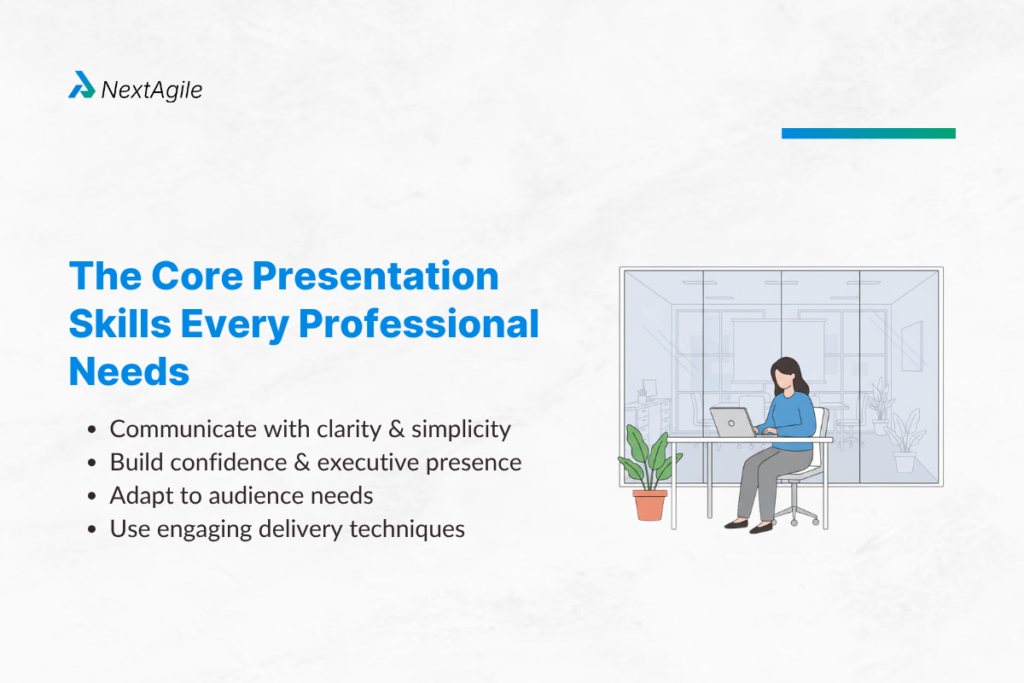
The Core Presentation Skills Every Professional Needs Presentation skills are the presentation side of the equation. Many professionals underestimate how heavily delivery influences perception. Audiences often judge confidence, credibility, and expertise within the first few minutes of a presentation, long before evaluating the actual content in detail.
Even the greatest story fails if presented poorly. Core presentation skills are:
Clarity of expression: Making things simple and easy to chew on. Confidence and presence: Establishing credibility with tone and body language. Audience adaptation: Adapting message to what is valued by the audience. Engagement techniques: Questioning, visualizing, or using humor. Presentation skills that are strong guarantee your message delivers. It’s not so much what you say, but how you say it. A monotone delivery can mute a great insight, and a good speaker can make even mundane updates stick.
Professionals who blend storytelling with crisp delivery and strong leadership skills
The 5 Core Elements of Storytelling in Presentations 1. Structure and Flow (The STORY Framework) All successful stories have structure. Without it, your presentation is disorganized. The STORY framework serves well:
Set the context Tension or challenge Opportunity or insight Resolution or solution Your call to action This structure holds people’s attention because it follows the way human beings intuitively experience things. Whether presenting a new initiative or raising money from investors, sticking to STORY keeps your story from wandering, it creates momentum toward a defined conclusion.
2. Establishing Emotional Connection with the Audience Facts may tell, but stories sell because they appeal to emotions. which is why emotional intelligence for leadership
When people feel something, they’ll remember it. Emotional resonance is especially valuable for leaders and educators, where power rests not only on reason but on resonance. A strategically placed story can motivate teams to take action, students to learn, or investors to invest in your dream. People rarely make decisions through logic alone. Emotions often determine whether information feels urgent, relevant, or meaningful enough to trigger action.
3. Visual Storytelling: Leveraging Slides and Data as Part of the Narrative Visuals are narrative devices. Slides, infographics, and charts must serve the story, not drown it. The golden rule? One idea per slide.
Information-dense presentations risk fatiguing attention. But by plotting data within a story sequence before, during, after you enable audiences to perceive meaning, not only numbers. For example, rather than spewing out figures, present them as a problem (tension), an insight (opportunity), and a resolution (solution).
One of the biggest presentation mistakes in enterprise environments is confusing information density with communication effectiveness. More slides and more text rarely improve understanding; they usually reduce retention.
Powerful visuals also aid memory. One powerful picture or chart can linger with your audience much longer than blocks of text. Visual storytelling works best when visuals reinforce meaning rather than compete for attention. Simplicity, contrast, and narrative sequencing are often more effective than highly complex slide designs.
4. Character and Conflict: Making Stories Relatable All great tales possess characters struggling with conflict. Characters in presentations don’t necessarily have to be fictional, they can be employees, customers, or even departments. Conflict injects stakes. Without stakes, there’s no motivation to care. This principle applies equally to business communication. A presentation without tension often feels informational rather than transformational because audiences never fully understand why change matters.
For instance, a corporate trainer explaining “resistance to change” could present a character, a cynical manager, and guide the audience through his journey from skepticism to embracing. That’s an immediate way to make concepts concrete.
By making your message personal, you turn abstract issues into tangible experiences. People recognize themselves in the story, which enhances engagement and encourages them to think about solutions.
5. Message Clarity and Takeaways: Assuring Audience Retention The conclusion is where impact is cemented. Without takeaways, people depart confused. Clarity of message stems from simplicity, reducing intricate points to a single or dual mnemonic idea.
Ask yourself: What do I want them to recall tomorrow? Then drive that home at the end. Whether it’s a “north star” vision, three steps of action, or one profound phrase, your takeaway should ground the presentation.
Clarity also means repetition. Write your main point first, demonstrate it with an anecdote, and restate it at the conclusion. That’s how you guarantee action and retention. Strategic repetition is not redundancy. It is reinforcement. The most effective communicators intentionally revisit core ideas throughout presentations to strengthen recall and message retention.
Mastering Delivery: Essential Presentation Skills Voice and Tone Control for Impact Your voice is your most adaptable instrument. Rate, volume, and tone alter the reception of messages. Monotone speech renders even the most stimulating concepts as boring, whereas varied tone provides emphasis. Delivery quality can dramatically alter audience perception of the same content. Tone, pacing, and pauses collectively influence emotional engagement more than slides alone ever can.
Effective speakers understand when to stop talking silence often trumps words. An expertly timed pause following a pivotal insight allows the listener to absorb and look ahead. Likewise, varying volume can demand attention or build intimacy.
Practice reading out loud and tape-recording yourself. Pay attention to whether your tone is in harmony with your message. In argumentative moments, raise your voice; in thoughtful ones, pause. Voice control is what turns delivery from functional to memorable. Exceptional presenters understand that audiences do not simply consume words. They respond to rhythm, emphasis, emotional variation, and conversational energy.
Body Language and Stage Presence Body language is heard above slides. Open positioning, eye contact, and intentional movement establish credibility. Nerves can be detected by the audience through fidgeting or not maintaining eye contact. Non-verbal communication strongly shapes trust. Inconsistent body language can unintentionally weaken authority even when the spoken message itself is strong.
Stage presence has nothing to do with theatrics it has to do with alignment of words with body. Standing tall when making main points conveys authority. Movement must be deliberate: walk while changing subjects, stand firmly when driving a point home.
Gestures are important too. Pointing, sweep of the hand, or gestural strokes enhance emphasis. Too much of it, though, distracts. Body language is like punctuation used correctly, it reinforces delivery. The goal is not theatrical performance. It is alignment. When gestures, posture, and facial expressions reinforce the spoken narrative, communication feels authentic and credible.
Engaging Audience Psychology Good presenters don’t address people with speech, they involve them. Which means appealing to attention, interest, and engagement. Audience engagement is ultimately about participation psychology. The moment listeners mentally contribute to the conversation, attention levels increase significantly.
Employ rhetorical questions: “What would you do in this situation?” Or polls in digital environments. These methods reset attention and encourage engagement.
Storytelling psychology comes into play as well: suspense keeps people glued, while resolution satisfies. Changing delivery, pauses, visual elements, or anecdotes renews attention every few minutes.
Ultimately, engagement is empathy, which is closely connected to building trust through a psychological safety workshop
How Storytelling Transforms Presentations ?Turning Data and Facts into Stories Statistics alone will not spur action. But information in such a way that it has a narrative creates context. Consider the presentation of a 30% reduction in turnover. Rather than recite the figures, tell the story of how disengaged staff were departing, what intervention was undertaken, and the ultimate rebound. Now data is connected to an experience, not a number.
Storytelling fills the gap between fact and feeling. Storytelling places numbers in the context of human life, allowing decision makers to understand not only “what” occurred but “why” it matters. Data explains reality. Stories explain significance. Organizations that combine both effectively create stronger alignment, persuasion, and decision-making clarity.
This conversion is precisely why managers who are great at storytelling tend to excel more than those merely using data-driven decks.
Making Complexity Simple Complexity is a killer of communication. Storytelling makes it easy by employing analogy, metaphor, or scenario.
Consider blockchain. A technical definition may lose most people. But present it as a “public ledger everyone can read and agree on,” and suddenly the idea makes sense. That’s storytelling in action.
When concepts are made memorable, they become contagious. Staff recall training sessions, investors recall pitches, and customers recall brand stories. Complicatedness dwindles, understanding increases.
Those leaders who excel in today’s hectic environments are those who are able to turn complexity into unclouded, memorable tales. Modern leadership increasingly depends on translation skills: converting ambiguity into clarity, complexity into simplicity, and strategy into stories people can rally behind.
Practical Strategies to Enhance Storytelling and Presentation Creating Effective Openings and Closings First impressions count. Openings need to hook people by posing a provocative question, startling statistic, or brief anecdote. Closings need to close the sale, recapitulating takeaways and reinforcing the call to action. Research consistently shows that audiences form early judgments about credibility within moments. Strong openings establish trust, curiosity, and psychological attention before the main message even begins.
One of the methods is the “full-circle close”: begin with a story or concept, thread through material, and come full circle back to it at the end. It is cohesive and memorable.
Consider openings as hooks and endings as anchors. Combined, they prevent your message from washing out when the presentation is over.
Audience Interaction that Builds Connection Interaction turns passive listeners into participants. For students, this might involve posing reflective questions. For corporate trainers, it could be role-playing. For leaders, it might be polls or brief feedback exercises.
Interaction generates psychological buy-in and improves workplace communication practices like feedback and delegation
The objective isn’t to busy time with talk but to craft a two-way experience where the audience feels heard and seen. That’s how presentations leave a lasting impact.
Practice and Rehearsal Strategies that Work Excellent presenters are made, not born; they practice incessantly. Rehearsal makes muscle memory, lessens nervousness, and makes gaps stand out. Confidence in public speaking is usually a byproduct of preparation rather than personality. Repetition reduces cognitive load, allowing presenters to focus more on connection and less on recall.
Record yourself, check posture and tone, and time your presentation. Rehearsing with others provides practice at simulating live audience responses. Even rehearsing in front of a mirror can fine-tune non-verbal communication.
The rule of thumb: rehearse sufficiently enough to memorize material but not so much you read from a script. Flexibility maintains spontaneity in delivery.
The more you rehearse, the more you are able to emphasize connection over recall. That’s the technique used by effortless-looking presenters.
Real-Life Demonstrations of Storytelling in Action Business and Corporate Case Studies Organizations more and more rely on storytelling for internal and external communications. Consider Apple, product releases aren’t dumps of specs; they’re stories about problems solved and possibilities unlocked.
And so too do leaders at consulting companies typically construct change efforts as sagas: “Here’s where we started, here’s the problem, here’s how we collectively got past it.” That kind of framing gets employees moving far more than the presentation of pie charts.
From my experience coaching executives, staff connect better with customer success stories than with KPIs. A story brings metrics to life, enabling employees to envision themselves as part of the larger picture. This is why customer stories, employee journeys, and real-world examples are so heavily used in leadership communication. They transform abstract business outcomes into relatable human experiences.
TED Talks and Public Speaking Examples TED Talks
For instance, Chimamanda Ngozi Adichie’s “The Danger of a Single Story” combines firsthand accounts with cultural commentary, leaving viewers both educated and emotionally affected.
Likewise, Simon Sinek’s “Start With Why” is not simply a book about business theory; it is presented as a narrative of purpose, supported with applicable examples.
Successful public speakers who achieve TED-level proficiency don’t simply speak, they transport listeners on a journey, showing that the story is the global unifier.
Tools and Resources for Growth Critical Tools and Software Storytelling can be amplified through digital tools. Canva and Prezi facilitate designing compelling visuals, while Miro and MURAL allow collaborative storyboarding. For storytelling with data, Tableau and Power BI combine visuals and narrative.
Recording tools such as Loom or Zoom practice sessions also assist in sharpening delivery. These are critical to virtual-first communication. As hybrid and remote work continue expanding, digital storytelling capability is becoming an essential professional skill rather than an optional enhancement.
The tool of choice varies with context: corporate trainers might rely on interactive platforms, while business owners might have a penchant for stripped-down slide design tools that focus on clarity.
Recommended Learning Platforms and Books Books do not go out of fashion. Made to Stick by Chip and Dan Heath is a lesson in how to make ideas stick, while Nancy Duarte’s Resonate
Learning platforms like Coursera and LinkedIn Learning provide excellent foundations. By framing requirements as stories, professionals learn to connect problems with solutions an essential mindset for mastering storytelling and presentation in both agile teams and executive communication. This mindset extends beyond Agile teams. It trains professionals to think from the audience’s perspective first, which is the foundation of effective communication and persuasion.
For those seeking applied learning, NextAgile offers specialized programs like the Agile Leadership Masterclass corporate leadership training
Common Mistakes and How to Avoid Them The Top Storytelling Presentation Mistakes The greatest error? Overloading slides with words. If readers are busy reading, they’re not listening. Another pitfall is spending too much time talking about yourself instead of your audience’s needs. When slides become scripts, presenters unintentionally compete with their own content. Audiences either read ahead or stop listening entirely.
Other presenters also avoid storytelling entirely and use only facts. Without emotional hooks, material vanishes soon.
Lastly, time management issues taking too long on setup and hasty endings undermines effect. Stories require rhythm.
Cultural and Contextual Considerations Storytelling is not one size fits all it has to be translated to culture. Humor that is effective in one area is baffling in another. Metaphors must be culturally acceptable. Context-aware communication is becoming increasingly important in global organizations where audiences bring different cultural expectations, communication styles, and interpretations.
In speaking to global audiences, eschew jargon-laden or culturally-bound references that isolate listeners. Emphasize instead on themes that are human across cultures: conflict, development, triumph.
Sensitivity to context creates trust. In adapting stories to the listener’s background, you are including them while still making impact.
Future Trends in Storytelling and Presentation Skills Ahead, three trends are prominent. One, AI-driven storytelling software is enabling professionals to frame stories quicker and better. Such sites propose story curves, imagery, and even cues for delivery. The future of presentation skills is shifting from information broadcasting toward immersive, interactive, and emotionally intelligent communication experiences.
Two, immersive technologies, VR and AR, are gaining traction in training and business storytelling. Imagine leading a crowd through a simulated customer journey rather than simply telling them about it.
Third, short-form storytelling is on the upswing. With dwindling attention spans, leaders are becoming adept at “micro-presentations”, compelling narratives within five minutes.
As AI-generated content becomes increasingly common, authentic storytelling and human-centered communication are becoming even more valuable differentiators. Information may become automated, but emotional connection, credibility, and audience trust still depend heavily on human delivery.
The professionals who will stand out in 2026 and beyond are not necessarily those with the most data but those who can create clarity, meaning, and action from complexity through compelling communication.
Conclusion Presentation and storytelling skills are not “soft skills”; they’re strategic tools in the rapidly changing world of today. As a student, leader, entrepreneur, or trainer, becoming proficient in these skills inspires trust, clarifies complexity, and mobilizes people to action.
The secret is balance. A solid story offers a framework and emotional depth. Refined delivery makes the message stick. Tools and drills hone both.
At NextAgile, we’ve witnessed firsthand the difference leaders make when they merge data with storytelling, logic with passion, and confidence with vulnerability. The result? Presentations that don’t simply inform they shape the future.
As you continue on, keep this in mind: the greatest presentations are not about being perfect. They’re about connection. And every leader, no matter where they come from, has stories to tell; stories that can shift the way people think, feel, and act.
Frequently Asked Questions 1. What’s the ROI of investing in storytelling and presentation skills? ROI appears in better persuasion, more powerful leadership influence, and quicker decision-making. Teams that excel at storytelling close deals more quickly, retain information more effectively, and inspire more trust. Over time, these abilities don’t merely make people better they make organizations more effective and brands stronger.
2. How do presentation and storytelling skills enhance leadership performance? Leaders who use narratives bridge vision and reality, which is why many organizations invest in leadership coaching services
3. How does storytelling enhance audience decision-making in presentations? Stories clarify complexity and make outcomes concrete. When they “see themselves” in a story, making decisions is simpler. Rather than dealing with unfiltered data, they visualize results, dangers, and advantages. That emotional definition accelerates decision-making and enhances commitment to the presenter’s suggestion.
4. Can narrative methods be applied to technical or fact-based presentations? Definitely. Technical information frequently has a tendency to alienate audiences, but storytelling fills the gap. Use analogies, customers’ tales, or before-and-after situations to visualize data. In this manner, complexity becomes palatable, and technical information is recalled not forgotten. Storytelling guarantees the human aspect of even the most data-intensive presentation.
Alok Dimri is the co-founder and leads the overall business at NextAgile, where he is responsible for strategy, client and consultant partnerships, and a whole lot of other core business activities like solutioning, branding, and customer engagement.
Over the past 16 years, he has worked extensively in business strategy, new business development, and key account management initiatives across process consulting and training domains.
 Skip to content