Skip to content


Introduction
Ever reacted sharply in a meeting and later realized it wasn’t the situation but something deeper that got triggered? That moment right there, that’s where leadership is won or lost. In our work with senior executives, we’ve seen a consistent pattern: Leadership breakdowns rarely come from lack of strategy; they come from unmanaged emotional responses under pressure. A passing comment feels like a challenge. A missed acknowledgment feels like disrespect. A delay feels like loss of control. And suddenly the tone shifts, decisions narrow, and conversations shut down. Here’s the real issue: Emotional triggers don’t damage leadership because they exist; they damage leadership because leaders justify them. “I was right to react.” “They needed to hear that.” “That’s just how I operate under pressure.” Maybe. But your team experiences something very different. This is why emotional intelligence for leadership is no longer optional. It’s not about being calm all the time. It’s about maintaining clarity when you’re not. Because leadership isn’t tested when things are smooth. It’s revealed in the 5-10 seconds between trigger and response. Master that window and you fundamentally change your leadership impact. What makes this challenge harder at senior levels is that consequences are rarely immediate. The impact shows up through shifts in team behavior, reduced openness, and slower alignment.What Emotional Intelligence for Leadership Actually Means?
In practice, emotional intelligence is less about awareness in isolation and more about how consistently that awareness translates into behavior during pressure moments.The Five Components of EQ in a Leadership Context
At a surface level, emotional intelligence for leadership is about understanding and managing emotions. But at an executive level, it’s more precise. It’s about maintaining behavioral control under pressure without losing strategic clarity. Let’s break this down in real leadership terms: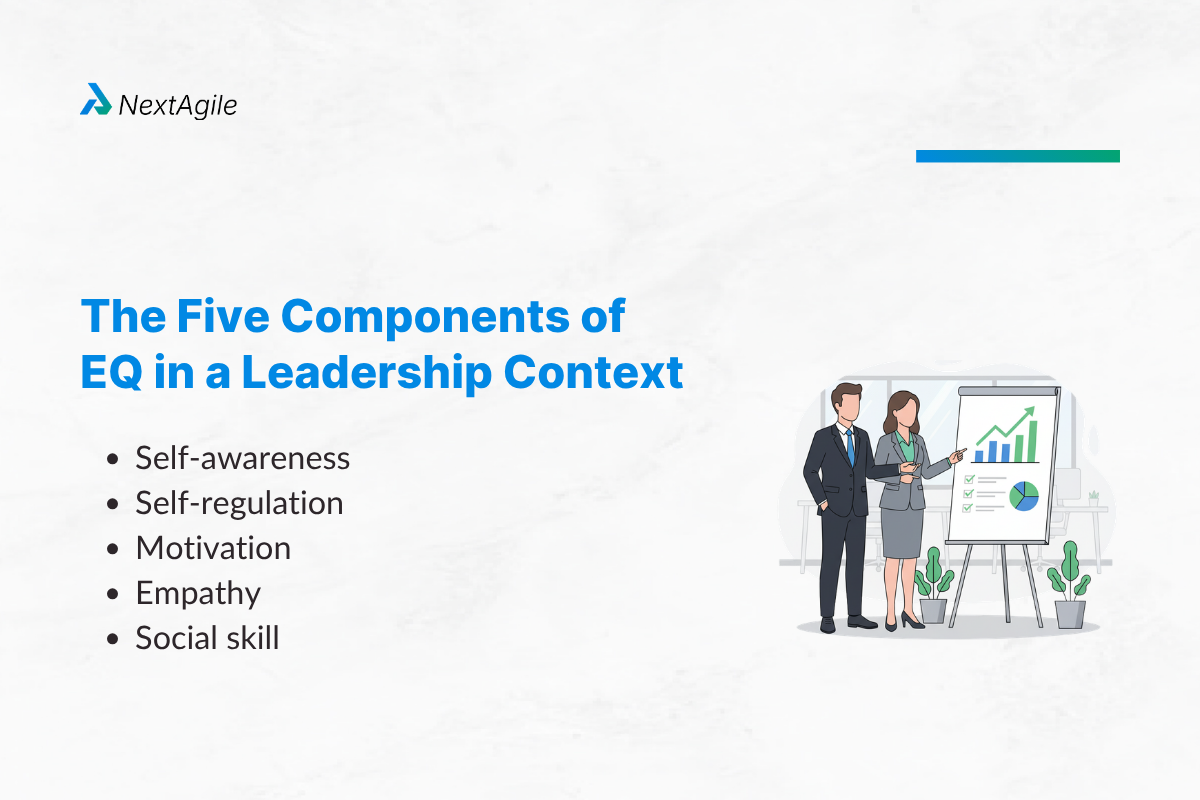
- Self-awareness Recognizing your emotional patterns in real time. Not after the meeting but during it.
- Self-regulation Ensuring emotion doesn’t dictate your behavior even when intensity is high.
- Motivation Understanding what internally drives your urgency, frustration, or persistence.
- Empathy Reading the emotional state of others accurately, especially in high-stakes conversations.
- Social skill Navigating tension, conflict, and alignment without escalation.
Why Senior Leaders Often Have Lower EQ Visibility?
As leaders become more senior, something subtle but critical happens. Their self-awareness decreases, even as their experience increases. Not because they lack capability. Because their environment changes.- Feedback becomes filtered
- Authority reduces challenge
- Time pressure eliminates reflection
What Are Emotional Triggers at Work?
Understanding this distinction changes the focus from controlling situations to understanding personal response patterns.How Triggers Form and Why Leaders Are Not Immune?
An emotional trigger is not the event itself. It’s the meaning your brain assigns to that event instantly. Triggers are shaped by:- Past experiences
- Personal values
- Identity (how you see yourself as a leader)
- If you value competence → inefficiency triggers frustration
- If you value respect → interruption feels like a threat
- If you value control → ambiguity creates anxiety
The Neuroscience of Triggered Leadership
When a trigger activates, your brain doesn’t pause to analyze; it moves to protect. The amygdala initiates a rapid response:- Threat detected
- Emotion activated
- Action initiated
- Premature decisions (to regain control)
- Defensive communication (to protect authority)
- Reduced cognitive flexibility (you stop considering alternatives)
- Teams stopped escalating risks early
- Problems surfaced late
- Delivery actually slowed down
The Most Common Emotional Triggers for Senior Leaders
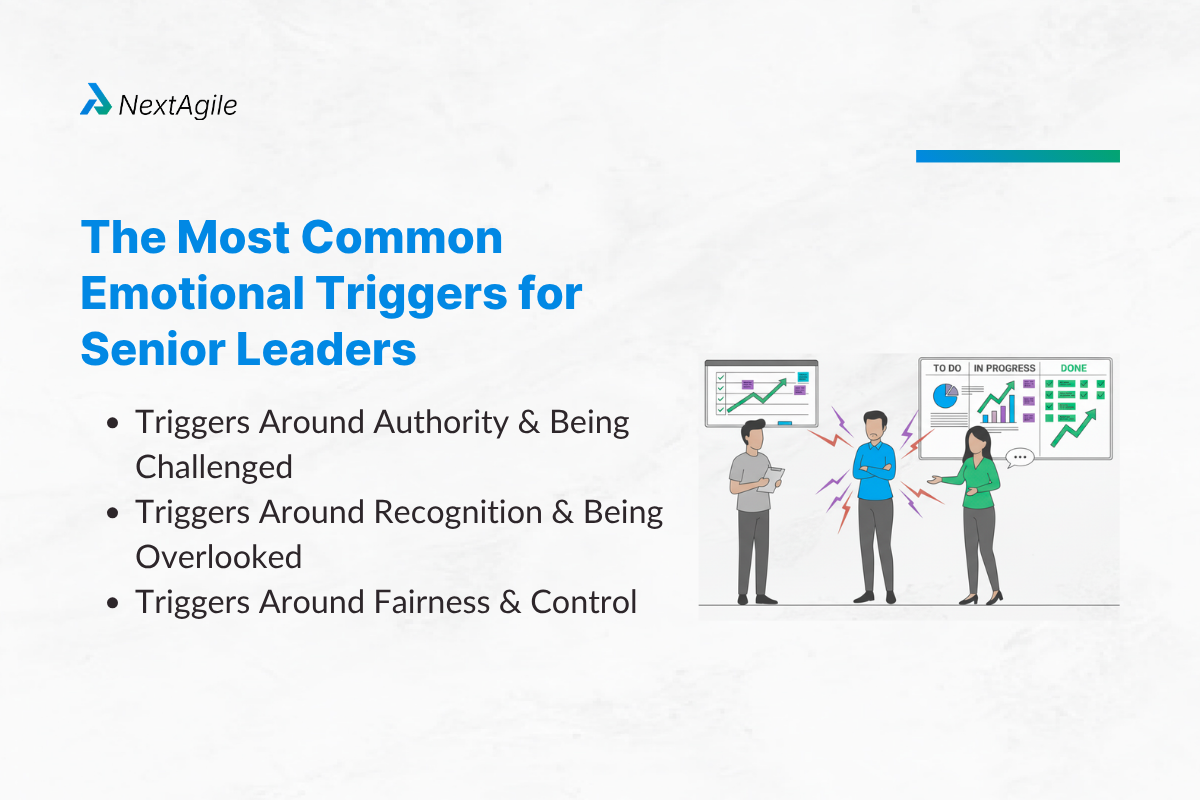
Triggers Around Authority and Being Challenged
Challenge is essential for good decision-making. But emotionally, it can feel like a threat. Here’s the paradox: The leaders who intellectually value debate are often the most triggered by it in practice. Why? Because “challenge” can be interpreted as:- Loss of control
- Questioning of competence
- Erosion of authority
Triggers Around Recognition and Being Overlooked
Recognition is deeply tied to identity. When leaders feel overlooked, it doesn’t just affect mood; it affects behavior. Common responses include:- Withdrawing from collaboration
- Seeking control over visibility
- Over-asserting contribution
Triggers Around Fairness and Control
Few triggers are as strong as perceived unfairness. When leaders see inconsistency, bias, or lack of accountability, reactions intensify. Similarly, loss of control, especially in uncertainty, creates discomfort. This leads to:- Micromanagement
- Over-involvement
- Decision bottlenecks
How Unmanaged Triggers Damage Leadership Effectiveness?
Unmanaged triggers don’t just create isolated incidents. They create patterns. And teams adapt to those patterns quickly. If a leader reacts strongly:- People stop challenging them
- Feedback gets filtered
- Risks are not surfaced early
- Reduced psychological safety
- Slower decision-making
- Lower innovation
Recognizing Your Personal Trigger Patterns
The earlier these signals are identified, the easier it becomes to shift behavior before it affects others.Physical and Behavioral Signs of an Activated Trigger
Triggers don’t appear suddenly; they signal themselves early. And those signals are critical. These signals are early warnings; ignore them, and your behavior will shift before you even realize it. Physically, you might notice:- Increased heart rate
- Tightness in jaw or shoulders
- Sudden urgency
- Interrupting more
- Shortened responses
- Defensive tone
A Leadership Trigger Self-Assessment
If you’re unsure whether triggers are affecting your leadership, check for these patterns:- Do people hesitate to challenge you?
- Do you feel frustrated more often than you express?
- Do conversations sometimes escalate faster than expected?
- Do you replay interactions after reacting?
Practical Strategies to Manage Emotional Triggers at Work
The goal is not to suppress emotion but to ensure that responses remain aligned with intent and context.The Pause, Name, and Choose Framework (Enhanced)
Most leaders try to control reactions. That rarely works in real time. What works is redirecting them.- Pause Create a micro-gap; even 2-3 seconds changes outcomes.
- Name Label the emotion:
- “I’m feeling defensive”
- “I’m feeling frustrated”
- Choose Ask:
- “What response aligns with my leadership intent?”
Building Long-Term Emotional Intelligence
Short-term control helps you survive the moment but it doesn’t change the pattern. Long-term change requires:- Consistent reflection
- Structured feedback
- Coaching support
Conclusion
For most leaders, the shift begins when they move from reacting automatically to responding deliberately, even if only in a few key moments each day. Emotional intelligence for leadership isn’t about removing emotion.- It’s about mastering it.
- Understanding what activates you.
- Recognizing it early.
- Responding with intention.
- Trust
- Communication
- Performance