Introduction In the fast-paced business environment of today, organizations thrive or perish on the health of their teams. Individual talent is no longer sufficient, it’s the collective group of individuals operating with clarity, ownership, and joint responsibility that produces real results. That’s when developing high performing teams goes from being a management fad; it becomes a competitive imperative. Building a high performing team is not an accidental outcome of talent density; instead it is to be deliberately engineered through leadership systems and behavioral discipline.
You’ve probably seen both sides of the spectrum. Some teams run like clockwork — aligned, motivated, and consistently delivering beyond expectations. Others, despite having great talent, struggle with silos, unclear goals, and low morale. The difference? Intentional design, strong leadership, and a clear roadmap for performance. Talent without alignment creates activity; alignment without ownership creates dependency. Only when both coexist does performance accelerate.
In this blog, we’ll explore the characteristics and qualities of high performing teams, step-by-step strategies to build one in 2026, common pitfalls (and how to avoid them), and real-world case studies from leading companies. We’ll also share the tools and metrics that sustain performance long-term.
If you’re exploring practical strategies to elevate your team, NextAgile consulting provides proven leadership insights and transformation frameworks that help organizations consistently build high performing teams.
How to Build a High Performing Team: Step-by-Step Guide (2026) How to build a high performing team: start with a shared purpose and named ownership , make it safe for people to disagree and raise risks early, give managers the delegation and feedback habits to coach rather than control, and review team health on a regular rhythm using a few outcome measures. Teams that skip the second step, psychological safety , often look aligned in meetings and stall in delivery.
Building High Performing Teams: What Makes Them Exceptional So, what makes a team “high performing,” anyway? At its simplest, it’s about collective energy converting into actionable results. High performing teams are not simply collections of good people — they’re tightly connected systems where clarity, trust, and accountability fuel momentum.
High performance emerges when interdependence replaces individual heroics and shared accountability drives collective execution.
Three characteristics always shine through:
First, common purpose . Members understand why their work is important and how it contributes to organizational objectives. This clarity creates motivation. Second, effective teamwork . Communication is open, disagreements are confronted constructively, and individuals feel free to raise questions without fear of being blamed. Third, measurable outcomes . High performing teams don’t work hard; they work smart, linking effort to result. The strongest teams treat metrics as navigational tools rather than reporting requirements. In our experience coaching executives, we’ve noticed these teams also exhibit resilience. They adapt when markets shift, use setbacks as learning moments, and innovate faster than competitors. Importantly, leadership in high performing teams isn’t about hierarchy; it’s distributed. Ownership and initiative are visible across levels. Adaptability is a hallmark of maturity where top teams pivot fast without losing momentum or morale.
Organizations strengthen succession with Building future leaders training .
Why high performing teams outperform the rest? High performing teams perform better because they work with clarity , discipline , and trust that average teams do not. Transparent goals empower people to make decisions for the strategy. This minimizes wasted effort and speeds up delivery. Clarity reduces cognitive load, allowing teams to invest energy in delivery rather than interpretation.
Another differentiator is trust. In low-performing teams, energy is wasted through politics, second-guessing, or insecurity. High performing teams do not spend time on protecting turf, but rather solving problems. Trust eliminates friction costs that silently slow most average teams.
They also perform better because feedback cycles are quicker. Groups that reflect often and respond rapidly don’t repeat failures. Mix in accountability where every member is accountable for outcomes and not merely tasks and the outcomes snowball. Fast feedback loops compress learning cycles and accelerate performance maturity.
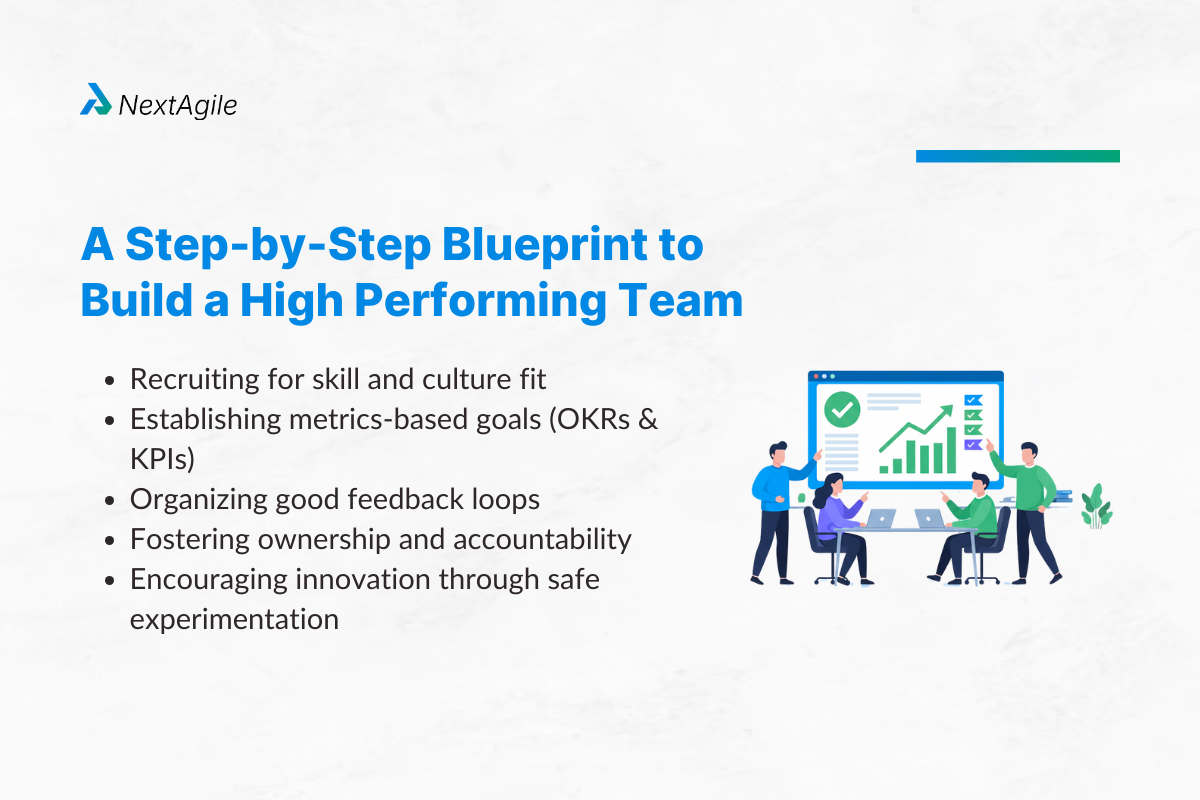
A Step-by-Step Blueprint to Build a High Performing Team Now let’s dissect the evidence-based steps to constructing a high-performing team. Each step supports the others, forming a loop of clarity, ownership, and growth.
Step 1: Recruiting for skill and culture fit Recruiting is where high performance begins. All too often, leaders bring in only technical competence and overlook cultural fit. But a single misaligned recruit can sabotage collaboration. Seek out candidates who not only have expertise but also share team values and work style. Use behavioral interview questions that uncover flexibility, collaboration, and resilience. Hiring for mindset protects team chemistry, which is often more fragile than technical capability.
High performance grows faster by building a culture of psychological safety
Think long-term: skills change, but values and mindset influence day-to-day performance. In my practice, successful teams consist of individuals who know both the “how” and the “why” behind the work. Staffing with culture as the top consideration builds a foundation for enduring success.
Without defined objectives, even the best teams go astray. High-performing teams adopt templates such as OKRs (Objectives and Key Results) or KPIs to measure progress. Goals must be ambitious but quantifiable. For instance, “grow customer retention by 15% in Q2” is so much more powerful than “enhance customer satisfaction.” Metrics align effort only when they are visible, shared, and tied to decision-making.
These measures do more than gauge achievement — they drive alignment. When people know what achievement looks like, teamwork becomes more acute. Goals must cascade from strategy, so everyone knows how what they contribute contributes. This creates motivation and minimizes misaligned effort. Many teams also rely on frameworks introduced through specialized engagements leveraging OKR consulting companies to align OKRs and KPIs with strategic objectives. Teams drift when goals are declared once but not reinforced through weekly accountability.
Step 3: Organizing good feedback loops Feedback is the oxygen of high-performing teams. Yearly reviews aren’t sufficient — feedback should be regular, constructive, and actionable. Introduce weekly check-ins, retrospectives, or peer reviews to ensure learning is ongoing. Continuous feedback shifts performance from episodic evaluation to real-time improvement.
The balance is the secret: having some praise alongside gaps to fill. Leaders need to lead by example through requesting feedback themselves, showing growth is for all. Feedback loops also reduce learning cycles as teams can shift direction rapidly when tactics aren’t working.
We’ve observed that organizations embedding feedback into daily rituals like stand-ups, sprint reviews, and even informal coffee chats consistently outperform those where feedback is sporadic or avoided. Feedback-rich environments normalize learning and prevent small issues from compounding.
Accountability transforms performance. In high performing teams, members don’t just complete tasks — they own outcomes. This means taking responsibility for results, not excuses. Leaders play a role by setting expectations clearly and tracking commitments. Role clarity reduces duplication while strengthening personal accountability.
RACI matrices (Responsible, Accountable, Consulted, Informed) are tools that establish roles and decrease ambiguity. Having accountability distributed among the team means fewer balls dropped and more initiative.
What I’ve observed is that accountability also builds trust. When individuals deliver consistently, teammates are comfortable counting on them. This predictability becomes the unseen glue of high-performing teams. Ownership is the invisible driver that converts responsibility into reliability.
Step 5: Encouraging innovation through safe experimentation Lastly, keep teams in top form. Great teams don’t dread failure, instead they view it as information. Leaders must establish a sense of psychological safety so that individuals feel comfortable experimenting without fear of blame. Psychological safety is the fuel that allows experimentation without fear-driven hesitation.
Basic practices such as pilot programs, hackathons, or structured “what if” meetings facilitate experimentation. The idea isn’t irresponsible risk-taking but systematic learning.
When leaders celebrate small wins and lessons learned, innovation becomes part of daily culture. Over time, these micro-experiments create breakthroughs that push the team ahead of competitors. High performing teams thrive because they consistently reinvent themselves. Innovation compounds when learning is rewarded as much as success.
Common Pitfalls to building high performing teams Even with the right intentions, teams often stumble. The most common pitfalls we’ve seen include unclear goals, weak communication, and disengagement. Most teams underperform not from lack of talent but from lack of alignment and execution discipline. Below are some of the most common ones:
Number one is misaligned goals . The team might be working but not being productive because their activities aren’t aligned with strategy. Solution? Tie every effort back to a measurable result. Leaders must constantly repeat the “why” until it becomes ingrained. Repetition of purpose is a leadership responsibility, not a communication redundancy. Another trap is low engagement . When members don’t feel heard or valued, motivation levels decline. To offset this, establish frameworks where each voice counts i.e. from daily stand-ups to cross-functional brainstorming. Engagement isn’t perks; it’s about feeling included. Inclusion creates emotional ownership, which directly impacts discretionary effort. Lastly, teams fail when feedback is shunned . Without honest talk, issues fester. Leaders need to make candor normal, demonstrating that feedback is a growth tool, not punishment. Silence is often mistaken for harmony when it actually signals disengagement. How Leading Teams Overcome challenges to building high performing Teams? Aligning goals and improving engagement – High-performance teams confront such pitfalls directly. They make goals cascade clearly from corporate vision to daily tasks. This renders priorities unavoidable. Leaders also connect goals to individual development, so people feel challenged and rewarded.
To increase engagement, leaders create psychological safety. They acknowledge contributions, encourage different opinions, and express gratitude outside performance indicators. From my experience, the teams that maintain momentum are those where individuals feel their voice matters.
When alignment and engagement combine, energy compounds. The team ceases to be a collection of individuals and becomes one, high performing entity. Alignment plus engagement produces momentum that is difficult for competitors to replicate.
Managers can strengthen execution through our Building High Performing Team Workshop .
Case Studies: Lessons from Top Companies Theories are potent, but examples linger. Let’s examine how high-performing teams function in practice.
Let’s consider Google’s Project Aristotle. The company observed what worked for some teams and not others. The discovery? Psychological safety was the top catalyst of high performance. Teams where people felt safe to take risks and be vulnerable consistently outpaced the rest. Safety enables candor, and candor accelerates team intelligence.
Spotify’s “squad model” demonstrates yet another principle: autonomy. Every squad works like a mini-startup, having an end-to-end product area. This ownership is driving accountability and innovation at the same time. Autonomy increases speed when paired with accountability.
High performing teams in startups and tech Startups with their fast tempo emphasize the importance of agility. High performing startup teams live on flexibility, making rapid decisions without considering hierarchy. Experimentation is fostered by leaders, and errors are not taken as mistakes but as tuition fees for innovation. Startups prove that agility thrives where ownership outweighs hierarchy.
In technology firms, collaboration tools such as Slack or Jira keep cross-functional teams on the same page. Tools, though, don’t drive performance — it’s transparency and accountability culture that turns them into a success driver. Tools amplify performance only when transparency and accountability are already embedded.
The takeout? In a multinational corporation as much as in a two-person startup, the same works: clarity, trust, ownership, and safety. These are the building blocks of high performing teams that work across the globe.
Managers can sharpen execution skills through our leadership workshop .
Tools & Metrics That Keep Teams High Performing Supporting high performance needs the appropriate infrastructure. Tools simplify cooperation, and metrics offer visibility into success. Measuring both output and outcome prevents teams from mistaking busyness for impact.
The most important metrics are velocity (the speed at which teams deliver), engagement scores, and customer impact metrics such as NPS. High-performing teams monitor both output and outcome, guaranteeing effort leads to actual value. Simplicity in systems often correlates with clarity in execution.
Collaboration and productivity platforms At the tool level, tools such as Slack, Microsoft Teams, or Asana facilitate communication and task coordination. For agile teams, Jira or Trello give visibility to the workflow. Collaboration tools must decrease friction, not introduce complexity.
But tools are only as effective as the habits built around them. Daily check-ins, transparent dashboards, and clear ownership ensure accountability. What I’ve seen with clients is that when teams adopt tools as part of rituals, performance sustains naturally.
Leaders must also guard against tool overload. The best teams pick a few platforms and use them deeply, rather than juggling too many. Ritual-driven tool usage sustains alignment and execution consistency.
Conclusion High performing teams do not occur overnight — they’re cultivated through conscious leadership, systematic practices, and ongoing growth. The high performing team strengths of clarity, trust, accountability, and innovation are common to all, but the process of creating them takes discipline. High-performing teams are sustained by habits, not occasional bursts of effort.
In 2025, as market volatility, AI, and remote working redefine teamwork, leaders need to double down on basics: recruiting for fit, having measurable goals, having feedback loops embedded, and taking ownership. The case studies demonstrate that companies that get this right uniformly outperform peers. Leadership consistency is the multiplier that transforms structured practices into cultural norms.
At NextAgile, we’ve helped leaders transform their teams through customized programs such as our team development workshop
The lesson? Begin tiny, but begin now. One definitive objective, one tighter feedback loop, one cultural change — eventually, these actions accrue into greatness.
If you’re looking to build a culture of high performing teams, consider partnering with a trusted leadership training company like NextAgile that aligns contextual leadership training programs with executive coaching and overall organizational agility. Our team excels at aligning leadership development with organizational objectives.
If you would rather build this with your own managers in the room, our one-day high performing team workshop works on your team’s real working agreements, ownership and decision rights.
Frequently Asked Questions 1. How do you gauge whether or not a team is high performing? A high performing team can be gauged through various lenses: speed of delivery, quality of work, customer satisfaction, and business outcome. In addition to metrics, engagement surveys and trust ratings inform us about teamwork and attitude. Real performance manifests itself when business outcomes and team health both improve at the same time. Balanced measurement ensures that performance excellence does not come at the cost of team wellbeing.
2. How much time does it take to establish a high performing team? It typically takes six months to one year, varying with team size, quality of leadership, and organizational culture. Alignment, trust, and accountability take continuous effort to develop. Accelerating the process is usually through formalized development programs, leadership coaching, and targeted workshops that instill habits of teamwork and feedback early. Structured coaching accelerates the behavioral maturity required for high performance.
3. Are remote teams capable of becoming high performing? Yes, distributed teams can succeed when leaders create clarity, organization, and collaboration tools. The basics don’t change: shared vision, quantifiable objectives, and emotional safety. Through video check-ins, open dashboards, and inclusive culture, remote teams can even surpass co-located teams by taking advantage of flexibility and diverse viewpoints. Remote excellence depends more on clarity and communication than proximity.
4. How does technology influence the creation of high performing teams? Technology speeds up collaboration, offers real-time visibility, and minimizes inefficiency. Platforms such as Slack, Asana, and Miro ensure communication is always flowing across time zones. But platforms alone won’t do the trick — culture and leadership are essential. Great teams use technology as an enabler, not a replacement, for trust and accountability. Technology is an enabler — culture determines whether it drives performance or distraction.
5. How do you ensure high performance in the midst of organizational shifts? Strong performance in transitions is contingent on leadership stability and communication. Leaders have to anchor teams back to purpose, clarify priorities, and talk about uncertainties openly. Regular check-ins, appreciation of small wins, and facilitation of psychological safety enable teams to stay engaged, focused, and resilient even while undergoing massive organizational change. Stability of purpose during change protects performance momentum.
Anuj Ojha is Co-Founder & Consulting Head at NextAgile. Anuj has designed & led multiple turnkey transformation journeys across industries, domains & geographies and has 16+ years of experience as an agile practitioner. He has worked with CXOs, CTOs & Key Leaders to translate their business objectives on the ground, contextualizing org transformations and creating buy-in across level, leading a team of coaches/consultants to implement agility across 150+ teams & trained more than 12k team members. Anuj’s core area of interest is business agility & working with leaders & teams to achieve long term sustainable, Agile culture & mindset.
 Skip to content