To stay relevant and have a competitive edge in today’s fast-paced and frequently changing world, innovation and customer centricity is a must. Organizations must change their thought process of solving customer problems, meet their articulated and unarticulated needs and to pivot to shifting market demands and new business realities.
Let’s take a moment and think why organisations like Nokia, Kodak, and Blackberry who were once market leaders lost their domination. Not pre-empting which way consumer behavior is shifting and what technological disruption are required to move to that direction can cost businesses. This has to be followed up with fast, agile execution and delivery along with frequent and effective feedback mechanisms to sustain the competitive advantage over a period of time.
While organizations move towards agile ways of working and delivering fast, they also need a shift in the way they understand user needs and solve it with innovation that suits them in the best possible way. This is exactly where design thinking comes into pthe icture. It is more than just a problem-solving approach. It is an effective and efficient way that puts empathy, collaboration, and innovation at the center of decision-making. By focusing on understanding the user and solving problems, design thinking helps businesses and organizations come up with new opportunities and deliver value to the customers continuously.
But what exactly are the benefits of design thinking for your business? How can your organization gain with the help of design thinking is what this blog is all about. In this blog, we’ll explore the key Design Thinking advantages that can add immense value to your business and how it can transform the way you approach perceived and non-perceived challenges and solve complex problems.
What is Design Thinking
Design thinking is a powerful and human centered approach that helps solve problems by deeply understanding the user’s needs. It emphasizes on challenging the assumptions, redefining the problems and creating solutions which are best for the users. Design thinking flow spreads across five stages:
Empathize with the users – Putting yourself in the end user’s shoes to understand their problems, challenges and pain points
Define the problem – Clearly define the problem you want to solve
Ideate Potential solutions – Come up with different multiple solutions for the same problem
Prototype – Create simple versions of your solution to test
Test – Take your solutions to the end users to get feedback and build on top of it
Design thinking focusses on empathy and collaboration. It encourages teams to diverge and explore all perspectives and then come up with the best solution. It is not a one time activity but an iterative approach that helps organizations quickly develop, refine and deliver value to the users.
Benefits Of Design Thinking
Design Thinking is a simple yet effective approach that enables businesses to steer through challenges with innovative solutions that promotes user centricity and iterative problem solving. Let’s see what are some of the design thinking advantages:
1. Collaborative
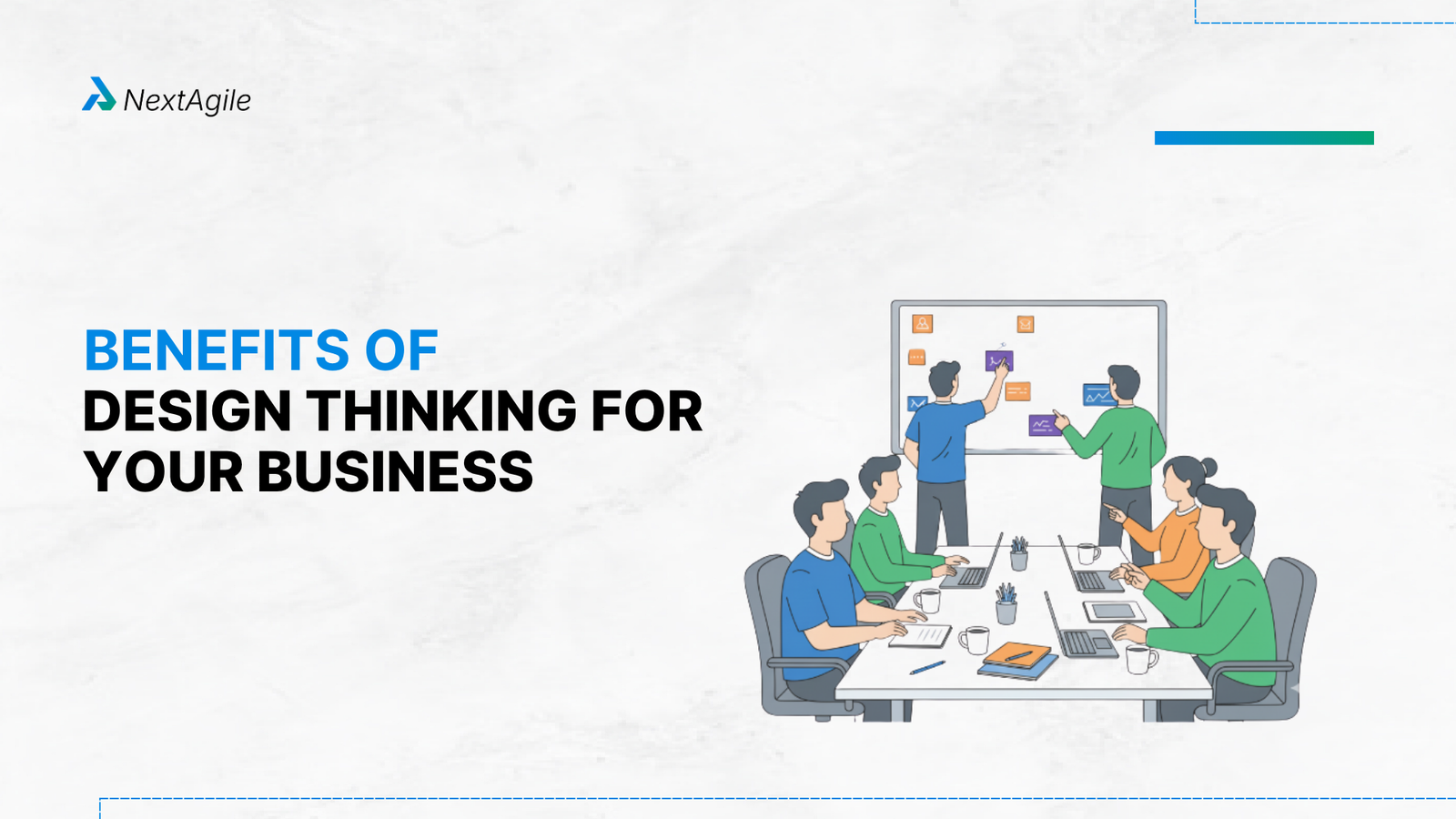
Design thinking creates a collaborative environment where cross functional teams come together, collate divergent perspectives from all the skillset and then come up with the best possible solution. This promotes creativity and results in well rounded fully baked innovative solutions. It also promotes shared ownership and collective problem solving and brings in the One Team mindset and enhances communication within the teams.
2. User-Focused
The base foundation of design thinking is that it’s user centric. It promotes teams and individuals to put themselves in the end user’s shoes and then solve their problem. By understanding user needs, pain points, challenges, goals in the center, businesses can create products and solutions that are more relevant to their target end users. This is one of the main design thinking advantages which helps businesses with growth and increased customer satisfaction.
3. Carefully Tested
Design thinking focuses strongly on iterative prototyping and testing making it an effective and user centric approach. Instead of launching the product/solutions based on assumptions or someone’s words, ideas are quickly prototyped and taken to the end users to get real time feedback. This approach helps teams identify flaws, issues and gaps before the solution is implemented or scaled. By prioritizing inputs from the users, design thinking ensures the product/solution actually solves the problem reducing the risk of failure.
4. Adaptable and Flexible
Design thinking is iterative in nature. This helps businesses to also adapt to agile ways of working. Change in customer needs, and new technologies emerging in the market require pivoting quickly needing new solutions. One of the design thinking benefits is that it helps companies adapt to changes quickly by experimenting and changing as per needs.
 Skip to content