Agile Coach vs Scrum Master: What Are The Differences?
Anuj Ojha
Talk to Expert for Free
Table of Contents
Scrum Master vs Agile Coach: Key Differences
The difference between agile coach and scrum master as marked in the below table are not absolute and may vary depending on the organization, context, or individual roles. However, this table highlights the general difference between Agile Coach and Scrum Master roles.
Characteristics
Scrum Master
Agile Coach
Focus
Team-level
Scrum framework Implementation
Organizational-level
Agile adoption
Primary Goal
Facilitate Scrum team
Ensure process adherence
Drive Agile transformation
Get Business Agility
Scope
Single team or project
Multiple teams, departments or organization-wide
Responsibilities
1. Facilitate Scrum events (e.g., Sprint Planning, Daily Scrum, Sprint Review, Sprint Retrospective)
2. Remove impediments (obstacles that hinder the team’s progress)
3. Coach team members (on Scrum principles, practices, and values)
1. Organizational design (helping the organization adapt its structure and processes to support Agile)
2. Leadership coaching (coaching leaders and managers to adopt Agile mindset and practices)
3. (Implicitly) Driving Agile transformation and business agility (though not explicitly listed, this is a key aspect of an Agile Coach’s role)
Skill Sets
1. Scrum framework expertise (in-depth knowledge of Scrum principles, practices and values)
2. Facilitation (ability to facilitate Scrum events, meetings and discussions)
3. Coaching (ability to coach team members on Scrum principles, practices and values)
1. Organizational development (knowledge of organizational design, culture and change management)
2. Change management (ability to manage and support organizational change)
3. (Implicitly) Agile framework expertise (though not explicitly listed, Agile Coaches typically have in-depth knowledge of Agile principles, practices and values)
4. Coaching (ability to coach leaders, teams, and individuals on Agile mindset and practices)
5. Facilitation (ability to facilitate workshops, meetings and discussions)
Mindset
Servant-leadership
Team-focused
Transformational, Organization-focused
Career Path
Often a stepping stone to Agile Coach or leadership roles
Typically a senior role, may lead to organizational leadership
Introduction to Agile Coach vs Scrum Master
The Information Technology Industry since its inception understood the essence of agility as the user requirement continuously evolved due to the rapid advancement in technology and the associated ecosystem. This got further impetus with the digital transformation wave that touched almost all sectors along with an overwhelming need to transition to new ways of working..
The flag bearers of this change were agilists who helped teams and organizations in understanding the why, what and how of various approaches and practices that could build the fabric of continuous planning, execution and delivery mindset.
In the journey to build cutting-edge solutions and platforms, teams adopt the Scrum approach to incrementally add capabilities. To empower the teams and foster a culture of agility, the Scrum Master role which is dedicated to educating, onboarding and elevating teams in Scrum principles is instrumental. In areas where adaptability is crucial due to rapidly changing demands, we implement Kanban, supported by Kanban Masters who facilitate seamless workflow. As the agile transformation evolves, the Agile Coach role emerges, which is focused on scaling agility across teams and driving holistic growth. In this blog, we’ll explore these roles in depth, uncovering the transformative impact on our teams and organization.
At most of the places, Scrum Master and Agile Coach are used as interchangeable terms today, possibly due to lack of knowledge and awareness. We will try to understand both Agile Coach vs Scrum Master roles in context with their emergence, their existence, difference between agile coach and scrum master and their future in this blog and delve into their respective roles.
The Emergence of the Agile Coach and Scrum Master role
Scrum Master role emerged in the early 2000s, with the Agile Manifesto (2001) and Scrum framework (1995). This role was primarily focused on software development, with an emphasis on team facilitation and process adherence
Agile Coach role emerged later, around 2008-2010, this role focused on organizational transformation and Agile adoption
The Evolution of Agile Coach and Scrum Master role
Both roles have expanded beyond software development to various industries and domains. They got popular with increased demand & growing recognition of Agile and Scrum values in driving business agility and innovation
Scrum Master and Agile Coach roles often overlap or combine, with varying emphasis on coaching, facilitation and leadership
The Future of Agile Coach vs Scrum Master Role
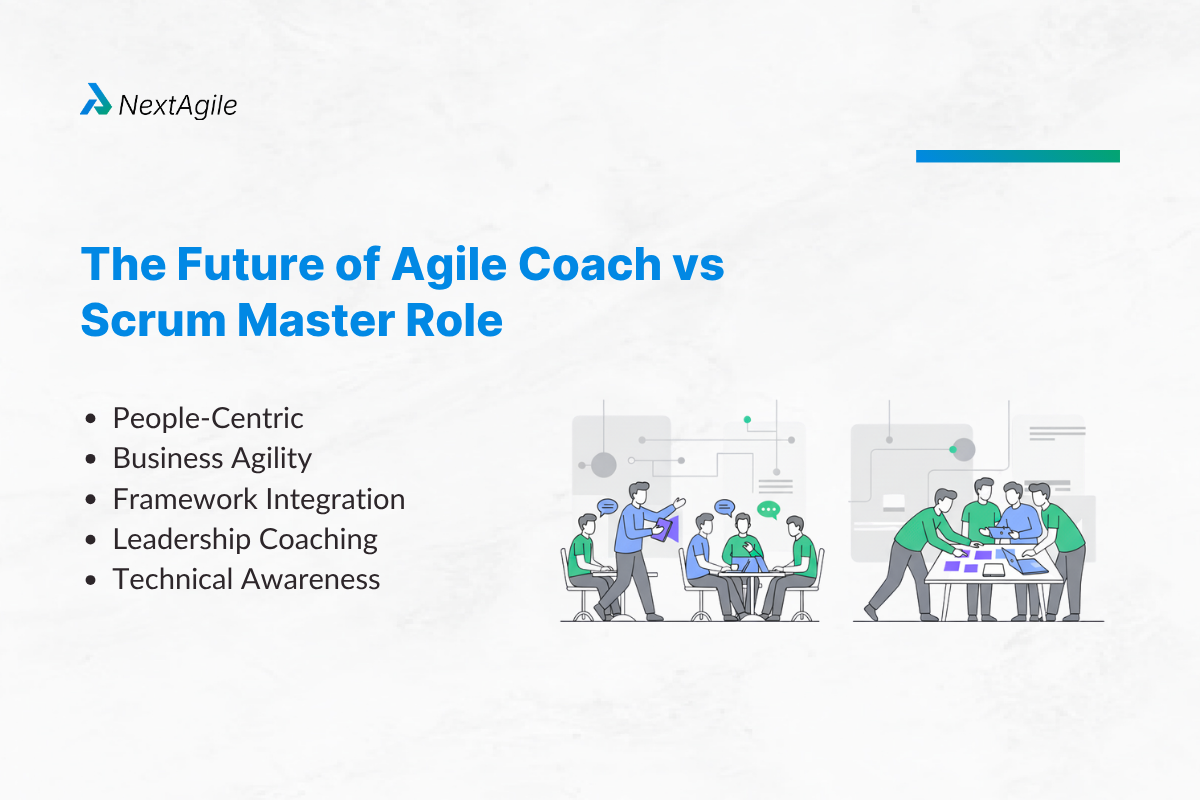
The Future of Agile Coach vs Scrum Master Role
Based on continued growth in agile adoption and digital transformation, the demand for skilled Scrum Masters and Agile Coaches will grow but with shifting focus.
From process-centric to people-centric approaches
Emphasis on business agility, innovation, and organizational culture
Integration with other frameworks and practices (e.g., Lean, Kanban, Design Thinking)
Agile Coaching as a distinct profession should address increased focus on leadership coaching and organizational development
Growing importance of awareness towards technical skills for Scrum Masters (e.g., DevOps, automation)
To consolidate, following are the key skills for future success:
Coaching and facilitation
Business acumen and strategic thinking
Technical skills (for Scrum Masters)
Organizational development and change management
Emotional intelligence and empathy
Continuous learning and adaptation
Agile Coach vs Scrum Master Comparison in detail
Before we start with comparison, let’s take a step back and understand the agile methodology. The Agile methodology is an iterative and incremental approach to software development that emphasizes flexibility, collaboration, and rapid delivery. It was created as a response to traditional waterfall methods, which were often rigid and slow to adapt to change. It could be translated to following key benefits that businesses are looking for:
Faster time-to-market
Improved collaboration and communication
Greater flexibility and adaptability
Higher quality software
Increased customer satisfaction
Reduced risk and uncertainty
To provide clearer direction for software development, the Agile Manifesto was published in 2002 and it expands the values and principles, which when followed would lead to agility. Following are the values and principles of Agile Manifesto –
 Skip to content