Key Highlights of Business Operations Business operations determine how efficiently trading companies convert customer orders into cash. Most execution delays occur during departmental handoffs not because of poor decisions. Standardized processes, clear ownership, and operational KPIs improve speed without increasing headcount. Strong business operations reduce inventory costs, improve working capital, and increase customer satisfaction. Mapping the order-to-cash process helps identify operational bottlenecks before they affect revenue. High-performing trading companies treat operations as a competitive advantage, not just a support function. Many trading companies believe their biggest operational challenge is finding new customers or negotiating better supplier prices. In reality, growth often stalls because execution cannot keep pace with demand.
Orders wait for approvals. Procurement teams lack visibility into sales commitments. Logistics teams receive incomplete documentation. Finance follows up on delayed invoices. Individually, these issues seem minor. Together, they create longer lead times, higher operating costs, frustrated customers, and unnecessary pressure on working capital.
These aren’t strategy problems, they’re business operations problems.
The most successful trading companies recognize that operational excellence isn’t achieved by hiring more people or introducing additional approval layers. It comes from designing clear workflows, assigning accountability, reducing unnecessary handoffs, and measuring the right operational KPIs.
Whether your organization trades industrial equipment, chemicals, consumer goods, commodities, or imported products, improving business operations can significantly increase execution speed while strengthening profitability.
This guide explains where trading companies typically lose momentum, how to streamline execution across departments, and the practical steps leaders can take to build operations that scale with business growth.
What Are Business Operations in a Trading Company? Business operations encompass the day-to-day activities required to move products, information, and cash efficiently across the organization. In a trading company, operations connect customer demand with supplier execution while ensuring every transaction progresses smoothly from inquiry to payment.
Unlike manufacturers, trading companies rarely produce goods themselves. Their competitive advantage lies in coordinating multiple moving parts, sales, procurement, logistics, warehousing, finance, compliance, and customer service, to deliver products quickly and accurately.
When these functions operate independently, delays multiply. When they operate as one integrated system, organizations improve responsiveness, reduce operational costs, and create a better customer experience.
At their core, business operations focus on one objective: Deliver the right product to the right customer at the right time with maximum operational efficiency and minimum working capital.
The role of operations in buying, selling, and fulfillment Every customer order passes through several interconnected processes before revenue is realized.
A simplified trading company workflow typically looks like this:
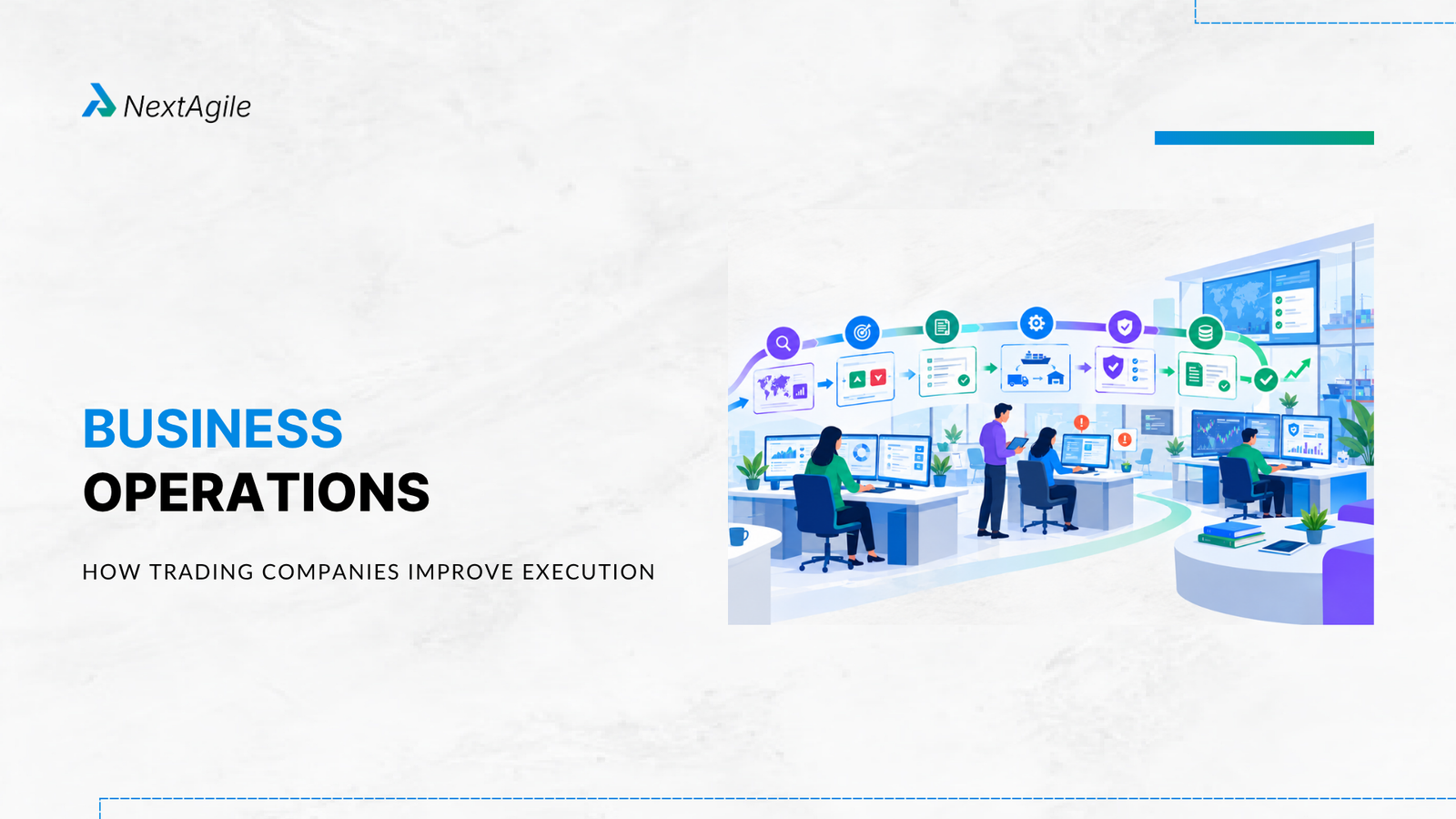
Customer places an order. Sales validates pricing and availability. Procurement confirms supplier commitments. Inventory is allocated or replenished. Logistics plans shipment. Documentation is prepared. Finance generates invoices. Payment is collected. Customer support resolves any post-delivery issues. Each step depends on information flowing accurately between departments.
If procurement receives incomplete requirements, purchasing slows down.
If logistics doesn’t receive shipping instructions on time, dispatch is delayed.
If finance waits for missing documentation, invoicing is postponed, directly affecting cash flow.
This is why operational excellence depends less on individual departmental performance and more on how effectively teams collaborate across the entire value chain.
Organizations investing in stronger cross-functional coordination can significantly reduce delays caused by fragmented communication and disconnected workflows.
Why operational excellence matters for profitability and customer satisfaction Many leaders associate business operations primarily with cost reduction.
While operational efficiency certainly lowers expenses, its broader business impact is often underestimated.
Well-designed operations improve:
Faster order fulfillment Higher customer satisfaction Better supplier relationships Improved inventory utilization Reduced operational risk Stronger working capital Increased delivery predictability For example, reducing the average order cycle by just two days allows businesses to invoice customers sooner, collect payments faster, and free up capital for future growth.
Operational excellence also improves customer confidence.
Customers remember suppliers who consistently deliver as promised, a direct expression of customer centricity in how operations are run day to day. Missed commitments, delayed shipments, and inconsistent communication often matter more than minor pricing differences.
This is why leading trading organizations continuously evaluate how work flows across departments rather than optimizing each function in isolation.
Instead of asking:
“How efficient is Sales?”
they ask:
“How efficiently does an order move from customer request to payment?”
That shift in perspective creates measurable improvements across the business.
Where Trading Companies Actually Lose Execution Speed Contrary to popular belief, most execution delays are not caused by poor strategic decisions. They occur during routine operational activities where work moves from one department to another.
Every handoff introduces opportunities for miscommunication, waiting time, duplicated effort, or unnecessary approvals. These small delays accumulate across hundreds or thousands of transactions, creating significant operational inefficiencies.
The objective is not simply to make each department faster but to improve how the entire system works together.
Handoffs between sales, procurement, and logistics One of the most common operational bottlenecks in trading companies occurs at departmental boundaries.
Sales confirms customer demand. Procurement negotiates with suppliers. Logistics arranges transportation. Finance manages invoicing. Although each function performs well individually, execution slows when responsibilities overlap or ownership becomes unclear.
Consider a typical scenario:
Sales commits to an aggressive delivery date without validating supplier lead times. Procurement identifies a sourcing delay but communicates it too late. Logistics receives revised shipment details after transport has already been scheduled. Finance postpones invoicing because dispatch documentation is incomplete. No single department created the problem.
The issue emerged because information was transferred slowly across multiple teams.
High-performing organizations reduce these delays by standardizing handoffs, clarifying ownership, and creating shared operational visibility instead of relying on emails and informal follow-ups.
They also invest in removing single-person dependency from daily operations , ensuring critical activities continue even when key individuals are unavailable.
Documentation and compliance delays that stall orders Documentation is another major source of execution delays, particularly for companies involved in international trade or regulated industries.
Purchase orders, invoices, certificates of origin, customs declarations, inspection reports, export documentation, tax records, and shipping documents must often be completed before goods can move.
Unfortunately, documentation is frequently treated as an administrative task rather than an operational process.
Common issues include:
Missing customer information Manual document preparation Duplicate data entry Version control problems Delayed approvals Compliance rework Poor coordination between commercial and logistics teams Every documentation error creates additional waiting time, increasing order cycle duration and delaying revenue realization.
Leading trading companies reduce these delays by digitizing workflows, standardizing document templates, automating approvals where appropriate, and assigning clear ownership for trade documentation.
Rather than asking teams to “work faster,” they redesign workflows to eliminate unnecessary waiting altogether.
Operational excellence is rarely about increasing effort; it is about improving flow.
Business Operations: How Trading Companies Can Improve Execution Improving business operations isn’t about introducing more processes. It’s about creating a system where work flows predictably across functions with minimal delays, rework, and confusion.
At NextAgile, we’ve observed that organizations rarely struggle because people aren’t working hard. They struggle because work is fragmented across departments, ownership is unclear, and performance is measured locally instead of end-to-end.
The following five-step framework helps trading companies improve execution without increasing headcount.
Step 1: Map the Order-to-Cash Process Before improving operations, leaders need visibility into how work actually flows.
Most organizations document high-level processes, but few understand what happens between departments. This is where delays usually occur.
Start by mapping the complete order-to-cash (O2C) journey, including:
Process Stage Questions to Ask Customer Order How is demand captured? Sales Validation Who approves pricing and delivery commitments? Procurement Are supplier lead times visible before commitments? Inventory Is stock availability updated in real time? Logistics Where do shipment delays occur most often? Finance How quickly are invoices generated after dispatch? Collections What causes payment delays?
While mapping, identify:
Waiting time between activities Duplicate approvals Manual data entry Rework loops Escalation points Single-person dependencies Many organizations discover that actual work differs significantly from documented Standard Operating Procedures (SOPs).
Instead of asking, “What should happen?”, ask: “What actually happens when a customer places an order?”
That difference often reveals the biggest improvement opportunities.
For organizations looking to systematically eliminate waste across workflows, Value Stream Mapping Consulting Services can help visualize delays, improve flow efficiency, and prioritize operational improvements.
Step 2: Standardize Handoffs Between Departments Every operational delay starts with an unclear handoff.
Sales assumes Procurement has enough information. Procurement assumes Logistics already knows supplier timelines. Finance assumes dispatch confirmations have been completed. Unfortunately, assumptions are poor operational processes.
Instead, define standardized handoff criteria between every department.
Each transition should clearly specify:
Required inputs Expected outputs Responsible owner Service-level expectations Escalation path For example:
Handoff Minimum Requirement Sales → Procurement Approved order, confirmed specifications, delivery commitment Procurement → Logistics Supplier confirmation, expected dispatch date Logistics → Finance Delivery confirmation, shipment documentation Finance → Customer Invoice within agreed SLA
Standardized handoffs reduce unnecessary emails, follow-ups, and approval cycles while improving accountability across teams.
Organizations also benefit from strengthening cross-functional coordination, ensuring departments optimize the entire workflow rather than individual functional targets.
Step 3: Assign Process Owners with Clear Accountability Many companies assign department managers but overlook end-to-end process ownership, the gap a clear accountability framework is built to close.
When execution problems arise, responsibility often shifts between functions:
Sales blames Procurement. Procurement blames Suppliers. Logistics blames Planning. Finance blames Documentation. Meanwhile, customers continue waiting.
High-performing trading companies assign a process owner responsible for overall execution and not just departmental performance.
Process owners don’t perform every task.
Instead, they:
Monitor workflow performance Resolve cross-functional bottlenecks Coordinate improvement initiatives Review operational KPIs Escalate systemic issues Ownership creates accountability across the value stream rather than within organizational silos.
As businesses grow, many also begin redesigning structure for growth , ensuring reporting lines support faster execution instead of creating additional bureaucracy.
Step 4: Track Operational KPIs Weekly Operations improve only when performance is measured consistently.
Many organizations review KPIs monthly, by which time delays have already affected customers.
Instead, monitor operational health through weekly reviews focused on execution rather than activity.
An effective KPI dashboard should answer questions such as:
Are orders moving faster? Where are delays increasing? Which suppliers create the highest variability? Which departments require support? Are bottlenecks recurring? Avoid tracking too many metrics.
A focused dashboard of 8–10 operational KPIs is usually sufficient for leadership decision-making.
Regular review meetings should emphasize problem-solving rather than reporting.
Organizations establishing a consistent management rhythm that catches operational delays early often resolve issues before they affect customers or financial performance.
Step 5: Continuously Review and Improve Workflows Operational excellence is not a one-time project.
Markets evolve.
Customers change expectations.
Suppliers introduce new constraints.
Technology creates new possibilities.
The organizations that consistently outperform competitors treat operational improvement as an ongoing management discipline.
A practical improvement cycle includes:
Review KPI trends. Identify recurring bottlenecks. Analyze root causes. Test process improvements. Measure outcomes. Standardize successful practices. Small improvements accumulated over time often generate larger business benefits than occasional large-scale transformation initiatives.
Continuous improvement also builds organizational resilience, enabling trading companies to adapt quickly to changing market conditions.
Common Operational Bottlenecks in Trading and Distribution Businesses Although every organization operates differently, several bottlenecks appear consistently across trading businesses.
Operational Bottleneck Business Impact Manual approvals Longer order cycle times Duplicate data entry Higher error rates Poor inventory visibility Stockouts or excess inventory Supplier communication delays Missed customer commitments Multiple spreadsheet tracking Lack of single source of truth Unclear ownership Slow issue resolution Email-driven workflows Information loss and rework Single-person dependency Business disruption during absence
One important observation is that these problems rarely exist independently.
Manual approvals create delays. Delays increase customer escalations. Escalations generate more emails. More emails reduce visibility. Reduced visibility creates further delays. Breaking this cycle requires improving the overall operating system rather than fixing isolated issues.
Operational KPIs Every Trading Company Should Track Operational KPIs provide early warning signals before small execution issues become major business problems. The objective isn’t simply to collect metrics; it’s to make better operational decisions.
Below are five KPIs every trading company should monitor.
Order Cycle Time Definition:
The average time taken from customer order confirmation to successful delivery.
Formula:
Order Delivery Date – Order Confirmation Date
Why it matters:
Measures end-to-end operational efficiency Highlights delays across departments Directly impacts customer satisfaction A consistently increasing cycle time usually indicates hidden bottlenecks within procurement, logistics, approvals, or documentation.
On-Time Delivery Rate Definition:
Percentage of orders delivered on or before the promised delivery date.
Formula:
(Orders Delivered On Time ÷ Total Orders) × 100
Why it matters:
Reflects operational reliability Improves customer trust Supports repeat business Even small improvements in on-time delivery can significantly strengthen customer retention.
Inventory Turnover Definition:
How efficiently inventory is sold and replenished during a specific period.
Formula:
Cost of Goods Sold ÷ Average Inventory
Higher inventory turnover generally indicates:
Better demand planning Reduced carrying costs Stronger cash utilization However, excessively high turnover may also signal understocking risks.
The goal is balance rather than maximization.
Order Accuracy Definition:
Percentage of orders fulfilled correctly without errors.
This includes:
Correct product Correct quantity Correct documentation Correct customer information High order accuracy reduces returns, customer complaints, and operational rework.
Rather than fixing errors after shipment, leading companies design processes that prevent them from occurring in the first place.
Perfect Order Rate Perfect Order Rate combines multiple operational indicators into a single measure.
An order is considered “perfect” only when it is:
Delivered on time Delivered complete Delivered without damage Supported by accurate documentation Invoiced correctly Because it reflects the customer’s complete experience, many organizations treat this as the most meaningful operational KPI.
Instead of optimizing individual functions separately, the Perfect Order Rate encourages teams to collaborate toward one shared business outcome.
How Better Operations Improve Cash Flow and Working Capital Many trading companies focus on increasing sales to improve profitability. While revenue growth is important, operational efficiency often has a faster and more sustainable impact on financial performance.
Every operational delay ties up working capital.
A delayed purchase order postpones supplier delivery. A delayed shipment postpones invoicing. A delayed invoice postpones payment collection. Together, these delays lengthen the cash conversion cycle and reduce liquidity.
Efficient business operations accelerate cash flow by reducing waiting time across the order-to-cash process.
Some of the biggest financial benefits include:
Faster invoice generation Shorter accounts receivable cycles Lower inventory carrying costs Reduced expedited shipping expenses Improved supplier payment planning Better utilization of working capital For example, if a trading company reduces its average order cycle time from 15 days to 11 days, invoices are generated earlier, payments are collected sooner, and cash becomes available for reinvestment without increasing sales volume.
Operational excellence is therefore not just an execution initiative—it is a financial strategy.
Leaders should regularly ask: “Where is cash waiting inside our processes?”
That question often reveals greater opportunities than another round of cost-cutting initiatives.
Technology That Supports Operational Excellence Technology alone does not create better business operations, but it enables consistent execution when supported by well-designed processes.
Rather than implementing multiple disconnected tools, successful trading companies build an integrated operational ecosystem that improves visibility, automation, and decision-making.
ERP Systems Enterprise Resource Planning (ERP) systems act as the operational backbone of trading businesses by connecting sales, procurement, inventory, finance, and logistics.
A well-implemented ERP enables:
Real-time inventory visibility Centralized order management Integrated financial reporting Supplier coordination Reduced manual data entry However, ERP implementation should simplify workflows and not digitize inefficient ones.
Warehouse Management Systems (WMS) Warehouse Management Systems improve inventory accuracy and fulfillment speed by managing storage, picking, packing, and dispatch activities.
Benefits include:
Faster warehouse operations Lower picking errors Better inventory utilization Improved shipment accuracy Real-time stock visibility For organizations managing multiple warehouses, WMS significantly improves operational consistency.
Workflow Automation Many operational delays occur because employees manually move information between systems, the core problem effective workflow management is designed to solve.
Workflow automation eliminates repetitive administrative work such as:
Purchase order approvals Invoice routing Shipment notifications Document generation Supplier follow-ups Compliance reminders Automation allows employees to focus on exception handling and customer value instead of repetitive coordination tasks.
Business Dashboards Leaders need operational visibility before they can improve execution.
Business dashboards consolidate KPIs into a single view, helping management identify bottlenecks before they affect customers.
An effective operational dashboard typically includes:
Order cycle time Perfect order rate Inventory turnover Open customer orders Supplier performance Delivery performance Cash conversion indicators The objective isn’t more reporting, it is faster decision-making.
Best Practices for Scaling Operations in Trading Companies As trading businesses grow, operational complexity increases faster than revenue.
Without scalable processes, organizations often respond by hiring more coordinators, introducing additional approvals, and creating more reporting layers. While these measures may solve short-term issues, they frequently slow execution over time.
High-performing trading companies scale differently.
1. Standardize Before You Scale Document repeatable processes before expanding operations.
Standardization reduces variation, improves training, and creates predictable customer experiences across locations, which is the discipline behind business process management done well.
2. Build Cross-Functional Accountability Departments should optimize the entire value stream—not individual functional targets.
Shared operational KPIs encourage collaboration instead of siloed performance.
Organizations that invest in cross-functional coordination typically resolve execution issues faster because accountability extends across the end-to-end workflow.
3. Eliminate Single-Person Dependencies Many trading companies rely heavily on experienced employees who possess undocumented operational knowledge. This creates significant business risk.
Standard operating procedures, knowledge sharing, and cross-training reduce operational dependency while improving business continuity.
Organizations focused on removing single-person dependency from daily operations become more resilient as they grow.
4. Create a Consistent Management Rhythm Operational excellence depends on regular review, not occasional firefighting.
Weekly operational reviews should focus on:
KPI trends Escalated issues Cross-functional bottlenecks Improvement actions Customer impact Building a management rhythm that catches operational delays early allows leaders to address systemic problems before they become customer complaints.
5. Improve Continuously, Not Occasionally Markets evolve continuously, so operations should too.
Leading organizations encourage employees to identify improvement opportunities every week instead of waiting for annual process improvement initiatives.
Small, incremental improvements compound into significant competitive advantages over time.
Common Mistakes That Slow Business Operations Many operational challenges are self-inflicted.
The following mistakes frequently reduce execution speed, even in otherwise successful trading companies.
Common Mistake Business Impact Optimizing departments instead of end-to-end workflows More handoff delays Measuring activity instead of outcomes Poor operational decisions Excessive approval layers Slower execution Manual spreadsheet tracking Limited visibility and errors Unclear process ownership Delayed issue resolution Lack of operational KPIs Reactive management Ignoring customer feedback Repeated service failures Scaling headcount instead of improving processes Higher operating costs
One recurring misconception is that operational problems require more people.
In reality, most growing organizations benefit more from better process design than additional staffing.
When workflows are clear, ownership is defined, and KPIs are visible, existing teams usually achieve significantly higher productivity.
Many organizations also discover that redesigning structure for growth enables faster execution than simply expanding reporting hierarchies.
Conclusion Successful trading companies don’t outperform competitors because they make better strategic decisions, they outperform because they execute those decisions faster and more consistently.
Operational excellence is built through disciplined processes, clear accountability, measurable KPIs, and continuous improvement across the entire order-to-cash value stream. The organizations that reduce handoff delays, strengthen process ownership, and improve cross-functional collaboration create lasting advantages in customer satisfaction, profitability, and working capital.
If your trading business is experiencing delayed orders, operational bottlenecks, inconsistent execution, or growing coordination challenges, the issue is rarely a lack of effort, it is usually the operating system itself.
At NextAgile, we help organizations redesign business operations using proven approaches such as Value Stream Mapping , operating model redesign, and cross-functional execution frameworks. Our consultants work alongside leadership teams to identify bottlenecks, improve execution flow, and build scalable operational systems that support sustainable growth.
If you’re ready to streamline your business operations and improve execution without simply adding more headcount, connect with NextAgile’s Agile Consulting Services to explore how we can help build a faster, more resilient organization.
Frequently Asked Questions 1.What causes execution delays in trading company operations? Execution delays usually occur because of inefficient handoffs between sales, procurement, logistics, finance, and warehouse teams. Manual approvals, poor documentation, unclear ownership, and disconnected systems create waiting time that slows the entire order-to-cash process.
2.How is business operations different in a trading company vs a manufacturer? Trading companies focus primarily on procurement, inventory management, logistics, customer fulfillment, and supplier coordination. Manufacturers additionally manage production planning, shop floor operations, equipment utilization, and manufacturing quality processes. As a result, trading companies depend more heavily on supply chain coordination and execution speed.
3.What KPIs should a trading company track for operational health? Five essential operational KPIs include:
Order Cycle Time On-Time Delivery Rate Inventory Turnover Order Accuracy Perfect Order Rate Together, these metrics provide a balanced view of operational efficiency, customer service, and working capital performance.
4.How can a trading company reduce documentation and compliance delays? Companies should standardize document templates, automate approval workflows, digitize trade documentation, define document ownership, and integrate ERP systems with logistics and finance processes. Regular process reviews also help eliminate recurring documentation bottlenecks.
5.Do trading companies need a dedicated operations manager? As organizations grow, a dedicated operations manager becomes increasingly valuable. They oversee end-to-end execution, coordinate across departments, monitor operational KPIs, resolve bottlenecks, and drive continuous improvement. Without clear operational ownership, execution often becomes fragmented across multiple teams.
6.How does process discipline affect working capital in a trading business? Strong process discipline shortens the order-to-cash cycle by reducing delays in procurement, fulfillment, invoicing, and collections. Faster execution means quicker revenue realization, lower inventory carrying costs, improved cash flow, and healthier working capital, all without requiring additional sales.
Alok Dimri is the co-founder and leads the overall business at NextAgile, where he is responsible for strategy, client and consultant partnerships, and a whole lot of other core business activities like solutioning, branding, and customer engagement.
Over the past 16 years, he has worked extensively in business strategy, new business development, and key account management initiatives across process consulting and training domains.
 Skip to content