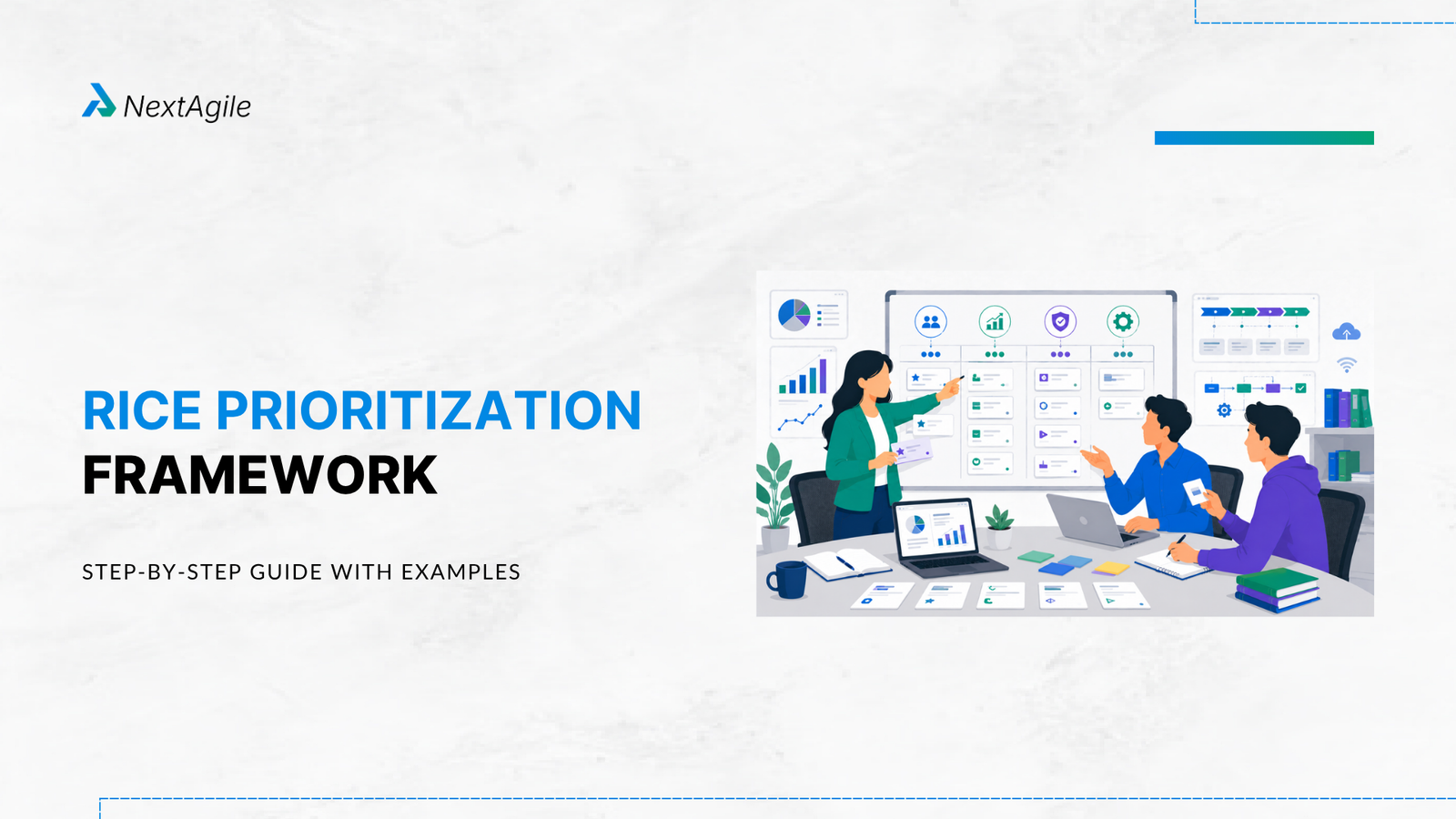
Key Highlights of RICE Prioritization Framework The RICE prioritization framework helps product teams make objective roadmap decisions by balancing customer reach, business impact, confidence, and delivery effort. RICE reduces opinion-driven prioritization and creates a transparent process for evaluating competing product initiatives. The quality of a RICE score depends more on the quality of its inputs than the formula itself. High-performing product teams use RICE as part of a broader product prioritization framework rather than as a standalone scoring exercise. Regularly reviewing RICE scores ensures roadmaps stay aligned with changing customer needs and business priorities. Combining RICE with customer insights, product strategy, and cross-functional collaboration leads to better product outcomes. The RICE prioritization framework provides an objective method for evaluating competing product initiatives. Its greatest strength is not mathematical accuracy but decision consistency. Reliable reach estimates, realistic impact assessments, evidence-based confidence scores, and comprehensive effort estimates create better product decisions. RICE works best when supported by customer research, strategic thinking, and disciplined product management practices. Organizations that combine structured prioritization with continuous learning deliver more valuable roadmaps and build stronger products over time. Introduction Every product team has more ideas than capacity.
Customers request new features. Sales teams push for enterprise commitments. Customer success escalates recurring issues. Engineering recommends technical improvements. Leadership introduces strategic initiatives. Each request appears important. Each stakeholder believes their priority deserves immediate attention. The challenge is not finding ideas.mThe challenge is deciding which ideas deserve investment.
Many product teams rely on intuition, stakeholder influence, or the loudest voice in the room. Building a disciplined product management approach requires structured prioritization techniques alongside proven Agile project management techniques that improve decision-making across teams.
Roadmaps become unstable. Development teams constantly change priorities. Customer value is delayed because important work competes with urgent work. Poor prioritization rarely results in one bad product decision. It creates dozens of average decisions while the highest-value opportunities remain buried in the backlog.
This is where the RICE prioritization framework becomes valuable.
Rather than debating opinions, RICE introduces an objective way to evaluate competing initiatives using measurable criteria. It allows product managers to compare features, improvements, experiments, and technical investments through a common decision-making model.
The result is not perfect prioritization. The result is better prioritization.
This guide explains how the RICE scoring model works, how to calculate a RICE score, when to use it, where teams make mistakes, and how leading product organizations integrate it into their product management practices.
The Hidden Cost of Poor Prioritization Most product roadmaps fail long before development begins. They fail during prioritization.
When product teams struggle to evaluate competing initiatives objectively, every roadmap discussion becomes a negotiation instead of a strategic decision.
Stakeholder influence replaces customer evidence. Urgency replaces value. Politics replaces product thinking. The consequences extend far beyond the product backlog. Engineering teams lose focus because priorities change repeatedly and customer-facing teams struggle to communicate realistic expectations.
Leadership questions delivery predictability. Customers wait longer for improvements that genuinely matter. Poor prioritization also creates hidden operational costs. Features with limited business value consume development capacity while important technical improvements remain postponed.
Teams spend months building capabilities that generate minimal customer impact. Meanwhile, high-value opportunities continue waiting. The longer these patterns continue, the more difficult roadmap planning becomes.
Organizations begin solving prioritization problems by adding governance, increasing approval layers, or scheduling more planning meetings.
None of these actions improve prioritization if decision-making remains subjective.
The real solution is creating a consistent framework that evaluates work using shared criteria. That is exactly what the RICE prioritization framework was designed to achieve.
Prioritization Is a Portfolio Decision, Not a Feature Decision One subtle mistake product organizations make is evaluating every initiative independently. Roadmaps are not simply collections of high-scoring features, they are investment portfolios.
High-performing organizations often integrate portfolio prioritization into their broader Agile transformation strategy to balance customer value, technical investment, and long-term business goals.
A healthy roadmap usually contains a deliberate mix of:
Growth initiatives that expand customer acquisition or revenue. Retention improvements that strengthen existing customer relationships. Technical investments that improve future delivery speed. Risk reduction work addressing security, compliance, or operational resilience. Discovery initiatives that reduce uncertainty before major commitments. RICE helps compare initiatives objectively, but portfolio balance remains a leadership decision. An organization that consistently prioritizes only customer-visible features often accumulates technical debt. Conversely, investing exclusively in platform improvements can delay market outcomes. Strong product leadership evaluates both initiative quality and portfolio composition.
Why Most Product Prioritization Frameworks Fail Most prioritization frameworks do not fail because they are mathematically incorrect. They fail because organizations use them without improving how decisions are made.
Many product teams continue relying on approaches such as:
Highest Paid Person Opinion. Customer escalation. Sales pressure. Executive requests. Recent customer complaints. Internal politics. These approaches often produce busy roadmaps. They rarely produce strategic roadmaps. Every feature appears important when viewed independently. The difficulty arises when multiple valuable initiatives compete for limited capacity. Without an objective evaluation method, prioritization becomes inconsistent.
Teams lose confidence in roadmap decisions because the reasoning changes from one planning cycle to the next.
Effective prioritization creates consistency. Stakeholders understand why one initiative moves ahead while another waits. Discussions become evidence-based rather than opinion-driven. The RICE framework provides that consistency by evaluating every opportunity through the same decision lens.
What Is the RICE Prioritization Framework? The RICE prioritization framework is a structured product prioritization framework that helps product teams evaluate competing initiatives using four measurable factors.
Reach. Impact. Confidence. Effort. Together these factors create a balanced view of customer value, business impact, delivery confidence, and implementation cost.
Rather than asking which feature feels most important, RICE asks a better question.
Which initiative delivers the greatest value relative to the effort required?
This shift changes the nature of prioritization discussions. Instead of defending opinions, teams evaluate assumptions. Instead of debating preferences, they compare measurable evidence.
The framework is particularly useful for:
Product roadmap planning. Feature prioritization. Backlog refinement. Growth initiatives. Customer experience improvements. Technical investments. Innovation experiments. Because every initiative receives a numerical score, teams can compare very different types of work using one consistent evaluation method. That transparency improves stakeholder alignment while making roadmap decisions easier to explain.
Where RICE Came From The RICE framework was originally developed by the product team at Intercom to improve consistency in roadmap prioritization.
Like many growing product organizations, Intercom faced an increasingly familiar challenge. Every stakeholder believed their initiative deserved immediate attention. Without a structured evaluation process, prioritization discussions became difficult to scale.
The RICE scoring model introduced a repeatable method for comparing opportunities using customer reach, expected impact, confidence in assumptions, and delivery effort.
Although it originated within software product management, the framework is now widely used across SaaS companies, digital product organizations, platform teams, and innovation groups.
Its popularity comes from its simplicity. The formula is straightforward. The thinking behind the formula is what makes it valuable.
Why Product Teams Need Objective Prioritization As products grow, decisions become more complex.
More customers generate more feedback.
More stakeholders introduce competing priorities.
More engineering teams create additional dependencies.
Without objective prioritization, roadmap discussions become increasingly influenced by urgency rather than value.
This often results in:
Frequent roadmap changes. Reduced engineering focus. Conflicting stakeholder expectations. Customer disappointment. Lower confidence in product leadership. Objective prioritization creates stability. Teams also benefit from using an Agile dashboard to improve visibility into roadmap progress, delivery risks, and changing priorities.Teams understand why initiatives are selected and leadership gains greater visibility into trade-offs. Engineering receives clearer direction while customers benefit from improvements that create measurable value.
Better prioritization also depends on leaders creating decision environments that encourage evidence over opinion, a capability developed through an Agile Leadership Masterclass .
The goal is not eliminating difficult decisions. The goal is making better decisions consistently.
Prioritization Should Reduce Decision Fatigue As organizations scale, prioritization meetings often become longer rather than better.
Without a common evaluation model, teams repeatedly debate the same questions:
Why is this feature important? Who requested it? What evidence supports it? Why is it being scheduled now? A well-governed prioritization framework reduces cognitive load by moving these discussions earlier in the discovery process. Product reviews become conversations about assumptions rather than arguments about preferences. Over time, this improves decision speed while increasing stakeholder confidence in roadmap governance.
The Four RICE Components Explained in Plain Language The strength of the RICE prioritization framework comes from evaluating opportunities through four complementary perspectives.
Each component answers a different business question. Together they produce a balanced assessment of value and investment.
Reach: How Many Users Does This Touch? Reach estimates how many customers or users will benefit from an initiative during a defined period.
It answers one simple question.
How many people will this work affect?
A feature used by ten thousand customers naturally creates more potential value than one used by one hundred customers.
Reach should always rely on measurable data.
Customer analytics. Usage reports. Market research. Historical trends. Product telemetry. Avoid estimating reach based on optimism. Reliable data produces more reliable prioritization.
Impact: Scoring on the 0.25 to 3 Scale Reach measures volume and impact measures significance.
It estimates how strongly the initiative improves the customer or business outcome.
Most teams use a simple scale.
3 represents massive impact. 2 represents high impact. 1 represents medium impact. 0.5 represents low impact. 0.25 represents minimal impact. Although impact involves judgement, product teams should support scores using customer evidence wherever possible.
The strongest product organizations discuss impact before assigning numbers. They define what meaningful improvement actually looks like.
Confidence: Adjusting for How Sure You Are Confidence reflects the quality of available evidence. Many product teams overestimate certainty. They assume customer feedback automatically validates product demand. The confidence score forces teams to challenge their assumptions.
Questions worth asking include:
Do we have customer research? Have we observed this behaviour through analytics? Have similar initiatives succeeded before? Are we making educated assumptions? A lower confidence score does not automatically eliminate an idea. It simply recognises uncertainty. This encourages product teams to validate assumptions before committing significant investment.
Effort: Person-Weeks or Person-Months Effort estimates the total work required to deliver the initiative.
Unlike many estimation methods that consider only engineering, RICE encourages product teams to evaluate effort across every contributing function.
Engineering. Product management. Design. Quality assurance. Data. Marketing. Customer enablement. Operational readiness. Ignoring non-engineering work produces artificially high RICE scores and unrealistic prioritization decisions. Cross-functional estimation also becomes easier when product, engineering, QA, and delivery teams follow shared Agile estimation techniques .
Effort should represent the total organisational investment required to deliver customer value.
The RICE Formula and How to Calculate a RICE Score The RICE prioritization framework is known for its simple formula. However, experienced product managers know the formula itself is only one part of the decision. The quality of the final score depends entirely on the quality of the assumptions behind each variable. The calculation follows this model. A higher score indicates that an initiative is expected to deliver greater value relative to the investment required. The framework should not replace product judgement. Instead, it provides a structured starting point for prioritization discussions. When product teams combine RICE scoring with customer insights, business strategy, and technical considerations, roadmap decisions become significantly more consistent. Worked Example With Real Numbers Consider two competing initiatives for a SaaS product. Feature A introduces a self-service onboarding experience. Feature B adds advanced dashboard customization. Both are valuable. The question is which one should be built first. Criteria Feature A Feature B Reach 8,000 users 1,500 users Impact 2 3 Confidence 90% 60% Effort 8 person-weeks 6 person-weeks
Applying the formula:
Feature A RICE Score = (8000 × 2 × 0.9) ÷ 8 = 1,800 Feature B RICE Score = (1500 × 3 × 0.6) ÷ 6 = 450 Although Feature B delivers a stronger impact for a smaller group of customers, Feature A creates significantly greater business value because it reaches far more users with relatively modest effort.
This example demonstrates why RICE helps remove bias from prioritization.
Without a structured framework, teams often choose the more exciting feature instead of the one that delivers greater overall value.
Why Two Teams May Score the Same Initiative Differently One criticism of RICE is that different teams can produce different scores for the same feature.
That observation is usually correct.
The reason is not that the framework is flawed—it is that product knowledge differs.
A mature product team with extensive customer research may assign a confidence score of 90 percent where another team with limited evidence assigns 50 percent. Similarly, engineering familiarity with a technology stack often changes effort estimates significantly.
Rather than chasing perfectly consistent scores, organizations should focus on making scoring assumptions explicit and reviewable. Transparency matters more than mathematical precision.
Decision Quality Pyramid The strongest product organizations understand that prioritization quality depends on decision quality.
Product decisions generally evolve through five levels.
Ideas are driven by instinct, individual preference, or stakeholder influence.
Customer requests, sales feedback, and executive suggestions begin shaping priorities.
Analytics, research, product usage, and customer behaviour validate assumptions.
Level 4: Business Outcomes Initiatives are evaluated against measurable commercial objectives rather than isolated feature requests.
Level 5: Structured Prioritization Frameworks such as the RICE prioritization framework combine evidence with business strategy to create transparent, repeatable decisions.
Organizations operating at the highest level spend less time debating priorities because the evaluation process is trusted across the business. Mature organizations also strengthen roadmap quality by improving their overall Agile maturity assessment practices.
RICE vs Other Prioritization Frameworks No prioritization framework is universally superior. The right choice depends on the maturity of the product, the complexity of the roadmap, and the quality of available data.
Understanding where RICE fits helps product managers apply it more effectively.
RICE vs MoSCoW The MoSCoW method categorizes work into four groups.
Must Have. Should Have. Could Have. Will Not Have. It works well when stakeholders need a simple way to classify requirements. However, it does not compare the relative value of initiatives within each category.
Several features may all be classified as Must Have without helping teams determine which one should be delivered first.
The RICE scoring model addresses this limitation by introducing measurable trade-offs between customer reach, business impact, confidence, and implementation effort.
If your team needs a structured way to rank backlog items, RICE generally provides greater decision clarity. If your goal is requirement classification during planning, MoSCoW remains an effective option.
RICE vs Value vs Effort Matrix The Value versus Effort Matrix is widely used because it is simple and visual.
Teams classify initiatives into four quadrants based on perceived value and implementation effort.
The approach works well during early ideation sessions. Its limitation is subjectivity. Value is rarely quantified. Effort often ignores uncertainty. Customer reach receives little attention.
The RICE framework introduces greater discipline by expanding value into measurable components and incorporating confidence as an adjustment factor. As products mature, this additional structure leads to more reliable prioritization decisions.
The NextAgile PRIORITIZE Model Many organizations assume that applying RICE automatically improves prioritization. Experience shows otherwise. Scoring works only when supported by disciplined product thinking.
At NextAgile, we encourage product teams to follow the PRIORITIZE model before assigning scores.
P – Define the customer problem Ensure the initiative solves a validated customer need rather than an internal assumption.
R – Estimate customer reach Use reliable data instead of optimistic projections.
I – Evaluate business impact Assess how the initiative contributes to strategic outcomes.
O – Gather objective evidence Support assumptions with analytics, customer research, and product insights.
R – Review implementation risks Identify dependencies and delivery uncertainty before prioritizing.
I – Estimate total investment Include engineering, design, testing, product management, operations, and customer enablement.
Understand which opportunities will be delayed by choosing this initiative.
I – Inspect assumptions regularly Customer behaviour changes. Scores should evolve with new evidence.
Use structured discussions rather than stakeholder influence.
E – Execute and measure outcomes Prioritization is complete only when business results validate the original assumptions.
Measuring outcomes consistently also requires strong Performance Management Consulting practices that align delivery metrics with organizational goals.
This broader model transforms RICE from a scoring exercise into a strategic product management capability.
When Not to Use RICE Although RICE is highly effective for roadmap prioritization, it is not appropriate for every decision.
For example, organizations generally avoid using RICE when:
responding to production incidents, addressing security vulnerabilities, meeting regulatory deadlines, resolving critical customer outages, fulfilling mandatory contractual commitments. These situations are governed by risk and business continuity rather than comparative value scoring.
Experienced product organizations recognise that prioritization frameworks support strategic decisions, while operational governance handles urgent work through separate processes.
Advanced Tips for Better RICE Scoring As organizations mature, product teams often adapt the framework to support more sophisticated decision-making.
Effective practices include:
Recalculating scores every quarter to reflect changing customer needs. Separating strategic initiatives from tactical enhancements. Using historical delivery data to improve effort estimates. Reviewing confidence scores during backlog refinement. Accounting for dependencies before final prioritization. Avoiding direct comparison between unrelated product portfolios. Treating RICE as one input alongside product vision and business strategy. The most effective product organizations maintain consistency without becoming overly dependent on the numbers.
Treat RICE as a Living Model One of the biggest differences between high-performing and average product teams is how often they revisit prioritization decisions.
Customer behaviour changes.
Markets evolve.
Competitors launch new capabilities.
Engineering estimates become more accurate as discovery progresses.
A RICE score created six months ago should not automatically determine today’s roadmap. Mature product organizations treat prioritization as an ongoing learning process rather than a one-time planning exercise.
Common Mistakes Teams Make With RICE Inflating Confidence Scores Confidence is frequently the most misunderstood part of the framework. Teams naturally become optimistic about their own ideas.
Assumptions are presented as evidence.
Customer anecdotes replace research.
Optimistic confidence scores produce misleading priorities. Healthy product teams encourage constructive challenge before assigning confidence.
A lower confidence score often highlights an opportunity for additional customer validation rather than a reason to reject the initiative.
Ignoring Effort From Non-Engineering Teams Another common mistake is estimating only software development effort.
Successful product delivery requires contributions from multiple functions. Design prepares user experiences. Product managers define requirements. Quality assurance validates releases. Marketing launches new capabilities. Customer success enables adoption.
Ignoring these activities produces unrealistic effort estimates and artificially increases RICE scores. Total organizational effort should always be considered.
Confusing High Scores With Automatic Approval A high RICE score should trigger discussion, not guarantee implementation.
Product strategy still matters.
A feature may receive an excellent score yet conflict with the organization’s positioning, architectural direction, or regulatory obligations.
Similarly, some strategically important initiatives—such as platform modernization or compliance programs—may generate relatively modest RICE scores while remaining essential for long-term success.
Effective product leaders use RICE to inform decisions, not replace judgment.
Free RICE Scoring Template Before scoring any backlog item, complete this checklist.
Evaluation Question Score Customer problem clearly defined Yes / No Estimated Reach ______ Estimated Impact ______ Confidence supported by evidence ______ Total implementation effort ______ Final RICE Score ______ Strategic alignment confirmed Yes / No Dependencies identified Yes / No Review date scheduled ______
This template creates consistency across roadmap discussions while improving transparency for stakeholders.
How NextAgile Helps Product Teams Prioritize With Discipline Many organizations already understand the RICE framework. The challenge lies in applying it consistently across products, portfolios, and business units.
NextAgile works with product organizations to build disciplined prioritization practices that align customer value, business strategy, and delivery capacity.
Rather than introducing another scoring model, we help teams establish repeatable decision-making systems that improve roadmap quality, reduce stakeholder conflict, and increase delivery predictability.
NextAgile supports organizations through Agile consulting services, product strategy coaching, portfolio management, leadership coaching program , and Agile transformation programs that improve prioritization, execution, and business outcomes across product teams.
Anuj Ojha
Frequently Asked Questions 1.Is RICE better than MoSCoW for a startup backlog? RICE is generally better when startups need to rank competing opportunities objectively. MoSCoW is more useful for classifying requirements but provides less guidance on sequencing priorities.
2.How often should RICE scores be recalculated? Scores should be reviewed whenever significant customer insights, market conditions, strategic priorities, or delivery estimates change. Many product teams reassess scores at least once every quarter.
3.Can RICE be used for non-product decisions like hiring or marketing? Yes. Although designed for product management, the framework can support prioritization in marketing, innovation, operational improvement, and internal initiatives, provided each variable can be estimated consistently.
4.What is a good RICE score benchmark? There is no universal benchmark because scores depend on the organization’s product, customer base, and scoring assumptions. The value of RICE lies in comparing initiatives within the same portfolio using consistent evaluation criteria rather than achieving a specific numerical target.
5.Should technical debt be prioritized using RICE? Technical debt can be evaluated using RICE, but teams should define impact carefully. Rather than focusing only on customer reach, impact may include reduced operational risk, improved engineering productivity, faster delivery, or lower maintenance costs. Many organizations evaluate technical debt alongside customer-facing features while also reserving dedicated engineering capacity to prevent long-term platform degradation . Anuj Ojha is Co-Founder & Consulting Head at NextAgile. Anuj has designed & led multiple turnkey transformation journeys across industries, domains & geographies and has 16+ years of experience as an agile practitioner. He has worked with CXOs, CTOs & Key Leaders to translate their business objectives on the ground, contextualizing org transformations and creating buy-in across level, leading a team of coaches/consultants to implement agility across 150+ teams & trained more than 12k team members. Anuj’s core area of interest is business agility & working with leaders & teams to achieve long term sustainable, Agile culture & mindset.
 Skip to content