Key Highlights of Leadership Coaching Program Understand what a leadership coaching program includes and how it differs from traditional leadership training. Learn when organisations should invest in leadership coaching and when coaching is unlikely to solve the underlying problem. Compare individual, group, and team coaching programs to identify the right approach for your leaders. Discover seven questions every organisation should ask before selecting a leadership coaching provider. Explore practical ways to measure leadership coaching ROI beyond participant satisfaction. Understand why leadership coaching is becoming a strategic investment for organisations navigating digital transformation, business agility , and AI-driven change. Introduction Leadership expectations have changed dramatically over the past few years. Today’s leaders are expected to make faster decisions, lead hybrid teams, embrace artificial intelligence, manage continuous change, and build a high performing culture where people remain engaged despite increasing uncertainty. Technical expertise alone is no longer enough to succeed.
As organisations face these challenges, many are discovering that traditional leadership learning programs have limitations. Workshops build awareness. Certifications develop knowledge. Yet sustainable leadership growth often requires something more personal, practical, and continuous.
That is where a l eadership coaching program creates value.
Unlike classroom training, coaching helps leaders apply new behaviours to real business situations. It creates space for reflection, challenges limiting assumptions, and builds the confidence needed to navigate complex decisions.
The question is no longer whether leadership coaching works. The real question is how to choose a program that delivers measurable business outcomes rather than simply providing an engaging learning experience.
This guide explains what a leadership coaching program should include, when organisations should invest, how to evaluate coaching providers, and what separates high-impact coaching from generic leadership development initiatives.
What Is a Leadership Coaching Program? And What It Is Not A leadership coaching program is a structured development journey designed to improve how leaders think, communicate, make decisions, and influence others over time.
Rather than teaching leadership concepts in isolation, coaching focuses on behavioural change. Leaders work with a coach to identify strengths, uncover blind spots, solve real workplace challenges, and develop habits that improve performance.
The emphasis is not on giving answers.
It is on helping leaders discover better questions, strengthen judgment, and make more effective decisions.
The strongest coaching programs combine self-awareness with accountability. Leaders leave each session with practical actions they can immediately apply inside their teams.
That is why coaching often produces longer-lasting behavioural change than standalone training programs.
Leadership Coaching vs Leadership Training: What Is the Difference? Leadership coaching and leadership training are often treated as interchangeable.
They are not. Training builds knowledge. Coaching develops capability. If you are comparing providers, see our guide to choosing a leadership training company in India .
Training typically introduces frameworks, tools, and best practices through workshops or structured learning sessions. Participants gain new information, but applying that knowledge remains their responsibility.
Leadership coaching takes the opposite approach.
The leader brings real business challenges into every conversation. The coach asks questions, challenges thinking, provides perspective, and supports behavioural change through continuous reflection and accountability.
The most effective organisations do not choose between coaching and training.
They combine both. Training establishes common language and foundational skills. Coaching ensures those skills become everyday leadership behaviours.
Leadership Training Leadership Coaching Builds knowledge Builds behavioural change Structured curriculum Personalised development Event based learning Continuous learning journey Same experience for everyone Tailored to individual challenges Measures participation Measures leadership outcomes Best for capability building at scale Best for leadership transformation
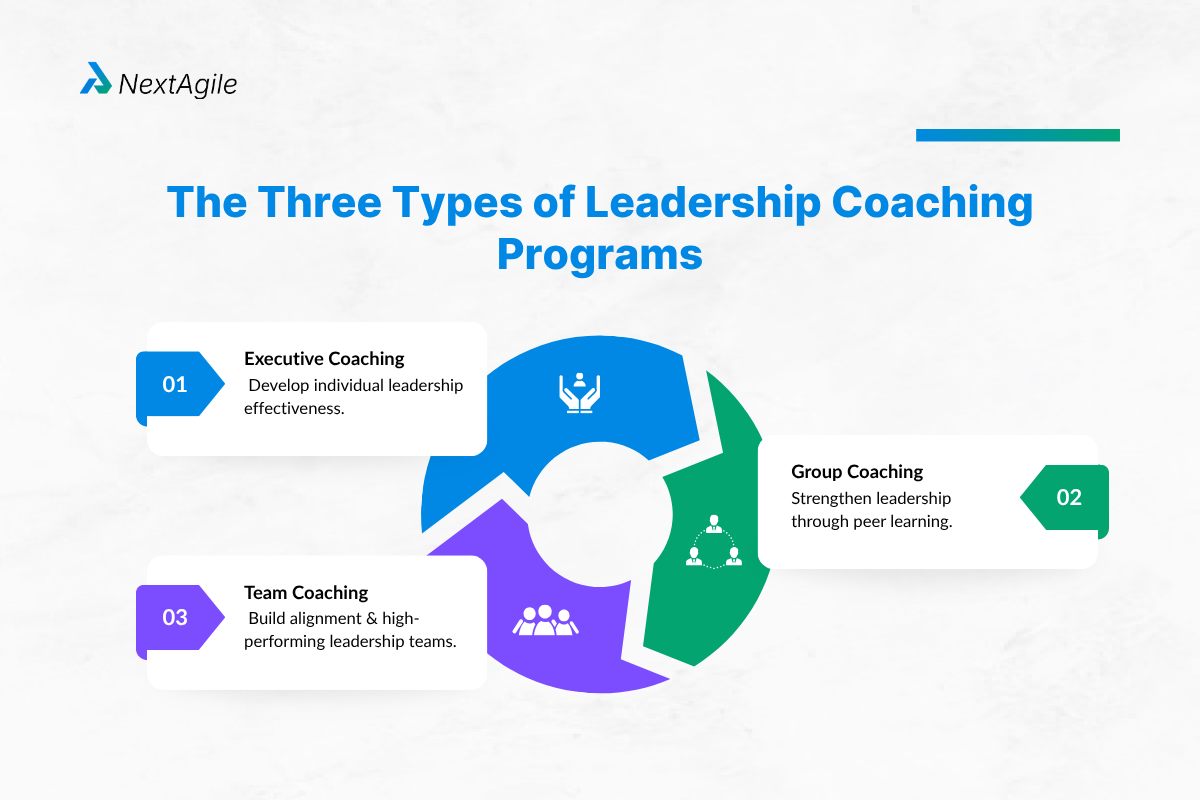
The 3 Types of Leadership Coaching Programs
Not every coaching engagement serves the same purpose.
Choosing the right format depends on organisational goals, leadership maturity, and the business outcomes you want to achieve.
Format 1: Individual Executive Coaching
An executive coaching program provides one-to-one coaching for senior leaders responsible for strategic decisions, organisational performance, and leadership culture.
Sessions focus on areas such as executive presence, stakeholder influence, decision making, resilience, and navigating organisational complexity.
Because conversations remain confidential, executives are often more willing to explore difficult challenges, leadership blind spots, and interpersonal dynamics that may not surface in group settings.
Individual coaching is particularly valuable during promotions, succession planning, organisational restructuring, and executive transitions.
Format 2: Group Leadership Coaching Programs
Group coaching brings together leaders facing similar challenges while allowing them to learn from one another’s experiences.
Rather than relying solely on the coach, participants gain insights through peer discussion, shared reflection, and collaborative problem solving.
This format works well for first-time managers, high-potential leaders, and leadership cohorts participating in development programs.
Group coaching also creates stronger internal leadership networks, helping managers build relationships beyond their own teams.
Format 3: Team Coaching Programs
Team coaching focuses on collective leadership rather than individual development.
Instead of improving one leader’s performance, coaching helps an entire leadership team strengthen collaboration, alignment, decision making, and trust.
This approach is particularly valuable for executive leadership teams, cross-functional leadership groups, Agile Release Trains, and transformation leadership teams.
When business performance depends on leaders working together rather than independently, team coaching often creates greater organisational impact than coaching individuals in isolation.
When Should Your Organization Invest in a Leadership Coaching Program? Leadership coaching is not a solution for every organisational challenge.
The timing matters just as much as the coaching itself.
The most successful coaching engagements begin when leadership capability becomes a business priority rather than simply an individual development objective.
5 Signs Your Organization Is Ready for a Leadership Coaching Program High-performing specialists are becoming first-time managers Many organisations promote technical experts into leadership positions without preparing them to lead people. Coaching helps these leaders transition from individual contributors to people developers.
Leadership capability is limiting business growth Growth often exposes leadership gaps.
Communication breaks down, decision making slows and managers become overwhelmed. Coaching helps leaders develop the confidence and capability needed to scale with the organisation.
Your organisation is experiencing significant change Whether introducing new operating models, expanding into new markets, or leading digital transformation, change creates uncertainty. Leaders need support to communicate effectively, manage resistance, and maintain team engagement.
Employee engagement is declining Low engagement is not always a people problem. It is frequently a leadership challenge. Coaching helps leaders improve trust, communication, feedback, and psychological safety, all of which directly influence employee experience.
Future leadership pipelines are weak Strong organisations build leaders before they need them. Leadership coaching prepares emerging leaders for greater responsibility while reducing succession risk.
When a Leadership Coaching Program Will Not Solve the Problem Coaching is powerful. It is not magic.
Some organisational challenges require structural changes rather than leadership conversations. Coaching is unlikely to deliver meaningful results when expectations, roles, or organisational priorities remain unclear.
It cannot compensate for ineffective performance management, unresolved cultural issues, poor organisational design, or a lack of executive sponsorship.
Similarly, coaching cannot replace accountability. If leaders are unwilling to reflect, experiment, or change their behaviour, even the best coaching program will struggle to create lasting impact.
The most successful organisations address systemic challenges while using coaching to strengthen leadership capability within that environment.
Why Leadership Coaching Matters During Agile Transformations Many Agile transformations focus heavily on frameworks, ceremonies, and delivery practices. Far fewer focus on leadership behaviour. Yet sustainable business agility depends on leaders changing how they think, make decisions, empower teams, and respond to uncertainty.
A leadership coaching program helps executives move beyond traditional command-and-control approaches toward adaptive leadership.
Leaders become better at coaching teams instead of directing them, creating clarity instead of micromanaging, and enabling faster decision making across the organisation.
Frameworks may change how teams work. Leadership coaching changes how organisations lead.
How to Evaluate and Choose a Leadership Coaching Program Selecting a leadership coaching program is not simply about finding an experienced coach. It is about choosing a partner who understands your business context, leadership challenges, and organisational goals.
The right coaching program should create measurable improvements in leadership effectiveness, not just positive participant feedback.
Before making an investment, organisations should evaluate both the coaching methodology and the outcomes it is designed to achieve.
7 Questions to Ask Before Choosing a Leadership Coaching Program What business outcomes is the program designed to improve? Leadership coaching should support business priorities, not operate independently from them.
Whether your goal is improving decision making, preparing future leaders, strengthening collaboration, or enabling organisational change, coaching objectives should align with measurable business outcomes.
Is the coaching customised or based on a standard curriculum? No two organisations face identical leadership challenges.
An effective executive coaching program adapts to organisational context, leadership maturity, and individual development goals rather than delivering identical coaching journeys for every participant.
What qualifications and business experience do the coaches bring? An ICF certified coaching program provides confidence that coaches follow recognised professional standards.
However, credentials alone are not enough. Enterprise coaching becomes significantly more valuable when coaches understand organisational transformation, leadership dynamics, and real business challenges.
How is progress measured? Coaching should produce observable behavioural change. Ask how the provider measures leadership effectiveness before, during, and after the engagement.
The strongest programs combine self-assessments, stakeholder feedback, coaching reflections, and business performance indicators.
How are managers and sponsors involved? Leadership development should not happen in isolation.
Managers and executive sponsors should help reinforce learning, provide feedback, and create opportunities for leaders to apply new behaviours. Without organisational support, coaching outcomes often fade over time.
Does the program include practical application? Leadership capability develops through practice.
Every coaching conversation should end with clear behavioural commitments that leaders test in real workplace situations before the next session.
What happens after the coaching program ends? Behavioural change takes time.
Look for providers that include follow-up reviews, progress checkpoints, or continued development support to help sustain improvements beyond the formal coaching engagement.
Warning Signs of a Poor Leadership Coaching Program Not every coaching program creates meaningful change.
Some focus heavily on inspirational conversations while neglecting accountability and measurable outcomes.
Be cautious if a coaching provider:
Cannot explain how coaching supports business goals. Promises rapid transformation in just a few sessions. Uses identical coaching plans for every leader. Measures success only through participant satisfaction surveys. Avoids discussing ROI or behavioural outcomes. Has limited experience working with enterprise leadership teams. Leadership coaching should challenge thinking, encourage experimentation, and produce visible improvements in leadership behaviour.
If those elements are missing, the program is unlikely to deliver lasting value.
Individual vs. Group vs. Team Coaching: Which Option Is Right for You? Coaching Format Best For Primary Outcome Typical Use Case Individual Coaching Executives and senior leaders Personal leadership effectiveness Executive transitions, succession, strategic leadership Group Leadership Coaching Program Managers and emerging leaders Shared learning and capability building Leadership development cohorts, manager development Team Coaching Executive and cross-functional leadership teams Collaboration, alignment, and decision quality Transformation programs, Agile leadership teams, senior leadership teams
Many organisations assume they must choose only one approach. In reality, the strongest leadership development programs combine all three.
Executives benefit from individual coaching. Managers grow through group coaching. Leadership teams strengthen collaboration through team coaching.
Together, they create a more consistent leadership culture across the organisation.
What Makes a Leadership Coaching Program Effective? The quality of leadership coaching depends less on the number of sessions and more on the design of the overall development journey.
Effective programs focus on behavioural change, continuous practice, and measurable business impact.
6 Features Every Effective Leadership Coaching Program Should Include A high-quality leadership coaching program should include:
Leadership assessments that identify strengths, development areas, and behavioural patterns. Clearly defined coaching goals aligned with organisational priorities. Regular coaching conversations supported by practical workplace application. Reflection exercises that help leaders recognise patterns in their thinking and behaviour. Stakeholder feedback that reinforces accountability and measures progress. Periodic reviews that evaluate both leadership growth and business outcomes. These elements create coaching journeys that extend beyond individual conversations and become part of everyday leadership practice.
How to Measure the ROI of a Leadership Coaching Program One of the most common questions senior leaders ask is whether coaching delivers measurable returns.
The answer depends on how success is defined. If coaching is measured only through participant satisfaction, its value will always appear subjective.
If coaching is linked to business performance, leadership capability becomes far easier to evaluate.
The NextAgile Leadership Impact Scorecard
At NextAgile, we recommend evaluating coaching across six dimensions.
Decision Quality – Are leaders making faster, better-informed decisions with greater confidence? Leadership Confidence – Do leaders demonstrate stronger communication, resilience, and executive presence? Team Engagement – Have trust, collaboration, and employee engagement improved? Cross-Functional Collaboration – Are teams working together more effectively across departments? Delivery Predictability – Have leadership improvements contributed to more consistent execution and business outcomes? Leadership Bench Strength – Is the organisation developing future leaders who are ready for greater responsibility? This balanced approach moves coaching discussions away from opinions and towards measurable organisational impact.
Leadership Coaching Programs in the Indian Enterprise Context Leadership coaching has evolved significantly within Indian organisations over the past decade.
Initially viewed as executive support for senior leaders, coaching is now becoming an integral part of leadership development across multiple organisational levels.
Companies recognise that sustainable growth depends on building leadership capability throughout the organisation rather than relying solely on a few experienced executives.
How Leadership Coaching Programs Work in Indian Organizations Indian organisations often operate within complex environments where rapid business growth, hierarchical structures, and diverse workforces coexist.
Leadership coaching helps managers navigate these realities by strengthening communication, decision making, stakeholder management, and people leadership.
Rather than replacing organisational culture, coaching helps leaders evolve it.
This is particularly valuable during mergers, digital transformation, business agility initiatives, and succession planning.
Why Group Leadership Coaching Is Growing in Indian Enterprises Many organisations are expanding beyond individual executive coaching to include group leadership coaching programs. This approach improves consistency across leadership teams while making coaching accessible to a broader group of managers.
Group coaching also encourages peer learning. Leaders realise they are not facing challenges alone. By discussing real workplace situations together, they develop stronger relationships, exchange practical ideas, and create shared leadership practices that extend beyond formal coaching sessions.
For organisations investing in leadership development at scale, group coaching often delivers both cultural and commercial value.
Conclusion Leadership coaching is no longer reserved for struggling leaders or senior executives preparing for promotion. It has become a strategic investment for organisations seeking stronger decision making, greater organisational agility, and sustainable leadership capability.
The most effective leadership coaching programs do more than improve individual performance. They strengthen collaboration, develop future leaders, improve execution, and create cultures where people can perform at their best.
Choosing the right coaching partner requires more than comparing credentials or session formats. It requires understanding how coaching connects to business outcomes, organisational priorities, and long-term leadership growth.
The best coaching programs do not simply change how leaders think. They change how organisations perform.
If your organisation is looking to develop leaders who can navigate complexity, accelerate transformation, and build high-performing teams, NextAgile partners with enterprises to design leadership coaching programs aligned with business outcomes. Reach out to us at consult@nextagile.ai to explore how we can support your leadership development journey.
Alok Dimri
Frequently Asked Questions 1. How do I justify the budget for a leadership coaching program to a CFO who only cares about numbers? Position coaching as a business investment rather than a learning initiative. Measure improvements in leadership effectiveness through decision quality, employee engagement, retention, productivity, succession readiness, and delivery performance. Connecting coaching outcomes to business metrics makes the investment easier to justify.
2. What is the minimum duration for a leadership coaching program to produce real behavioural change? Most organisations begin seeing meaningful behavioural improvements within three to six months. Sustainable leadership change typically requires ongoing practice, reflection, and reinforcement rather than a few isolated coaching sessions.
3. What is the difference between a leadership coaching program and a mentoring program? Mentoring focuses on sharing experience and providing advice based on the mentor’s expertise. Leadership coaching helps leaders develop their own thinking through structured questioning, reflection, and accountability. Both approaches are valuable but serve different purposes.
4. Is a virtual leadership coaching program as effective as in-person coaching? Yes. Virtual coaching can be equally effective when sessions remain interactive, confidential, and supported by regular practice between meetings. Many organisations now prefer virtual coaching because it provides greater flexibility while maintaining consistent engagement.
5. Should I choose an Indian coaching provider or an international coaching firm for an enterprise leadership coaching program? The decision should depend on organisational needs rather than geography. Look for coaches who understand your industry, organisational culture, leadership challenges, and business objectives. The strongest providers combine global coaching practices with practical enterprise experience.
6. Should a leadership coach for my organization’s program specialize in my industry? Industry knowledge can accelerate context and credibility, particularly in highly regulated or technical sectors. However, strong coaching skills, business acumen, and experience leading organisational change are often more important than industry expertise alone. The ideal coach combines both perspectives to deliver relevant and practical leadership development.
Alok Dimri is the co-founder and leads the overall business at NextAgile, where he is responsible for strategy, client and consultant partnerships, and a whole lot of other core business activities like solutioning, branding, and customer engagement.
Over the past 16 years, he has worked extensively in business strategy, new business development, and key account management initiatives across process consulting and training domains.
 Skip to content