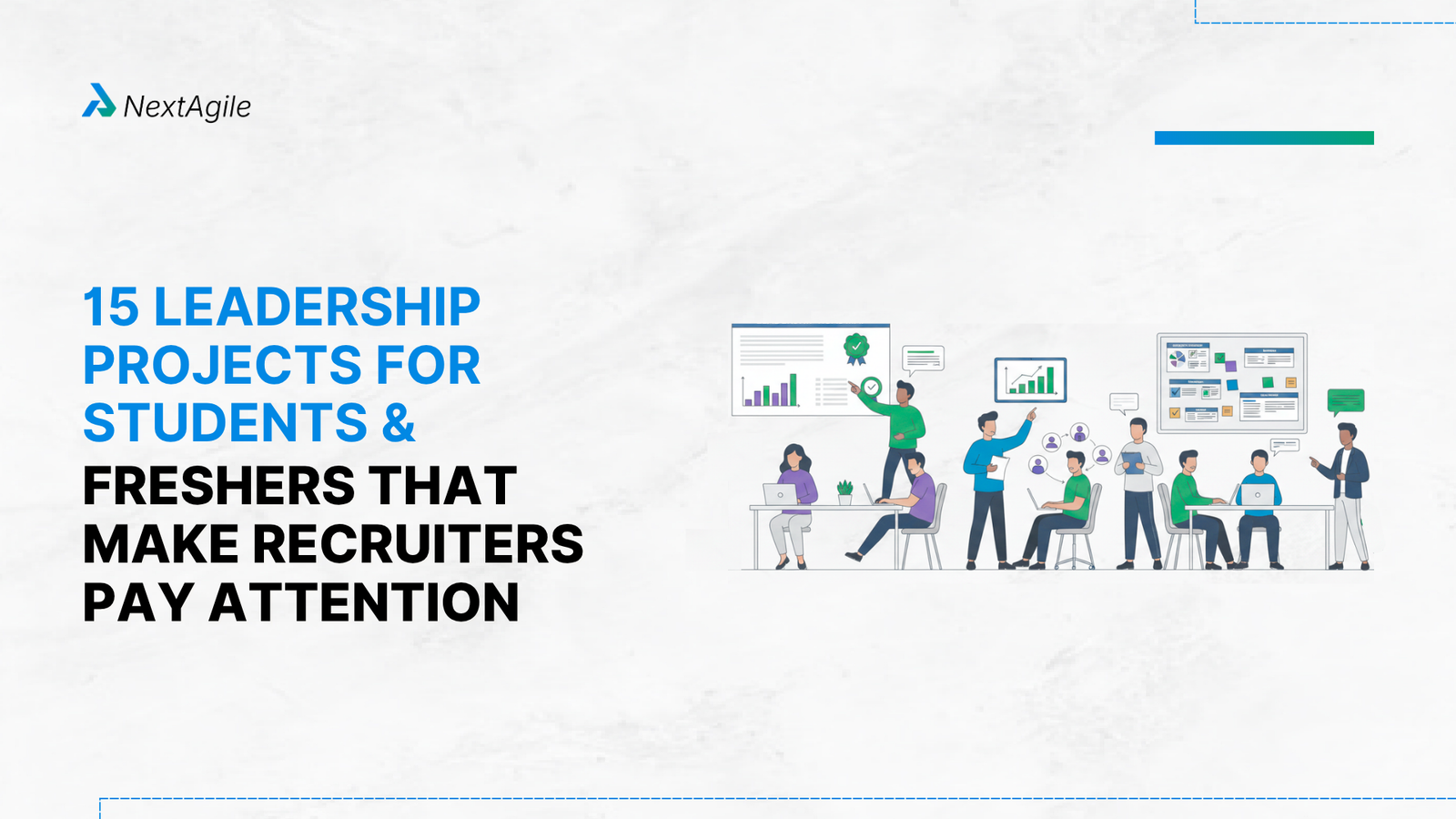
Key Highlights of Leadership Projects for Students The 15 best leadership projects for students include organizing workshops, reviving struggling college clubs, running peer study groups, mentoring juniors formally, leading Agile project teams, building digital tools used by peers, conducting original surveys, starting professional organization chapters, and launching community initiatives around campus problems. Key data : A 2025 LinkedIn Talent Trends report found that 87% of recruiters prioritize demonstrated leadership over GPA for campus hire shortlisting. Only 18% of final-year students in India can describe a leadership project with measurable outcomes (CII Skills Survey, 2025). The documentation format that works: Action verb + team size + outcome + timeframe. Example: Led a 12-member team to organize the college annual tech fest, increasing attendance by 40% over the previous year within a six-week planning period. Recruiters at companies like Deloitte, Infosys, Goldman Sachs India, and product startups say they screen for leadership signals before they look at grades. The problem is that most final-year students do not have a leadership project they can describe with measurable outcomes. They have participated in things. They have been members of clubs. They have contributed to group assignments. But they have not led something with a team, a goal, and a result. This guide gives you fifteen specific projects you can start and complete before graduation, organized by the time they require, with guidance on how to document each one for maximum interview impact.
A leadership project is not a skill certification or an academic assignment. It is a situation where you set a goal, organized or influenced other people around that goal, made decisions under uncertainty, and produced a result you can describe with numbers. These fifteen projects all fit that definition. For early-career professionals who want to develop these skills in a structured environment alongside technical training, the NextAgile corporate leadership training programs and leadership learning programs provide structured frameworks for building leadership capability at every career stage.
Why Recruiters Trust Evidence More Than Potential One of the biggest shifts in campus hiring over the past five years is the move from potential-based evaluation to evidence-based evaluation. Recruiters no longer assume that leadership capability will emerge after joining the organization. They actively look for proof that candidates have already influenced people, handled ambiguity, and delivered outcomes before entering the workforce.
Leadership projects provide exactly that evidence. They demonstrate initiative without authority, execution without formal power, and accountability without organizational hierarchy. Those are the same conditions under which many graduate trainees and first-time managers are expected to operate.
This is why two students with identical academic records can receive very different interview outcomes. The candidate who can explain how they navigated conflicting stakeholder expectations or recovered a struggling initiative provides observable evidence of leadership maturity, while the other can only describe coursework and participation.
Why Leadership Projects Outperform Certifications on a Fresher Resume Recruiters see thousands of resumes with the same set of certifications: HackerRank, Coursera, Google Analytics, AWS Cloud Practitioner. These are useful signals of self-directed learning, but they do not differentiate candidates at the behavioral interview stage.
Leadership Projects Build Compound Career Capital Unlike certifications, leadership projects continue creating value long after they are completed.
A successful project can become:
a resume achievement a behavioral interview story a LinkedIn content series a portfolio case study a recommendation letter a discussion point during networking conversations evidence during promotion discussions years later This compounding effect explains why experienced leaders frequently refer back to projects they led early in their careers. The project itself ends, but the credibility it generates often compounds across multiple career transitions.
Students who intentionally document their leadership experiences therefore build an asset that grows in professional value over time rather than a credential that simply occupies one line on a resume.
What does differentiate candidates is a project story that includes a problem you identified, people you organized around it, a decision you made under pressure, and an outcome you can measure. This is what every behavioral interview question is trying to surface using the STAR method (Situation, Task, Action, Result). A leadership project gives you ready-made STAR stories. A certification gives you a line on a resume.
The other advantage of leadership projects is specificity. ‘Led a 15-member team to raise INR 80,000 for a campus NGO event within six weeks’ tells a recruiter more about your capability than a 40-hour online course completion badge. One is evidence. The other is credential. Both have value, but leadership projects earn significantly more conversational weight in an interview. The NextAgile blog on leadership skills covers the core behavioral competencies that enterprise recruiters evaluate and how to build them systematically before your first role.
Selecting the Right Leadership Project Students often assume that the most impressive leadership project is the largest one. In reality, recruiters are usually more interested in clarity of ownership than scale of execution .
Leading a five-person initiative where responsibilities, decisions, failures, and outcomes are clearly attributable to you can create a stronger interview narrative than participating in a fifty-person event where your contribution is difficult to explain.
A useful selection criterion is simple:
Choose the project where you will make the highest number of meaningful decisions rather than the project with the highest visibility. Leadership develops through decision-making, not event attendance.
15 Leadership Projects for Students: Low Effort, Medium Effort, and High Effort Low-Effort Projects (2 to 4 Weeks) 1. Organize a Department-Level Skill-Building Workshop Plan and deliver a half-day workshop for your department on a skill your peers actually need: resume writing, LinkedIn profile optimization, Python basics for non-CS students, or public speaking. Handle logistics, find a speaker or facilitate it yourself, and collect feedback forms at the end. Document: attendance count, average feedback score, and at least one concrete follow-up action the participants took. This project demonstrates planning, facilitation, and delivery in one exercise.
2. Start a Structured Peer Study Group and Track Outcomes Create a structured study group of five to ten peers for a difficult subject. Set a fixed weekly schedule, assign discussion leadership roles on rotation, and track attendance and grade improvements at the end of the semester. Three things differentiate this from an informal study session: it is scheduled and structured, different people lead each session, and outcomes are measured. These three elements make it a leadership project rather than a social arrangement.
3. Lead a Campus Fundraising Drive for a Real Cause Organize a fundraiser for an NGO, a campus cause, or a community event. Define a financial goal, build a small team, divide roles, and execute over two to three weeks. Document the amount raised, the team size, and the specific obstacles you encountered and navigated. Fundraising projects test negotiation, stakeholder management, and delivery under pressure simultaneously, which are exactly the competencies that management trainee roles evaluate.
4. Run a Four-Week Social Media Campaign for a College Club Take ownership of a dormant social media account for a college club or student organization. Build a content calendar, execute consistently for four weeks, and measure follower growth, engagement rate, and the response rate to any call-to-action posts. This project demonstrates communication leadership, consistent execution, and data-driven decision-making in a context every recruiter in a marketing, product, or business role will recognize.
5. Create a Structured Resource Guide for Your Juniors Survey your seniors and batchmates, then build a comprehensive resource guide covering placement preparation, internship applications, lab resources, or study materials for first-year students. Format it cleanly, distribute it through official channels, and track downloads or engagement. This project demonstrates initiative, empathy, and the ability to curate and present information in a way that serves others, which is a core element of the servant leadership style increasingly valued in Agile and product organizations.
Small Projects Build the Leadership Habits Behind Bigger Ones Many students underestimate the value of smaller initiatives because they compare themselves with peers leading major festivals or national competitions.
In practice, recruiters understand that leadership capability develops progressively. Organizing one successful workshop teaches planning. Running a study group teaches facilitation. Coordinating a fundraiser teaches stakeholder management.
Repeated across multiple projects, these experiences create leadership habits: anticipating risks, communicating proactively, delegating effectively, and reflecting after execution.
The size of the project matters less than the consistency with which these habits are practiced and refined.
Medium-Effort Projects (1 to 2 Months) 6. Revive or Rebuild a Struggling College Club Take over a club that has low attendance, no active programming, or zero engaged members. Redefine its purpose clearly. Recruit a founding team of five to eight committed members. Run two or three events. Document the before-and-after state with specific numbers: attendance went from 3 to 45, event frequency went from 0 to 2 per month. Turnaround stories are among the most compelling leadership narratives in competency interviews because they require diagnosis, persuasion, planning, and execution all in one project.
7. Conduct an Original Survey and Publish Your Findings Design a survey on a topic relevant to your field or your campus. Collect at least 100 responses. Analyze the data, identify patterns, and write up findings as a report or a LinkedIn article. Students who are new to research projects can review publicly available survey analysis templates to understand how raw survey responses are transformed into meaningful insights, charts, and recommendation reports. Publish it with your name. This project demonstrates research leadership, data literacy, communication, and the intellectual confidence to put your own analysis in public. It also produces a credentialed piece of work that hiring managers can verify.
8. Launch a Small Business or Freelance Project Even a four-week freelance engagement, a small product you sell online, or a service you provide to three clients counts as a leadership project when it involves client management, delivery accountability, and outcome documentation. The scale does not matter. The narrative does. What problem did you solve, for whom, at what price, and with what result? Real transactions teach accountability faster than any simulated project exercise.
Before approaching your first client, it helps to create a clear scope of work and delivery plan. These freelance project proposal templates can help students structure client requirements, timelines, deliverables, and pricing discussions more professionally.
9. Lead a Cross-Department or Cross-College Event Coordinate an event that requires working with students from at least three other departments or colleges. Managing stakeholders who do not report to you, who have competing priorities, and who joined voluntarily is the precise challenge of corporate cross-functional leadership. Document the team size, the coordination challenges, and the outcome. This is directly transferable to any project management, product, or consulting role.
10. Formally Mentor a Junior Student for One Semester Volunteer as a formal mentor through your college’s placement cell, alumni association, or a structured program. Set weekly check-ins, define learning goals with the mentee at the start of the semester, track progress, and document the outcomes: internship secured, skill developed, exam performance improved. Mentoring is one of the highest-signal leadership projects for consulting, HR, and leadership development roles, and it maps directly to the coaching competency that enterprise organizations evaluate at every level. The NextAgile blog on how to develop leadership skills covers the development habits that make mentoring relationships genuinely effective rather than just nominally structured.
Cross-Functional Collaboration Is Becoming a Hiring Differentiator Modern organizations rarely solve problems within functional silos. Engineers collaborate with designers, analysts with product managers, and consultants with operations teams.
Leadership projects that require coordination across departments therefore simulate the collaborative reality of professional work far better than isolated academic assignments.
Students who have already negotiated priorities between different groups, resolved conflicting expectations, and aligned diverse stakeholders demonstrate organizational awareness that typically takes new hires several months to develop after joining.
For recruiters, this lowers onboarding risk and signals readiness for collaborative environments.
High-Effort Projects (2 to 4 Months) 11. Build a Community Around a Real Campus Problem Identify a problem on campus that affects a significant number of students: food waste in the canteen, mental health awareness, poor placement outcomes in a specific department, or inaccessible study spaces. Build a group of ten or more students around solving it. Run campaigns, pilot a solution, and document what changed as a result of the community’s actions. Community-building is one of the hardest leadership skills to fake and one of the most valued in social impact, consulting, and organizational development roles.
12. Lead an Industry Consulting Project With a Real Client Through your college’s industry collaboration program or through direct outreach to a small business, NGO, or startup, partner with an organization to solve a real operational problem. Conduct discovery, define the problem precisely, build a team of three to five students, develop a structured recommendation, and present it to the client. Document the client’s feedback and whether any recommendation was implemented. This is a ready-made case study you own and can walk through in any consulting or business analyst interview.
13. Start a Student Chapter of a Professional Organization Chapters of PMI, IEEE, NASSCOM, CII, or similar professional bodies can often be started by students with a small founding team and a faculty sponsor. Launch the chapter, define its programming calendar, run two to three events in the first semester, and recruit twenty or more active members. This project comes with a credentialed institutional brand and demonstrates organizational creation capability, which is the most sophisticated leadership signal available at the student level.
14. Build and Launch a Free Digital Tool Used by Your Peers Build a tool that people actually use: a Notion dashboard for placement preparation, a curated reading list website, a subject-specific YouTube channel, or a WhatsApp bot that answers common questions about a difficult course. Free tools with real users generate usage data that is direct proof of value delivered. Monthly active users, views, or download counts are your outcome metrics. This project is directly transferable to product roles at tech companies where user adoption is the primary success metric.
Students looking for inspiration can explore open-source student project ideas on GitHub to understand how simple tools evolve into widely used community resources.
15. Lead an Agile Project Team Using Real Sprint Practices Apply Scrum or Kanban methods to a real student project, internship, or hackathon team. Run two-week sprints, hold a retrospective at the end of each sprint, and use a tool like Trello, Jira, or Notion to make the sprint board visible. Free Scrum and Agile templates can help students set up sprint boards, backlogs, and retrospectives without investing in enterprise software.
Document your role as the team lead or Scrum Master equivalent. This project is directly transferable to any technology, product, or consulting role and signals to interviewers that you have operational fluency with Agile delivery practices. The NextAgile Agile Induction Workshop and Agile and Scrum Masterclass teach exactly these practices in structured simulation environments for students and early-career professionals.
The Best Leadership Projects Leave Systems Behind Exceptional leadership is not measured only by what was accomplished during a project but by what continues after the leader steps away.
Projects that create reusable documentation, operating procedures, knowledge repositories, mentoring frameworks, or sustainable communities generate value beyond the individual’s direct involvement.
Recruiters often recognize this as evidence of systems thinking a capability associated with more mature leaders who optimize organizations rather than simply complete tasks.
A useful reflection question after every project is:
“If I graduate tomorrow, will this initiative continue because of the systems I built?”
If the answer is yes, the project demonstrates organizational leadership rather than individual effort.
How to Document Leadership Projects for Maximum Resume and Interview Impact The documentation format that separates a project that impresses from one that is ignored: Action verb + team size + outcome + timeframe.
Example: Led a 12-member team to organize the college’s annual tech fest, increasing attendance by 40% year over year within a six-week planning period.
Quantification Creates Credibility Many students weaken otherwise impressive leadership stories by describing activities instead of outcomes.
Compare these examples:
Organized a coding workshop. versus
Led a six-member organizing committee that delivered a coding workshop attended by 180 students, achieving a 94% satisfaction score and generating 70 registrations for the college programming club. The second statement immediately communicates scale, ownership, and measurable impact.
Whenever possible, quantify:
people influenced budget managed attendance achieved engagement generated revenue raised time saved adoption rates satisfaction scores process improvements participation growth Numbers transform experiences into evidence.
Every project entry needs three elements: what you did (your specific role), how many people were involved, and what measurably changed. Remove any project that cannot be described in these terms. If you cannot state the team size and the outcome with a number, the project is an activity, not a leadership story. Activities belong on social posts. Leadership stories belong on resumes and in interviews.
One additional documentation practice that compounds over time: keep a running leadership journal. After every significant experience, write three sentences immediately: what you did, what the outcome was and what you would do differently. Do this for twelve months and you will walk into campus placements with fifteen to twenty specific stories, each ready for a behavioral interview question. The NextAgile blog on emotional intelligence for leadership covers the reflective practices that accelerate leadership development and make documentation habits stick.
Leadership Projects Also Build Self-Awareness Beyond improving employability, leadership projects accelerate personal growth because they expose students to situations that classrooms rarely simulate.
Leading volunteers without authority, making decisions with incomplete information, recovering after setbacks, and balancing competing stakeholder expectations all create opportunities for reflection.
Many students discover their preferred leadership style, communication patterns, and decision-making tendencies only after managing real initiatives.
Viewed from this perspective, leadership projects are not merely resume builders—they are low-risk environments for developing the judgment and adaptability required throughout an entire professional career.
Conclusion Leadership is not about holding a title, it’s about identifying a problem, bringing people together, and delivering measurable results. Even one well-executed leadership project can provide stronger interview stories than multiple certifications. Start with a project that matches your available time and interests, document your impact carefully, and focus on outcomes that recruiters can verify.
Want to strengthen your leadership, collaboration, and project management skills before entering the workforce? Explore NextAgile’s leadership development programs and Agile learning workshops to gain hands-on experience that translates directly into career success.
The strongest leadership portfolios rarely consist of one extraordinary achievement. Instead, they reflect a consistent pattern of identifying problems, mobilizing people, learning through execution, and improving over time.
Recruiters recognize this progression because it mirrors how leadership develops inside organizations. Careers are built through repeated demonstrations of ownership rather than isolated moments of brilliance.
Students who begin building that pattern before graduation enter the workforce with a level of professional credibility that extends far beyond academic credentials alone.
Frequently asked questions 1. Do recruiters value failed leadership projects if the outcomes were poor? Yes. Recruiters are often more interested in how you handled setbacks, stakeholder conflicts, and unexpected challenges than whether the project achieved every goal. A well-documented failure with clear lessons learned can be more impressive than a routine success.
2. Can introverted students build leadership experience without holding formal positions? Absolutely. Leadership is not limited to titles such as club president or event coordinator. Students can demonstrate leadership by mentoring peers, initiating projects, coordinating teams, or solving problems that benefit a group, even without a formal designation.
3. What evidence should students keep to prove leadership project outcomes? Students should save attendance records, feedback forms, screenshots, reports, project plans, budget summaries, LinkedIn posts, certificates, and testimonials. These artifacts help validate achievements during interviews and portfolio reviews.
4. Are virtual or online leadership projects viewed differently than in-person projects? Most recruiters evaluate leadership outcomes rather than the project format. Leading a remote team, managing virtual events, or coordinating online communities can demonstrate communication and collaboration skills that are highly relevant in modern workplaces.
5. How many leadership projects should a fresher include on a resume? Quality matters more than quantity. Two to four well-documented leadership projects with measurable outcomes usually create a stronger impression than listing ten activities with limited evidence of impact.
6. What is the biggest mistake students make when describing leadership projects in interviews? Many candidates spend too much time explaining what the team did and too little time explaining their personal contribution. Interviewers want to understand the decisions you made, challenges you handled, and the specific impact of your leadership.
Sujith G. is an agile practitioner with expertise in setting up the agile environment by coaching and training teams, individuals and stakeholders in the area of lean agile software principles. He has overall 12+ years of exp out of which 9+ years have been in Agile and Scrum implementation and adoption. Sujith has coached 70+ teams on agile practices & implementation techniques and has extensive experience in setting up metrics, JIRA & Azure DevOps. Experienced in identifying gaps in the system, creating scrum awareness, piloting and scaling scrum.
 Skip to content