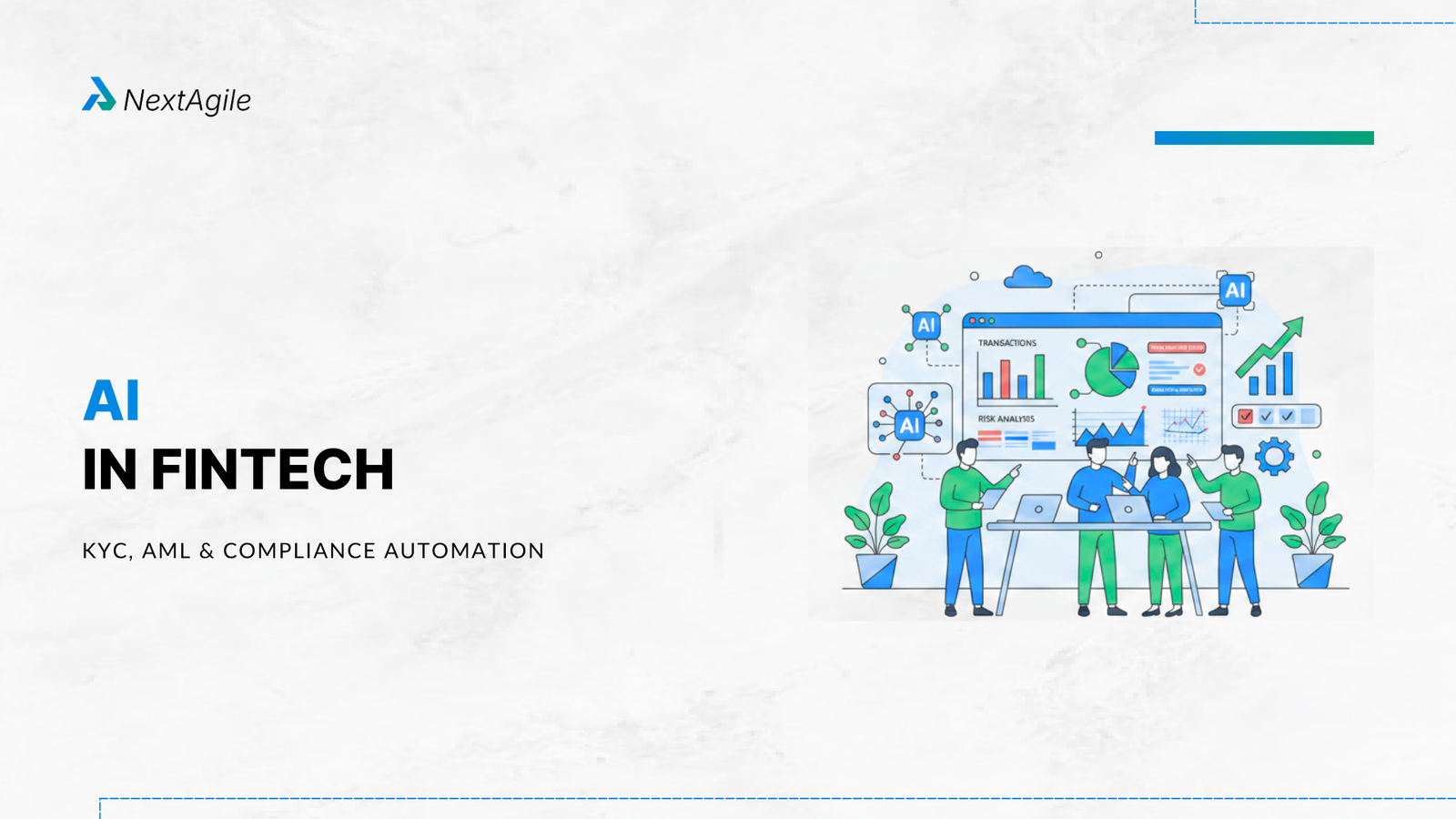
AI in Fintech: KYC, AML & Compliance Automation (2026 Guide)
Alok Dimri
Talk to Expert for Free
Table of Contents
Key Takeaways of AI in Fintech
AI in fintech is now essential for scaling KYC, AML, and compliance efficiently
Machine learning reduces AML false positives by up to 50%+
Generative AI accelerates regulatory reporting and AML investigations
Explainable AI is mandatory for RBI-aligned compliance frameworks
Agentic AI enables continuous, real-time compliance monitoring
Agile delivery is critical for adapting to regulatory changes in India
Fintechs that delay AI adoption risk higher fraud losses and slower growth
Introduction
In 2026, fintech companies that haven’t embedded AI into compliance workflows are already falling behind on onboarding speed, fraud detection, and regulatory responsiveness.
You’ve probably seen this firsthand.
Customers expect instant onboarding. Regulators expect airtight compliance. And fraudsters? They’re getting smarter by the day.
Traditional compliance systems simply weren’t built for this scale.
Here’s what’s changed: AI in fintech is no longer just about automation; it’s about decision intelligence at scale. The ability to interpret regulations, detect risk patterns, and act in real time.
But (and this is where most companies struggle), adopting AI doesn’t guarantee results. Poor implementation, lack of governance, and siloed teams often derail even well-funded initiatives.
In our experience at NextAgile, the difference between success and failure isn’t the model; it’s how you design, deliver, and govern AI systems.
Let’s break down what actually works.
Why AI and Fintech Are a High-Stakes Combination
The Scale of the Problem: Why Traditional Compliance Methods Are Failing Indian Fintech
Compliance today isn’t just complex; it’s overloaded.
Think about the numbers:
Millions of transactions daily
Real-time payment systems
Increasing fraud sophistication
Manual reviews and rule-based systems simply can’t keep up.
Worse, they create hidden inefficiencies:
AML teams spend up to 70% of time on false positives
KYC delays lead to 20-30% customer drop-offs
Compliance backlogs increase regulatory risk
This is where AI in fintech changes the game. Instead of static rules, machine learning models continuously learn from transaction patterns, detect anomalies, and prioritize real risks.
One mid-sized Indian fintech we worked with at NextAgile reduced AML false positives by 52% in under 4 months, cutting the investigation workload nearly in half. That’s not incremental improvement. That’s operational transformation.
India’s Regulatory Landscape in 2026: RBI, SEBI, DPDP Act, and What They Mean for AI Deployment
Regulation in India is evolving fast, and it’s getting stricter.
You’re dealing with:
 Skip to content