Skip to content


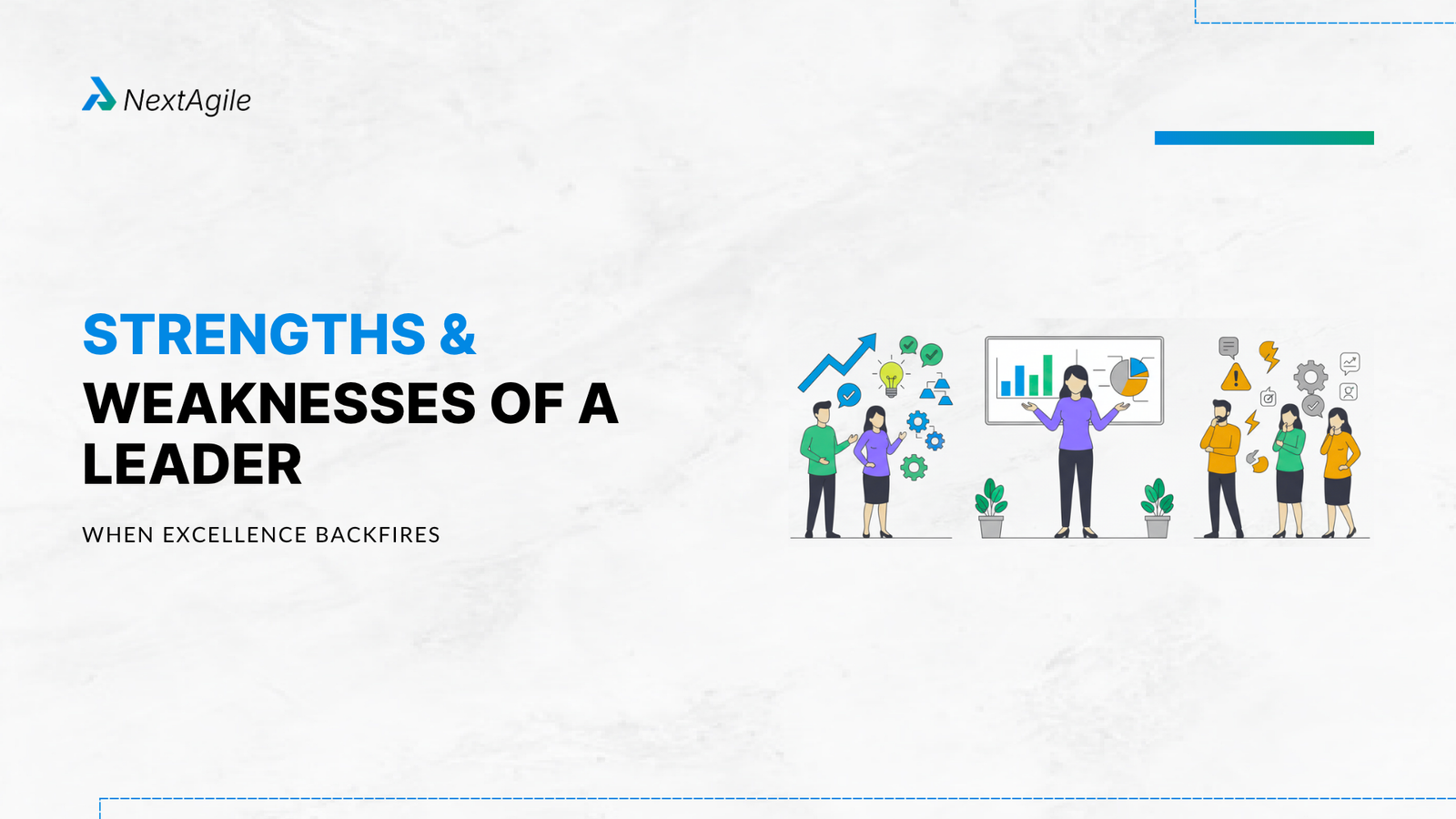
Key Highlights About Strengths and Weaknesses of a Leader
- Most leadership failures don’t come from weaknesses, they come from overusing strengths like decisiveness, collaboration, or drive without realizing when they’ve gone too far.
- Every strength exists on a spectrum. When used well it creates impact, when overused it becomes a liability that limits your team’s performance and voice.
- High-performing leaders face higher risk because past success reinforces the same behaviors, even when those behaviors stop working at scale.
- Strong leadership is not about adding new skills, it is about calibrating your strengths based on the situation and understanding how your team actually experiences you.
Introduction
Most leaders don’t fail because they lack strengths.
They fail because they over-rely on the very strengths that made them successful.
This is the uncomfortable truth at senior levels of leadership.
- The decisive leader becomes controlling.
- The collaborative leader avoids hard conversations.
- The high-drive leader burns out their team.
And here’s the real risk:
These don’t feel like mistakes. They feel like doing more of what works.
That’s why understanding the strengths and weaknesses of a leader is not about identifying gaps; it’s about recognizing when your strengths become liabilities.
At NextAgile, we’ve seen a consistent pattern across leadership transformations in organizations striving for business agility, where leaders must adapt their approach as complexity increases.:
Leaders don’t need more strengths. They need better calibration of the strengths they already have.
Because every strength operates on a spectrum. And leadership effectiveness depends on knowing where you are on that spectrum at any given moment. What makes this pattern difficult to detect is that results often continue in the short term. Teams adjust, compensate, and deliver. The impact shows up later through slower decisions, reduced ownership, and quiet disengagement.
Understanding the Strengths and Weaknesses of a Leader
Most leadership challenges at senior levels are not capability gaps. They are calibration gaps, where the same behavior creates different outcomes depending on context.
These calibration gaps often become visible when organizations evaluate their leadership and organizational maturity through structured frameworks like an agile maturity assessment.
The Strength-to-Liability Continuum Every Leader Must Know
Leadership strengths are not binary, they exist on a continuum.
Every strength has three zones:
- Optimal zone → where it creates impact
- Tension zone → where it starts to limit others
- Liability zone → where it becomes counterproductive
Take decisiveness:
- In the optimal zone → it drives speed and clarity
- In the tension zone → it reduces input
- In the liability zone → it becomes autocratic
What changes isn’t the strength itself but how much of it the situation can absorb before it becomes counterproductive.
This is the strength shadow side and it’s one of the most critical (and ignored) ideas in leadership development.
Because leaders don’t develop new weaknesses at senior levels.
They overextend their strengths under pressure, scale, or complexity. The shift from strength to liability is gradual. Without deliberate reflection or feedback, leaders often cross this line without realizing it.
Why High Performers Are Most at Risk?
High-performing leaders are especially vulnerable to this trap. Why?
Because success reinforces behavior
If your decisiveness drove results in the past, you’ll lean into it more. If your attention to detail improved outcomes, you’ll double down on it. Over time, this creates behavioral rigidity disguised as expertise.
A senior operations leader we coached as part of a leadership coaching engagement was known for execution excellence.
His strength: precision and control.
His reality at scale:
- He reviewed every decision
- Bottlenecks increased
- Team ownership declined
The shift wasn’t capability, it was calibration.
Once he reduced control at the right moments:
- Decision velocity improved
- Ownership increased
- Team performance scaled
High performers struggle not because they lack awareness but because:
- Their success reduces critical feedback
- Their patterns feel justified
- Their blind spots are reinforced by results
The stronger the past success, the harder it becomes to question the behavior behind it. This is why experienced leaders need more, not less, external perspective.
The Most Common Leadership Strengths That Become Weaknesses
Here’s where most leaders underestimate risk.
Not all strengths are equally dangerous when overused.
The most dangerous overused strength isn’t decisiveness. It’s confidence, because it’s the least likely to be questioned.
Let’s break down the most common patterns. These patterns are not rare edge cases. They show up consistently across industries, functions, and leadership levels, especially during periods of growth and pressure.
These patterns show up consistently during agile transformation initiatives, especially when organizations scale rapidly.
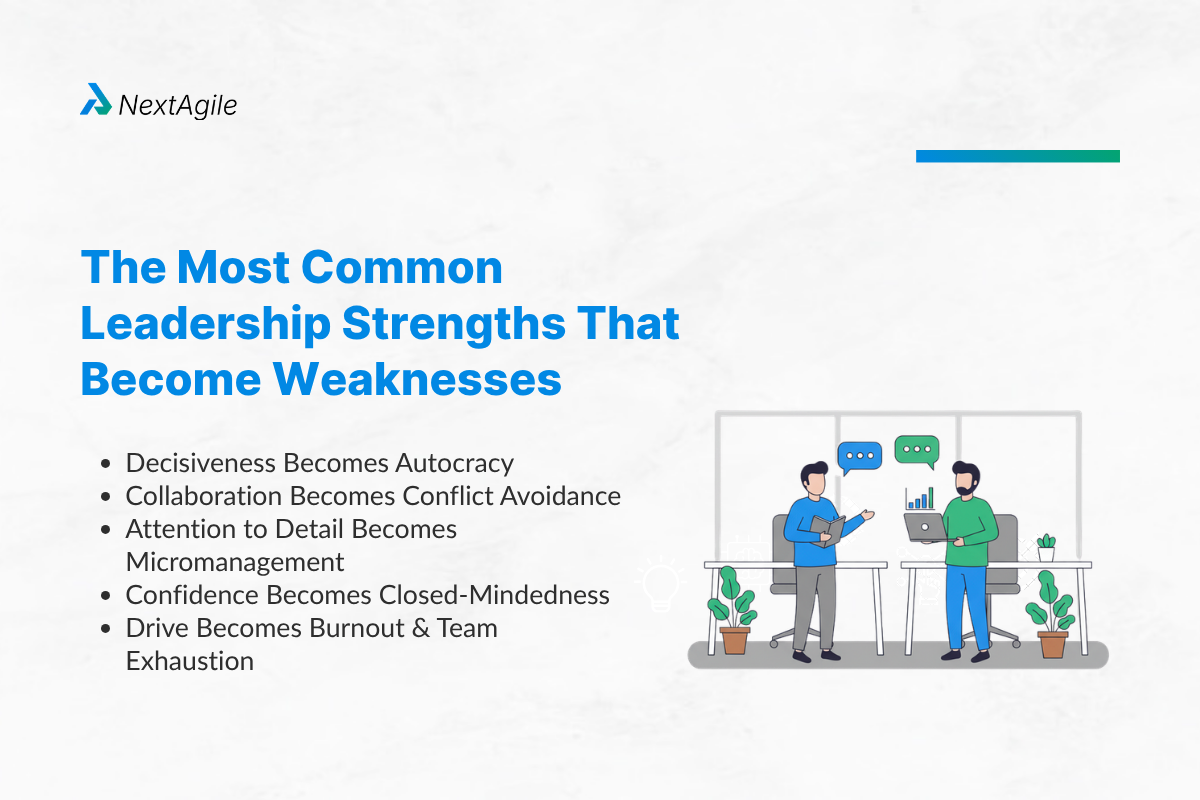
Decisiveness Becomes Autocracy
Decisiveness is essential in leadership. But when applied uniformly, it suppresses input and reduces decision quality.
A senior leader we worked with moved fast, but his team disengaged.
His shift was simple: “Before I decide, I want two alternative perspectives.”
This maintained speed but reintroduced thinking. Speed without input often feels efficient in the moment, but it reduces alignment and ownership over time.
Collaboration Becomes Conflict Avoidance
Collaboration builds alignment, but overextended, it delays progress.
The intent is harmony but the result is delayed decisions, unresolved tension, and missed opportunities.
Strong leaders don’t avoid conflict. They use it intentionally to sharpen thinking. Avoiding tension may preserve short-term comfort, but it often delays clarity and leads to more complex issues later.
Attention to Detail Becomes Micromanagement
Detail orientation ensures quality. But beyond a threshold, it creates:
- Dependency
- Slower execution
- Reduced ownership
Leaders feel in control. Teams feel constrained.
Teams tend to mirror leadership behavior. When leaders stay too close to details, teams hesitate to step forward independently.
Confidence Becomes Closed-Mindedness
Confidence builds trust until it shuts down dissent.
This is where overconfidence in leadership becomes a derailer.
Leaders begin to:
- Rely only on their judgment
- Filter out alternative perspectives
- Reinforce existing thinking
And the cost is subtle but significant: reduced adaptability in complex environments. The absence of challenge is rarely a sign of agreement. It is often a signal that people are choosing not to engage.
Drive Becomes Burnout and Team Exhaustion
Drive creates momentum.
But when sustained without calibration, it leads to:
- Leader fatigue
- Team burnout
- Declining performance over time
One executive we worked with said: “I thought I was pushing for excellence. My team experienced it as constant pressure.”
That gap is where leadership breaks down. Sustained intensity without recovery reduces effectiveness over time, even when intent remains positive.
A Real Leadership Derailment Story (What This Looks Like in Practice)
A business unit head in a fast-scaling company was known for three strengths:
- Decisiveness
- High standards
- Strong ownership
Within 12 months:
- Attrition increased
- Innovation slowed
- Senior team disengaged
His view: “The team isn’t stepping up.”
The team’s reality: “There’s no space to contribute.”
The intervention:
- Structured 360 feedback
- Behavioral coaching
- Strength recalibration
The shift:
- He reduced decision dominance in strategic discussions
- Increased team-led problem solving
- Created space for dissent
The outcome (within 6 months):
- Engagement scores improved
- Decision quality increased
- Leadership bench strength grew
The key insight:
His strengths didn’t change. His application of them did.
What changed was not the leader’s capability but the space created for others to contribute. That shift often unlocks more value than additional effort from the leader.
How to Recognize When Your Strength Is Hurting Your Team?
Feedback Signals to Watch For
Overused strengths don’t show up as obvious failures.
They show up as behavioral signals:
- People agree quickly but commit slowly
- Meetings feel smooth but decisions don’t stick
- You hear less disagreement over time
- Problems surface late instead of early
Silence is not alignment; it’s often adaptation to your leadership style.
And that’s where risk begins. These signals are often subtle at first. Leaders who act on them early prevent larger performance and culture challenges later.
Behavioral Self-Audit (High-Precision Diagnostic)
If 2-3 of these are true, your strengths may be working against you:
- You rely on the same leadership approach across situations
- Your team rarely challenges your thinking
- You feel you’re carrying too much yourself
- Decisions need to be revisited frequently
- Execution slows despite strong intent
Once these patterns become visible, you can deliberately adjust how and when you deploy your strengths. The goal of this reflection is not to reduce your strengths, but to use them more deliberately based on the situation.
The Cost of Overused Strengths (What Leaders Underestimate)
Left unchecked, overused strengths lead to:
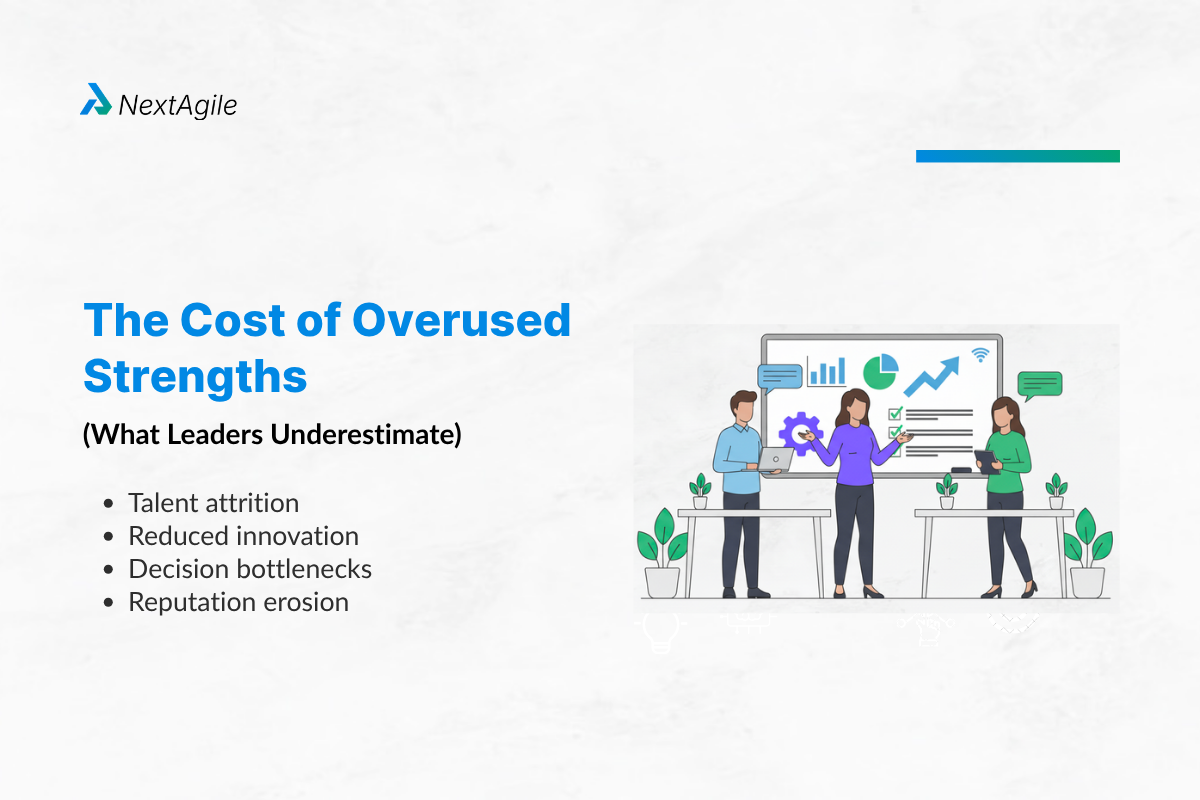
- Talent attrition → strong performers disengage first
- Reduced innovation → fewer ideas surface
- Decision bottlenecks → everything depends on the leader
- Reputation erosion → leader becomes difficult to work with
This is how leadership derailers develop; not suddenly, but gradually. And by the time they’re visible, the cost is already high. The impact compounds over time. Small behavioral patterns, when repeated, shape how teams think, act, and engage.
Recalibrating Your Strengths for Greater Leadership Impact
The Situational Calibration Approach
Most leaders apply strengths consistently.
Effective leaders apply them contextually.
Ask: “What does this situation require, not what am I naturally inclined to do?”
For example:
- Crisis → increase decisiveness
- Strategy → expand collaboration
- Execution → enable delegation
Leadership effectiveness is not about consistency. It’s about precision in application. Leaders who adapt their approach based on context create more balanced teams, where both speed and thoughtful input can coexist.
How Coaching Reveals the Shadow Side?
The biggest challenge with overused strengths?
They don’t feel like weaknesses. That’s why an external perspective is critical.
At Nextagile, we’ve found:
- Leaders already have the capability
- What they lack is visibility into their impact
Through:
- 360-degree feedback
- Pattern identification
- Real-time behavioral shifts
Leaders begin to see:
- Where their strengths create friction
- How their intent differs from impact
- What needs recalibration
And that’s where transformation happens. External perspective works because it highlights patterns that are difficult to see from within day-to-day leadership situations.
Conclusion
For many leaders, improvement begins with a simple shift from relying on instinct to pausing and asking what the situation actually demands. Understanding the strengths and weaknesses of a leader isn’t about fixing flaws.
It’s about managing strengths with awareness.
Because every strength carries a risk:
- Used well → it creates impact
- Overused → it creates limitations
The leaders who scale successfully are not the most talented.
They’re the most self-aware and adaptable.
They continuously ask:
- Where am I overusing my strengths?
- What does this situation actually need?
- How am I being experienced, not just how I intend to lead?
In our leadership coaching and leadership training programs, we at NextAgile understand that leadership doesn’t break due to lack of strengths. It breaks when strengths go unchecked, uncalibrated, and unquestioned. Leaders who build this awareness create teams that think more independently, contribute more openly, and perform more consistently.
Every step you take sharpens your influence, strengthens your teams, and transforms your organization. Leadership development is a strategic investment, not a soft skill.