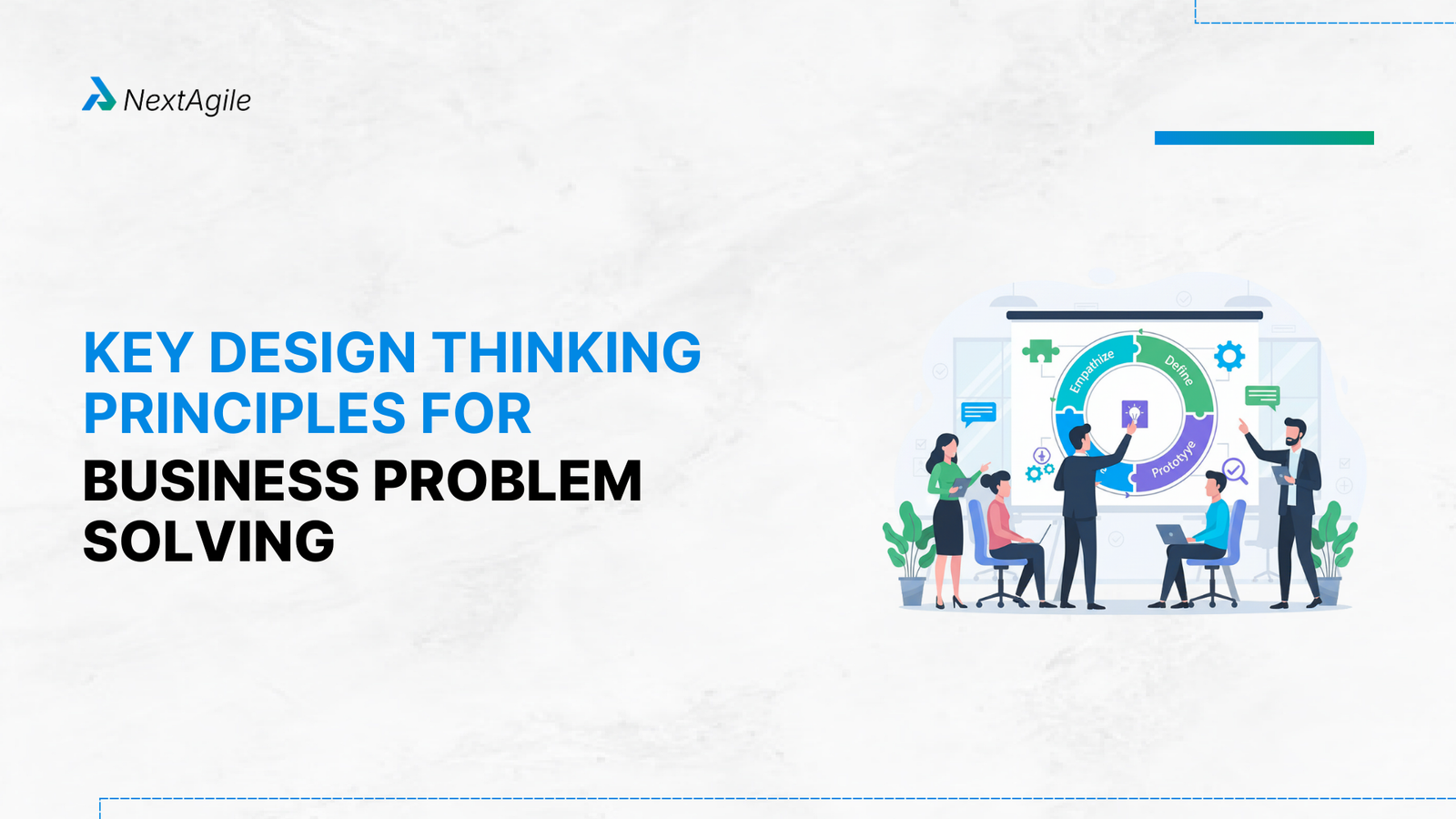
Key Design Thinking Principles for Business Problem Solving
Sujith G
Talk to Expert for Free
Table of Contents
Introduction
In today’s VUCA world where innovation is the key to drive success, traditional/conventional ways of problem solving may not be sufficient or even outdated. We need a framework that is iterative in nature, can bring in elements of empathy, collaboration to get multiple solutions, and then roll out the best solution based on the feedback. This may not be a prescriptive solution rather is a way of working or mindset shift that is needed.
But what teams or individuals keep in mind with respect to the construct or thought process is defined by the principles of design thinking. What guides the teams to explore problems, come up with perspectives, experiment and empathise with the users are the principles. Be it a fresher, management grade person or even a CEO, these principles should help teams or individuals with the right mindset to drive innovation and solve user centric problems to stay relevant.
This blog aims at guiding teams and individuals in understanding:
What exactly is design thinking?
What are the key principles of design thinking?
How can we apply design thinking in our environment?
What are the core principles of design thinking?
What are some design thinking principles examples?
What is design thinking?
Design thinking is a simple yet powerful way of working that focuses on understanding the customer needs and developing innovative solutions. It promotes empathy, collaboration and experimentation to create human centered, consumer centric solutions.
Design thinking flow spreads across five stages:
Empathize with the users – Putting yourself in the end user’s shoes to understand their problems, challenges and pain points
Define the problem – Clearly define the problem you want to solve
Ideate Potential solutions – Come up with different multiple solutions for the same problem
Prototype – Create simple versions of your solution to test
Test – Take your solutions to the end users to get feedback and build on top of it
These stages may not be sequential, that is there could be a lot of to and fro between these stages to come up with the best solution that solves the end user problems.
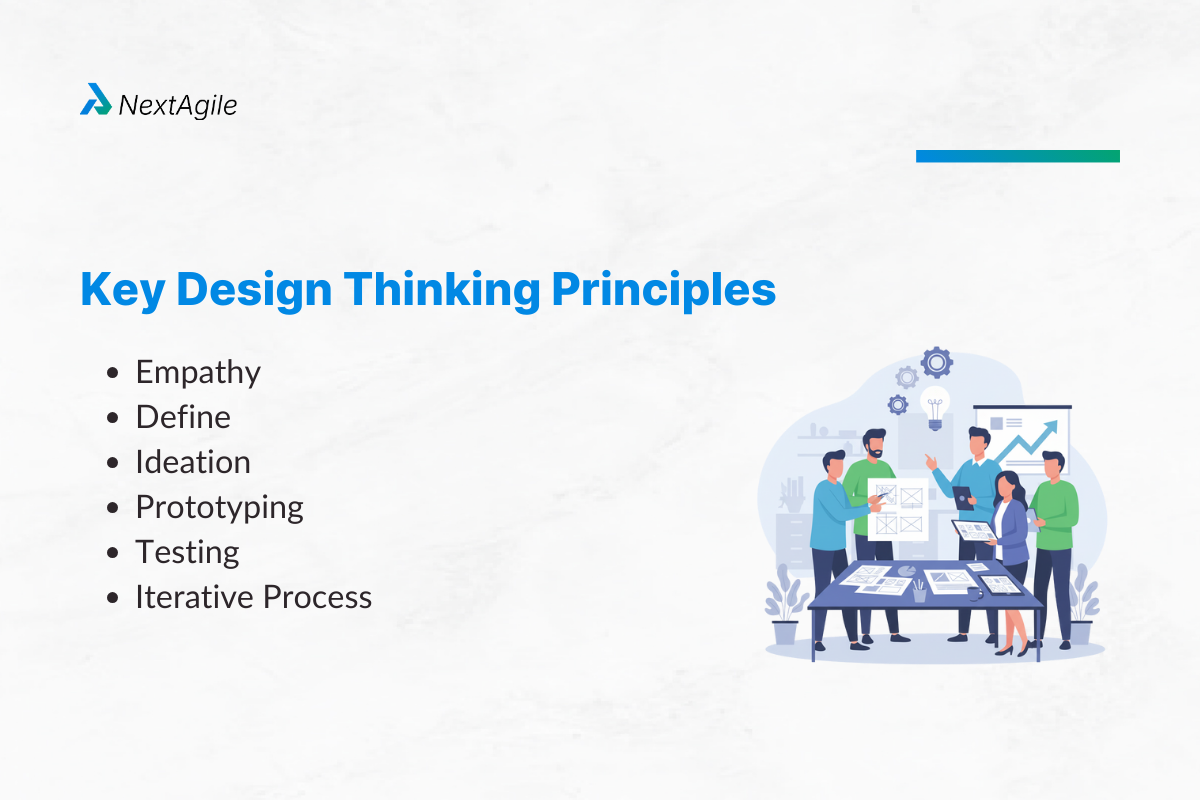
Key Design Thinking Principles
Design thinking principles are the guide that paves the path towards innovative solutions that are human centered. Before we jump into design thinking principles, let’s quickly understand the stages involved:
Empathy: This stage is about understanding user needs and experiences and needs a good amount of observation, interviewing and also interaction with them. This creates an environment where we can understand who are the users, their challenges and pain points
Define: This stage involves clearly writing down the specific problem the users are facing based on the insights gathered in the empathy phase. Writing down the specific problems helps teams to concentrate on solving the problem without any assumptions
Ideation: This stage is about coming up with multiple solutions from multiple perspectives for a single problem. This removes any assumptions and promotes options by brainstorming the solutions
Prototyping: With the best potential solution, the next stage is to quickly create a simple version of the solution like flow, visual designs wireframes that can help us validate if the solution we are thinking will actually solve the problem
Testing: Users are at the center of design thinking. This phase involves taking the prototype to the set of actual users to test and validate the effectiveness of the solution
Iterative Process: Is about repeating the phases in cycles as new problems and ideas come up. This helps in continuously improving and adapting. The main idea is on being flexible and learning from failure to arrive at the best potential solution
Design Thinking is built on some core principles that guide innovation and problem solving. With these principles, teams can develop user centered solutions that deliver impact which matters to the users and drive creativity. Let’s delve into the key principles of design thinking in detail:
Collaborative Approach
The most important design thinking principle is to collaborate. Collaboration brings in different perspectives from different people. It promotes open discussion and disagreements and diverse ideas among the teams that could potentially bring out a well rounded approach to problem solving. Collaboration helps teams to build on each other’s ideas and create innovative solutions that actually address the user needs.
Iterative Process
Design thinking is not a one time activity. It is an iterative process where all the stages mentioned above run in loops/cycles. This approach helps teams to learn from the mistakes and pivot quickly to make the solutions better. Iteration also reduces the risk blast radius by helping teams refine ideas continuously rather than making a perfect product at once.
 Skip to content