What Is a Product Roadmap? How Agile Teams Build and Use One
Sudha Madhuri
Talk to Expert for Free
Table of Contents
Introduction to Product Roadmap
Agile development is often associated with short-term planning to keep pace with changing customer needs and volatile business contexts. However, this doesn’t mean that long-term planning (read roadmaps) doesn’t matter or is not done. On the contrary, roadmaps (product roadmaps in the context of this blog) play a vital role in agile development – providing long-term vision, an ability to adapt to shifting business/industry/market dynamics and lending context to the team’s everyday work. This blog intends to help you explore the basic tenets of building a product roadmap – easily and effectively.
We will try to answer the following questions based on our experience as an agile consulting firm:
What is a Product Roadmap?
Why is Product Roadmap important?
Which teams could use Product Roadmaps?
How to create a Product Management Roadmap?
Some best practices to follow to get the best Product Roadmaps?
What is an Agile Product Management sample and Agile Product Management example?
What is a product roadmap?
A product roadmap is a living, strategic document that lays out the initiatives or features of a product lined for a future build. It is built in line with a product vision, which is based on the strategic goals of the organization. A roadmap adapts itself to customer needs, learnings and market opportunities. Guiding stars for the organization – product roadmaps align customers and product teams on products planned for release – with a singular focus on solving customer problems. As complex as it sounds, a product roadmap can be as simple as a list containing the features and their spread over timelines – more about that later.
A product roadmap is also used as a communication tool to showcase to customers the lined-up features, drawing them towards upcoming features on the product front. However, such a roadmap is not to be confused with release plans, feature lists, or release timelines.
Product Roadmaps enable us to:
Align organizations to their customers
Set clear priorities
Break work down into smaller work items
Collaborate smoothly
Properly allocate and manage resources based on products planned
Which Teams Use Product Roadmaps?
So which are the teams which should be using Product Roadmaps? We have listed a few teams which have a use case for a product management roadmap, this list is not exhaustive though:
Product Management Team uses Product Roadmap to set direction for Product owners and development teams around product features laid out for future builds (e.g. in upcoming months, quarters)
Development Team uses it to plan their POCs and to research on complex and uncertain features before actual development among other things.
Engineering and Solutions team uses Product Roadmaps to plan the architectural runway for future demands
Support Teams are customer-facing people who solve any issues that customers have wrt to the product in use. Involving the customer support teams in Product Roadmaps helps in incorporating feedback collected by them. Support teams can help in prioritizing the features on the product roadmap based on the complaints received from the customers based on their priority and severity
Customer Service team/product onboarding teams use Product Roadmaps to plan their training and customer onboarding. Customer service teams can respond to customers about products and their delivery plans using the document which helps to boost their confidence levels
Sales team can use Product Roadmap to plan their product demo to showcase in trade shows and other events
C suite/executive should use Product Roadmap to know about their customers, strategize and plan their investments, understand the ROI and decide on the long term future growth trajectory and goals.
Why Are Product Roadmaps Important?
Product roadmaps, unlike traditional roadmaps, are very dynamic. They are open to inspect and adapt as per the changing business, competition, technology, customer and other dynamics. This is key to any organization in the face of today’s ever-changing business needs, and the uncertainty of the VUCA environment.
Modern organizations need to welcome and respond to such a multitude of changes and prepare themselves to course correct faster to avoid redundancy. Let’s discuss some of the reasons why Product strategy roadmaps are so important today:
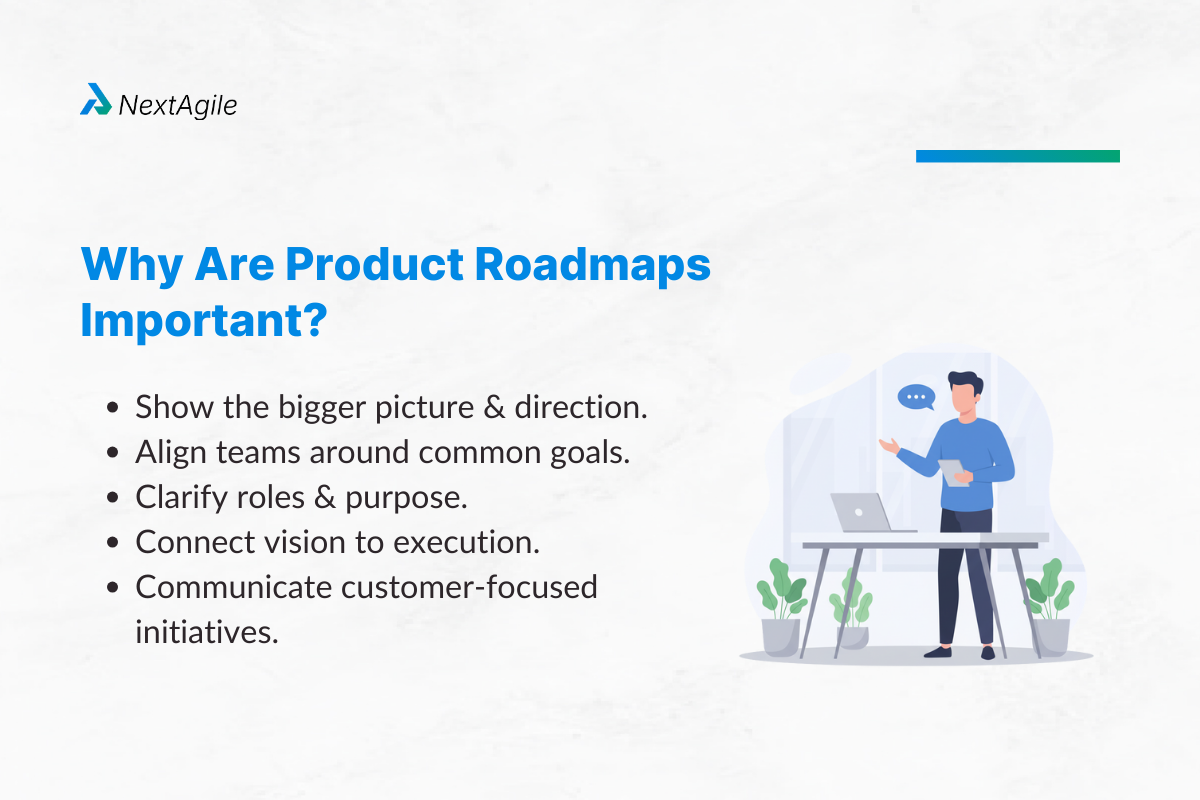
They show the bigger picture and sets the direction
Align all teams and stakeholders to common goals and initiatives
They help teams and individuals to know their role and why is it important?
Acts as a bridge between the product vision and the development plan
Aids as a communication tool to showcase initiatives charted out to support customer needs
It brings transparency across the organization by exposing teams to planned initiatives
Ensures focus on the value proposition of initiatives over deliverables and their timelines (Read this again, it is very important yet much misunderstood)
Articulate organizational strategy clearly, through aligned initiatives plotted on the roadmap
Product Roadmaps evolve based on lessons learnt and opportunities identified
Product roadmaps don’t just capture the “What” of themes/initiatives, but go on to “empathize with the “Why” behind them (Again, very important, deserves a second read)
Help those in charge communicate objectives and share status updates quickly with minimal lag
Help in cultivating open and transparent communication between teams & stakeholders
Improve communication between the development and marketing/sales leading to a more efficient allocation of resources, minimizing misunderstandings and potential conflicts
Better understand and prioritize the needs and demands of your users for better product management
Easier goal-setting and tracking as the objectives are quantified
Key Elements to Consider While Creating a Product Roadmap
When creating product management roadmaps, one should remember to bring alignment, transparency and it must address customer needs.
Below are some of the Key elements to consider while creating a Product Roadmap:
 Skip to content