Scaling with Spotify Agile Model: Case Study for Product Engineering
Geographically distributed teams with cross-culture differences struggling to align with customer objectives exceeded client expectations in a time-bound agile transformation, as demonstrated in this Spotify agile case study.
CREATE YOUR STORY
Problem
How to implement Agile for a Product engineering client?
Our client is serving their UK-based partner for digital projects on audio domain. Here the software & hardware intervention is key and there has been a huge dependency on the availability of devices by OEMs.
Communication among all stakeholders : development team is based in India, the product owners are based in the US, the project coordinator is in Taiwan and the project sponsors are based in the UK
Business drivers : Transparency, Predictability, Time to market, End-user satisfaction, Quality, Measurable outcomes/ productivity, Cost saving, Performance Optimization, Continuous Monitoring.
Journey
4 Scrum teams & multiple business leaders are Distributed in teams across 2 Regions. A Group size of 38 engineers in Pilot Spotify Agile model and 2 coaches working closely with the teams for 3 months remotely.
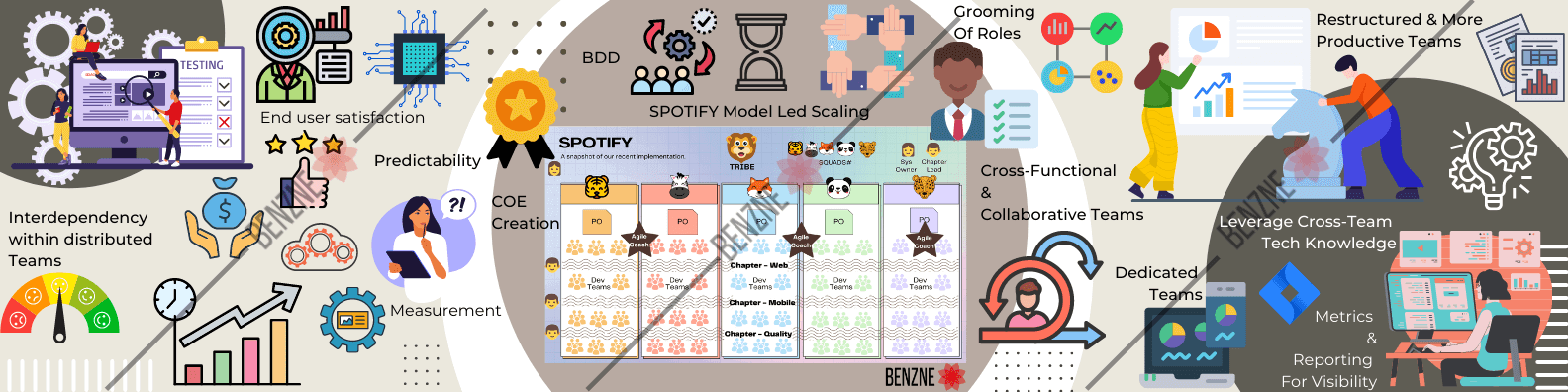
Streamlined reporting and metrics Created COE, developed Scrum Master, Product Owner roles, implemented agile at scale, and introduced Behavior Driven Development.
Outcomes
Restructured teams to make them more focused towards client expectations with fully dedicated resources and a stable outlook to avoid context switching. Resolved challenges of Distributed teams like language, cross-culture & time zone differences.
In remote working, it was imp not to get trapped in zillion meetings, the concept of ‘no meeting zones’ to optimize productive time was implemented.
We scaled using the Spotify Agile model, a cross-team technical knowledge-sharing group to benefit from economies of scale. Metrics & reports to bring visibility to all including clients, Improvised project management tool – JIRA and made it more relevant.
Benzne Agile case studies capture our transformation journey, problems we solved and outcomes achieved. We have incorporated a healthy mix of agile case study examples to provide reference across multiple client scenarios.
Organisational agility case study for a leading IT services firm
Business Agility for a Global Product Engineering Firm
Delivering Aligned, Cross-Cultural Agility Across Distributed Teams Using the Spotify Model
Client Overview
The client is a global product engineering and semiconductor solutions firm supporting a UK-based partner in the digital audio domain. Their work involves complex hardware–software integration with strong dependencies on device availability from multiple OEMs.
Teams were distributed across India, the US, Taiwan, and the UK, operating in different time zones, cultures, and communication styles. With rising expectations around transparency, predictability, quality, and time to market, leadership sought a consulting partner to modernise the delivery model and achieve customer-centric agility at scale.
Business Challenges
The organisation faced a set of delivery, collaboration, and operational constraints that hindered product velocity and alignment:
Fragmented Communication Across Regions
Distributed teams and cultural differences
created gaps in alignment, clarity, and
day-to-day collaboration.
Hardware-Driven Delivery
Delays
Heavy reliance on OEM hardware slowed
testing, integration, and overall
release timelines.
Low Cross-Functional
Synchronisation
Development teams, Product Owners,
coordinators, and sponsors operated
without consistent alignment across geographies.
Inconsistent Agile Discipline
Variability in practices and sprint execution
reduced predictability and weakened
stakeholder trust.
Excessive Meeting Overload
Remote working led to inflated meeting hours, limiting productive development time and
focused execution.
Lack of Measurable Outcome Metrics
Clear indicators for transparency, productivity, cost efficiency, customer satisfaction, and continuous monitoring were missing.
The client required a scalable Agile model that strengthened collaboration, improved visibility, and enhanced alignment with customer objectives.
Our Approach
NextAgile implemented a structured, time-bound transformation using the Spotify Model as the foundation for scale.
- Conducted Agile maturity assessments across all teams.
- Assessed collaboration patterns, cross-region communication, and release dependencies.
- Mapped value streams across hardware and software workflows to identify bottlenecks in flow and integration.
- Implemented a pilot Spotify Agile Modelwith Squads, Chapters, and Guilds aligned to domain expertise.
- Redefined roles for Product Owners, Scrum Masters, and Tech Leads to streamline accountability.
- Established clear sprint governance, backlog readiness criteria, and Definition of Done for hardware-software workflows.
- Introduced “no-meeting zones” to safeguard focus time and reduce execution fatigue.
- Embedded two NextAgile coaches for three months to guide day-to-day delivery.
- Strengthened ceremonies, cross-team collaboration, and inter-region communication.
- Introduced Behaviour-Driven Development (BDD) to improve requirement clarity and alignment.
- Improved project management tooling (JIRA) for accurate workflow mapping, reporting, and collaboration.
- Created real-time dashboards for visibility on progress, dependencies, and impediments.
- Streamlined reporting to provide clarity for internal teams and external clients.
- Established predictable sprint cadences to enhance stakeholder trust and delivery alignment.
- Created a dedicated Center of Excellence (CoE)to drive ongoing Agile maturity.
- Set up knowledge-sharing Guilds to scale technical capability across Squads.
- Built internal capability by coaching new Scrum Masters and Product Owners for long-term sustainability.
Impact & Outcomes
Within a short transformation window, the client achieved substantial improvements across delivery flow, collaboration, and customer satisfaction:

Focused, Dedicated Squads
Teams were reorganized into aligned Squads to deliver with clearer ownership and stronger client focus.

Stronger Cross-Cultural Collaboration
Improved coordination across time zones and cultures reduced delays and strengthened daily communication.

Scalable Spotify-Inspired Structures
Chapters and Guilds enabled effective knowledge sharing, faster issue resolution, and smoother scaling.

Reduced Meeting Fatigue
“No-meeting zones” and structured
governance freed up productive development time.

Improved Predictability & Transparency
Enhanced JIRA workflows and
dashboards provided clearer visibility into progress and risks

Higher Client Confidence
Consistent reporting, measurable delivery metrics, and steady rhythm increased trust and reliability.

Testimonial
Ready to Transform Your Agile Journey?
If your distributed engineering organisation is navigating cross-cultural complexity, hardware-software dependencies, or the need for scalable Agile ways of working, NextAgile can help.